
 100% FREE ACCESS
7th Standard CBSE Syllabus & Materials
7th Standard CBSE
CBSE 7th Social Science Theme E - Understanding Market - New Sample Question Papers Study Material - QB365 Set A
NEW7th Standard CBSE
CBSE 7th Social Science Theme E - From Barter to Money - New Sample Question Papers Study Material - QB365 Set A
NEW7th Standard CBSE
CBSE 7th Social Science Theme D - The Constitution of India- An Introduction - New Sample Question Papers Study Material - QB365 Set A
NEW7th Standard CBSE
CBSE 7th Social Science Theme D - From the Rulers to the Ruled : Types of Governments - New Sample Question Papers Study Material - QB365 Set A
NEW7th Standard CBSE
CBSE 7th Social Science Theme B - The Age of Reorganisation - New Sample Question Papers Study Material - QB365 Set A
NEW7th Standard CBSE
CBSE 7th Social Science Theme B - The Rise of Empires - New Sample Question Papers Study Material - QB365 Set A

Published on: 22/09/2018
First chapter one mark
Download CBSE Class 7th Standard CBSE Science question papers, sample papers, important questions, and previous year solved papers in PDF format. Get free study materials, NCERT solutions, and exam preparation resources for Class 7th Standard CBSE Science
Questions + Answers key
Take MCQ Science Test
1.
Can you give me a name?
Solve each of the following riddles by writing the name of the organism and its mode of nutrition. One riddle is solved to help you.
(a) I am tall but I cannot move. I am green and can prepare my own food. Tree, autotroph.
(b) I live in water, people keep me in an aquarium and feed me ......................, .......................
(c) I am small and I can fly. I disturb your sleep, bite you and suck your blood which is my food. ......................, .......................
(d) I am white and soft. I grow well in the rainy season. Children pluck me from the ground and admire me. I absorb nutrients from decomposed dead parts of plants and animals in the soil ......................
2.
Fill in the blanks of the paragraph given below with the words provided in the box. chlorophyll, energy, food, carbon dioxide, water photosynthesis
Note: A word can be used more than once.
Leaves have a green pigment called ...................... (a) ...................... which captures ...................... (b) ...................... from sunlight. This ...................... (c) ...................... is used in the process of ...................... (d) ...................... and along with other raw materials like ...................... (e) ...................... and ...................... (f) ...................... synthesis ...................... (g) ......................
3.
I am small and I can fly. I disturb your sleep, bite you and suck your blood which is my food ............. , ................
4.
I live in water; people keep me in an aquarium and feed me .............. , ................
5.
Photosynthesis along with other raw materials like ................
6.
Cuscuta is a ___________ plant.
7.
Leaves are called the _____________ of plants.
8.
The openings present on the surface of leaves are protected by cells called _____________
9.
The association where two participating plants mutually benefit each other is called ______________
10.
During photosynthesis, plants take in ___________ and release ____________
11.
Where do Rhizobium bacteria live?
12.
Name the bacteria which converts atmospheric nitrogen into a soluble form.
13.
In which form plants use nitrogen?
14.
Can plants use nitrogen in the manner they use carbon dioxide?
15.
Name the substances from which plants get nitrogen.
16.
What are proteins?
17.
Write the three main parts of the cell.
18.
In which form saprotrophs take their food?
19.
Given an example of a parasitic plant.
20.
Write the equation of photosynthesis
21.
What is the function of chlorophyll ?
22.
State whether food is made in all parts of plants or only in certain parts.
23.
What is the mode of nutrition of human and other animals?
24.
What is the mode of nutrition in plants?
25.
What are Nutrients?
26.
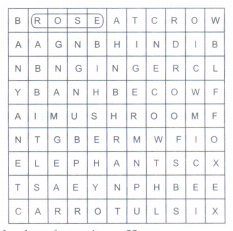
Spot as many organisms as possible in the puzzle given as figure by encircling them as shown. Write the names on an sheet of paper and categorise them into autotrophs and heterotrophs. Classify the heterotrophs into herbivores, carnivores, omnivores and saprophytes.
27.
The symbiotic relationship between algae and fungi is called ................
28.
The bacteria Rhizobium lives in the roots of ...........
29.
Algae are .........
30.
Tiny pores present on the surface of the leaves are called ..................
31.
The components of food are called ..................
32.
The organisms which depend on other for their food are called ...................
33.
Chlorophyll is the site of reception of ............ energy during photosynthesis.
34.
All green plants are called ...............
35.
............ is produced and ..............is utilised during photosynthesis.
36.
Plants like cuscuta takes food from .............. plant.
37.
Name the following the pores through which leaves exchange gases.
38.
Name the following a plant that has both autotrophic and heterotrophic mode of nutrition.
39.
Name the following a parasitic plant with yellow, slender and tubular stem.
40.
The term that is used for the mode of nutrition in yeast, mushroom and bread-mould is :
autotrophic
insectivorous
saprophytic
parasitic
41.
In the absence of which of the following will photosynthesis not occur in leaves?
Guard cells
Chlorophyll
Vacuole
Spacebetween cells
42.
The tissue responsible for the transportation of food in plants:
Xylem
Phloem
Stomata
Root hair
43.
Lichens are the association of :
An autotroph and a saprotroph
An autotroph and a heterotroph
A green plant and non-green plant
All of the above
44.
Insectivorous plant is :
Mushroom
Mango tree
Pitcher plant
Algae
45.
During photosynthesis:
Carbon dioxide is released
Oxygen is released
Nitrogen is released
None of these
46.
Which one of the following is parasite?
Lichens
Algae
Cuscuta
Fungus
47.
Algae is:
Parasite
Saprotroph
Autotroph
None of these
48.
The raw materials for photosynthesis are:
Oxygen and water
Carbon dioxide and water
Water, carbon dioxide, chlorophyll and solar energy
Nitrogen and water
49.
Farmers use manure and fertilisers to
replenish plant
replenish soil
replenish air
replenish fungi
50.
The ultimate source of food on earth is
plants
sunlight
animals
proteins
51.
Which of the following raw material is available in the air for photosynthesis?
Oxygen
Carbon dioxide
Nitrogen
Hydrogen
52.
In the process of photosynthesis, plants
take O2 and release CO2
take CO2 and release O2
take and release O2
take O2 and release water
53.
Two organisms are good friends and live together. One provides shelter, water and nutrients while the other prepares and provides food. Such an association of organisms is termed as
saprophyte
parasite
autotroph
symbiosis
54.
When we observe the lower surface of a leaf through a magnifying lens, we see numerous small openings. Which of the following is the term given to such openings?
Stomata
Lamina
Midrib
Veins
55.
If iodine is dropped on the boiled leaf it gives blue-black colour due to the presence of
starch
protein
fat
vitamin
56.
In the plant of cactus leaves are modified into
branches
spines
leaf vein
pitcher
57.
Insectivorous plant among the following is
lichen
Cuscuta
pitcher plant
bread mould
58.
Pitcher plant traps insects because it
is a heterotroph
grows in soils which lack in nitrogen
does not have chlorophyll
has a digestive system like human beings
59.
The symbiotic association is seen in which of the following?
Lichens
Algae
Fungi
Bacteria
60.
Which of the following statements is/are correct?
(i) All green plants can prepare their own food.
(ii) Most animals are autotrophs.
(iii) Carbon dioxide is not required for photosynthesis.
(iv) Oxygen is liberated during photosynthesis.
Choose the correct answer from the options below:
(i) and (iv)
only (ii)
(ii) and (iii)
(i) and (ii)
61.
The raw material used by plants during photosynthesis
N2 and O2
O2, H2, CO2
CO2 and water
water and minerals
62.
In the process of photosynthesis, which of the following energy conversions occur?
Solar energy is changed into chemical energy
Solar energy is changed into mechanical energy.
Bioenergy is converted into chemical energy
Chemical energy is changed into light energy.
63.
Organisms which prepare food for themselves using simple naturally available raw materials are referred to as
heterotrophs
autotrophs
parasites
saprophytes
64.
Plants take carbon dioxide from the atmosphere mainly through their
roots
stem
flowers
leaves
65.
Which part of the plant takes in carbon dioxide from the air for photosynthesis?
Root hair
Stomata
Leaf veins
Sepals
66.
The plant which traps and feeds on insects is
Cuscuta
China rose
pitcher plant
rose
67.
Amarbel is an example of
autotroph
parasite
saprotroph
host
68.
Lichens
69.
Lichen
70.
Chlorophyll
71.
Transpiration
72.
Stomata
73.
Parasite
74.
Man
75.
Sun
76.
Cells
77.
Mushroom
78.
CO2 and water
79.
Tiny pores present on leaf
80.
Leaf
81.
Mango tree
82.
Insects
83.
Cuscuta
84.
Bacteria Rhizobium
85.
Saprotroph
86.
Animals
87.
Amarbel
88.
Nitrogen
89.
Rhizobium can fix atmospheric nitrogen into nitrogen compound.
90.
Lichen is a saprophytic plant.
91.
Pitcher plant eats insects.
92.
Fungi are green plants that can synthesise their own food.
93.
Chlorophyll is present in an animal cell.
94.
Cells are called building block of a body.
95.
Animals are heterotrophs.
96.
Food is necessary for plants only.
97.
Solar energy is converted into chemical energy during photosynthesis.
98.
The product of photosynthesis is not a protein.
99.
Plants which synthesise their food themselves are called saprotrophs.
100.
Carbon dioxide is released during photosynthesis
1.
()
(b) fish, heterotroph
(c) mosquito, parasite
(d) mushroom, saprophyte
2.
()
(a) chlorophyll
(b) energy
(c) energy
(d) photosynthesis
(e) Carbon dioxide
(f) water.
(g) Food/Carbohydrates
3.
()
mosquito, parasite
4.
()
fish, heterotroph
5.
()
Carbon dioxide
6.
()
parasitic
7.
()
food factory
8.
()
guard cells
9.
()
symbiosis
10.
()
carbon dioxide, oxygen
11.
()
They live in the roots of legumes such as gram, peas and other pulses.
12.
()
Rhizobium bacteria.
13.
()
Soluble form (soluble nitrates).
14.
()
The plants can not use nitrogen in the manner they use carbon dioxide. They need N2 in soluble form.
15.
()
Fertilizers and manures.
16.
()
Proteins are the nitrogenous substances which contains nitrogen with carbon, hydrogen and oxygen.
17.
()
(i) Cell membrane (ii) Nucleus (iii) Cytoplasm.
18.
()
Saprotrophs take their food in solution form from dead organic matter.
19.
()
Cuscuta (Amarbel).
20.
()
Carbon dioxide + Water \(\overset { Sunlight }{ \underset { Chlorophyll }{ \xrightarrow{} } } \) Carbohydrate + Oxygen
CO2 + H2O \(\overset { Sunlight }{ \underset { Chlorophyll }{ \xrightarrow{} } } \) C6H12O6 + O2
21.
()
Chlorophyll captures the energy from the sunlight for the photosynthesis.
22.
()
The food is made mainly in leaves and some green parts of the plants.
23.
()
Heterotropic
24.
()
Autotrophic.
25.
()
The compounds or components of food which are necessary for our body are called nutrients.
26.
()
Number of organisms: 22
(Some examples are given. You many find the rest of the organisms)
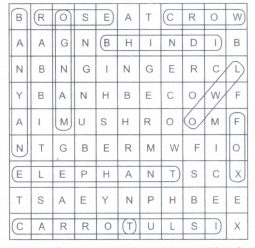
Autotrophs - Rose, Mango, Bhindi, Carrot Banyan, Tulsi,Ginger, Yam.
Heterotrophs - Elephant, Ant, Yeast, Tiger,Mushroom, Fox,Mice, Owl, Cow, Crow, Rabbit, Bee, Fish
Herbivores - Elephant, Cow, Rabbit, Bee
Carnivores - Fox,Tiger
Omnivores - Ant, Mice, Owl, Crow, Fish
Saprophytes - Mushroom, Yeast.
27.
()
Lichens.
28.
()
Legumes (pulses)
29.
()
Autotrophs
30.
()
Stomata
31.
()
Nutrients.
32.
()
Heterotrophs.
33.
()
Light
34.
()
Autotrophs
35.
()
Oxygen, carbon dioxide
36.
()
Host
37.
()
Stomata
38.
()
Pitcher plant (insectivorous plant)
39.
()
Cuscuta (amarbel)
40.
(c)
saprophytic
41.
(b)
Chlorophyll
42.
(b)
Phloem
43.
(b)
An autotroph and a heterotroph
44.
(c)
Pitcher plant
45.
(c)
Nitrogen is released
46.
(c)
Cuscuta
47.
(c)
Autotroph
48.
(c)
Water, carbon dioxide, chlorophyll and solar energy
49.
(b)
replenish soil
50.
(a)
plants
51.
(b)
Carbon dioxide
52.
(b)
take CO2 and release O2
53.
(a)
saprophyte
54.
(a)
Stomata
55.
(a)
starch
56.
(b)
spines
57.
(c)
pitcher plant
58.
(b)
grows in soils which lack in nitrogen
59.
(a)
Lichens
60.
(a)
(i) and (iv)
61.
(c)
CO2 and water
62.
(a)
Solar energy is changed into chemical energy
63.
(b)
autotrophs
64.
(d)
leaves
65.
(b)
Stomata
66.
(c)
pitcher plant
67.
(b)
parasite
68.
()
Symbiosis
69.
()
Symbiont
70.
()
Green pigment
71.
()
Loss of water through leaves.
72.
()
Exchange of water and gas.
73.
()
Cuscuta
74.
()
Heterotrophs
75.
()
Ultimate source of energy.
76.
()
Structural units of bodie.
77.
()
Saprophyte
78.
()
Raw material
79.
()
Stomata
80.
()
Food factory of plants
81.
()
Autotroph
82.
()
Pitcher plant
83.
()
Parasite
84.
()
N2-fixing
85.
()
Fungi
86.
()
Heterotrophs
87.
()
Parasite
88.
()
Bacteria
89.
(a)
90.
(b)
91.
(a)
92.
(b)
93.
(b)
94.
(a)
95.
(a)
96.
(b)
97.
(a)
98.
(a)
99.
(b)
100.
(b)

7th Standard CBSE Syllabus & Materials
7th Standard CBSE
CBSE 7th Social Science Theme B - New Beginnings : Cities and States - New Sample Question Papers Study Material - QB365 Set A
NEW7th Standard CBSE
CBSE 7th Social Science Theme A - Climates of India - New Sample Question Papers Study Material - QB365 Set A
NEW7th Standard CBSE
CBSE 7th Social Science Theme A - Geographical Diversity of India - New Sample Question Papers Study Material - QB365 Set A
NEW7th Standard CBSE
CBSE 7th Science Earth, Moon and the Sun - New Sample Question Papers Study Material - QB365 Set A



CBSE 7th Standard CBSE Subjects
CBSE Standards




