
 100% FREE ACCESS
11th Standard CBSE Syllabus & Materials
11th Standard CBSE
CBSE 11th Economics PART-A - Presentation of Data - New Sample Question Papers Study Material - QB365 Set A
NEW11th Standard CBSE
CBSE 11th Economics PART-A - Organisation of Data - New Sample Question Papers Study Material - QB365 Set A
NEW11th Standard CBSE
CBSE 11th Economics PART-A - Collection of Data - New Sample Question Papers Study Material - QB365 Set A
NEW11th Standard CBSE
CBSE 11th Economics PART-A - Introduction to Economics and Statistics - New Sample Question Papers Study Material - QB365 Set A
NEW11th Standard CBSE
CBSE 11th Business Studies International Trade Sample Question Papers Study Material - QB365 Set A
NEW11th Standard CBSE
CBSE 11th Business Studies Evolution and Fundamentals of Business Sample Question Papers Study Material - QB365 Set A

Published on: 15/12/2018
From this post questions are covered from Grade 11 Chapter 14, Oscillations is the next step after learning about projectile motion, rectilinear motion and others in lower grades. The study of oscillatory motion is basic to physics; its concepts are required for the understanding of many physical phenomena. This chapter will help us to study in detail about oscillations and oscillatory motion.
The description of a periodic motion, in general, and oscillatory motion, in particular, requires some fundamental concepts, like period, frequency, displacement, amplitude and phase. These concepts are developed in this chapter. Along with; Periodic and Oscillatory Motions, Period and Frequency, Displacement, Simple Harmonic Motion, Simple Harmonic Motion and Uniform Circular Motion, Velocity and Acceleration in Simple Harmonic Motion, Force Law for Simple Harmonic Motion, Energy in Simple Harmonic Motion, Some Systems Executing Simple Harmonic Motion, Oscillations due to a Spring, Simple Pendulum, Damped Simple Harmonic Motion, Forced Oscillations and Resonance are explained in this chapter.
Laws based on Oscillations, numerical problems with solved and problems for practice, formulas to derive equations and solve problems, graphs, diagrams and theoretical explanations help to sail through the chapter and comprehend the learning experience.
NCERT Grade 11 Chapter 14, Oscillations is a part of Unit X, Oscillations and Waves. Unit X has a weightage of 10 marks in the final examination of Grade 11 as per the latest pattern.
Download CBSE Class 11th Standard CBSE Physics question papers, sample papers, important questions, and previous year solved papers in PDF format. Get free study materials, NCERT solutions, and exam preparation resources for Class 11th Standard CBSE Physics
Questions + Answers key
Take MCQ Physics Test
1.
A uniform spring whose unstretched length is I has a force constant k. The spring is cut into two pieces of unstretched lengths. l1and l2, where l1= nl2 and n is an integer. What are the corresponding force constants k1 and k2 in terms of n and k?
2.
A block is resting on a piston which is moving vertically with a simple harmonic motion of period 1 sec. At what amplitude of motion will the block and the piston seperate? What is the maximum velocity of the piston at this amplitude?
3.
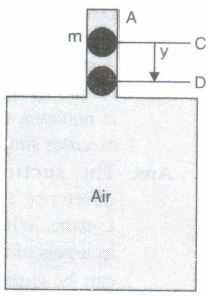
An air chamber of volume V has a neck area of cross section a into which a ball of mass m just fits and can move up and down without any friction (Fig.). Show that when the ball is pressed down a little and released, it executes SHM. Obtain an expression for the time period of oscillations assuming pressure-volume variations of air to be isothermal.
4.
Plot the corresponding reference circle for each of the following simple harmonic motions. Indicate the initial (t = 0) position of the particle, the radius of the circle, and the angular speed of the rotating particle. For simplicity, the sense of rotation may be fixed to be anti-clockwise in even) case: (x is in cm and t is in s)
(a) x = - 2 sin (3t + \(\pi\)/3)
(b) x = cos (\(\pi\)/6 - t)
(c) x = 3 sin (2\(\pi\)t + \(\pi\)/4)
(d) x = 2 cos \(\pi\)t,
5.
What is the length of a simple pendulum, which ticks seconds ?
6.
A block whose mass is 1 kg is fastened to a spring. The spring has a spring constant of 50 N m–1. The block is pulled to a distance x = 10 cm from its equilibrium position at x = 0 on a frictionless surface from rest at t = 0. Calculate the kinetic, potential and total energies of the block when it is 5 cm away from the mean position.
7.
A particle is executing SHM of amplitude A. At what displacement from the mean position is the energy half kinetic and half potential?
8.
The vertical motion of a huge piston in machine is simple harmonic with a frequency of 0.50 s-1. A block of 10 kg is placed on the piston. What is the maximum amplitude of the piston's SHM for the block and the piston to remain together?
9.
The maximum acceleration of a simple harmonic oscillator is a0 and the maximum velocity is v0 . What is the displacement amplitude?
10.
Every SHM is periodic motion, but every periodic motion need not to be a simple harmonic motion. Do you agree? Give an example to justify your statement.
11.
Define the restoring force and it characterstic in case of an oscillating body.
12.
A simple pendulum is transferred from earth to the surface of moon. How will its time period be affected?
13.
What is the force equation of a SHM?
14.
What is the frequency of a second pendulum in an elevator moving up with an acceleration of \(\frac{g}{2}?\)
15.
The displacement of two particles executing simple harmonic motion are represented by equations, y = 4 sin (10t +θ) and y2 = 5 cos 10t. What is the phase difference between the velocities of these particles?
16.
A mass attached to a spring free to oscillate, with angular velocity \(\omega \) in a horizontal plane without friction or damping. It is pulled to a distance x0 and pushed towards the centre with a velocity v0 at time t = 0. Determine the amplitude of the resulting oscillations in terms of the parameters \(\omega \),x0 and v0.
17.
The piston in the cylinder head of a locomotive has a stroke (twice the amplitude) of 1.0 m. If the piston executes simple harmonic motion with an angular frequency of 200 rad/min, then what is its maximum speed?
1.
Here I = l1 + l2 ...(i)
and l1 = nl2
We know \(k=\frac { Mg }{ l } ...(iii)\)
\(k_{ 1 }=\frac { Mg }{ l_{ 1 } } ...(iv)\)
and \(k_{ 2 }=\frac { Mg }{ l_{ 2 } } ...(v)\)
Dividing equation (iv) by equation (iii) we find
\(\frac { { k }_{ 1 } }{ k } =\frac { l }{ { l }_{ 1 } } =\frac { { l }_{ 1 }+{ l }_{ 2 } }{ { l }_{ 1 } } =1+\frac { { l }_{ 2 } }{ { l }_{ 1 } } \)
From equation (ii), we find \(\frac { { l }_{ 1 } }{ { l }_{ 2 } } =n\)
\(\frac { { k }_{ 1 } }{ k } =1+\frac { 1 }{ n } or{ k }_{ 1 }=\left( \frac { n+1 }{ n } \right) k\)
From equation (v) and (iii), we find:
\(\frac { { k }_{21 } }{ k } =\frac { l }{ { l }_{ 2 } } =\frac { { l }_{ 1 }+{ l }_{ 2 } }{ { l }_{ 1 } } =\frac { { l }_{1 } }{ { l }_{ 2 } }+1 \)
From equation (ii) we have \(\frac { { l }_{ 1 } }{ { l }_{ 2 } } =n\)
\(\frac { { k }_{ 2 } }{ k } =(n+1)\quad \therefore { k }_{ 2 }=k(n+1)\)
2.
We know that
y = a sin ωt
∴ Velocity of the block = \({dy\over dt}= aω\ cos\ ωt\)
and acceleration of the block \(={d^2y\over dt^2}=-ω^2asin\ ωt=-ω^2y\)
For maximum acceleration y = a
\(∴\ \left(d^2y\over dt^2\right)_{max}=-ω^2a\)
The block will be separated form the piston when
\(ω^2=g\ or\ a={g\over ω^2}\)
or \(s={gT^2\over 4\pi^2}\)
According to the given problem T = 1see
\(a={g\over 4\pi^2}={9.8\over 4\times(3.14)^2}=0.248m/sec^2\)
At this amplitude, the maximum velocity of the block will be
\(ω\ a={2\pi a\over T}={2\times3.14\times0.248\over 1}=1.56m/sec\)
3.
Consider an air chamber of volume V with a long neck of uniform area of cross-section A, and a frictionless ball of mass m fitted smoothly in the neck at position C, Fig. The pressure of air below the ball inside the chamber is equal to the atmospheric pressure. Increase the pressure on the ball by a little amount p. so that the ball is depressed to position D, where CD = y.
There will be decrease in volume and hence increase in pressure of air inside the chamber. The decrease in volume of the air inside the chamber, ΔV = Ay
Volumetric strain =\(\frac { change\ in\ volume }{ original\ volume } \)
\(=\frac { \Delta V }{ V } =\frac { Ay }{ V } \)
∴Bulk Modulus of elasticity E. will be
\(E=\frac { stress(or\ increase\ in\ pressure) }{ volumetric\ strain } \)
\(=\frac { -p }{ Ay/V } =\frac { -pV }{ Ay } \)
Here, negative sign shows that the increase in pressure will decrease the volume of air in the chamber.
Now, \(p=\frac { -EAy }{ V } \)
Due to this excess pressure, the restoring force acting on the ball is
\(F=p\times A=\frac { \_ EAy }{ V } .A=\frac { -E{ A }^{ 2 } }{ V } y\quad ...(i)\)
Since F ∝ y and negative sign shows that the force is directed towards equilibrium position. If the applied increased pressure is removed from the ball, the ball will start executing linear SHM in the neck of chamber with C as mean position.
In S.H.M., the restoring force,
F = -ky ...(ii)
Comparing (i) and (ii), we have
Spring factor, k = EA2/V
Here inertia factor mass of ball = m.
Period, T = \(2\pi \sqrt { \frac { inertia\ factor }{ spring\ factor } } \)
\(=2\pi \sqrt { \frac { m }{ { EA }^{ 2 }/V } } =\frac { 2\pi }{ A } \sqrt { \frac { mV }{ E } } \)
∴ Frequency, v = \(\frac { 1 }{ T } =\frac { A }{ 2\pi } \sqrt { \frac { E }{ mV } } \)
4.
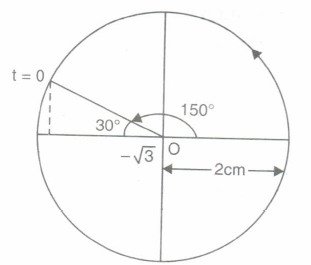
\(x=2cos\left( 3t+\frac { \pi }{ 3 } +\frac { \pi }{ 2 } \right) \)
Radius of the reference circle, r = amplitude of SHM = 2 cm,
At t = 0, x = - 2sin\(\frac{\pi}{3}=\frac{-2\sqrt3}{2}=-\sqrt3 cm\)
Also ωt = 3t ∴ ω = 3rad/s
\(cos{ \phi }_{ 0 }=-\frac { \sqrt { 3 } }{ 2 } ,{ \phi }_{ 0 }={ 150 }^{ 0 }\)
The reference circle is, thus, as plotted below.
(b) \(x=cos\left( t-\frac { \pi }{ 6 } \right) \)
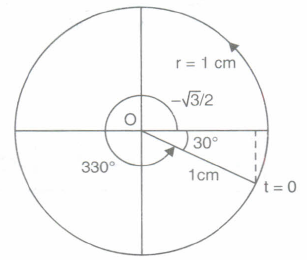
Radius of circle, r amplitude of SHM = 1 cm
At t= 0, X = cos\(\frac{\pi}{6}=\frac{\sqrt3}{2}cm\)
Also ωt = 1t⇒ ω = 1rad/s
\(cos{ \phi }_{ 0 }=\frac { \sqrt { 3 } }{ 2 } ,{ \phi }_{ 0 }=-\frac{\pi}{6}\)
The reference circle is, thus as plotted below
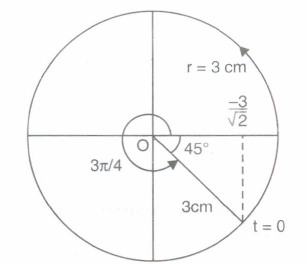
(c) \(x=3cos\left( 2\pi t+\frac { \pi }{ 4 } +\frac { \pi }{ 2 } \right) \)
Here, radius of reference circle, r = 3 cm and at t = 0, x = 3 sin\(\frac{\pi}{4}=\frac{\sqrt3}{2}cm\)
ωt = 2\(\pi\)t⇒ ω = 2\(\pi\)rad/s
\(cos{ \phi }_{ 0 }=\frac { \sqrt { \frac { 3 }{ 2 } } }{ 3 } =\frac { 1 }{ \sqrt { 2 } } \)
Therefore,the reference circle is being shown below.
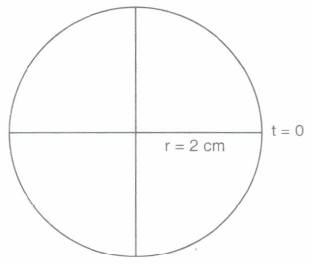
(d) x = 2 cos \(\pi\)t
Radius of reference circle, r = 2 cm and at t = 0, x = 2 cm
∴ ωt = \(\pi\)t or ω = \(\pi\)rad/s
\(cos{ \phi }_{ 0 }=1,{ \phi }_{ 0 }=0\)
The reference circle is plotted below
5.
From Eq, the time period of a simple pendulum is given by,
\(T=2 \pi \sqrt{\frac{l}{g}}\)
From this relation one gets,
\(l=\frac{g T^{2}}{4 \pi^{2}}\)
The time period of a simple pendulum, which ticks seconds, is 2 s. Therefore, for g = 9.8 m s–2 and T = 2 s, L is
\(=\frac{9.8(ms^{-2}) \times4(s)^{2}}{4 \pi^2}=1\)
= 1 m
6.
The block executes SHM, its angular frequency, as given by Eq \(ω = \sqrt{\frac{k}{m}}\)
\(ω = \sqrt{\frac{50 Nm^{-1}}{1kg}}\)
= 7.07 rad s–1
Its displacement at any time t is then given by, x(t) = 0.1 cos (7.07t) Therefore, when the particle is 5 cm away from the mean position, we have 0.05 = 0.1 cos (7.07t)
Or cos (7.07t) = 0.5 and hence sin (7.07t) = \(\frac{\sqrt{3}}{2}\) = 0.866
Then, the velocity of the block at x = 5 cm is = 0.1 × 7.07 × 0.866 m s–1
= 0.61 m s–1
Hence the K.E. of the block, \(= \frac{1}{2}\) mv2
= ½[1kg × (0.6123 m s–1 )2 ] = 0.19 J
The P.E. of the block, \(= \frac{1}{2}\) k x2 = ½(50 N m–1 × 0.05 m × 0.05 m) = 0.0625 J
The total energy of the block at x = 5 cm, = K.E. + P.E. = 0.25 J
we also know that at maximum displacement, K.E. is zero and hence the total energy of the system is equal to the P.E. Therefore, the total energy of the system,
= ½(50 N m–1 × 0.1 m × 0.1 m ) = 0.25 J
which is same as the sum of the two energies at a displacement of 5 cm. This is in conformity with the principle of conservation of energy.
7.
As, Ek = Ep
\(\therefore \) \(\frac { 1 }{ 2 } m{ \omega }^{ 2 }({ A }^{ 2 }-{ x }^{ 2 })=\frac { 1 }{ 2 } m{ \omega }^{ 2 }{ x }^{ 2 }\)
\(\\ \Rightarrow \quad { A }^{ 2 }-{ x }^{ 2 }={ x }^{ 2 }\ or\ 2{ x }^{ 2 }={ A }^{ 2 }\)
\(\\ \Rightarrow \quad { x }^{ 2 }=\frac { { A }^{ 2 } }{ 2 } or\ x=\pm \frac { A }{ \sqrt { 2 } } \)
Thus, the energy will be half kinetic and half potential at displacement \(\frac { A }{ \sqrt { 2 } } \) on either side of the mean position.
8.
As, \(v=\frac { 1 }{ 2\pi } \sqrt { \frac { k }{ m } } \)
\(k=4\pi ^{ 2 }m{ v }^{ 2 }\)
For maximum displacement \({ y }_{ max }=A\)
Maximum restoring force,
F = - kA =- mg
or \(A=\frac { mg }{ k } =\frac { mg }{ 4{ \pi }^{ 2 }{ mv }^{ 2 } } =\frac { g }{ 4\pi ^{ 2 }{ v }^{ 2 } }\)
\( \\ =\frac { 9.8 }{ 4\times { (3.14) }^{ 2 }\times { (0.50) }^{ 2 } } =0.99m\)
9.
Let A be the displacement and \(\omega \) be the angular frequency of the simple harmonic oscillator.
\(Then,\ \ a_{ 0 }=\omega ^{ 2 }A\ and\ v_{ 0 }=\omega A\)
\(\\ on\ dividing,\ \frac { { v }_{ 0 }^{ 2 } }{ { a }_{ 0 } } =\frac { { \omega }^{ 2 }{ A }^{ 2 } }{ { \omega }^{ 2 }A } =A\ or\ A=\frac { { v }_{ 0 }^{ 2 } }{ { a }_{ 0 } } \)
10.
Yes, every periodic motion need to be SHM. e.g. the motion of the earth round the sun is a periodic motion, but not simple harmonic motion as the back and forth motion is not taking place.
11.
A force which takes the body towards the mean postion in oscillation is called restoring force.
Characterstic of Restoring Force
The restoring force is aleays directed towards the mean positin and its magnitude of any instant is directly. Proportional to the displacement of the particle froom its mean postion of that instance.
12.
As value of g on moon is less than that on earth, in accordance with the realtion T =2π\( \sqrt{l/g}\), the time period of oscillations of a simple pendulum on moon will be greater.
13.
According to force equation of SHM, F = - kx, where k is a constant known as force constant.
14.
For second pendulum, frequency v = \(\frac{1}{2}\)s-1
When elevator is moving upwards with acceleration a, the effective acceleration due to gravity is g1= g + a = g + \(\frac{g}{2}\)=\(\frac{3g}{2}\)
Since,\(v=\frac { 1 }{ 2\pi } \sqrt { \frac { g }{ l } } \)
Hence, v2 ∝g
\(\therefore \frac { { v }_{ 1 }^{ 2 } }{ { v }^{ 2 } } =\frac { { g }_{ 1 } }{ g } =\frac { \frac { 3g }{ 2 } }{ g } =\frac { 3 }{ 2 } \)
\(or\quad \frac { { v }_{ 1 } }{ v } =\sqrt { \frac { 3 }{ 2 } } =1.225\)
\(\Rightarrow { v }_{ 1 }=1.225v=1.225\times \frac { 1 }{ 2 } =0.612{ s }^{ -1 }\)
15.
For 1st particle
y1= 4 sin (10t +θ)
Velocity = \(\frac{dy_1}{dt}\)=4 \(\times\) 10 cas (10t +θ)
For second particle
y2= 5 cos 10t = 5 sin(10t + \(\pi/2\))
Velocity= \(\frac{dy_2}{dt}\) = 5 \(\times\)10 cos (10t + \(\pi/2\))
= 5 sin(10t+\(\pi/2\))
Phase difference between velocities
=(10t + θ)-(10 t+ \(\pi/2\))
=\(\left( \theta -\frac { \pi }{ 2 } \right) \)
16.
If in a spring mass system, the mass is displaced and given a velocity, also it will perform SHM but with an amplitude more than the amount of extension.
We have for SHM
x = A cos\((\omega t+\theta )\)
where,x = displacement, A = amplitude
\(\theta \) = phase constant, we get
On differenting with respect to t,
\(\frac { dx }{ dt } =-A\omega sin(\omega t+\theta )\)
\(\\ \Rightarrow \ v=-A\omega sin(\omega t+\theta \)
where, v= instantaneous velocity of the particle at t.
Now , at t = 0,x = x0
From Eq(i)
\(\Rightarrow { x }_{ 0 }=Acos\theta \)
Again at t = 0, v = v0
FromEq(ii)
\( -{ v }_{ 0 }=-A\omega sin\theta \ or\ \frac { { v }_{ 0 } }{ \omega } =Asin\theta \)
\(\\ { A }^{ 2 }({ cos }^{ 2 }\theta +{ sin }^{ 2 }\theta )={ x }_{ 0 }^{ 2 }+\left( \frac { v_{ 0 } }{ \omega } \right) ^{ 2 }\)
\( \Rightarrow A^{ 2 }={ x }_{ 0 }^{ 2 }+\left( \frac { v_{ 0 } }{ \omega } \right) ^{ 2 }\ \)
\(\\ or A=\sqrt { { x }_{ 0 }^{ 2 }+\left( \frac { { v }_{ 0 } }{ \omega } \right) ^{ 2 } } \)
17.
()
Given, angular frequency of the piston, \(\omega \) = 200 rad/min
Stroke length = 1m
Amplitude of SHM,
A = Stroke length/2 = 1/2 = 0.5
vmax = \(\omega \)A
= 200 x 0.5 = 100 m/min

11th Standard CBSE Syllabus & Materials
11th Standard CBSE
CBSE 11th Business Studies Forms of Business Organisation Sample Question Papers Study Material - QB365 Set A
NEW11th Standard CBSE
CBSE 11th Business Studies Business, Trade and Commerce Sample Question Papers Study Material - QB365 Set A
NEW11th Standard CBSE
CBSE 11th Physics Waves Sample Question Papers Study Material - QB365 Set A
NEW11th Standard CBSE
CBSE 11th Physics Kinetic Theory Sample Question Papers Study Material - QB365 Set A



CBSE 11th Standard CBSE Subjects
CBSE Standards









