
 100% FREE ACCESS
7th Standard CBSE Syllabus & Materials
7th Standard CBSE
CBSE 7th Social Science Theme E - Understanding Market - New Sample Question Papers Study Material - QB365 Set A
NEW7th Standard CBSE
CBSE 7th Social Science Theme E - From Barter to Money - New Sample Question Papers Study Material - QB365 Set A
NEW7th Standard CBSE
CBSE 7th Social Science Theme D - The Constitution of India- An Introduction - New Sample Question Papers Study Material - QB365 Set A
NEW7th Standard CBSE
CBSE 7th Social Science Theme D - From the Rulers to the Ruled : Types of Governments - New Sample Question Papers Study Material - QB365 Set A
NEW7th Standard CBSE
CBSE 7th Social Science Theme B - The Age of Reorganisation - New Sample Question Papers Study Material - QB365 Set A
NEW7th Standard CBSE
CBSE 7th Social Science Theme B - The Rise of Empires - New Sample Question Papers Study Material - QB365 Set A

Published on: 07/12/2018
The important questions provided below will also make students familiar with the marking scheme and the difficulty level of the exam. The important questions for CBSE class 7 Maths are prepared by subject experts according to the latest syllabus of CBSE. Students are advised to solve these important questions which can make them more focused on their exam and also bring a sense of discipline and seriousness in their exam preparation.
The Central Board of Secondary Education (CBSE) is a prestigious educational board which comes under the Union Government of India. Here, you will get the clue that from where and how the questions are being framed from the chapter Perimeter and Area for CBSE Class 7 Maths. These questions can provide students a chapter wise preparation strategy so that they can prepare for their exam more efficiently.
The National Council of Education and Training sets the curriculum for all schools that follow the Central Board of Secondary Education (CBSE) across the nation. Creative questions were added in this question paper in order to enhance the student's knowledge and get the idea that how to answer strategic questions asked in the board exams. This question paper is designed based on the academic syllabus. Sample papers should be practiced in examination condition at home or school and also show it to your teachers for checking or compare with the answers provided.
Download CBSE Class 7th Standard CBSE Mathematics question papers, sample papers, important questions, and previous year solved papers in PDF format. Get free study materials, NCERT solutions, and exam preparation resources for Class 7th Standard CBSE Mathematics
Questions + Answers key
Take MCQ Mathematics Test
1.
Find the perimeter of a triangle, whose three sides are 3 cm, 5 cm and 7 cm respectively.
2.
From the following rectangles of length 6 cm and breadth 4 cm is composed of congruent polygons. Find the area of each polygon.
q.png)
3.
The length of a wall is 5/4 times of its height. If the area of the wall is 180 m2. What is the sum of the length and height of the wall?
4.
What is the length of a wire required to fence a rectangular flower bed?
5.
Find the area of a circle whose circumference is 88 cm.
6.
From a circular sheet of radius 4 cm, a circle of radius 3 cm is removed. Find the area of the remaining sheet. (take \(\pi\) = 3.14)

7.
Give two examples, where the area increases as the perimeter increases.
8.
A plot is in the form of a parallelogram ABCD. Owner of this plot wants to build OLD AGE HOME, DISPENSARY, PARK and HEALTH CENTRE for elderly people as shown in the figure given below:
P is a point on the diagonal BD.
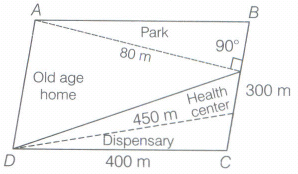
(a) Find the area of plot ABCD.
(b) Which values are depicted here?
9.
A wall of a room is of dimensions 5 m x 4m. lt has a window of dimensions 1.5 m x 1 m and a door of dimensions 2.25 m x 1 m. Find the area of the wall, which is to be painted.
10.
The perimeter of the following figure is
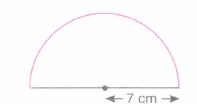
27 cm
28 cm
36 cm
40 cm
11.
The perimeter of a square is 48 cm. Its area is
144 cm2
12 cm2
48 cm2
100 cm2
12.
If 'l ' and 'b ' are length and breadth of a rectangle respectively, then its perimeter is:
\(\frac{l+b}{2}\)
2(l + b)
2(l + R)
4(l + R)
13.
The area of the shaded region is:
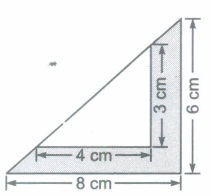
12 cm2
24 cm2
36 cm2
18 cm2
14.
The perimeter of the figure ABCDEFGHIJ is
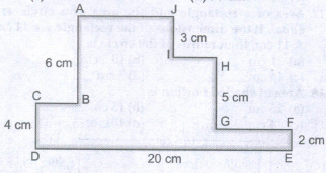
60 cm
30 cm
40 cm
50 cm
15.
If 1 m2 = x mm2, then the value of x is
1000
10000
100000
1000000
16.
What will be the area of the largest square that can be cut out of a circle of radius 10 cm?
100 cm2
200 cm2
300 cm2
400 cm2
17.
If the sides of a parallelogram are increased to twice of its original lengths, how much will the perimeter of the new parallelogram?
1.5 times
2 times
3 times
4 times
18.
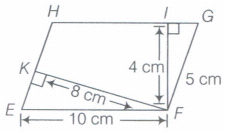
In the following figure, EFGH is a parallelogram, altitudes FK and FI are 8 cm and 4 cm respectively. If EF = 10 cm, then the area of EFGH is
20 cm2
32 cm2
40 cm2
80 cm2
19.
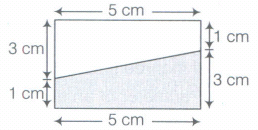
Area of shaded portion in the following figure is
25 cm2
15 cm2
10 cm2
12 cm2
20.
A wire is bent to form a square of side 22 cm. If the wire is rebent to form a circle. Then the Area of the circle is
196 cm2
212 cm2
616 cm2
644 cm2
21.
A wire is bent to form a square of side 22 cm. If the wire is rebent to form a circle, its radius is
22 cm
14 cm
11 cm
7 cm
22.
The radius of a circle is 14 cm. The area of the semi-circle is _______.
23.
1 hectare =_______ m2.
24.
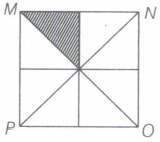
Area of the square MNOP of following figure is 144 cm2. Area of each triangle is ________.
25.
The circumference of a circle is 85 m, if the radius of circle is 8 m.
26.
The area of a rhombus is 96 cm2. If one of its diagonals is 12 em, then find the perimeter of the rhombus.
27.
The figure given below represents a rectangular lawn with a circular flower bed. Find:
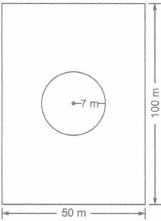
The area of the lawn excluding the flower bed.
28.
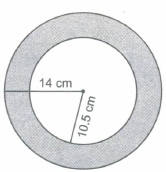
The adjoining figure shows two circles with same centre. If the radius of the outer circle is 14 cm and the radius of the inner circle is 10.5 cm, then find:
The area of the outer circle.
29.
The area of a square and a rectangle are equal. If the side of the square is 30 cm and the breadth of the rectangle is 25 cm, find the length of the rectangle.
30.
What is the area of a semi-circle of radius 'r ' cm?
1.
\(\therefore\) Perimeter of a triangle = Sum of lengths of all three sides
= 3 + 5 + 7 = 15 cm
So, perimeter of the triangle will be 15 cm.
2.
Given, length of rectangle = 6 cm
and breadth of rectangle = 4 cm
\(\therefore\) Area of a rectangle = Length X Breadth = 6 x 4 = 24 cm.
From the given figure, it is clear that rectangle is divided into 4 congruent polygons.
\(\therefore\) Area of each polygon = \(\frac{1}{4}\times\) Area of a rectangle
= \(\frac{1}{4}\times\) 24 = 6 cm2.
3.
27 m
4.
We need to find the perimeter of a rectangular flower bed, which gives the required length of the wire required to fence a rectangular flower bed.
5.
Here, the circumference = 88 em.
Let radius of the circle be 'r',
\(\therefore\) 2\(\pi\)r=88.
or 2\(\times\)\(\frac{22}{7}\)\(\times\)r=88
or r=\(\frac{88\times7}{2\times22}\)=14 cm
Now, area of the circle =\(\pi\)r2=\(\frac{22}{7}\)\(\times\)14\(\times\)14 cm2=22\(\times\)2\(\times\)14 cm2
=616 cm2
Thus, the area of the circle is 616 cm2.
6.
Given, radius of a circular sheet (outer circle), R = 4 cm and radius of removed circular sheet (inner circle), r = 3 cm.
We know that, Area of a circle = \(\pi\) x (Radius)2
\(\therefore\) Area of circular sheet of radius 4 cm = \(\pi\) x (4)2
= 3.14 x 16 = 50.24 cm2
and area of circular sheet of radius 3 cm = \(\pi\) x (3)2
= 3.14 x 9 = 28.26 cm2
\(\therefore\) Area of remaining sheet= Area of circular sheet of radius 4 cm - Area of circular sheet of radius 3 cm
= 50.24 - 28.26 = 21.98 cm2
Hence, the area of the remaining sheet is 21.98 cm2.
7.
There are two examples as given below:
Example 1. Let the length of a rectangle = 5 cm and breadth of a rectangle = 3 cm
\(\therefore\) Area of a rectangle = Length X Breadth
= 5 X 3=15 cm2
and perimeter of a rectangle = 2 (Length + Breadth)
= 2 ( 5 + 3) = 2 X 8 = 16 cm
Again, let the length of a rectangle = 6 cm and breadth of a rectangle = 5 cm
\(\therefore\) Area of a rectangle = Length X Breadth = 6 X 5 = 30 cm2
and perimeter of a rectangle = 2 (Length + Breadth)
= 2 (6 + 5) = 2 X 11 = 22 cm
Thus, for both rectangles, area increases as the perimeter Increases.
Example 2. Let the side of a square = 4 ern
\(\therefore\) Perimeter of square = 4 X Side = 4 x 4 = 16 cm
and area of square = (Side X Side)
= 4 X 4 = 16 sq ern
Again, let the side of a square = 5 cm
\(\therefore\) Perimeter of square = 4 X Side = 4 x 5 = 20 cm
and area of square = Side X Side
= 5 x 5 = 25 sq cm
Thus, for both squares, area increases as the perimeter Increases.
8.
(a) In the parallelogram ABCD, AD = BC, AB = DC
Base = 300 m and height = 80 m
\(\therefore\) Area of a parallelogram = Base x Height
so, area of parallelogram = 300 m x 80 m
= 24000 m2
(b) The values are depicted here is that owner of the plot is a very helpful cooperative to the society.
9.
A wall of a room is of dimensions 5 m x 4 m.
Length of the room = 5 m
Breadth of the room = 4 m
\(\therefore\) Area of the room = 5 x 4= 20 m2
Length of the window = 1.5 m
Breadth of the window = 1 m
\(\therefore\) Area of the window = 1.5 x 1 = 1.5 m2
Length of the door = 2.25 m
Breadth of the door = 1 m
\(\therefore\) Area of the door = 2.25 x 1 = 2.25 m2
The area of the wall to be painted = Area of the room - Area of the window - Area of the door
= 20 - 1.5 - 2.25
= 20 - 3.75 = 16.25 m2.
10.
Perimeter = \(2\times 7+\frac { 22 }{ 7 } \times 7\)
= 14 + 22 = 36 cm
11.
Side = \(\frac { 48 }{ 4 } \)= 12 cm
Area = 12 \(\times\)12 = 144 cm2
12.
(b)
2(l + b)
13.
(d)
18 cm2
14.
(a)
60 cm
15.
(d)
1000000
16.
(b)
200 cm2
17.
(b)
2 times
18.
(c)
40 cm2
19.
(c)
10 cm2
20.
(c)
616 cm2
21.
(b)
14 cm
22.
()
308 cm2
23.
()
10000
24.
Area of the squares MNOP= 144 cm2 [given]
Since number of the triangles in square is 8.
So, area of each triangle will be \(\frac{144}{8}\) = 18 cm2.
25.
(b)
26.
ABCD is the rhombus such that its diagonals AC and BD intersect at O. Here BD = 12 cm.
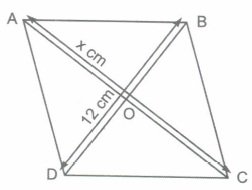
Suppose AC = x cm.
Since, the area of a rhombus =\(\frac{1}{2}\)\(\times\)[Product of 2 its diagonals]
\(\therefore\)Area of the rhombus ABCD =\(\frac{1}{2}\)\(\times\) 12 \(\times\) x cm2
2 But the area of the rhombus ABCD = 96 cm2
\(\Rightarrow\)\(\frac{1}{2}\)\(\times\)12 \(\times\) x = 96
\(\Rightarrow\)x=\(\frac{96\times2}{12}\)cm \(\Rightarrow\)x=8\(\times\)2cm
\(\Rightarrow\) x=16 cm
Since, the diagonals of a rhombus, bisect each other at right angles.
\(\therefore\)\(\angle \)COD = 90°, OC =\(\frac{1}{2}\)\(\times\) 16 cm=8 cm
and Od=\(\frac{1}{2}\)\(\times\) 12 cm =6 cm
Now, in right \(\Delta\)COD, we have
\(\Rightarrow\)OD2 + OC2 = CD2 \(\Rightarrow\) 62 + 82 = CD2
\(\Rightarrow\)36 + 64 = CD2 \(\Rightarrow\)100 = CD2
\(\Rightarrow\) 102 = CD2 \(\Rightarrow\) CD = 10 cm.
Since, all the sides of rhombus are equal and perimeter of a rhombus = 4 x Side.
\(\therefore\) Perimeter ofthe rhombus = 4 x 10 em = 40 cm
27.
()
4846 m2
28.
()
616 cm2
29.
()
36 cm
30.
()
\(\frac{\pi{r}^2}{2}\)

7th Standard CBSE Syllabus & Materials
7th Standard CBSE
CBSE 7th Social Science Theme B - New Beginnings : Cities and States - New Sample Question Papers Study Material - QB365 Set A
NEW7th Standard CBSE
CBSE 7th Social Science Theme A - Climates of India - New Sample Question Papers Study Material - QB365 Set A
NEW7th Standard CBSE
CBSE 7th Social Science Theme A - Geographical Diversity of India - New Sample Question Papers Study Material - QB365 Set A
NEW7th Standard CBSE
CBSE 7th Science Earth, Moon and the Sun - New Sample Question Papers Study Material - QB365 Set A



CBSE 7th Standard CBSE Subjects
CBSE Standards




