
 100% FREE ACCESS
10th Standard CBSE Syllabus & Materials
10th Standard CBSE
CBSE 10th Social Science ECO - Globalisation and the Indian Economy - New Model Questions Papers Study Material - QB365 Set A
NEW10th Standard CBSE
CBSE 10th Social Science ECO - Money and Credit - New Model Questions Papers Study Material - QB365 Set A
NEW10th Standard CBSE
CBSE 10th Social Science ECO - Sectors of the Indian Economy - New Model Questions Papers Study Material - QB365 Set A
NEW10th Standard CBSE
CBSE 10th Social Science ECO - Development - New Model Questions Papers Study Material - QB365 Set A
NEW10th Standard CBSE
CBSE 10th Social Science PS - Outcomes of Democracy - New Model Questions Papers Study Material - QB365 Set A
NEW10th Standard CBSE
CBSE 10th Social Science PS - Gender, Religion and Caste - New Model Questions Papers Study Material - QB365 Set A

Published on: 31/07/2018
In this question paper, some of the important one mark, two and five marks questions from the chapter Periodic Classification of Elements are covered. The questions are prepared from the book back and previous year questions.
Download CBSE Class 10th Standard CBSE Science question papers, sample papers, important questions, and previous year solved papers in PDF format. Get free study materials, NCERT solutions, and exam preparation resources for Class 10th Standard CBSE Science
Questions + Answers key
Take MCQ Science Test
1.
Taking the example of an element of atomic number 16, explain how the electronic configuration of the atom of an element relates to its position in the modern periodic table and how valency of an element is calculated on the basic of its atomic number.
2.
How does the electronic configuration of an atom of an element relate to its position in the modern periodic table? Explain with one example?
3.
(a) What is meant by periodicity in properties of elements with reference to the periodic table?
(b) Why do all the elements of the same group have similar properties?
(c) How will the tendency to gain electrons change as we go from left to right across a period? Why?
4.
What physical and chemical properties of elements were used by Mendeleev in creating his periodic table? List two observations which posed a challenge to Mendeleev's Periodic Law.
5.
Write the number of periods the modern periodic table has. How do the valency and metallic character of elements vary on moving from left to right in a period? How do the valency and atomic size of elements vary down a group?
6.
Arrange the following elements in the increasing order of their metallic character Mg, Ca, K, Ge, Ga
7.
Identify and name the metals out of the following elements whose electronic configurations are given below
(a) 2,8,2
(b) 2,8,1
(c) 2,8,7
(d) 2,1
8.
" Hydrogen occupies a unique position in Modern Periodic Table". Justify the statement.
9.
In the Modern Periodic Table, which are the metals among the first ten elements?
10.
Which one of the following depicts the correct representation of atomic radius(r) of an atom?
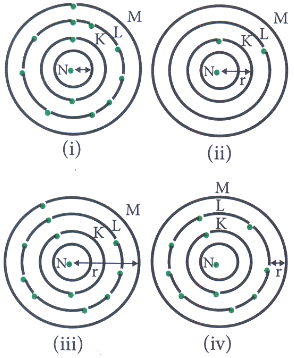
(i) and (ii)
(ii) and (iii)
(iii) and (iv)
(i) and (iv)
11.
The element with atomic number 14 is hard and forms acidic oxide and a covalent halide. To which of the following categories does the element belong?
Metal
Metalloid
Non-metal
Left-hand side element
12.
What type of oxide would Eka-aluminium form?
EO3
E3O2
E2O3
EO
13.
Arrange the following elements in the order of their decreasing metallic character: Na, Si, Cl, Mg, Al
Cl>Si>Al>Mg>Na
Na>Mg>Al>Si>Cl
Na>Al>Mg>Cl>Si
Al>Na>Si>Ca>Mg
14.
Which of the following elements does not lose an electron easily?
Na
F
Mg
Al
15.
Which of the following gives the correct increasing order of the atomic radii of O, F and N?
O,F,N
N,F,O
O,N,F
F,O,N
16.
An element which is an essential constituent of all organic compounds belong to
group 1
group 14
group 15
group 16
17.
Which of the following statements about the Modern Periodic Table is correct:
It has 18 horizontal rows known as Periods
It has 7 vertical columns known as Periods
It has 18 vertical columns known as Groups
It has 7 horizontal rows known as Groups.
18.
In Mendeleev's Periodic Table, gaps were left for the elements to be discovered later. Which of the following elements found a place in the periodic table later
Germanium
Chlorine
Oxygen
Silicon
19.
Which of the following statements is not a correct statement about the trends when going from left to right across the periods of periodic Table?
The elements become less metallic in nature.
The number of valence electrons increases.
The atoms lose their electrons more easily.
The oxides become more acidic.
20.
Nitrogen (atomic number 7) and phosphorus (atomic number 15) belong to group 15 of the Periodic Table. Write the electronic configuration of these two elements. Which of these will be more electronegative? Why?
21.
(a) Why do we classify elements?
(b) What were the two criteria used by Mendeleev in creating his Periodic Table?
(c) Why did Mendeleev leave some gaps in his Periodic Table?
(d) In Mendeleev's Periodic Table, why was there no mention of Noble gases like Helium, Neon and Argon?
(e) Would you place the two isotopes of chlorine, Cl-35 and Cl-37 in different slots because of their different atomic masses or in the same slot because their chemical properties are the same? Justify your answer.
22.
Atoms of eight elements A, B, C, D, E, F, G and H have the same number of electronic shells but different number of electrons in their outermost shells. It was found that elements A and G combine to form an ionic compound which can also be extracted from sea water. Oxides of the elements A and B are basic in nature while those of E and F are acidic. The oxide of element D is almost neutral. Answer the following questions based on the information given herein:
(i) To which group period of the Periodic table do the listed elements belong?
(ii) Which one of the eight elements is likely to be a noble gas?
(iii) Which one of the eight elements would have the largest atomic radius?
(iv) Which two elements amongst these are likely to be non-metals?
(v) Which one of these eight elements is likely to be a semi-metal or metalloid?
23.
(a) Electropositive nature of the element(s) increases down the group and decreases across the period
(b) Electronegativity of the element decreases down the group and increases across the period
(c) Atomic size increases down the group and decreases across a period (left to right)
(d) Metallic character increases down the group and decreases across a period.
On the basis of the above trends of the Periodic Table, answer the following about the elements with atomic numbers 3 to 9.
(a) Name the most electropositive element among them.
(b) name the most electronegative element.
(c) Name the element with smallest atomic size.
(d) Name the element which shows maximum valency.
24.
An element A (atomic number 17) reacts with an element B (atomic number 20) to form a divalent halide.
(a) Where in the periodic table are elements A and B placed?
(b) Classify A and B as metal (s), non-metal(s) or metalloid(s).
(c) What will be the nature of oxide of element B? Identify the nature of bonding in the compound formed.
(d) Draw the electron dot structure of the divalent halide.
1.
Atomic number of the element=16
Electronic configuration = K L M = 2, 8, 6
Since this element has 3 shells, the period number will be 3 as period number is equal to the number of shells that start filling up in it.
No. of valence electrons = 6
The group number will be 10+6=16
The valency of an element is determined by the number of valence eletrons present in the outermost shell.
Valency of the element will be = 8 - Valence electrons = 8-6=2.
2.
The position of element depends upon number of valence electrons which depend upon electric configuration. Those elements which have same valence electrons, occupy same group.
Those elements which have one valence electron belong to group 1.
Elements with two valence electrons belong to group 2.
Period number is equal to numbers of shells.
If valence electrons are equal to 1, it belongs to group 1. If it has 2 shells, it belongs to second period, e.g. if element 'X' has atomic number 11, its electronic configuration is 2,8,1. It has one valence electron, it belongs to group 1 and it has three shells therefore, it is in third period.
3.
(a) The repetition of same properties after definite interval is called periodicity in properties.
(b) It is because they have same valence electrons therefore, have similar properties.
(c) Tendency to gain electrons increases from left to right in a period because atomic size goes on decreasing and effective nuclear charge increases.
4.
Atomic mass as a physical property and nature and formulae of oxide and hydride formed, and chemical property was used by Mendeleev.
Observations :
(i) Increasing order of atomic weights could not be maintained while matching chemical properties. Chemical properties do not depend atomic mass.
(ii) Isotopes have different atomic mass but same chemical properties.
5.
(a) There are seven periods in the modern periodic table.
(b) On moving from left to right in a period, the valency of elements increases from 1 to 4 and then decreases to 0.
(c) On moving from left to right in a period, the metallic characters of elements decreases as the electropositive character of elements decreases on moving from left to right in a period.
(d) All the elements in a group have same valency, because the number of valence electrons in a group is same.
(e) On going down in a group of the periodic table, the size of atoms increases because a new shell of electrons is added to the atoms at every step on moving down in a group.
6.
Arranging the given elements into different groups and periods in order of their increasing atomic numbers we have:
| Group No: | 1 | 2 | 13 | 14 |
| Third Period: | Mg | - | - | - |
| Fourth Period: | K | Ca | Ga | Ge |
Since the metallic character decrease along a period from left to right, therefore, metallic character increases in the order: Ge < Ga < Ca < K. .
Since metallic character increases down the group from top to bottom, therefore Ca is more metallic than Mg.
Combining above two results, the overall metallic character increases in the order: Ge < Ga < Mg < Ca < K.
7.
Since elements 1 - 3 electrons in the valence shell are metals, those having 4 valence electrons may be non-metals, metalloids or may even be metals those having 5-8 valence electrons are non-metals. Thus elements a), b) and d) are metals while element c) is a non-metal.
| Electronic configuration | No. of valence electrons | Metal/Nonmetal | Atomic number | Name of the element |
| a) 2,8,2 | 2 | Metal | 2+8+2=12 | Magnesium |
| b) 2,8,1 | 1 | Metal | 2+8+1=11 | Sodium |
| c) 2, 8, 7 | 7 | Non-metal | 2+8+7=17 | Chlorine |
| d) 2,1 | 3 | Metal | 2+1=3 | Lithium |
8.
Hydrogen occupies a unique position in the modern periodic table because of the following reasons:
(i) Both hydrogen and halogens have similar outer electric configuration. Therefore some of the properties of hydrogen are similar to those of alkali metals and hence it can be placed in group 1 along with alkali metals.
(ii) Both hydrogen and halogens have similar outer electric configuration. Therefore some of the properties of hydrogen are similar to those of halogens and hence it can be placed in group 17 along with halogens.
(iii) In some properties, it differs from both hydrogen and halogens. For examples, the oxide of hydrogen (H 2O) is neutral but the oxides of alkali metals (Na 2O, K2O) are basic while those of halogen (Cl2O7, Br2O5) are acidic.
9.
Lithium, Beryllium, Boron are the metals in Modern Periodic Table among the first ten elements.
10.
(b)
(ii) and (iii)
11.
(b)
Metalloid
12.
(c)
E2O3
13.
(b)
Na>Mg>Al>Si>Cl
14.
(b)
F
15.
(d)
F,O,N
16.
(b)
group 14
17.
(c)
It has 18 vertical columns known as Groups
18.
(a)
Germanium
19.
(c)
The atoms lose their electrons more easily.
20.
(a) Atomic number of Nitrogen is 7 and electronic configuration is 2, 5. Atomic number of Phosphorus is 15 and electronic configuration is 2, 8, 5.
(b) Phosphorus will be more electronegative because phosphorous and nitrogen both are non-metals. Phosphorous is situated in the lower side than Nitrogen. In non-metals, as we go top to bottom the electronegativity is increased.
21.
(a) As different elements were being discovered, scientists gathered more information about the properties of these elements. It was observed that it was difficult to organise all the information or properties of these elements. So scientists started discovering some pattern in their properties to classify all the known elements to make their study easier.
(b) Atomic mass and similarity of chemical properties (compounds formed by elements with oxygen and hydrogen) were the two criteria used by Mendeleev in his Periodic Table.
(c) Mendeleev left some gaps in his Periodic Table as he predicted the existence of some elements that had not been discovered at that time.
(d) Noble gases like helium, neon, argon etc. were not mentioned in Mendeleevs Periodic Table because these gases were discovered later as they are very inert and present in extremely low concentrations in our atmosphere. After the discovery of noble gases they could be placed in a new group without disturbing the existing order of the Periodic Table.
(e) The two isotopes of chlorine CI-35 and CI-37 would be placed in different slots of Mendeleevs Periodic Table as both have different atomic masses. But the two isotopes have same chemical properties so would also be placed in the same slot. This is a contradiction. Thus position of isotopes of an element is not defined in Mendeleevs Periodic Table.
22.
(i) A and B belong to group 1 and 2 because they form basic oxides. C belongs to group 13 as it has 3 valence electrons. D belongs to group 14 as it forms almost neutral oxide. E and F belong to group 15 and 16 as they form acidic oxides. G belongs to group 17 as it has 7 valence electrons and H belongs to group 18. They belong to 3rd period of Periodic Table because sodium belongs to 3rd period and AG is NaCl, ionic compound of sodium which can be obtained from sea water and A(Na) and G( Cl) belong to 3rd period.
(ii) H belong to noble gas.
(iii) A has the largest atomic radius.
(iv) E and F are likely to be non-metals.
(v) D is likely to be metalloid or semi-metal.
23.
The names and symbols of elements having atomic numbers 3 - 9 are :
| Atomic number | 3 | 4 | 5 | 6 | 7 | 8 | 9 |
| Name | Lithium | Beryllium | Boron | Carbon | Nitrogen | Oxygen | Fluorine |
| Symbol | Li | Be | B | C | N | O | F |
a) Lithium (Li)
b) Fluorine (F)
c) Fluorine (F)
d) Boron (B)
e) Carbon (C)
24.
(a) The electronic configuration of element A with atomic number 17 is 2, 8, 7. Since it has 7 valence electrons, therefore, it lies in group 17 (1O + 7). Further, since in element A, third shell is being filled, it lies in third period. In other words A is chlorine.
Further, the electronic configuration of element B with atomic number 20 is 2, 8, 8,2. Since it has 2 valence electrons, it lies in the group 2. Further since in element B fourth shell is being filled, it lies in 4th period.
(b) Since element A has seven electrons in the valence shell and needs one more electron to complete its octet therefore it is a non-metal. Further since element B has two electrons in the valance shell which it can easily lose to achieve the stable electronic configuration of the nearest inert gas, therefore it is a metal.
(c) Since element B is a metal therefore its oxide (CaO) must be basic in nature. Further since metals and non -metals form ionic compounds, therefore the natyre of bonding in calcium oxide is ionic.
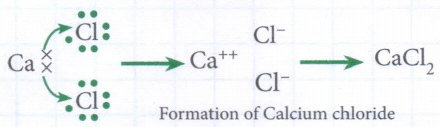
(d) The electron dot structure of divalent metal halide CaC12 is

10th Standard CBSE Syllabus & Materials
10th Standard CBSE
CBSE 10th Social Science PS - Federalism - New Model Questions Papers Study Material - QB365 Set A
NEW10th Standard CBSE
CBSE 10th Social Science PS - Power Sharing - New Model Questions Papers Study Material - QB365 Set A
NEW10th Standard CBSE
CBSE 10th Social Science GEO - Manufacturing Industries - New Model Questions Papers Study Material - QB365 Set A
NEW10th Standard CBSE
CBSE 10th Social Science GEO - Minerals and Energy Resources - New Model Questions Papers Study Material - QB365 Set A



CBSE 10th Standard CBSE Subjects
CBSE Standards





