
 100% FREE ACCESS
11th Standard CBSE Syllabus & Materials
11th Standard CBSE
CBSE 11th Economics PART-A - Presentation of Data - New Sample Question Papers Study Material - QB365 Set A
NEW11th Standard CBSE
CBSE 11th Economics PART-A - Organisation of Data - New Sample Question Papers Study Material - QB365 Set A
NEW11th Standard CBSE
CBSE 11th Economics PART-A - Collection of Data - New Sample Question Papers Study Material - QB365 Set A
NEW11th Standard CBSE
CBSE 11th Economics PART-A - Introduction to Economics and Statistics - New Sample Question Papers Study Material - QB365 Set A
NEW11th Standard CBSE
CBSE 11th Business Studies International Trade Sample Question Papers Study Material - QB365 Set A
NEW11th Standard CBSE
CBSE 11th Business Studies Evolution and Fundamentals of Business Sample Question Papers Study Material - QB365 Set A

Published on: 01/08/2018
In this question paper, some of the important one mark, two and five marks questions from the chapter Photosynthesis in Higher Plants are covered. The questions are prepared from the book back and previous year questions.
Download CBSE Class 11th Standard CBSE Biology question papers, sample papers, important questions, and previous year solved papers in PDF format. Get free study materials, NCERT solutions, and exam preparation resources for Class 11th Standard CBSE Biology
Questions + Answers key
Take MCQ Biology Test
1.
Which photosystem will work if only longer wavelengths of light are given to a plant ?
2.
Differences between stroma and grana of chloroplasts.
3.
Expand RuBP and also mention the role of RuBP in photosynthesis.
4.
Why is the colour of a leaf kept in the dark frequently yellow, or pale green? Which pigment do you think is more stable?
5.
Mention any two reasons, which prove that photosynthesis is essential for sustaining life on the earth.
6.
Mention the four basic requirements for chemiosmosis to occur.
7.
What would happen to the rate of photosynthesis in C3-plants if CO2 concentration level almost doubles from its present level in the atmosphere?
8.
Does moonlight support photosynthesis? Find out.
9.
Enumerate the type of chlorophyll known as universal photosynthetic pigment.
10.
Oxygen evolved during photosynthesis comes from H2O or CO2 ?
11.
Which compound is meant for donating hydrogen to carbohydrate in Calvin cycle?
12.
How many molecules of carbon dioxide, ATP and NADPH are required to make one molecule of glucose?
13.
Why is photosynthesis is an oxidation-reduction process?
14.
Mention the possible location in the chloroplast, where cyclic flow of electrons (cyclic photophosphorylation) occurs.
15.
Which mechanism of photosynthesis is responsible for trapping of light energy, splitting of water, oxygen release and formation of ATP and NADPH?
16.
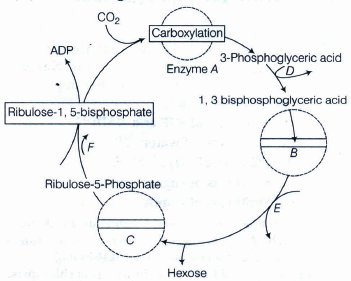
The diagram given below shows stages in the light-independent reactions of photosynthesis.
Answer the following
(i) At which stage NADPH is oxidised?
(ii) What are A, B and C?
(iii) At what stages ATP is converted into ADP?
17.
Give comparison between the cyclic and non-cyclic photophosphorylation.
18.
What conditions enable RuBisCO to function as an Oxygenase? Explain the ensuring process.
19.
Give comparison between the C3 leaf anatomy and C4 leaf anatomy
20.
Name the two important enzymes of C3 and C4 pathways, respectively? what important role do they play in fixing CO2
21.
Explain how during light reaction of photosynthesis, ATP synthesis as a chemiosmotic phenomenon takes place?
22.
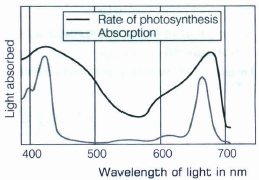
In the figure given below, the black line (upper) indicates action spectrum for photosynthesis and the lighter line (lower) indicates the absorption spectrum of chlorophyll-a, answer
the following.
(i) What does the action spectrum indicate?
How can we plot an action spectrum?
Explain with an example.
(ii) How can we derive an absorption spectrum for any substance?
(iii) If chlorophyll-a is responsible for light reaction of photosynthesis, why do the action spectrum and absorption spectrum not overlap?
23.
Six turns of Calvin cycle are required to generate one mole of glucose. Explain.
1.
Longer wavelength = 700nm.
Findout which PS operates at 700 nm light.
2.
Differences between stroma and grana of chloroplasts are
| Stroma | Grana |
| It is the jelly-like matrix of the chloroplast. |
These are formed of stacks of thylakoids. |
| Dark reaction takes place here. | Light reaction takes place here. |
3.
RuBP is known as Ribulose 1,5-Bisphosphate. It is the primary acceptor of carbon dioxide in Calvin cycle of C3-plants. It forms the first stable compound of photosynthesis known as PGA.
4.
Leaves kept in the dark become yellow or pale green due to disintegration of pigment chlorophyll. Light is essential for formation of chlorophyll. The carotene or carotenoids pigments are more stable as they do not affected by absence of light.
5.
Two reasons are as follows
(i) It is the process by which food is manufactured for all living organisms.
(ii) It is the only natural process by which oxygen is liberated into the atmosphere. This O2 is used by all living organisms respiring aerobically.
6.
Four basic requirements are as follows
(i) A unit membrane
(ii) A proton pump
(iii) A proton gradient
(iv) ATP synthase enzyme
7.
If the CO2 concentration in C3-plants almost get doubles from its present level in the atmosphere, plants will grow much faster and lead to the higher productivity due to higher rate of photosynthesis.
8.
The intensity of moonlight is several thousands times less than that of direct sunlight, insufficient for the light-dependent phase of photosynthesis. So, photosynthesis does not occur in moonlight.
9.
Chlorophyll-a is known as the universal photosynthetic pigment present in almost all photosynthetic organisms.
10.
Oxygen in photosynthesis evolves from H2O (i.e., by splitting of water ) during light reaction.
11.
NADPH is responsible for donating hydrogen to reduce CO2 in Calvin cycle.
12.
6 molecules of carbon dioxide, 18 molecules of ATP, 12 molecules of NADPH are required to make 1 glucose molecule.
13.
Photosynthesis is an oxidation-reduction process because water is oxidized to release oxygen and carbon are reduced to produce carbohydrate(glucose).
14.
Cyclic flow of electrons occur in the stromal lamellae of chloroplast.
15.
Light reaction is responsible for all the above mentioned conditions.
16.
(i) NADPH is oxidised at stage E
(ii) A-RuBP carboxylase oxygenase (RuBisCO), B-Reduction, C-Regeneration
(iii) ATP is converted to ADP at stages D and E.
17.
Comparison between the cyclic and non-cyclic photophosphorylation
| cyclic photophosphorylation | non-cyclic photophosphorylation |
| It occurs in photosystem-I in stromal or i ntergranal lamellae. |
It is carried out by both PS-I and PS-II i n the granal thylakoids. |
| It is not connected to photolysis of water so on oxygen is evolved. |
It is connected with photolysis of water, so oxygen is evolved in it. |
| It is activated by light of 700 nm wavelength | It occurs in 680 nm as well as 700 nm wavelength |
| It generates ATP only, there is no formation of NADPH2 | It produces both ATP as well as NADPH2 |
| Chlorophyll does not receive any electron from donor. | The source of electrons is photolysis of water. |
| The system does not take part in photosynthesis except in bacteria |
This system is connected with CO2, fixation and is dominant in green plants. |
18.
Carboxylation is the most crucial step of the Calvin cycle.where CO2 is utilized for the carboxylation of RuBP.This reaction is catalyzed by the enzyme RuBP carboxylase, which results in the formation of two molecules of 3-PGA. Since this enzyme also has an oxygenation activity, it would be more correct to call it RuBP carboxylase oxygenase or RuBisCO.
19.
comparison between the C3 leaf anatomy and C4 leaf anatomy
| C3 leaf anatomy | C4 leaf anatomy |
| Only one type of chloroplast is present |
Kranz anatomy, i.e type of cell, each with its own type of chloroplast is present |
| Less efficient in photosynthesis than C4 leaves. |
More efficient in photosynthesis than C3 leaves |
| Only mesophyll cells Carryout photosynthesis. | Both mesophyll cells and bundle sheath cells carry out Photosynthesis. |
20.
The important enzymes of C3-cycle is RuBisCO and that of C4 pathway is PEP carboxylase.They help in the fixation of CO2 .In C3-cycle the CO2 acceptor is Ribulose-1, 5 Biphosphate (RuBP) and the first stable product is phosphoglyceric acid (PGA).In C4-cycle, the CO2 acceptor is PEP carboxylase and the first stable product is Oxaloacetic Acid(OAA).
21.
Chemiosmosis requires a membrane, a proton pump, a proton gradient and ATP synthase enzyme. Energy is used to pump protons across a membrane, to create a gradient or a high concentration of protons whithin the thylakoid lumen. ATPsynthase enzyme catalyses the formation of ATP, along with the NADPH produced by the movement of electrons. The energy carried by ATP molecules will be used immediately in the biosynthetic reaction taking place in the stroma for fixing CO2 and synthesis of sugars.
22.
(i) It is the relative rates of photosynthesis at different wavelengths of light.
(ii) Absorption of different wavelengths of light by a particular pigment is plotted and is called the absorption spectrum of that pigment.
(iii) Chlorophyll-a is responsible for light reaction of photosynthesis, but the action spectrum and absorption spectrum do not overlap because, though chlorophyll is the main pigment responsible for absorption of light, other thylakoid pigments like chlorophyll-b, xanthophylls and carotenoids, which are called accessory pigments. also absorb and transfer the energy to chlorophyll-a. Indeed they not only enable a wider range of wavelength of incoming light to be utilised for photosynthesis, but also protect chlorophyll-a from photooxidation.
23.
Calvin cycle is a series of reactions that leads to the formation of glucose. The steps involve utilisation of 2 molecules of ATP for phosphorylation and 2 of NADPH for reduction per CO2 molecule fixed. The fixation of six molecules of CO2 and six turns of the cycle are required for the synthesis of one molecule of glucose through these reactions.
Hence, for every CO2 molecule entering the Calvin cycle, 3 molecules of ATP and 2 of NADPH are required. It is probably to meet this difference in number of ATP and NADPH used in the dark reaction that the cyclic phosphorylation takes place. To make one molecule of glucose six turns of the cycle are required.

11th Standard CBSE Syllabus & Materials
11th Standard CBSE
CBSE 11th Business Studies Forms of Business Organisation Sample Question Papers Study Material - QB365 Set A
NEW11th Standard CBSE
CBSE 11th Business Studies Business, Trade and Commerce Sample Question Papers Study Material - QB365 Set A
NEW11th Standard CBSE
CBSE 11th Physics Waves Sample Question Papers Study Material - QB365 Set A
NEW11th Standard CBSE
CBSE 11th Physics Kinetic Theory Sample Question Papers Study Material - QB365 Set A



CBSE 11th Standard CBSE Subjects
CBSE Standards









