
 100% FREE ACCESS
7th Standard CBSE Syllabus & Materials
7th Standard CBSE
CBSE 7th Social Science Theme E - Understanding Market - New Sample Question Papers Study Material - QB365 Set A
NEW7th Standard CBSE
CBSE 7th Social Science Theme E - From Barter to Money - New Sample Question Papers Study Material - QB365 Set A
NEW7th Standard CBSE
CBSE 7th Social Science Theme D - The Constitution of India- An Introduction - New Sample Question Papers Study Material - QB365 Set A
NEW7th Standard CBSE
CBSE 7th Social Science Theme D - From the Rulers to the Ruled : Types of Governments - New Sample Question Papers Study Material - QB365 Set A
NEW7th Standard CBSE
CBSE 7th Social Science Theme B - The Age of Reorganisation - New Sample Question Papers Study Material - QB365 Set A
NEW7th Standard CBSE
CBSE 7th Social Science Theme B - The Rise of Empires - New Sample Question Papers Study Material - QB365 Set A

Published on: 13/12/2018
The Central Board of Secondary Education (CBSE) is a prestigious educational board. Here, you will get the clue that from where and how the questions are being framed from the chapter Practical Geometry for CBSE Class 7 Mathematics. These questions can provide students with a chapter wise preparation strategy so that they can prepare for their exam more efficiently.
The National Council of Education and Training sets the curriculum for all schools that follow the Central Board of Secondary Education (CBSE) across the nation. The important questions provided below will also make students familiar with the marking scheme and the difficulty level of the exam. The important questions for CBSE class 7 Mathematics are prepared by subject experts according to the latest syllabus of CBSE. Students are advised to solve these important questions which can make them more focused on their exam and also bring a sense of discipline and seriousness in their exam preparation.
Creative questions were added in this question paper in order to enhance the student's knowledge and get the idea that how to answer strategic questions asked in the board exams. This question paper is designed based on the academic syllabus. Sample papers should be practiced in examination condition at home or school and also show it to your teachers for checking or compare with the answers provided.
Download CBSE Class 7th Standard CBSE Mathematics question papers, sample papers, important questions, and previous year solved papers in PDF format. Get free study materials, NCERT solutions, and exam preparation resources for Class 7th Standard CBSE Mathematics
Questions + Answers key
Take MCQ Mathematics Test
1.
Which of the following can not be the measures of a triangle?
8 cm, 5 cm, 2 cm
10 cm, 10 cm, 4 cm
10 cm, 6cm, 4 cm
9 cm, 8 cm, 7 cm
2.
To construct an isosceles right angled, triangle we must know:
the length of its hypotenuse
measure of both acute angles
measure of one acute angle and one side
length of one side
3.
If the perimeter of a triangle is given, then to construct the triangle we must know:
sum of any two sides
measure of an angle
length of anyone side
none of these
4.
We can construct a triangle, only when the length of any side is:
greater than the difference of the other two sides
less than the difference of the other two sides
equal to the difference of the other two sides
none of these
5.
To construct an equilateral triangle with a given side, which of the following is used?
Each angle of an equilateral triangle is 90°.
The sum of three angles of a triangle is less than 180°.
The sum of any two sides is equal to the third side.
Each angle of an equilateral triangle is 60°.
6.
In the given constructed figure, the length of segment AC is equal to
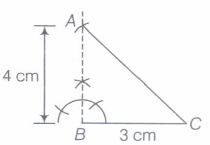
7 cm
14 cm
1 cm
5 cm
7.
In the given figure, AB = AC = BC, then the value of each angle is equal to
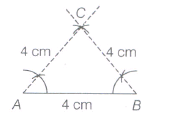
40°
70°
90°
60°
8.
In which of the following cases, a triangle can be drawn?
AB= 4 cm, BC= 8 cm and CA= 2 cm
BC= 5.2 cm, \(\angle B=90^0\) and \(\angle C=110^0\)
XY = 5 cm,\(\angle X=45^0\)and \(\angle Y=60^0\)
An isosceles triangle with the length of each equal side 6.2 cm.
9.
Which of the following sets of triangles could be the lengths of the sides of a right angled triangle?
3 cm, 4 cm, 6 cm
9 cm, 16 cm, 26 cm
1.5 cm, 3.6 cm, 3.9 cm
7 cm, 24 cm, 26 cm
10.
A triangle can be constructed by taking two of its angles as
110°, 40°
70°,115°
135°, 45°
90°,90°
11.
Construct \(\triangle\) ABC, right angled at B, given that AC = 5 cm and BC = 4 cm.
12.
Construct a triangle ABC when AB = 5.5 cm, BC = 4.5 cm and \(\angle\)B = 60°.
13.
Draw a right angle triangle having hypotenuse of length 5.4 cm, and one of the acute angles of measure 60°
14.
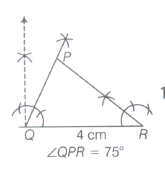
A playground PQR is triangular in shap,where \(\angle PQR=75^0,\angle PRQ=30^0\) and QR=4 cm.Measure \(\angle QPR.\)
15.
Can you slightly modify the construction of a line parallel to a given line through a point not on the line to use the idea of equal corresponding angles instead of equal alternate angles?
16.
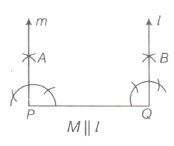
Draw the lines perpendicular to the line segment PQ at P and Q What is the relation between the two lines drawn?
17.
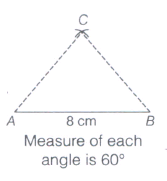
Construct an equilateral triangle in which AB = BC = CA = 8 cm. What is the measure of its each angle?
18.
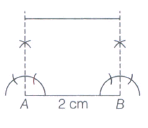
Draw two parallel lines at a distance of 2 cm apart.
19.
PQ is a given line. If RS and TV are parallel to PQ and are drawn on either side of PQ. Then, check if RS and TU are parallel to each other also.
20.
Study the following problem. ΔABC, if AC = 7 cm, m ㄥA = 600 and m ㄥB = 50°, can you draw the triangle?
21.
Construct ΔPQR, if PQ = 5 cm, m \(\angle PQR\) = 105° and m \(\angle QRP\) = 40° (Hint: Recall angle-sum property of a triangle).
22.
Construct a \(\triangle ABC\) in which AB = 2 cm, BC = 4.5 cm and AC = 4cm.
23.
The measure of each angle of an equilateral triangle is____________
24.
In right triangle, the measure of one of the acute angles is 65°. The measure of the other acute angle is____________.
25.
If AB = 6 cm and BC = 6 cm are given, then this type of triangle is called_______.
26.
The construction of an equilateral triangle can done, if the value of the given angles should be equal to__________.
27.
The bisector of a line segment, divide the line segment in two___________parts.
28.
What is the type of each angle of an equilateral triangle?
29.
What is the relation between the difference of any two sides and the third side?
30.
Write the angle measures of an isosceles right angled triangle.
31.
What is the each angle of an equilateral mangle?
32.
Can we draw a mangle having two right angles?
1.
(c)
10 cm, 6cm, 4 cm
2.
(d)
length of one side
3.
(a)
sum of any two sides
4.
(a)
greater than the difference of the other two sides
5.
(d)
Each angle of an equilateral triangle is 60°.
6.
(d)
5 cm
7.
(d)
60°
8.
(c)
XY = 5 cm,\(\angle X=45^0\)and \(\angle Y=60^0\)
9.
(c)
1.5 cm, 3.6 cm, 3.9 cm
10.
(a)
110°, 40°
11.
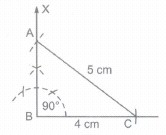
Steps of construction:
I. Draw a line segment BC = 4 cm. A,
II. At B, construct \(\angle\)CBX = 90°.
III. With centre C and radius 5 cm, draw an arc to cut \(\overrightarrow{BX}\) at A.
IV. Join AC.
Thus, \(\triangle\) ABC is the required triangle.
12.
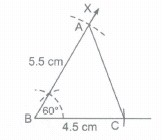
Steps of construction:
I. Draw a line segment BC = 4.5 cm.
II. Construct \(\angle\)CBX = 60° at B.
III. From BX, cut off line segment BA = 5.5 cm,
IV. Join AC
Thus, ABC is the required triangle.
13.
Let MBC be a right triangle, right angled at C, such that hypotenuse AB = 5.4 cm. Further, let Then by the angle sum property of ΔABC, we have
\(\angle A+\angle B+\angle C\) = 180°
\(\Rightarrow\) 60° \(\angle B\) + 90° = 180°
\(\Rightarrow\) 150° + \(\angle B\) = 180°
\(\Rightarrow\) \(\angle B\) =180° - 150° = 30°
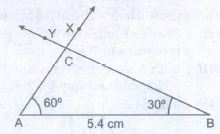
To draw ΔABC, we follow the following steps:
(a) Draw a line segment AB = 5.4 cm.
(b) Draw\(\angle BAX\) measure 60°.
Then, ΔABC is the required triangle.
14.
15.
Yes,we can slightly modify the construction of a line parallel to a given line through a point not on the line to use the idea of equal corresponding angles instead of equal alternate angles. For modifying this construction, we change only Step IV, VI and VII and new steps are given below:
Step IV With A as centre and radius same as in Step III draw an arc EF to cut BA (extended) at P.
Step V Place the pointed tip of the compasses at C and adjust the. opening so that the pencil tip is at D.
Step VI With the same opening as in Step V and with Pas centre, draw an arc which cut the arc EF at Q.
Step VII Join AQ to draw a line m, which is parallel to the given line I.
Here, \(\angle ABC,\angle PAQ\) are corresponding angles,
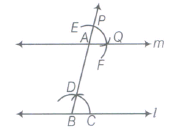
Therefore, I II m.
16.
17.
18.
19.
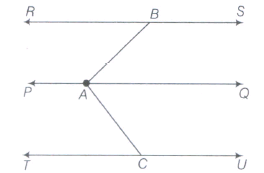
Yes, RS II PQ II TU. Since, two lines parallel to a given line are also parallel to each other.
20.
Yes,we can draw ΔABC.
Here, the side AC, ㄥA and ㄥB of ΔABC are given. But to draw the triangle, we required ㄥC.
In ΔABC, by angle sum property, we have
ㄥA + ㄥB + ㄥC = 180° ⇒ 60° + 50° + ㄥC = 180°
⇒ 110° + ㄥC = 180° ⇒ ㄥC = 180° -110° = 70°
Now, we have side AC, m ⇒ A and mㄥC.
So, we can draw MBC, by ASA criterion.
21.
PQ = 5 cm, \(\angle PQR\) =105°, \(\angle QRP\) = 40°
\(\therefore\) 105° + 40° + \(\angle QPR\) = 180°
\(\therefore\) 145° + \(\angle QPR\) = 180°
\(\angle QPR\) = 180° - 145°
\(\angle QPR\) = 35°
(a) Draw a line segment PQ of 5 em.
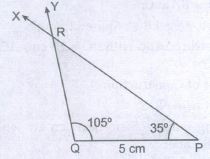
(b) From point P draw an angle of 35°, such that \(\angle QPX\) = 35°
PQR is required triangle.
22.
Steps of construction
(i) Draw a line BC = 4.5 cm.
(ii) With centre B and radius 2 cm draw an arc.
(iii) With centre C and radius 4 cm draw an arc which cuts the previous arc at A.
(iv) Join AB and AC.
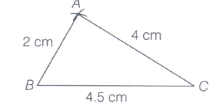
Hence, \(\triangle ABC\) is the required triangle in which AB= 2 cm, BC= 4.5 cm and AC= 4 cm.
23.
()
60°
24.
()
25°
25.
()
isosceles triangle
26.
()
600
27.
()
equal
28.
()
acute angle
29.
()
less than the third side
30.
()
45°,45°,90°.
31.
()
60°
32.
()
No.

7th Standard CBSE Syllabus & Materials
7th Standard CBSE
CBSE 7th Social Science Theme B - New Beginnings : Cities and States - New Sample Question Papers Study Material - QB365 Set A
NEW7th Standard CBSE
CBSE 7th Social Science Theme A - Climates of India - New Sample Question Papers Study Material - QB365 Set A
NEW7th Standard CBSE
CBSE 7th Social Science Theme A - Geographical Diversity of India - New Sample Question Papers Study Material - QB365 Set A
NEW7th Standard CBSE
CBSE 7th Science Earth, Moon and the Sun - New Sample Question Papers Study Material - QB365 Set A



CBSE 7th Standard CBSE Subjects
CBSE Standards




