
 100% FREE ACCESS
11th Standard CBSE Syllabus & Materials
11th Standard CBSE
CBSE 11th Economics PART-A - Presentation of Data - New Sample Question Papers Study Material - QB365 Set A
NEW11th Standard CBSE
CBSE 11th Economics PART-A - Organisation of Data - New Sample Question Papers Study Material - QB365 Set A
NEW11th Standard CBSE
CBSE 11th Economics PART-A - Collection of Data - New Sample Question Papers Study Material - QB365 Set A
NEW11th Standard CBSE
CBSE 11th Economics PART-A - Introduction to Economics and Statistics - New Sample Question Papers Study Material - QB365 Set A
NEW11th Standard CBSE
CBSE 11th Business Studies International Trade Sample Question Papers Study Material - QB365 Set A
NEW11th Standard CBSE
CBSE 11th Business Studies Evolution and Fundamentals of Business Sample Question Papers Study Material - QB365 Set A

Published on: 31/07/2018
Some of the important questions are prepared from this Redox Reactions. In this question paper, questions are prepared from the book back and creative question.
Download CBSE Class 11th Standard CBSE Chemistry question papers, sample papers, important questions, and previous year solved papers in PDF format. Get free study materials, NCERT solutions, and exam preparation resources for Class 11th Standard CBSE Chemistry
Questions + Answers key
Take MCQ Chemistry Test
1.
Calculate the oxidation number of sulphur, chromium and nitrogen in \({ H }_{ 2 }{ SO }_{ 5 },{ Cr }_{ 2 }{ O }_{ 7 }^{ 2- }and{ NO }_{ 3 }^{ - }\). Suggest structure of these compounds. Count for the fallacy.
2.
Permanganate ion reacts with bromide ion in basic medium to give manganese dioxide and bromate ion. Write the balanced ionic equation for the reaction.
3.
Identify the substance oxidised reduced, oxidising agent and reducing agent for each of the following reactions:
\((a) \ 2ABr(s)+{ C }_{ 2 }{ H }_{ 6 }{ O }_{ 2 }(aq)\rightarrow 2Ag(s)+2HBr(aq)+{ C }_{ 2 }{ H }_{ 6 }{ O }_{ 2 }(aq)\)
\( (b) \ HCHO(l)+2[Ag(N{ H }_{ 3 }{ ) }_{ 2 }{ ] }^{ + }(aq)+3O{ H }^{ - }(aq)\rightarrow 2Ag(s)+HCO{ O }^{ - }(aq)+4N{ H }_{ 3 }(aq)+2{ H }_{ 2 }O(l)\)
\((c) \ HCHO(l)+{ 2Cu }^{ 2+ }(aq)+5O{ H }^{ - }(aq)\rightarrow { Cu }_{ 2 }O(s)+HCO{ O }^{ - }(aq)+3{ H }_{ 2 }O(l)\)
\( (d) \ { N }_{ 2 }{ H }_{ 4 }(l)+{ 2H }_{ 2 }{ O }_{ 2 }(l)\rightarrow { N }_{ 2 }(g)+{ 4H }_{ 2 }O(l)\)
\( (e) \ Pb(s)+Pb{ O }_{ 2 }(s)+2{ H }_{ 2 }{ SO }_{ 4 }(aq)\rightarrow 2PbSO_{ 4 }(s)+{ 2H }_{ 2 }O(l)\)
4.
Justify that the following reaction are redox reaction
(a) \(CuO(s)+{ H }_{ 2 }(g)\rightarrow Cu(s)+{ H }_{ 2 }O(g)\)
(b) \({ F }e_{ 2 }O_{ 3 }(s)+3CO(g)\rightarrow 2Fe(s)+3{ CO }_{ 2 }(g)\)
(c) \(4BCl_{ 3 }(g)+3LiAl{ H }_{ 4 }(s)\longrightarrow 2{ B }_{ 2 }{ H }_{ 6 }(g)+3LiCl(s)+3AlC{ l }_{ 3 }(s)\)
(d) \(2k(s)+{ F }_{ 2 }(g)\longrightarrow 2K^{ + }{ F }^{ - }(s)\)
(e) \(4N{ H }_{ 3 }(g)+5{ O }_{ 2 }(g)\longrightarrow 4NO(g)+6H_{ 2 }O(g)\)
5.
Why does the following reaction occur?
\({ XEO }_{ 6 }^{ 4- }(aq)+{ 2F }^{ - }(aq)+{ 6H }^{ + }(aq)\longrightarrow { Xeo }_{ 3 }(g)+{ F }_{ 2 }(g)+3{ H }_{ 2 }O(l)\)
What conclusion about the compound Na4CeO6 (of which \(XeO_{ 6 }^{ 4- }\)is a part) can be drawn from the reaction?
6.
Calculate the oxidation number of phosphorus in the following species.
\({ HPO }_{ 3 }^{ 2- }\)
7.
Does the oxidation number of an element in any molecule or any polyatomic ion represent the actual charge on it?
8.
Two half cells are AI3+ (aq) /AI and Mg2+ (aq)/Mg.The reduction potentials of these half-cells are -1.66 V and -2.36 V respectively. Calculate the cell potential. Write the cell reaction also.
9.
Consider the reactions:
(a) H3PO2(aq) + 4 AgNO3(aq) + 2 H2O(l) → H3PO4(aq) + 4Ag(s) + 4HNO3(aq)
(b) H3PO2(aq) + 2CuSO4(aq) + 2 H2O(l) → H3PO4(aq) + 2Cu(s) + H2SO4(aq)
(c) C6H5CHO(l) + 2[Ag (NH3)2]+(aq) + 3OH–(aq) → C6H5COO–(aq) + 2Ag(s) + 4NH3 (aq) + 2 H2O(l)
(d) C6H5CHO(l) + 2Cu2+(aq) + 5OH–(aq) → No change observed.
What inference do you draw about the behaviour of Ag+ and Cu2+ from these reactions?
10.
Balance the following equations in basic medium by ion electron and oxidation number methods and identify the oxidising agent and the reducing agent
\(CI_{ 2 }O_{ 7 }(g)+H_{ 2 }O_{ 2 }(aq)\longrightarrow CIO_{ 2 }^{ - }(aq)+O_{ 2 }(g)\)
11.
Can we use KCI as electrolyte in the salt bridge of the cell, Cu(s) I Cu2 (aq) II Ag+(aq) I Ag(s)?
12.
Find the value of n in 4MnO4-+8H+ +ne- \(\rightarrow\) Mn2+ +4H2O
13.
What is the most essential conditions that must be satisfied in a redox reaction?
14.
Why do the following reactions proceed differently ?
Pb3O4 + 8HCl\(\rightarrow \) 3PbCl2 + Cl2 + 4H2O and
Pb3O4 + 4HNO3\(\rightarrow \)2Pb(NO3)2 + PbO2 + 2H2O
15.
Suggest a list of the substances where carbon can exhibit oxidation states from –4 to +4 and nitrogen from –3 to +5.
1.
Oxidation number of S in \({ H }_{ 2 }{ SO }_{ 5 }\)is 2(+1) + x + 5(-2) = 0 or x = +8
But oxidation number of S cannot be more than 6 because S has only 6 valence electrons. This fallacy is removed by calculating oxidation number of S by chemical bonding method.
Let us consider the structure of \({ H }_{ 2 }{ SO }_{ 5 }\)
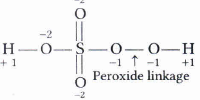
In \({ H }_{ 2 }{ SO }_{ 5 }\), two oxygen atoms are in -1 oxidation state.
Let the oxidation number of S be x.
\(\underset { For \ H }{ 2(+1) } +\underset { For \ three \ O }{ 3(-2) } +x+\underset { For \ O-O }{ 2(-1) } =0\)
\( 2+(-6)+x+(-2)=0\)
\( x=+6\)
Therefore, the oxidation number of S in \({ H }_{ 2 }SO_{ 5 }\)is +6.
(ii) Oxidation number of Cr in \({ Cr }_{ 2 }{ O }_{ 7 }^{ 2- }\)is
2x + (-2)7 = -2
2x = +12
x = +6
Let us consider the structure of \({ Cr }_{ 2 }{ O }_{ 7 }^{ 2- }\) ion
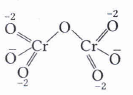
Let the oxidation number of each Cr-atom be x.
4(-2) + (-2) + 1(-2) + 2x = 0
-8-2-2 + 2x = 0
2x = +12, x = +6
Oxidation number of Cr in \({ Cr }_{ 2 }{ O }_{ 7 }^{ 2- }\) is same i.e+6 whether it is calculated by conventional method or by chemical bonding method. Hence, there is no fallacy.
(iii) Oxidation number of N in \(NO_{ 3 }^{ - }\)be x
[x + 3(-2) = -1 or x = +5]
Let us consider the structure of \(NO_{ 3 }^{ - }\)ion

Let the oxidation number of N be x
\(\underset { For \ \overset { - }{ O } }{ 1(-1) } +x+\underset { For \ (=O) }{ 1(-2) } +\underset { For(\rightarrow O) }{ 1(-2) } =0\)
\(x=+5\)
Oxidation number of N in \({ NO }_{ 2 }^{ - }\)ion is same, i.e+5 whether it is calculated by conventional method or by chemical bonding method hence, there is no fallacy.
2.
Step 1 : The skeletal ionic equation is
\(Mn{ O }_{ 4 }^{ - }(aq)+{ Br }^{ - }(aq)\longrightarrow Mn{ O }_{ 2 }(s)+Br{ O }_{ 3 }^{ - }(aq)\)
Step 2 : Assign oxidation numbers for Mn and Br
\(\overset { +7 }{ Mn{ O }_{ 4 }^{ - } } (aq)+\overset { -1 }{ { Br }^{ - } } (aq)\longrightarrow \overset { +4 }{ Mn{ O }_{ 2 } } (s)+\overset { +5 }{ Br{ O }_{ 3 }^{ - } } (aq)\)
this indicates that permanganate ion is the oxidant and bromide ion is the reductant.
Step 3: Calculate the increase and decrease of oxidation number, and make the increase equal to the decrease.
\(2\overset { +7 }{ Mn{ O }_{ 4 }^{ - } } (aq)+\overset { -1 }{ { Br }^{ - } } (aq)\longrightarrow \overset { +4 }{ Mn{ O }_{ 2 } } (s)+\overset { +5 }{ Br{ O }_{ 3 }^{ - } } (aq)\)
Step 4: As the reaction occurs in the basic medium, and the ionic charges are not equal on both sides, add 2 OH– ions on the right to make ionic charges equal.
\(Mn{ O }_{ 4 }^{ - }(aq)+{ Br }^{ - }(aq)\longrightarrow Mn{ O }_{ 2 }(s)+Br{ O }_{ 3 }^{ - }(aq)+2OH^{ - }(aq)\)
Step 5: Finally, count the hydrogen atoms and add appropriate number of water molecules (i.e. one H2O molecule) on the left side to achieve balanced redox change.
\(Mn{ O }_{ 4 }^{ - }(aq)+{ Br }^{ - }(aq)+{ H }_{ 2 }O(l)\longrightarrow Mn{ O }_{ 2 }(s)+Br{ O }_{ 3 }^{ - }(aq)+2OH^{ - }(aq)\)
3.
(a) Oxidised substance → C6H6O2 Reduced substance → AgBrO xidising agent → AgBr Reducing agent → C6H6O2
(b) Oxidised substance → HCHO Reduced [Ag(NH3)2]+ substance → Oxidising agent → [Ag(NH3)2]+ Reducing agent → HCHO
(c) Oxidised substance → HCHO Reduced substance → Cu2+ Oxidising agent → Cu2+ Reducing agent → HCHO
(d) Oxidised substance → N2H4 Reduced substance → H2O2 Oxidising agent → H2O2 Reducing agent → N2H4
(e) Oxidised substance → Pb Reduced substance → PbO2 Oxidising agent → PbO2 Reducing agent → Pb
| S,No | Substance oxidised (reducing agent) |
Substance reduced (oxidising agent) |
| (i) | \({ C }_{ 2 }{ H }_{ 6 }{ O }_{ 2 }(aq)\) | AgBr(s) |
| (ii) | HCHO(l) | \([Ag(N{ H }_{ 3 }{ ) }_{ 2 }{ ] }^{ + }(aq)\) |
| (iii) | HCHO(l) | \({ Cu }^{ 2+ }(aq)\) |
| (iv) | \({ N }_{ 2 }{ H }_{ 4 }(l)\) | \({ H }_{ 2 }{ O }_{ 2 }(l)\) |
| (v) | Pb(s) | \(Pb{ O }_{ 2 }(s)\) |
| (v) | Pb(s) | \(Pb{ O }_{ 2 }(s)\) |
4.
(a) \(CuO(s)+{ H }_{ 2 }(g)\rightarrow Cu(s)+{ H }_{ 2 }O(g)\)
Assign oxidation numbers of each atom above its symbol.
\(\overset { +2-2 }{ CuO } (s)+\overset { 0 }{ H_{ 2 } } (g)\rightarrow \overset { 0 }{ Cu } (s)+\overset { +1 }{ H_{ 2 } } \ \overset { -2 }{ 0 } \ (g)\)
Oxidation number of Cu in Cuo is +2.It decreases from +2 to zero in Cu.While oxidation number of hydrogen increases from 0(in H2) to +1 (in H2O)
This shows the CuO is reduced to Cu but H2 is oxidised to H2O.Hence,it is an example of redox reaction.
(b) \(\overset { +3 }{ { Fe }_{ 2 } } \ { 0 }_{ 3 }(s)+3\overset { +2-2 }{ CO } (g)\longrightarrow \overset { 0 }{ 2F } \ e(s)+\overset { +4-2 }{ CO_{ 2 } } (g)\)
Oxidation number of Fe decreases from +3(in Fe2O3) to zero (in Fe) and oxidation number of C increases from +2 (in CO) to +4
(in CO2 ). This shows that Fe2O3 is reduced to Fe and CO is oxidised to CO2. Hence, it is a redox reaction.
(c) \(\overset { +3-1 }{ 4BCl_{ 3 } } (g)+\overset { +1+3-1 }{ 3LiAl{ H }_{ 4 } } (s)\longrightarrow \overset { -3+1 }{ 2{ B }_{ 2 }{ H }_{ 6 } } (g)+\overset { +1-1 }{ 3LiCl } (s)+3\overset { +3-1 }{ AlC{ l }_{ 3 } } (s)\)
Oxidation number of B decreases from +3(in BCl3) to -3(in B2H6) and oxidation number of H increases from -1(in LiAlH4) to +1 (in B2H6 ). This shows that BCl3 is reduced to B2H4 and LiAlH4 is oxidised. Hence, it is redox reaction.
(d) \(\overset { 0 }{ 2k(s) } +\overset { 1 }{ { P }_{ 2 } } \longrightarrow 2\overset { +1-1 }{ K{ F } } (s)\)
Oxidation number of K increases from zero(in K) to +1 (in KF) and oxidation number of F reduces from zero(in F2) to -1(in KF).This shows that K is oxidised and F2 is reduced.Hence it is a redox reaction
(e) \(4\overset { -3-1 }{ N{ H }_{ 3 } } (g)+5\overset { 0 }{ { O }_{ 2 } } (g)\longrightarrow 4\overset { +2-1 }{ NO } (g)+6\overset { +1-2 }{ H_{ 2 }O } (g)\)
Oxidation number of N increases from -2(in NH3) to +2(in NO) and oxidation number of O decreases from zero (in O2) to-2
(in NO and H2O). This shows that NH3 is oxidised and O2 is reduced. Hence, it is a redox reaction.
5.
\(\overset { +8 }{ Xe } { O }_{ 6 }^{ 4- }(aq)+\overset { -1 }{ { 2F }^{ - } } (aq)+6{ H }^{ + }(aq)\longrightarrow \overset { +6 }{ Xe } { O }_{ 3 }(g)+\overset { 0 }{ { F }_{ 2 } } +3{ H }_{ 2 }O(l)\)
In the above reaction, oxidation number of Xe in \(XeO_{ 6 }^{ 4- }\) and oxidation number of F increases from -1(in F-) to zero(in F2 ).
Hence \(XeO_{ 6 }^{ 4- }\) or Na4XeO6 is reduced and F- is oxidised.
This reaction occur because Na4XeO6 or \(XeO_{ 6 }^{ 4- }\) is a stronger oxidising agent than fluorine.
6.
Suppose that the oxidation number of P in \({ HPO }_{ 3 }^{ 2- }\) be x.
Theb, 1 + x + 3 (-2) = -2
or x + 1 - 6 = -2 or x = +3
7.
No, the oxidation number of an element in any species is an apparent charge on the atom which it appears to have acquired when all other atoms in the species are removed as ions.
8.
Since, Mg2+(aq)/Mg electrode = - 2.36V is at lower potential than Al3+(aq)/AI electrode = - 1.66 V, therefore, Mg2+ (aq)/Mg electrode acts the anode and AI3+(aq)/Mg electrode acts as the anode and AI3+(aq) /AI acts as the cathode.In other words, Mg loses electrons and AI3+ ion accepts electrons.Thus, the cell reaction is
3Mg +2 AI3+ \(\rightarrow\) 3Mg2+ + 2AI and Eocell = EoAL3+ I AI - EMg2+ I Mg = -1.66-(-2.36)
= +0.70 V
9.
Ag+ and Cu2+ act as oxidising agents in reactions (a) and (b) respectively.
In reaction (c), Ag+ oxidises C6H5CHO to C6H5COO–, but in reaction (d), Cu2+ cannot oxidise C6H5CHO.
Hence, we can say that Ag+ is a stronger oxidising agent than Cu2+.
10.
\(CI_{ 2 }O_{ 7 }(g)+4H_{ 2 }O_{ 2 }(aq)+2OH^{ - }(aq)\longrightarrow 2CIO_{ 2 }^{ - }(aq)+5H_{ 2 }O(I)+4O_{ 2 }(g)\)
11.
KCI cannot be used as electrolyte in the salt bridge because CI- ions will combine with Ag+ ions to form white precipitates of AgCI
12.
4MnO4-+8H+ +ne- → Mn2+ +4H2O
-1 + 8 + n = +2
-1 - 2+ 8 + n = 0
n = - 5 or 5e-
13.
In a redox reaction, the total number of electrons lost by reducing agent must be equal to the number of electrons gained by the oxidising agent.
14.
Pb3O4 is actually a stoichiometric mixture of 2 moles of PbO and 1 mole of PbO2 i.e(2 PbO.PbO2). In PbO2, lead is present in +4 oxidation state, whereas the stable oxidation state of lead in PbO is +2. PbO2 thus can act as an oxidant (oxidising agent) and therefore, can oxidise Cl- ion of HCl into chlorine. We may also keep in mind that PbO is a basic oxide. Therefore, the reaction.
Pb3O4 + 8HCl\(\rightarrow\)3PbCl2 + Cl2 + 4H2O
can be splitted into two reactions namely:
2PbO + 4HCl\(\rightarrow\)2PbCl2 + 2H2O
(acid-base reaction)
\(\overset { +4 }{ Pb{ O }_{ 2 } } +4\overset { -1 }{ HCl } \rightarrow \overset { +4 }{ Pb } \ { Cl }_{ 2 }+\overset { 0 }{ { Cl }_{ 2 } } +{ 2 }H_{ 2 }O\)
(redox reaction)
Since, HNO3 itself is an oxidising agent, therefore it is unlikely that the reaction may occur between PbO2 and HNO3 . However, the acid-base reaction occurs between PbO and HNO3 as
2PbO + 4HNO3\(\rightarrow\)2Pb(NO3)2 + 2H2O
It is the passive nature of PbO2 against HNO3 that makes the reaction different from the follows with HCl.
15.
| Substance | On of C | Substance | ON of N |
| CH4 | -4 | NH3 | -3 |
| C2H6 | -3 | N2H4 | -2 |
| C2H4 or CH3Cl | -2 | N2H2 | -1 |
| C2H2 | -1 | N2 | 0 |
| CH2Cl2 or C2CH12O6 | +1 | N2O | +2 |
| C6Cl6 or C2Cl2 | +1 | NO | +2 |
| CHCl3 or CO | +2 | N2O3 | +3 |
| (COOH)2 | +3 | N2O4 | +4 |
| CCl4 or CO2 | +4 | N2O5 | +5 |

11th Standard CBSE Syllabus & Materials
11th Standard CBSE
CBSE 11th Business Studies Forms of Business Organisation Sample Question Papers Study Material - QB365 Set A
NEW11th Standard CBSE
CBSE 11th Business Studies Business, Trade and Commerce Sample Question Papers Study Material - QB365 Set A
NEW11th Standard CBSE
CBSE 11th Physics Waves Sample Question Papers Study Material - QB365 Set A
NEW11th Standard CBSE
CBSE 11th Physics Kinetic Theory Sample Question Papers Study Material - QB365 Set A



CBSE 11th Standard CBSE Subjects
CBSE Standards









