
 100% FREE ACCESS
11th Standard CBSE Syllabus & Materials
11th Standard CBSE
CBSE 11th Economics PART-A - Presentation of Data - New Sample Question Papers Study Material - QB365 Set A
NEW11th Standard CBSE
CBSE 11th Economics PART-A - Organisation of Data - New Sample Question Papers Study Material - QB365 Set A
NEW11th Standard CBSE
CBSE 11th Economics PART-A - Collection of Data - New Sample Question Papers Study Material - QB365 Set A
NEW11th Standard CBSE
CBSE 11th Economics PART-A - Introduction to Economics and Statistics - New Sample Question Papers Study Material - QB365 Set A
NEW11th Standard CBSE
CBSE 11th Business Studies International Trade Sample Question Papers Study Material - QB365 Set A
NEW11th Standard CBSE
CBSE 11th Business Studies Evolution and Fundamentals of Business Sample Question Papers Study Material - QB365 Set A

Published on: 27/07/2018
The chapter Relations and Functions contains the important question in CBSE 11th Standard Mathematics. It covers one mark, two, three and five marks questions from the book back and previous year questions.
Download CBSE Class 11th Standard CBSE Mathematics question papers, sample papers, important questions, and previous year solved papers in PDF format. Get free study materials, NCERT solutions, and exam preparation resources for Class 11th Standard CBSE Mathematics
Questions + Answers key
Take MCQ Mathematics Test
1.
Find the range of \(f\left( x \right) =\frac { x-2 }{ 3-x } \)
2.
If \(y=f(x)=\frac { 1-x }{ 1+x } ,\) then show that x = f(y).
3.
Let \(f:R\rightarrow R\) and \(g:R\rightarrow R\) defined by \(f\left( x \right) =x+1\) and\(g\left( x \right) =2x-3\) Find,\(f+g\) , \(f-g\) and \(\frac { f }{ g } \)
4.
Let A and B be two sets such that n(A)=5 and n(B) =2. If a,b,c,d,e are distinct and (a,2),(b,3),(c,2),(d,3),(e,2) are elements of A x B, find A and B.
5.
If A= {1,2,3), B={1,2,3,4}, C= {5,6} and D={5,6,7,8}, then verify that \((A\times C)\subset (B\times D) \)
6.
Let f(x)=x2 and g(x)=2x+1 be two real functions.Find (fg) (x)
7.
Let f(x)=x2 and g(x)=2x+1 be two real functions.Find (f –g) (x)
8.
Let f(x)=x2 and g(x)=2x+1 be two real functions.Find (f + g) (x), (f –g) (x), (fg) (x),\(\left(\frac{f}{g}\right)(x)\)
9.
Find the inverse relation \(\left( { R }^{ -1 } \right) \)in each of the following cases R= {(x,y) : x, y \(\in\) N, x + 2y = 8}
10.
What are the sum and difference of identity function and the reciprocal function?
11.
Let\(f:\left[ 2,\infty \right] \rightarrow R\) and \(g:\left[ -2,\infty \right] \rightarrow R\) be two real functions defined by \(f(x)=\sqrt { x-2 } \) and \(g(x)=\sqrt { x+2 } \). Find \(f+g\) and \(f-g\)
12.
Find the domain and range of the relation R = {(x, y) : x + y = 8; x, \(y\in N\)}
13.
Let \(f\) and \(g\) be real functions defines by \(f(x)=\sqrt { x+2 } \) and \(g\), then\(g(x)=\sqrt { 4-{ x }^{ 2 } } \) find the following function: \(\frac { f }{ g } \)
14.
Let \(f\) and \(g\) be real functions defines by \(f(x)=\sqrt { x+2 } \) and \(g\) ,then\(g(x)=\sqrt { 4-{ x }^{ 2 } } \) find the following function: f . g
15.
Let \(f\) and \(g\) be real functions defines by \(f(x)=\sqrt { x+2 } \) and \(g\) , then\(g(x)=\sqrt { 4-{ x }^{ 2 } } \) find the following function: \(f+g\)
16.
If two functions are defined as \(f(x)=\frac { 1 }{ (x-2) } ,x\neq 2\) and \(g(x)=(x-2)^{ 2 }\) , then find f + g.
17.
If A = {a,b} and B = {2,3}, then find the number of relations from A to B.
Number of relations from A to B \(={ 2 }^{ n\left( A \right) \times n\left( B \right) }={ 2 }^{ n\left( A\times B \right) }\)
18.
Let A = {a,b,c} and B={x: x\( \in \) N, x is a prime number less than 5}. Find A x B ans B x A.
Show that A x B \( \neq \) B x A.
19.
Which of the following relations are functions?
\(\left\{ (2,0),(4,8),(2,1),(3,6) \right\} \)
20.
Which of the following relations are functions?
\( \left\{ (3,3),(4,2),(5,1),(6,0),(7,7) \right\} \)
21.
Find the values of a and b, if (a-3,b+7)=(3,7)
22.
Find the values of a and b, if (2a-5,4)=(5,b+6)
23.
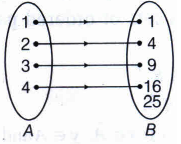
Let A = {1,2,3,4} and B = {1,4,9,16,25} and R be a relation defined from A to B as \(R=\{ (x,y):x\in A,y\in B,\quad and\quad y={ x }^{ 2 }\} \).
Depict this relation using arrow diagram
24.
If a function \(f:R\rightarrow R\) be defined by
\(f(x)=\begin{cases} 3x-2,\quad x<0 \\ 1,\quad \quad \quad \quad x=0 \\ 4x+1,\quad x>0 \end{cases}\)
Find f(1), f(-1), f(0), f(2).
1.
Given, \(f\left( x \right) =\frac { x-2 }{ 3-x } =y\) (say)
Here, denominator = 3 - x
Put denominator = 0, we get 3 - x = 0 \(\Rightarrow \) x = 3
Therefore, Domain of y = f(x) is R - {3}
Now, consider \(y=\frac { x-2 }{ 3-x } \)
\(\Rightarrow y(3-x)=(x-2)\)
\(\Rightarrow 3y-xy=x-2\)
\(\Rightarrow x+xy=3y+2\)
\(\Rightarrow x(1+y)=3y+2\)
\(\Rightarrow x=\frac { 3y+2 }{ 1+y } \)
It will define, if \(1+y\neq 0\ \Rightarrow y\neq -1\)
So, x=g(y) takes real values, if \(y\in R-\{ -1\} \)
Also, \(\frac { 3y+2 }{ 1+y } \neq 3\) for all \(y\in R-\{ -1\} \)
[ \(\therefore \) if \(\frac { 3y+2 }{ 1+y } =3,\)then 3y+2 = 3+3y \(\Rightarrow \) 2 = 3, which is absurd]
\(\Rightarrow \frac { 3y+2 }{ 1+y } \neq 3\quad y\in R-\{ -1\} \)
Thus, \(x=\frac { 3y+2 }{ 1+y } \in \) Domain (f), \(\forall \ y\in R-\{ 1\} \)
Hence, the range of f(x) is R-{-1}.
2.
We have, \(y=f(x)=\frac { 1-x }{ 1+x } \)
Then, \(f(y)=\frac { 1-y }{ 1+y } =\frac { 1-\left( \frac { 1-x }{ 1+x } \right) }{ 1+\left( \frac { 1-x }{ 1+x } \right) } \) [from Eq. (i)]
\(\frac { \frac { 1+x-(1-x) }{ 1+x } }{ \frac { 1+x+1-x }{ 1+x } } =\frac { 2x }{ 2 } \)
\(\Rightarrow \) f(y) = x
\(\therefore \) x = f(y), when \(y=f(x)=\frac { 1-x }{ 1+x } \)
3.
\(f+g=3 x-2\)
\(f-g=-x+4\)
\(\frac { f }{ g } :R-\left\{ \frac { 3 }{ 2 } \right\} \rightarrow R,\) \(\frac { f }{ g } =\frac { x+1 }{ 2x+1 } \)
4.
\(\because \) (a,2),(b,3),(c,2),(d,3),(e,2) \(\in \) A x B
\(\therefore \) a,b,c,d,e \(\in \) A and 2,3 \(\in \) A x B
Also, it is given that n(A) = 5, n(B) = 2
\(\therefore \) A = {a,b,c,d,e}, B = {2,3}
5.
\(A\times C\) = {(1,5),(1,6),(2,5),(2,6),(3,5),(3,6)}
\(B\times D\) = {(1,5),(1,6),(1,7),(1,8),(2,5),(2,6),(2,7),(2,8),(3,5),(3,6),(3,7),(3,8),(4,5),(4,6),(4,7),(4,8)}
Here, elements (1,5),(1,6),(2,5),(2,6),(3,5),(3,6) \(\in \) \(A\times C\) are also belongs to \(B\times D\), therefore \((A\times C)\subset (B\times D)\)
6.
\((f+g)(x)=x^{2}+2 x+1,(f-g)(x)=x^{2}-2 x-1,\)
\((\text { fg })(x)=x^{2}(2 x+1)=2 x^{3}+x^{2},\left(\frac{f}{g}\right)(x)=\frac{x^{2}}{2 x+1}, x \neq-\frac{1}{2} \)
7.
We have,
\((f+g)(x)=x^{2}+2 x+1,(f-g)(x)=x^{2}-2 x-1\)
\((\text { fg })(x)=x^{2}(2 x+1)=2 x^{3}+x^{2},\left(\frac{f}{g}\right)(x)=\frac{x^{2}}{2 x+1}, x \neq-\frac{1}{2} \)
8.
We have,
\((f+g)(x)=x^{2}+2 x+1,(f-g)(x)=x^{2}-2 x-1\)
\((\text { fg })(x)=x^{2}(2 x+1)=2 x^{3}+x^{2},\left(\frac{f}{g}\right)(x)=\frac{x^{2}}{2 x+1}, x \neq-\frac{1}{2} \)
9.
R = {(x,y) : x, y \(\in\) N, x + 2y = 8}
\(\therefore \) x + 2y = 8
When x=2, y=3
When x=4, y=2
When x=6, y=1
\(\Rightarrow \) R= {(2,3),(4,2),(6,1)}
\(\Rightarrow \)\({ R }^{ -1 }\)= {(3,2),(2,4),(1,6)}
10.
Let\(f\left( x \right) =x,g\left( x \right) =\frac { 1 }{ x }\) ;
Domain\((f)=R={ D }_{ 1 }\)
Domain\((g)=R-\left\{ 0 \right\} ={ D }_{ 2 };{ D }_{ 1 }\cap { D }_{ 2 }=R-\{ 0\} \)
Ans Sum= \(x+\frac { 1 }{ x } \)and difference \(x-\frac { 1 }{ x } \)
11.
Domain \(f=\left[ 2,\infty \right] ={ D }_{ 1 }\) [say]
Domain g= \(\left[ -2,\infty \right] ={ D }_{ 2 }\) [say];
Ans \(\left( \sqrt { x-2 } +\sqrt { x+2 } \right) \)and\(\left( \sqrt { x-2 } -\sqrt { x+2 } \right) \)
12.
Domain (R) = {1, 2, 3, 4, 5, 6, 7}
Range (R) = {7, 6, 5, 4, 3, 2, 1}
13.
\(f(x)=\sqrt { x+2 } ,g(x)=\sqrt { 4-{ x }^{ 2 } } \)
\(f\)(x) is defined for \(x+2\ge 0\Rightarrow \ge -2\)
Domain(\(f\)) = \([-2,\infty )\)
\(g(x)\)is defined for \(4-{ x }^{ 2 }\ge =0\Rightarrow { x }^{ 2 }-4\le 0\)
\(\Rightarrow (x-2)(x+2)\le 0\Rightarrow x\in \left[ -2,2 \right] ;Domain(g)=\left[ -2,2 \right] \)
Domain(\(f\)) \(\cap \) domain(\(g\)) = [-2,2]
\(1/\sqrt { 2-x } \)
14.
\(f(x)=\sqrt { x+2 } ,g(x)=\sqrt { 4-{ x }^{ 2 } } \)
\(f\)(x) is defined for \(x+2\ge 0\Rightarrow \ge -2\)
Domain(\(f\))=\([-2,\infty )\)
\(g(x)\)is defined for \(4-{ x }^{ 2 }\ge =0\Rightarrow { x }^{ 2 }-4\le 0\)
\(\Rightarrow (x-2)(x+2)\le 0\Rightarrow x\in \left[ -2,2 \right] ;Domain(g)=\left[ -2,2 \right] \)
Domain(\(f\)) \(\cap \) domain(\(g\)) = [-2,2]
\(\left( x+2 \right) \sqrt { 2-x } \)
15.
\(f(x)=\sqrt { x+2 } ,g(x)=\sqrt { 4-{ x }^{ 2 } } \)
\(f\)(x) is defined for \(x+2\ge 0\Rightarrow \ge -2\)
Domain(\(f\))=\([-2,\infty )\)
\(g(x)\)is defined for \(4-{ x }^{ 2 }\ge =0\Rightarrow { x }^{ 2 }-4\le 0\)
\(\Rightarrow (x-2)(x+2)\le 0\Rightarrow x\epsilon \left[ -2,2 \right] ;Domain(g)=\left[ -2,2 \right] \)
Domain (\(f\)) \(\cap \) domain (\(g\)) = [-2,2]
\(\left( \sqrt { x+2 } \right) \left[ 1+\sqrt { 2-x } \right] \)
16.
Given functions are
\(f(x)=\frac { 1 }{ (x-2) } ,x\neq 2\) and \(g(x)=(x-2)^{ 2 }\)
\((f+g)(x)=f(x)+g(x)=\frac { 1 }{ (x-2) } +(x-2)^{ 2 },\quad x\neq 2\)
\(=\frac { 1+(x-2)^{ 3 } }{ x-2 } ,x\neq 2\)
17.
We have, A = {a,b} and B = {2,3},
\(\therefore \ n\left( A\times B \right) =n\left( A \right) \times n\left( B \right) =2\times 2=4\)
Now, number of subsets of A x B
\(={ 2 }^{ n\left( A\times B \right) }={ 2 }^{ 4 }=16\)
Thus, the number of relations from A to B is 16.
18.
Given sets are A={a,b,c} and B={x: x \( \in \)N, x is a prime number leaa than 5}={2,3}
For element a of set A, All ordered pairs are (a,2), (a,3).
For element b of set A, All ordered pairs are (b,2), (b,3).
For element c of set A, All ordered pairs are (c,2), (c,3).
\( \therefore \) A X B = {(a,2)(a,3),(b,2)(b,3)(c,2)(c,3)}
For element 2 of set B, all ordered pairs are (2,a), (2,b),(2,c).
For element 3 of set B, all ordered pairs are (3,a), (3,b), (3,C).
\( \therefore \)B X A = {(2,a), (2,b), (2,c), (3,a), (3,b), (3,c)}
Since, (a,2) \( \neq \) (2,a)
A X B \( \neq \) B X A
19.
\(\left\{ (2,0),(4,8),(2,1),(3,6) \right\} \)
It is not a function because first elements of (2,0) and (2,1) are same.
20.
\( \left\{ (3,3),(4,2),(5,1),(6,0),(7,7) \right\} \)
It is a function because the first element of each ordered pair is different.
21.
We know that, two ordered pairs are equal, if their corresponding elements are equal.
(a-3,b+7)=(3,7)\(\Rightarrow \) a-3=3 and b+7=7
[equating corresponding elements]
\(\Rightarrow \) a=3+3 and b=7-7
\(\Rightarrow \) a=6 and b=0
22.
We know that, two ordered pairs are equal, if their corresponding elements are equal.
(2a-5,4)=(5,b+6)\(\Rightarrow \)2a-5=5 and 4=b+6
[equating corresponding elements]
\(\Rightarrow \) 2a=5+5 and and 4-6=b
\(\Rightarrow \) 2a=10 and -2=b
\(\Rightarrow \) a=5 and b=-2
23.
The relation R={(1,1),(2,4),(3,9),(4,16)}
24.
f(1) = 5
f(-1) = -5
f(0) = 1
f(2) = 9

11th Standard CBSE Syllabus & Materials
11th Standard CBSE
CBSE 11th Business Studies Forms of Business Organisation Sample Question Papers Study Material - QB365 Set A
NEW11th Standard CBSE
CBSE 11th Business Studies Business, Trade and Commerce Sample Question Papers Study Material - QB365 Set A
NEW11th Standard CBSE
CBSE 11th Physics Waves Sample Question Papers Study Material - QB365 Set A
NEW11th Standard CBSE
CBSE 11th Physics Kinetic Theory Sample Question Papers Study Material - QB365 Set A



CBSE 11th Standard CBSE Subjects
CBSE Standards









