
 100% FREE ACCESS
7th Standard CBSE Syllabus & Materials
7th Standard CBSE
CBSE 7th Social Science Theme E - Understanding Market - New Sample Question Papers Study Material - QB365 Set A
NEW7th Standard CBSE
CBSE 7th Social Science Theme E - From Barter to Money - New Sample Question Papers Study Material - QB365 Set A
NEW7th Standard CBSE
CBSE 7th Social Science Theme D - The Constitution of India- An Introduction - New Sample Question Papers Study Material - QB365 Set A
NEW7th Standard CBSE
CBSE 7th Social Science Theme D - From the Rulers to the Ruled : Types of Governments - New Sample Question Papers Study Material - QB365 Set A
NEW7th Standard CBSE
CBSE 7th Social Science Theme B - The Age of Reorganisation - New Sample Question Papers Study Material - QB365 Set A
NEW7th Standard CBSE
CBSE 7th Social Science Theme B - The Rise of Empires - New Sample Question Papers Study Material - QB365 Set A

Published on: 31/07/2018
From the chapter Respiration in Organisms, some of the important questions are covered in this question paper. The questions are covers from the Higher Order Thinking Questions and Value Based Questions
Download CBSE Class 7th Standard CBSE Science question papers, sample papers, important questions, and previous year solved papers in PDF format. Get free study materials, NCERT solutions, and exam preparation resources for Class 7th Standard CBSE Science
Questions + Answers key
Take MCQ Science Test
1.
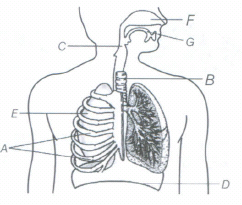
Observe the given diagram of human respiratory system. List the organs from (A) to (G).
2.
After we work hard or perform physical activity, we feel hungry. Explain why
3.
Why do we often sneeze when we inhale a lot of dust-laden air?
4.
List the similarities and differences between aerobic and anaerobic respiration
5.
Why does an athlete breathe faster and deeper than usual after finishing the race?
6.
The raw material for cellular respiration is
glucose
sucrose
fructose
starch
7.
Earthworms and frogs breathe through their skin because of which the skin of both the organisms is
moist and rough
dry and rough
dry and slimy
moist and slimy
8.
Yeast is used in wine and beer industries because it respires
aerobically producing oxygen
aerobically producing alcohol
anaerobically producing alcohol
anaerobically producing CO2
9.
During exhalation, the ribs
move outwards
move downwards
move upwards
do not move at all
10.
During heavy exercise, we get cramps in the legs due to the accumulation of
carbon dioxide
lactic acid
alcohol
water
11.
We take deep breathes after we hold on breath for the one minute.
12.
Living organism respire to get energy from food.
13.
Insects have spiracles on the lower surface of the body.
14.
The size of the chest cavity increases during inhalation.
15.
Plants carry out photosynthesis only during the day and respiration only at night.
16.
Explain cellular respiration.
17.
Certain small pores are present on the surface of plant through which gaseous exchange occurs. Identify these pores?
18.
In the experiment, where we exhale into lime water containing glass. What changes were observed by you?
19.
Our nostrils has hair and mucous. What is the need to have them in our nasal cavity?
20.
The cellular respiration process takes place in which cell organelle?
21.
It is not wise to sleep under a tree during night. Why?
22.
A food stall owner was preparing dough for making bhaturas. He added a pinch of yeast and sugar to the dough and left it in a warm place. After few hours, the dough had risen. There was a sour smell too.
(a) Why did the dough rise?
(b) Why did the dough smell sour?
(c) Why was sugar added to the dough?
(d) What would have happened if the dough was kept in the refrigerator, soon after it was prepared?
23.
Lungs are very..............organ
24.
Taking in of air rich in O2 inside the body is called _____
25.
................is an essential phenomenon for the survival of living organisms
26.
Exchange of gases in the leaves takes place with the help of...........
27.
Diaphragm forms the.............. of the chest cavity.
1.
The human respiratory system have following organs:
A- Ribs
B- Trachea
C- Pharynx
D - Diaphragm
E- Lungs
F- Nasal passage
G- Oral cavity
2.
When we work hard or perform physical activity (like running, swimming, cycling), we need more energy. To fulfil the energy requirement, we breathe faster. Fast breathing helps in supply of more oxygen to our cells. Due to this, rate of breakdown of food increases and more energy is released. The rapid breakdown of food makes us to feel more hungry.
3.
When we inhale dust-laden air, dirt-particles are captured within the nostrils. Sometimes, they get past the nostril hair in the nasal cavity and irritate the lining of the cavity, as a result, we sneeze. Sneezing expels these foreign particles from the inhaled air and a dust free, clean air enters in our body
4.
Differences between aerobic and anaerobic respiration are as follows
| Aerobic respiration | Anaerobic respiration |
| It uses oxygen | It takes place in the absence of oxygen |
| Glucose is completely broken down into Co2 and water along with release of high amount of energy | Glucose is broken into ethyl alcohol or lactic acid CO2 and energy produced is in low amount |
| It occurs in all living organisms like mammals | It occurs in lower organisms like yeast, fungi and bacteria |
| Glucose + O2 \(\rightarrow\) co2 + H2O2 + Energy | Glucose \(\rightarrow\) ethyl alcohol + Co2 + Energy |
Similarities between aerobic and anaerobic respiration are as follows
(i) Both break down the glucose.
(ii) Release of energy takes place in both.
(iii) CO2 is the common product in both.
5.
Our body needs energy for all activitie, while doing heavy exercises like running and there is a larger demand of energy to perform these activities. Hence, more oxygen is required to meet extra demand of energy. Therefore, an athlete breathes faster and deeper than usual after finishing the race
6.
(a)
glucose
7.
(d)
moist and slimy
8.
(c)
anaerobically producing alcohol
9.
Move downwards During exhalation the ribs moves downwards causing a decrease in area of chest cavity forcing the air out.
10.
Lactic acid It is produced during heavy exercise as sufficient oxygen is not available to muscles.
11.
(a)
12.
(a)
13.
(b)
14.
(a)
15.
(b)
16.
The process of braeak down of food in the cell with the release of energy is called cellular respiration
17.
Stomata are the tiny pores that are present on the surface of plant through which gaseous exchange occurs.
18.
When we exhale into lime water its colour changes, into slightly milky white because exhaled air contains CO2,
19.
Our nostrils possess hairs and mucous lining. These help in preventing dirt, dust and germs from entering our respiratory system.
20.
Cellular respiration takes place in the mitochondria of the cell
21.
During day, plants photosynthesise in the presence of sunlight and uses CO2 produced during respiration. During this process O2 is released as a byproduct and a balance between O2 and CO2 is maintained in the atmosphere. But in the night. plants do not photosynthesise. Plants are unable to use CO2 during night and produces CO2 and takes O2 during respiration. This leads to the increase in the proportion of CO2 in the air.
So, if one sleeps under a tree at night. he will have problems in breathing as the amount of CO2 in the air around will certainly be more than oxygen. Therefore, it is not advisable to sleep under trees during night because the person will suffer from suffocation and feel excess weight on chest.
22.
(a) The dough rises due to the release of carbon dioxide during anaerobic respiration by yeast cell.
(b) Yeast, during anaerobic respiration also produces alcohol which results in the sour smell of dough.
(c) Sugar is added into the dough, because it acts as a food for yeast. Yeast upon incomplete breakdown of sugar or food produces CO2, alcohol and energy (in less amount).
(d) If the dough is kept in the refrigerators after it was prepared, then dough will neither raise nor become sour. Yeast requires high temperature to grow, multiply and to respire. At low temperature, the yeast will not respire to produce the byproducts of anaerobic respiration.
23.
()
delicate
24.
()
inhalation
25.
()
Breathing
26.
()
Stomata
27.
()
Floor

7th Standard CBSE Syllabus & Materials
7th Standard CBSE
CBSE 7th Social Science Theme B - New Beginnings : Cities and States - New Sample Question Papers Study Material - QB365 Set A
NEW7th Standard CBSE
CBSE 7th Social Science Theme A - Climates of India - New Sample Question Papers Study Material - QB365 Set A
NEW7th Standard CBSE
CBSE 7th Social Science Theme A - Geographical Diversity of India - New Sample Question Papers Study Material - QB365 Set A
NEW7th Standard CBSE
CBSE 7th Science Earth, Moon and the Sun - New Sample Question Papers Study Material - QB365 Set A



CBSE 7th Standard CBSE Subjects
CBSE Standards




