
 100% FREE ACCESS
11th Standard CBSE Syllabus & Materials
11th Standard CBSE
CBSE 11th Economics PART-A - Presentation of Data - New Sample Question Papers Study Material - QB365 Set A
NEW11th Standard CBSE
CBSE 11th Economics PART-A - Organisation of Data - New Sample Question Papers Study Material - QB365 Set A
NEW11th Standard CBSE
CBSE 11th Economics PART-A - Collection of Data - New Sample Question Papers Study Material - QB365 Set A
NEW11th Standard CBSE
CBSE 11th Economics PART-A - Introduction to Economics and Statistics - New Sample Question Papers Study Material - QB365 Set A
NEW11th Standard CBSE
CBSE 11th Business Studies International Trade Sample Question Papers Study Material - QB365 Set A
NEW11th Standard CBSE
CBSE 11th Business Studies Evolution and Fundamentals of Business Sample Question Papers Study Material - QB365 Set A

Published on: 01/08/2018
Some of the important questions are prepared from this chapter Respiration in Plants.
Students, subscribe and get plenty of question paper with answer key. For subscription please click here.
Download CBSE Class 11th Standard CBSE Biology question papers, sample papers, important questions, and previous year solved papers in PDF format. Get free study materials, NCERT solutions, and exam preparation resources for Class 11th Standard CBSE Biology
Questions + Answers key
Take MCQ Biology Test
1.
What are the products formed by the splitting of fructose-1, 6-bisphosphate?
2.
When a substrate is being metabolised, why does not all the energy that is produced get released in one step? It is released in multiple steps. What is the advantage of stepwise release?
3.
Where is cytochrome-c located? What is its function?
4.
What are the main steps in aerobic respiration? Where does it take place?
5.
Name the inhibitor of oxidative phosphorylation
6.
What is the respiratory quotient when fats are used in respiration?
7.
Write two energy yielding reactions of glycolysis.
8.
Mention the step of citric acid cycle, which is not mediated by dehydrogeneous enzyme.
9.
At which step of respiration, hydrogen of NADH2 is used?
10.
Why oxygen is an ultimate acceptor of electrons in ETS?
11.
Pyruvic acid, the key end product of glycolysis has many metabolic fates.What does it form under aerobic condition?
12.
What are respiratory substrates? Name the most common respiratory substrate.
13.
What are the end products of alcoholic fermentation.
14.
Write the overall equation of respiration
15.
Name two openings in plants through which exchange of gases takes place?
16.
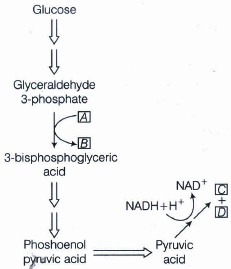
Study the following fiqure and label A, B, C and D pathway of anaerobic respiration in yeast.
17.
The energy yield in terms of ATP is higher in aerobic respiration than during anaerobic respiration. Why is there anaerobic respiration even in organisms that live in aerobic condition like human beings and angiosperms?
18.
What is Pentose Phosphate Pathway(PPP)? Where does it take place?
19.
What are the assumptions made during the calculation of net gain of ATP?
20.
Name the site(s) of pyruvate synthesis.Also, write the chemical reaction, wherein pyruvic acid dehydrogenase acts as a catalyst.
21.
Name the end products of aerobic and anaerobic fate of glycolysis.List two ways by which molecules of ATP are produced in glycolysis during aerobic respiration in a cell.
22.
What is the significance of step-wise release of energy in respiration?
23.
What is the significance of stepwise release of energy in respiration.
1.
3-phosphoglyceraldehyde and dihydroxyacetone phosphate.
2.
the stepwise release of energy have advantage to the cell. Because if all the energy from the glucose would be released at once then most of it would be lost in the form of light and heat. This energy is trapped in ATP is utilised in various energy-requiring processes of the organisms and for the synthesis of the other biomolecules in the cell.
3.
Cytochrome-c is attached to the outer surface of the inner membrane of mitochondria.
It acts as a mobile carrier for transfer of electrons between complex III and complex IV.
4.
The main steps in aerobic respiration are as follows
(i) Glycolytic breakdown of glucose into pyruvic acid.
(ii) Oxidative decarboxylation of pyruvic acid to acetyl Co-A(acetyl coenzyme-A)
(iii) Krebs' cycle.
(iv) Terminal oxidation and phosphorylation in respiratory chain.
It occurs inside the mitochondrial matrix.
5.
Oligomycin B and DCCD inhibit oxidative phosphorylation by blocking the proton pore of the ATP synthase.
6.
If the respiratory substrate is fat, then RQ of the respiring cells will be less than one because the volume of CO2 evolved is quite less in comparison to the volume of O2 being consumed.
7.
The conversion of BPGA to 3-phosphoglyceric acid(PGA), is an energy yielding process, this energy is trapped by the formation of an ATP. Another ATP is synthesised during the conversion of PEP to pyruvic acid.
8.
Conversion of oxaloacetic acid to citric acid is not mediated by dehydrogenase enzyme.
9.
The hydrogen atoms accepted by NADH2 during glycolysis are introduced to route I of ETS. In this route, 3 ATP molecules are produced.
10.
Oxygen is the ultimate acceptor of electrons in ETS because it is highly reactive and combines with protons to form metabolic water.
11.
It forms carbon dioxide and water, with the release of energy.
12.
The organic substances,which are catabolished in the living cells to release energy are called respiratory substrates.Though may foodstuff-carbohydrate, fat or protein may act as a respiratory substrate, the common respiratory substract is glucose.
13.
Ethyl alcohol and CO2 are the end products of alcoholic fermentation.
14.
C6H12O6 → 6O2 + 6H2O+Energy(ATP)
15.
The leaves exchange gases through pores called Stomata. Stomata are the small openings present on the inner surface of the leaves. Stomata can be opened and closed. During the night when no photosynthesis takes place, the plant breathes in oxygen and breathe out carbon dioxide through stomata.
16.
A = NAD+
B = NADH + H+
C = Ethyl alcohol
D = CO2
17.
(i) The anaerobic respiration occurs even in organisms that live in aerobic condition like human beings and angiosperms under conditions of oxygen scarcity that happens in the muscle tissue. Under intense use, muscles demand too much energy (ATP) and consume much more oxygen to produce that energy.
(ii) This high consumption leads to oxygen scarcity and the muscle cells begin to make lactic acid by anaerobic respiration trying to fulfill their energetic needs.
(iii) Similarly, yeast cells under deficient conditions carry out anaerobic respiration.
18.
It is an alternative method of aerobic respiration which occurs in cytoplasm of mature cells. This pathway accerents 60% of total respiration occurring in lower cells.
19.
The calculations of net gain of ATP can be made only on certain assumptions.
(i) There is a sequential, orderly pathway functioning with one substrate forming the next and with glycolysis, TCA cycle and ETS pathway following one after another.
(ii) The NADH synthesised in glycolysis is transferred into the mitochondria and undergoes oxidative phosphorylation.
(iii) None of the intermediates in the pathway are utilised to synthesise any other compound.
(iv) Only glucose is being respired, no other alternative substrates are entering in the pathway at any of the intermediary stages.
But this kind of assumptions are not really valid in a living system. All pathway work simultaneously and do not take place one after another. Substrates enter the pathways and are withdrawn from it as and when needed; enzymatic rates are controlled by multiple means. In overall steps, there is a net gain of 36 ATP molecules during aerobic respiration of one molecule of glucose.
20.
Pyruvate synthesis takes place in cytoplasm by the process of glycolysis.
The chemical reaction,wherein pyruvic acid dehydrogenase acts as a catalyst is as follows
The reactions catalysed by pyruvic dehydrogenase require the participation of several coenzymes, including NAD+ and Co-A
Pyruvic acid + Co-A + NAD+ \(\underrightarrow { { Mg }^{ 2+ } } \) Acetyl Co-A + NADH + H+
Pyurvate dehydrogenase
21.
Pyruvic acid \(\underrightarrow { { O }_{ 2 } } \) CO2+water
End product of anaerobic glycolysis are CO2 and ethanol or lactic cid.
Molecules of ATP are [produced in two ways in glycolysis by
(i) direct transfer of phosphate to ADP.
(ii) oxidation of NADH produced during glycolysis to NAD+
22.
During oxidation within a cell, all the energy contained in respiratory substrates is not released free in a single step. It is release in a series of slow stepwise reaction controlled by enzymes and it is trapped as chemical energy in the form of ATP. This ATP is stored for the later utilistion wherever, required. Hence, ATP acts as the energy currency of cell.
The energy stored in ATP can be utilised following
(i) In various energy requiring processess of organism
(ii) The carbon skelton produced during respiration is used as precursors for the synthesis of other molecules.
23.
The process of aerobic respiration is divided into four phases – glycolysis, TCA cycle, ETS, and oxidative phosphorylation. It is generally assumed that the process of respiration and production of ATP in each phase takes place in a step-wise manner. The product of one pathway forms the substrate of the other pathway. Various molecules produced during respiration are involved in other biochemical processes. The respiratory substrates enter and withdraw from pathway on necessity. ATP gets utilized wherever required and enzymatic rates are generally controlled. Thus, the step-wise release of energy makes the system more efficient in extracting and storing energy.

11th Standard CBSE Syllabus & Materials
11th Standard CBSE
CBSE 11th Business Studies Forms of Business Organisation Sample Question Papers Study Material - QB365 Set A
NEW11th Standard CBSE
CBSE 11th Business Studies Business, Trade and Commerce Sample Question Papers Study Material - QB365 Set A
NEW11th Standard CBSE
CBSE 11th Physics Waves Sample Question Papers Study Material - QB365 Set A
NEW11th Standard CBSE
CBSE 11th Physics Kinetic Theory Sample Question Papers Study Material - QB365 Set A



CBSE 11th Standard CBSE Subjects
CBSE Standards









