
 100% FREE ACCESS
7th Standard CBSE Syllabus & Materials
7th Standard CBSE
CBSE 7th Social Science Theme E - Understanding Market - New Sample Question Papers Study Material - QB365 Set A
NEW7th Standard CBSE
CBSE 7th Social Science Theme E - From Barter to Money - New Sample Question Papers Study Material - QB365 Set A
NEW7th Standard CBSE
CBSE 7th Social Science Theme D - The Constitution of India- An Introduction - New Sample Question Papers Study Material - QB365 Set A
NEW7th Standard CBSE
CBSE 7th Social Science Theme D - From the Rulers to the Ruled : Types of Governments - New Sample Question Papers Study Material - QB365 Set A
NEW7th Standard CBSE
CBSE 7th Social Science Theme B - The Age of Reorganisation - New Sample Question Papers Study Material - QB365 Set A
NEW7th Standard CBSE
CBSE 7th Social Science Theme B - The Rise of Empires - New Sample Question Papers Study Material - QB365 Set A

Published on: 02/03/2019
Revision Test On Geography
Download CBSE Class 7th Standard CBSE Social Science question papers, sample papers, important questions, and previous year solved papers in PDF format. Get free study materials, NCERT solutions, and exam preparation resources for Class 7th Standard CBSE Social Science
Questions + Answers key
Take MCQ Social Science Test
1.
Read the given below extract and answer the questions that follow
Lake :A Source of Livelihood (A case study)
Binod is a fisherman living in the Matwali Maun village of Bihar. He is a happy man today. With the efforts of the fellow fishermen - Ravindar, Kishore, Rajiv and others, he cleaned the Maun or the ox-bow lake to cultivate different varieties of fish. The local weed ( vallineria , hydrilla) that grows in the lake is the food of the fish.
The land around the lake is fertile. He sows crops such as paddy, maize and pulses in these fields. The buffalo is used to plough the land. The community is satisfied. There is enough fish catch from the river - enough fish to eat and enough fish to sell in the market. They have even begun supply to the neighboring town.
For how long fish cultivation do not face any threat?
2.
Differences between warm ocean current and cold ocean current
3.
What are the four means of transport?
4.
Name three types of rocks
5.
What is the cause of high temperature in cities as compared to that of villages?
6.
Salima was excited about the summer camp she was attending. She had gone to visit Manali in Himachal Pradesh along with her classmates. She recalled how surprised she was to see the changes in the landform and natural vegetation as the bus climbed higher and higher.
The deep jungles of the foothills comprising sal and teak slowly disappeared. She could see tall trees with thin pointed leaves and cone shaped canopies on the mountain slopes. She learnt that those were coniferous tree. She noticed blooms of bright flowers on tall trees. These were the rhododendrons. From Manali as she was travelling up to Rohtang pass she saw that the land was covered with short grass and snow in some places.
Read the above passage and answer the following question.
What is the reason of Salima's excitement?
7.
Which are the two major components of biotic environment?
8.
In the crossword table given below, some words are hidden. They are all about vegetation and wildlife. Find them.

9.
Differentiate between volcano and earthquake
10.
What are sand dunes?
11.
Bromeliads are special plants that store water in their
Stem
Leaves
Root
None of these
12.
Yakis found in :
Sahara
Africa
Oasis
Ladakh
13.
Which day of the year is celebrated as water day?
22 January
15 March
15 August
22 March
14.
Life support system among the following is :
Transportation
Music system
Environment
Both (a) and (b)
15.
Generally the warm ocean currents originate near
poles
equator
None of these
16.
Gold, petroleum and coal are examples of
rocks
minerals
fossils
17.
Which vehicle does not pollute the environment?
Cycle
Bus
Aeroplane
18.
Which of the following domains is held up by the gravitational forces?
Hydrosphere
Lithosphere
Atmosphere
Biosphere
19.
Which is not a component of human environment?
Land
Religion
Community
20.
As we go up the layers of the atmosphere, the pressure
increases
decreases
remains the same
21.
Which river drains the Canadian prairies?
Mississippi
Saskatchewan
Orange and Limpopo
None of these
22.
Steppe grassland is found in
South Africa
Australia
Central Asia
23.
Mushroom rocks are found in
deserts
river valleys
glaciers
24.
Settlement flourished and civilisations develop near___________ valleys.
25.
Lithosphere is made up of __________and __________and is covered by a thin layer of soil.
26.
________ means of transport thus saves time and energy.
27.
The_________________ inside the Earth moves in a circular manner.
28.
Explain the process of water cycle.
29.
Write a short note on the flora and fauna found in the Ladakh desert.
30.
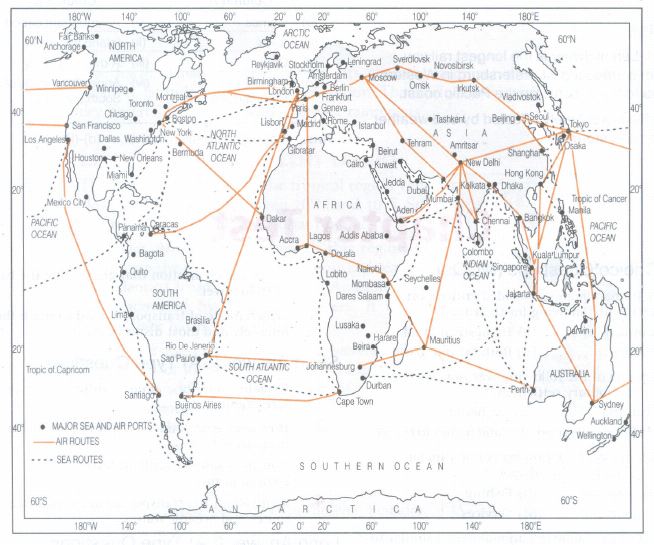
From the given below map, find out important sea ports and airports.
31.
What does lithosphere provide us?
32.
What are the reasons behind evolution of settlements near the river valleys?
33.
What is the nature of hot air?
34.
Describe the life of people of the rainforests.
35.
Which occupation is followed by the people in Velds?
36.
How have the settlements changed over a period of time?
37.
Describe two types of grasslands found on the globe.
38.
How have human beings adapted to the environment to fulfil their needs?
39.
Briefly write about flora and fauna of Velds.
40.
Mention which mode of communication you will prefer most in the following situations-
(a) Your grandfather has suddenly fallen ill. How will you inform the doctor?
(b) Your mother wants to sell the old house. How will she spread this news?
(c) You are going to attend the marriage of your cousin for which you will be absent from the school for the next two days. How will you inform the teacher?
(d) Your friend has moved out with his/her family to New York. How will you keep in touch on a daily basis?
41.
Make a collage to show places of attractions in India. You can divide the class in different groups to show attractions based on mountain landscapes, coastal beaches, wildlife sanctuaries and places of historical importance?
42.
What are Lithospheric plates? Why do they move slowly?
43.
Find out the names of a few rivers of the world that form a delta.
1.
As long as the pollutants from nearby towns do not find their way into the lake waters, the fish cultivation will not face any threat.
2.
| Warm ocean current | Cold ocean current |
|
It originates near the equator and move |
It carries water from polar or higher latitudes to tropical or lower latitudes. |
| It brings warm temperature over land surface. |
The Labrador Ocean current is cold current |
| The Gulf Stream is a warm current | It brings cold temperature over land surface |
3.
Roadways, railways, waterways and airways are the four means of transport.
4.
The three major types of rocks are igneous rocks, sedimentary rocks and metamorphic rocks
5.
Temperature in cities is much higher than that of villages. The concrete and metals in buildings and
the asphalt of roads get heated up during the day. This heat is released during the night. Also, the crowded high rise buildings of the cities trap the warm air and thus raise the temperature of the cities.
6.
Salima was excited about the summer camp.
7.
Plants and animals are the rwo major components of biotic environment.
8.
Horizontally
Bamboo,Lichen, Seal, Mosses, Tulsi, Ebony, Tundra, Llanos, Whale, Hen, Fowl, Grass, prairie, Goat, Zebra, Pampas, Flora, Pine, Chir, Taiga, Fir, Deciduous, Horse
Vertically
Shrub, Cactus, Down, Ox, Fauna, Pig, Lion
9.
Volcano Molten material erupts suddenly from the vent of Earth's crust.
Earthquake Movements of lithospheric plates causes vibration and that vibration is called earthquake.
10.
Sand dunes are those hill-like structures which are formed by the deposition of blowing wind in deserts.
11.
(b)
Leaves
12.
(d)
Ladakh
13.
(d)
22 March
14.
(c)
Environment
15.
(b)
equator
16.
(b)
minerals
17.
(a)
Cycle
18.
(c)
Atmosphere
19.
(a)
Land
20.
(b)
decreases
21.
(b)
Saskatchewan
22.
(c)
Central Asia
23.
(a)
deserts
24.
()
river
25.
()
rock, minerals
26.
()
Modern
27.
()
molten magma
28.
When water evaporates from land and different water bodies, it becomes water vapour. As the air gets warmer, its capacity to hold the water vapour increases. When the water vapour rises, it starts cooling. The water vapour condenses causing formation of droplets of water. When these droplets of water become too heavy to float in air, then they come down as precipitation in the form of either dew, rain, snow, sleet or hail.
29.
Due to high aridity, the vegetation is sparse. There are scanty patches of grasses and shrubs for animals to graze. Groves of willows and .poplars are seen in the valleys.
During the summers, fruit trees such as apples, apricots and walnuts bloom. Several species of birds are sighted in Ladakh. Robins, redstarts, Tibetan snowcock, raven and hoopoe are common. Some of these are migratory birds. The animals of Ladakh are wild goats, wild sheep, yak and special kinds of dogs. The animals are reared to provide for the milk, meat and hides. Yak's milk is used to make cheese and butter. The hair of the sheep and goat is used to make woollens.
30.
Important sea ports are - Los Angles, Quito, Lima, Santiago, Rio de Janerio, Panama, Miami, Houston, New Orleans,Dakar,Boston, Douala, Lobito, Cape Town,Perth, Colombo, Chennai, Kolkata, Mumbai, Jakarta, Bangkok, Dhaka, Tokyo,Seoul, Shanghai, Dubai, etc.
Important Airports are - Vancouver, Mexico city, Nairobi, Paris, Moscow, Beijing, New Delhi, Hong Kong, Sydney, NewYork,tehram, Mauritius, Singapore, London, Buenos Airies, etc.
31.
()
Forests, grasslands for grazing, land for agriculture and human settlement are provided by lithosphere
32.
()
Settlement grew near the river valleys because of availability of water and fertile land.
33.
()
When air is heated, it expands, becomes lighter and goes up.
34.
(i) People grow most of their food in small areas after clearing some trees in the forest. Work is distributed among men and women. Men hunt and fish along the rivers and women take care of the crops.
(ii) They mainly grow tapioca, pineapple and sweet potato. Cash crops like coffee, maize and cocoa are also grown. They practise "slash and burn agriculture"
(iii) As hunting and fishing are uncertain it is the women who keep their families alive by feeding them the vegetables they grow.
(iv) The staple food is manioc, also known as cassava, that grows under the ground like the potato. They also eat queen ants and egg sacs
(v) The rainforests provide a lot of wood for the houses. Some families live in thatched houses shaped like beehives. There are other large apartments-like houses called Maloca with a steeply slanting roof.
35.
(i) Sheep rearing is the most important occupation of the people. Sheep is bred to obtain wool which has given rise to the wool industry in the Velds. Merino sheep is a popular species and their wool is very warm.
(ii) Dairy farming is the next important occupation. Cattle are reared in the warmer and wetter regions and the dairy products like butter, cheese are produced for both domestic supply and also for export.
(iii) The Velds have rich reserve of minerals. Iron and steel industry has developed where coal and iron are present. Gold and diamond mining are major occupations of people of this region.
(iv) Johannesburg is known for being the gold capital of the world. Kimberley is famous for its diamond mines.
(v) Mining of diamond and gold in South Africa led to the establishment of trade ties with Britain and gradually South Africa became a British Colony.
(vi) This mineral rich area has a well-developed network of transport.
36.
(i) In the early times, human beings lived on trees and in caves.
(ii) When they started to grow crops it became necessary to have a permanent home.
(iii) The settlements grew near the river valleys as water was available and land was fertile.
(iv) Human settlements became larger with the development of trade, commerce and manufacturing. (v) Settlement flourished and civilisations developed near river valleys
37.
(i) Tropical grasslands:
These grasslands occur on either side of the equator and extend till the tropics. This vegetation grows in the areas of moderate to low amount of rainfall. The grass can grow about 3 to 4 metres in height. Savannah grasslands of Africa are of this type. Common animals found in the tropical grasslands are elephants, zebras, giraffes, deer and leopards.
(ii) Temperate grasslands:
These grasslands are found in the mid-latitudinal zones and in the interior parts of the continents. Usually, grass here is short and nutritious. Wild buffaloes, bisons, antilopes are common in the temperate region.
38.
From the early times human beings have been interacting with the environment and they modified it according to their needs.
Early humans adapted themselves to the natural surroundings. They led a simple life and fulfilled their needs from the nature around them. But their needs kept on increasing. They became varied also. For fulfilling their needs, human beings learnt new ways to change the environment. They learnt to grow crops, domesticate animals and led a settled
life. The wheel was invented. Surplus food was produced. Barter system emerged. Transportation became faster, trade started, commerce developed and information revolution made communication easier and speedy across the world. Industrial revolution made possible and large scale production started.
In the present environment, mind-boggling variety of clothes, games, food items are purchased.
In this way human beings adapted to the environment in order to fulfil their needs
39.
The vegetation cover is sparse, with more of grasses.
Red grass grows in bush velds.
In the high velds acacia and maroola are seen to be growing.
The animals of the velds are primarily lions, leopards, cheetah and kudu.
40.
(a) Through telephone
(b) By advertising in the newspaper, or on the local TV news channel
(c) Sending a leave application to the teacher by post, or by hand personally.
(d) Through e-mail using the Internet.
41.
Students can collect photographs of different mountain landscapes, coastal beaches, wildlife sanctuaries and places of historical importance such as Taj Mahal, Red Fort, Qutub Minar, etc., from different magazines and newspapers.
42.
The Lithosphere is broken into a number of plates known as the Lithospheric plates. They move very slowly because the molten magma inside the earth moves in a circular way.
43.
List of some rivers deltas:
(i) Ganga - Brahmaputra Delta
(ii) Indus River Delta
(iii) Mississippi River Delta
(iv) Nile Delta
(v) Volga Delta
(vi) Yangtze River Delta

7th Standard CBSE Syllabus & Materials
7th Standard CBSE
CBSE 7th Social Science Theme B - New Beginnings : Cities and States - New Sample Question Papers Study Material - QB365 Set A
NEW7th Standard CBSE
CBSE 7th Social Science Theme A - Climates of India - New Sample Question Papers Study Material - QB365 Set A
NEW7th Standard CBSE
CBSE 7th Social Science Theme A - Geographical Diversity of India - New Sample Question Papers Study Material - QB365 Set A
NEW7th Standard CBSE
CBSE 7th Science Earth, Moon and the Sun - New Sample Question Papers Study Material - QB365 Set A



CBSE 7th Standard CBSE Subjects
CBSE Standards




