
 100% FREE ACCESS
10th Standard CBSE Syllabus & Materials
10th Standard CBSE
CBSE 10th Social Science ECO - Globalisation and the Indian Economy - New Model Questions Papers Study Material - QB365 Set A
NEW10th Standard CBSE
CBSE 10th Social Science ECO - Money and Credit - New Model Questions Papers Study Material - QB365 Set A
NEW10th Standard CBSE
CBSE 10th Social Science ECO - Sectors of the Indian Economy - New Model Questions Papers Study Material - QB365 Set A
NEW10th Standard CBSE
CBSE 10th Social Science ECO - Development - New Model Questions Papers Study Material - QB365 Set A
NEW10th Standard CBSE
CBSE 10th Social Science PS - Outcomes of Democracy - New Model Questions Papers Study Material - QB365 Set A
NEW10th Standard CBSE
CBSE 10th Social Science PS - Gender, Religion and Caste - New Model Questions Papers Study Material - QB365 Set A

Published on: 01/11/2019
s1
Download CBSE Class 10th Standard CBSE Science question papers, sample papers, important questions, and previous year solved papers in PDF format. Get free study materials, NCERT solutions, and exam preparation resources for Class 10th Standard CBSE Science
Questions + Answers key
Take MCQ Science Test
1.
Define the terms 'nutrients' and 'nutrients'.List two differences between 'Holozoic nutrition' and 'Saprophytic nutrition'.Give two examples of each of these two types of nutrition.
2.
Explain the process of 'photosynthesis' in plants.List four factors which influence this process and describe how each of them affects the rate of the photosynthesis process.
3.
(a)Draw the respiratory system of human beings.
(b)Label the following on the diagram drawn: Larynx, Trachea, Primary Bronchus, Lungs
(c)What happens to the carbon dioxide which collects in human tissues?
4.
Describe the alimentary canal of man.
5.
Describe double circulation in human beings. Why is it necessary?
6.
(a) List any two characteristics of a good fuel.
(b) What are non-renewable resources of energy? Give two examples of such resources.
7.
Every one of us can do something to reduce our consumption of various natural resources. List four such activities based on 3-R approach.
8.
We often observe domestic waste decomposing in the bylanes of residential colonies. Suggest ways to make people realise that the improper disposal of waste is harmful to the environment.
9.
List two measures that you would suggest for the better management of water resources.
10.
"We need to manage our resources". List two reasons to justify this statement.
11.
List two environment-friendly practices or habits which need to be followed by every member of a family/community. Explain how these practices will support the "save the Environment" mission.
12.
Our food grains such as wheat and rice, the vegetables and fruits and even meat are found to contain varying amounts of pesticide residues. State the reason to explain how and why it happens?
13.
Water is a valuable resource. List two ways that you would suggest every family member to save this resource.
14.
List two advantages associated with water harvesting at the community level.
15.
List four measures that can be taken to conserve forests.
16.
(a) Why do we need to manage our resource carefully?
(b) Why management of natural resources requires a long-term perspective?
17.
What is meant by "sustainable management"? Why is reuse considered better than recycling?
18.
List four advantages of properly managed watershed management.
19.
Which of the two is a better option, (i) to collect rainwater in ponds or artificial lakes, or (ii) to it recharge groundwater by water harvesting ? List two advantages of the option to justify your answer.
20.
How did 'Chipko Andolan' ultimately benefit the local people? Describe briefly.
21.
Why are forests considered "biodiversity hot spots"? List two ways in which an individual can effectively contribute to the management of forests and wildlife.
22.
"Reuse is better than recycling of materials". Give reason to justify this statement.
23.
State the meaning of "sustainable management'. Reduce is better than recycling. How?
24.
List the products of combustion of fossil fuels. What are their adverse effects on the environment?
25.
List three problems which arise due to construction of big dams. suggest a solution for these problems.
26.
"Burning fossil fuels is a cause of global warming". Justify this statement.
27.
List four advantages of water stored in the ground.
28.
What is an equitable distribution of resources in a society and why is it necessary? State any two factors which work against an equitable distribution of resources.
29.
Define:
(1) Biomass
(2) Anaerobic degradation.
30.
Give two examples each of the following:
(1) Renewable sources of energy
(2) Non-renewable sources of energy.
31.
List any four characteristics of a good fuel.
32.
List any four disadvantages of using fossil fuels for the production of energy.
33.
What are non-renewable resources of energy? Give two examples of such resources.
34.
Name any four categories of people who depend on the forest resources, mentioning major needs of each category.
35.
State any four personal choices you would like to make to reduce energy consumption without affecting the quality of life or work explaining how each one of them would help you to do so.
36.
What is meant by sustainable management. The environmentists are insisting upon "sustainable natural resource management". State its four advantages.
37.
What is a dam? Write two main advantages and two ill-effects of construction a big dam.
38.
What is meant by exploitation of resources with short-term aims? List its four advantages.
39.
List any two causes of our failure to sustain availability of underground water.
40.
What is wildlife? How is wildlife important for us?
41.
How do advantages of exploiting natural resources with short-term aims differ from the advantages of managing our resources with a long-term perspective?
42.
An environmentalist on visit to your school suggested the use of three R's to save the environment. Explain what he meant by three R's and how you would follow his advice at home.
43.
Suggest any four changes that you would like to incorporate in the life style of students of your age to move towards a sustainable use of available resources.
44.
What is 'Chipko Movement'? Why should we conserve forest?
45.
List any four advantages of water harvesting.
46.
Why must we conserve our forests? List any two cause for deforestation to take place.
47.
What is water harvesting? Mention any two water harvesting structures.
48.
State two reasons each of conserving (a) forest and (b) wildlife.
49.
Suggest three ways to maintain a balance between environment and development to survive.
50.
What is water harvesting? Mention any two water harvesting structures.
51.
State two reasons each of conserving (a) forest and (b) wildlife.
52.
Suggest a few measures for controlling carbon dioxide levels in the atmosphere.
53.
Why do you think there should be an equitable distribution of resources? What forces would be working against an equitable distribution of our resources?
54.
Though your uncle has two cars, his son who is your classmate comes with you in school bus. What character of uncle would you appreciate?
55.
Point out two differences between an artery and vein.
56.
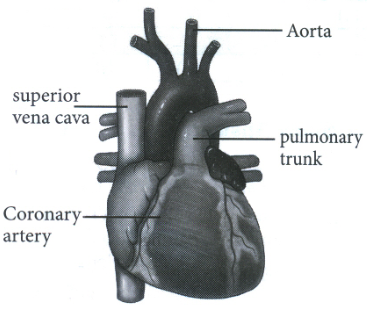
Draw the human heart and label the following on it:
(i)Aorta,
(ii)Coronary,
(iii)pulmonary trunk and
(iv)superior vena cava.
57.
List two vital functions of the human kidney.Name the procedure used in the working of artificial kidney.
58.
Write one function of each of the following components of the transport system in human beings:
(a) Blood vessels
(b) Blood platelets
(c) Lymph
(d) Heart
59.
Why is transpiration important for plants?
60.
Why does absorption of digested food occur mainly in the small intestine?
61.
Differentiate between an artery and vein.
62.
Name the following:
(i)The process in plants that links light energy with chemical energy
(ii)Organisms that can prepare their own food
(iii)The cell organelle where photosynthesis occurs
(iv)Cells that surround a stomatal pore
(v)Organisms that cannot prepare their own food
(vi)An enzyme secreted from gastric glands in stomach that acts on proteins.
63.
What do the following transport?
(a)Xylem
(b)Phloem
(c)Pulmonary vein
(d)Pulmonary artery
64.
Given below are a few statements related to biodiversity. Pick those that correctly describe the concept of biodiversity
(i) Biodiversity refers to the different species of flora and fauna present in an area
(ii) Biodiversity refers to only the flora of a given area
(iii) Biodiversity is greater in a forest
(iv) Biodiversity refers to the total number of individuals of a particular species living in an area
(i) and (ii)
(ii) and (iv)
(i) and (iii)
(ii) and (iii)
65.
From the list given below pick the item that is not a natural resource
Soil
Water
Electricity
Air
66.
Tiny pores present on the surface of the leaf are called
Stomata
Guard cells
Chloroplast
None of these
67.
Complete digestion of carbohydrates, proteins and fats takes place in
Stomach
Large intestine
Small intestine
Villi
68.
Deoxygenated blood enters the heart through
Right ventricle
Right atrium
Light ventricle
Left atrium
69.
How 'respiration' different from 'breathing'? Explain the processes of 'aerobic' respiration and 'anaerobic' respiration.
70.
Name the constituents of blood.Why white blood corpuscles are called 'soldiers of the body'?
71.
What is 'translocation'? Why is it essential for plants?Where in plants are the following synthesized:
(i)Sugar (ii)Hormones
72.
Give reasons for the following:
(i)The glottis is guarded by epiglottis
(ii)The lung alveoli are covered with blood capillaries.
(iii)The wall of trachea is supported by cartilage rings.
73.
Write the functions of the following in the digestive process:
(i)Bile
(ii)Bicarbonate secreted by the duodenum
(iii)Pancreatic amylase
74.
How are oxygen and carbon dioxide transported in human beings? How are lungs designed to maximize the area for exchange of gases?
75.
Why is Government of India imposing a ban on the use of polythene bags? Suggest two alternatives to these bags and explain how this ban is likely to improve the environment.
76.
Explain giving example where active involvement of local people lead to efficient management of forest.
77.
Why are the Arabari forests of Bengal known to be a good example of conserved forest?
78.
What is the importance of forest as a resource?
79.
Suggest a few useful ways of utilising waste water.
1.
Nutrition can be defined as the process of acquiring source of energy from the outside to the inside of the body. Nutrients are the different sources of energy acquired by living organisms by the process of nutrition.
| Holozoic nutrition | Saprophytic nutrition |
|---|---|
| 1.It is the process in which living organisms take up complex. |
1.In this type of nutrition, the organisms obtain their nutrients by digesting dead and decaying organic matter. |
| 2.A specialised digestive system is involved. Examples: human beings, cow |
2.The organisms lack specialised digestive system and produce enzymes, which digest the organic matter outside the cell and the digested nutrients are then absorbed into the cell. Examples : Some bacteria and fungi. |
2.
Photosynthesis is the process by which plant cells prepare food (carbohydrates) from inorganic raw materials such as carbon dioxide and water in presence of sunlight and chlorophyll.
\({ 6CO }_{ 2 }+{ 6H }_{ 2 }O\xrightarrow [ Chlorophyll ]{ Sunlight } { C }_{ 6 }{ H }_{ 12 }{ O }_{ 6 }+{ 6O }_{ 2 }\)
The process of photosynthesis takes place in two phases:
Light reaction - It requires light which is absorbed by chlorophyll molecules to split water molecules into hydrogen and oxygen. ATP and NADPH2 are produced during this phase and it occurs in the thylakoid membrane of the chloroplasts.
Dark reaction - It does not require light energy and it occurs in the stroma of chloroplasts, In this phase, the ATP and NADPH2 formed during light reaction are utilised and CO2 is reduced to form carbohydrates.
The four factors affecting the rate of photosynthesis are:
(i) Sunlight - Sunlight provides the energy required for the preparation of food by plants. In the absence of sunlight, photosynthesis cannot take place.
(ii) Carbon dioxide - Carbon dioxide acts as the substrate for photosynthesis. During this process, carbon dioxide and water are converted into carbohydrates.
(iii) Water - During photosynthesis, water is photolysed into oxygen and hydrogen and it provides the energy for photosynthesis.
(iv) Chlorophyll - Chlorophyll is the green pigment present in the leaves which absorbs sunlight
3.
(a) and (b)
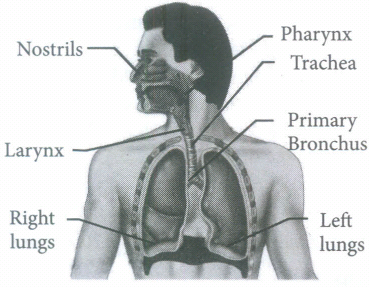
(c) The carbon dioxide which gets collected in the human tissues dissolves in the blood and is transported back to the lungs to be expelled out.
4.
The alimentary canal is nearly 9 m long. It includes -
1. Mouth and Buccal Cavity: It is the upper most opening of human digestive system which gives passage if for ingestion of food. Buccal cavity takes in the food cuts the food into small pieces and chews them to make it soft or easy swallowing. Buccal cavity also has three pairs of salivary glands. These glands secrete saliva
which contains water, salts, mucin and an enzyme ptyalin. Ptyalin is salivary amylase which splits starch and glycogen into maltose.
2. Pharynx: It acts as a passage for the food from buccal cavity to oesophagus.
3. Oesophagus: It is a long and tubular structure which pushes the food rhythmically forward.
4. Stomach: It is a large organ which expands when food enters it. It serves four functions:
(i) Storage of food - Carbohydrates gets digested till the salivary enzyme ptyalin is destroyed by HCI, secreted in the stomach.
(ii) Churning of food - The stomach wall produces muscular contraction, for the food to get churned and to mix it thoroughly with gastric juice.
(iii) Partial digestion - There are three types of gastric juice in stomach namely HCI, protein digesting enzyme (pepsin) and mucus.
(iv) Exit of food - The stomach releases food into the small intestine in a controlled and regulated manner.
Functions of the Gastric Juices
(i) HCI - Makes the tnedium acidic, kills the germs present in the food.
(ii) Pepsin - Acts in acidic medium, breaks proteins into peptone.
(iii) Mucus - Protects the inner lining of the stomach from the action of the acid under normal conditions.
(iv) Gastric juice - Also contains some gastric lipase which partially breaks down lipids.
(v) Regulation of flow of food - Stomach regulates the flow of partially digested food into the small intestine.
5. Small intestine: It is the longest part of digestive system. It is a narrow tube divided into three parts
(i) duodenum
(ii) jejunum and
(iii) ileum. It is the site of the complete digestion of proteins, carbohydrate and fats. Duodenum receives the secretion of bile from bile duct and pancreatic juice from pancreatic duct.
Bile juice
(i) It is secreted by liver and stored temporarily in the gall bladder.
(ii) It has bile pigments and bile salts.
(iii) It has no enzymes and thus has no chemical action on food, but breaks down the fat molecules into small globules.
(iv) This process is called emulsification of fats. Pancreatic juice
(i) It includes pancreatic amylase which breaks down starch, pancreatic lipase which breakdown lipids and trypsin for digesting proteins.
(ii) The secretions of pancreatic duct make the medium alkaline, which is favourable for the action of pancreatic enzymes.
Pancreas secretes hormones insulin and glucagons. The walls of small intestine contains glands which secrete intestinal juice called succus entericus which helps in digesting protein A into amino acids, carbohydrates into glucose, fats into fatty acids and glycerol. The digested food is taken up by the walls of the intestine which has numerous fingers like projection called villi. Villi are richly supplied with blood vessels which the absorbed food to obtain energy. The presence of villi and
blood capillaries increases the capacity of absorption by the wall of intestine
6. Large intestine: It includes three parts namely caecum, colon and rectum. It is shorter but wider than small intestine. It secretes mucus for lubrication. The undigested food is collected as faeces egested out through anus which is regulated by anal sphincter.
5.
During double circulation in human beings, blood passes the through heart twice for completing one cycle of circulation.
The double circulation includes the following processes
(i) Pulmonary circulation In this circulation, the deoxygenated blood is pushed by right ventricle to the lungs for oxygenation through pulmonary artery. This oxygenated blood is then brought back to the left atrium of the heart through pulmonary veins.
(ii) Systemic circulation In this circulation, oxygenated blood brought to left atrium goes to the left ventricle. It is then passed on to different body parts of body through aorta.
Such separation allows a highly efficient supply of oxygen to the body. This is usefull in animals that have high energy needs, such as birds and mammals, which constantly, use energy to maintain their body temperature.
6.
(a) Characteristics of a good fuel.
(1) It should have a high calorific value.
(2) it should burn without giving out any smoke or harmful gasses.
(3) Its ignition temperature should neither be too low nor too high.
(4) After burning it shuls not leave much ash behind.
(b) Those sources of energy which have accumulated in nature over a very-very long time and cannot be quickly replaced when exhausted, are called non-renewable sources of energy.
Example: Fossil fuels and nuclear fuels are non-renewable sources of energy.
7.
(1) We can reduce the use of LPG by making use of solar cooker for cooking food.
(2) We can reduce the wastage of water by repairing the leakage in taps.
(3) We should collect all the discarded household items like newspapers, broken plastic items, glass bottles etc. and send them to the respective industries for recycling to make fresh paper, plastic and glass objects.
(4) We can drink soft cold drinks available in the glass bottles instead f pearipet or metal containers as these glass bottles can be refilled and thus reused again.
8.
(1) When the domestic waste is decomposed by the action of micro-organisms then it becomes the breeding place of flies and mosquitoes. Flies and mosquitoes are the carrier and vector of many dangerous diseases. So some posters related to the spread of such diseases can be pasted on the walls in public places on the walls in public places to create awareness.
(2) There should be a strict fine imposed by the sanitary officer from the families which throw their domestic wastes on the roads.
9.
(i) Rainwater harvesting-it means rain water should not be allowed flow into the drains but make it percolate into the soil more efficiently.
(ii) Recycling of water used in bathrooms and kitchens should be encouraged.
(iii) Construction of dams.
10.
(i) The resources of the earth are limited.
(ii) The proper management can ensure equitable distribution of natural resources so that all the people can benefit from the development of these resources.
11.
(1) disposal of wastes after separating them into biodegradable and non-biodegradable waste material.
(2) Use of unleaded petrol and alternate sources of energy, keeping the car engines properly tuned and services and types inflated to the right pressure so that the vehicle runs smoothly.
12.
Pesticides are poisonous chemical substances which are sprayed over crop plants to protect them from pests and diseases. These pesticides mix up with soil and water and are then absorbed by growing plants along with water and other minerals. Thus pesticides level (plant level) and in the process of transfer of food through food chains these harmful chemicals get concentrated at each trophic level. These chemicals are non-biodegradable. So they get accumulated at each trophic level. Pesticides present in wheat grains, fruits vegetable and meat cannot always be removed by washing. etc.
13.
(1) Leakage of taps should be checked and repaired.
(2) Rinsed water of washed clothes can be reused for watering the plants or for cleaning the floor etc.
14.
(1) Water harvesting improves the quality of ground water thereby improving vegetation in and around the area. It also prevents soil erosion.
(2) Water harvesting in rural areas not only increases the agricultural production and income of the farmers but also makes less severe the effect of droughts and floods, and increases the life of downstream dams and reservoirs.
15.
(1) By silviculture-It means reforesting those lands from where large number of trees have been cut in a planned way.
(2) By taking the help of the local people in conserving the forests, e.g., sal forests of Arabari forest range of West Bengal were conserved with the help of the local people by the Forest Department of that state.
(3) Encouraging the people not to overuse the materials obtained from the forests, e.g., timber.
(4) Indiscriminate felling of trees for commercial gains should be stopped.
(5) Overgrazing in forests should be discouraged and forest fires should be prevented.
16.
We need to manage our natural resources because of the following reasons:
The resources of the earth are limited. as the human population is increasing rapidly, the demand for resources increases day by day. The proper management can ensure that these last for the generations to come.
The proper management of natural resources takes into consideration a long-term perspective so that these natural resources are used judiciously at present and their exploitation to the hilt for short term gains is prevented. This is essential to meet their future needs and demands.
17.
The development and management of resources in such a way which meets the current basic human needs and also preserves the resources for the needs of future generations is called sustainable management.
The process of 'reuse' is considered better than the process of 'recycling' because recycling requires the use of a large amount of energy and money whereas no energy is required for reusing materials.
18.
(i) Watershed management emphasizes scientific soil and water conservation in order to increase the biomass production. It strictly maintains the water quality.|
(ii) Watershed management develops primary resources of land and water, to produce secondary resources of plants and animals for use in a manner which will not cause ecological imbalance.
(iii) watershed management increases the production and income of the watershed community.
(iv) It mitigates droughts and floods and increases the life of the downstream dam and reservoirs.
19.
To allow rainwater to recharge groundwater by water harvesting is the better option. Its advantages are:
(i) Groundwater does not evaporate.
(ii) Groundwater does not provide breading ground for mosquitoes.
20.
(i) During 1970 in Reni village of Garhwal, a contractor was allowed to cut trees in a forest near the village.
(ii) When the contractor's workers went to the forest to cut trees, the women of the village hugged the tree trunks to prevent the workers from cutting trees.
(iii) Chipko means 'hug' and the movement began with the villagers hugging trees. it is called the 'Chipko Andolan'.
(iv) The movement benefited the local population as it conserved the forest products. it benefited the environment as it conserved the quality of soil and sources of water thereby, maintained balance in nature.
21.
Due to the presence of a large numbers of species threatened with extinction, forests are said to be 'biodiversity hotspots'.
The two ways in which an individual can contribute effectively to the management of forests and wildlife are:
(1) As individuals, we can try to cut down the use of products directly obtained from forests such as gum, rubber, wood, paper, etc., thereby protecting against the excessive cutting of trees.
(2) As individuals, we must discourage and protect against the poaching of wild animals for commercial use.
22.
Sustainable management' is the management of resources in which development can be maintained for a long time without undue damage to the environment.
Recycling needs additional energy to make a usable item. Reuse does not require additional energy and hence, is better than recycle.
23.
Sustainable management' is the management of resources in which development can be maintained for a long time without undue damage to the environment.
Recycling needs additional energy to make a usable item. Reuse does not require additional energy and hence, is better than recycle.
24.
When fossil fuels are burnt, carbon dioxide, water, oxides of nitrogen and oxides of sulphur are formed. If the combustion takes place in insufficient air, then carbon monoxide is formed instead of carbon dioxide. Of these products, the oxides of sulphur and nitrogen and carbon monoxide are poisonous gases and carbon dioxide is a greenhouse gas.
25.
Three problems of construction of large dams are:
(i) Displacement of large number of people.
(ii) Huge cost of construction and low benefit compared to cost. These problem can be sorted out by constructing smaller dams instead of a big dam.
(iii) Submerging of plantation under the water leading to release of methane gas causing global warming.
(iv) The pressure exerted by the stored water makes the shift in the tectonic plates causing earthquakes.
26.
Fossil fuels like coal and petroleum are formed from biomass. In addition to carbon, they contain hydrogen, nitrogen and sulphur. When fossil fuels are burnt, the products are carbon dioxide, water vapour, oxides of nitrogen and oxides of sulphur. Carbon dioxide is a greenhouse gas. Increases in the percentage of carbon dioxide increases the temperature on earth which leads to global warming.
27.
(1) It does not evaporate.
(2) It is relatively protected from contamination by human and animal wastes.
(3) It does not provide breeding ground for mosquitoes.
(4) It provides moisture for vegetarian.
28.
Equitable distribution of resources means ensuring benefits from the development of resources to all human beings.
There should be equitable distribution of resources because every living being has an equal right on the natural resources of the earth. If anybody is using them excessively, it means somewhere else somebody is being deprived of it Factors which work against equitable distribution of resources are:
(1) Advancement and development of society.
(2) Energisation and materialization.
29.
(1) The material contained in the bodies of plants and animals is called biomass.
(2) Breakdown of organic matter by micro-organisms when oxygen is not present is known as anaerobic degradation.
30.
(1) Geothermal energy, wind energy
(2) Coal, petroleum
31.
(1) Higher calorific value
(2) Lesser pollution
(3) Sustainable for longer period
(4) Easily transportable.
32.
(1) Fossil fuels cause pollution.
(2) They also cause acid rain.
(3) They disturb ecology.
(4) They cannot be reused, i.e. they are non-renewable.
33.
Sources which are not available again and are getting exhausted and are called non-renewable sources of energy, e.g. coal, petroleum.
34.
(1) Local people who live around forests: They use forests for grazing their cattle, collecting fruits, firewood, bamboo and thatch.
(2) Industrialists: They collect raw, materials from forests for their industries.
(3) Tourists: They visit forests for recreation.
(4) Forest department of Government: They control the resources of forest.
35.
(1) By switching off unnecessary lights and fans. This will reduce consumption of coal in production of electricity.
(2) By using public transport such as bus, metro, train etc. as much as possible. This will reduce consumption of petrol and diesel.
(3) By repairing leaked water taps. We can save water by following this method. This will save energy that is spent during treatment and pumping of water.
(4) Reusing used paper, envelopes, etc. This will save the trees from which paper is made; it will also save energy spent on making and recycling papers.
36.
Sustainable management is the management of natural resources which requires a long-term perspective so that they last for generations to come and are not to be exploited by the short-term gains. Its four advantages are as follows:
(1) Resources last for a longer duration.
(2) It provides steady economic growth.
(3) It helps in ecological conservation.
(4) It reduces pollution.
37.
Dams are massive barriers built across revers and streams to confine and utilise the flow of water for human utilise the flow of water for human purposes such as irrigation and generation of electricity.
Two main advantages of constructing a big dam are:
(1) Generation of electricity.
(2) Irrigation.
Two ill-effect of constructing a big dam are:
(1) It displays large number of people.
(2) It causes deforestation and loss of biodiversity.
38.
Exploitation of resources with short-term aims means consumption of resources for immediate requirement without their conservation for future.
Its four advantages are:
(1) It fulfills the requirement of mass population.
(2) It provides industrial growth.
(3) It provides economic development.
(4) It makes life comfortable.
39.
(1) Rising population: As the population increases, demand for water increases resulting in depletion of underground water level.
(2) Industrialization: Industries need more and more water to manufacture products. With growing industrialization, demand for water increases which results in reduction in the availability of underground water.
40.
Wildlife means all those naturally occurring animals, plants and their species which are not cultivated, domesticated and tamed. Wildlife is important for us because.
(1) They provide great aesthetic value for human beings.
(2) They help in maintaining ecological balance.
41.
Exploiting resources with short-term aim is just to reap huge profit, whereas using resources with a long-term perspective is to reap the benefit in a sustainable manner so that these will last for generations to come.
42.
Three R's to save the environment.We can reduce pressure on the environment by applying the maxim of 'Reduce, Recycle and Reuse' in our lives.
(a) Reduce means 'to use less'.
(i) By switching off unnecessary lights and fans to save electricity.
(ii) By repairing leaky taps to save water.
(iii) By not wasting food.
(b) Recycle means to collect plastic,paper, glass and metal items and recycle these materials to make required things.
(i) In order to recycle, firstly segregation of waste is necessary so that materials that can be recycled are not dumped along with other wastes.
(c) Reuse means 'to use things again and again'
(i) The used envelopes can be reversed and used again instead of being thrown away.
(ii) The plastic bottles of food items like jam or pickle can be used for storing things in the kitchen.
43.
(1) Follow the principle of three R's- reduce, recycle and reuse.
(2) Plant more trees.
(3) Use public transport, school bus and car pools.
(4) Switch off unnecessary lights and fans, thereby save electricity.
44.
'Chipko Movement' is a non-political public movement for conservation of natural habitat and wildlife by preventing excessive commercial exploitation of forests. Chipko means 'hugs' and the movement was started by the villagers of Garhwal by hugging trees to stop the contractors from cutting the trees. We should conserve forests because it helps in protection of land, retaining sub-soil water, checking floods, and thereby maintain in the ecosystem.
45.
(1) It provides drinking water.
(2) It provides irrigation water.
(3) It is responsible for the increase in groundwater level.
(4) it reduces storm water discharge, urban flood and overloading of sewage treatment plants.
46.
Conservation of forests
(1) Forests help in protection of land and retaining sub-soil water.
(2) Forests check floods and maintain ecosystem.
Therefore, forests must be conserved for economic and social growth.
Causes of deforestation
(1) For industrial needs.
(2) For development projects like building of roads or dams.
47.
(i) Water harvesting means capturing rainwater where it falls or capturing the run off in a local for future use.
(ii) Two water harvesting structures are Khadins in Rajasthan and Kulchas in Himachal Pradesh.
48.
(a) Forest
(1) It helps in retaining the sub-soil water.
(2) It checks flood.
(b) Wildlife
(1) To maintain ecological equilibrium.
(2) To protect the nature.
49.
(1) Forest resources should be used in an environment friendly and developmentally sound manner.
(2) Instead of using non-renewable natural resources, use of renewable natural resources should be preferred.
(3) Waste water generated by industries should be recycled.
50.
(i) Water harvesting means capturing rainwater where it falls or capturing the run off in a local for future use.
(ii) Two water harvesting structures are Khadins in Rajasthan and Kulchas in Himachal Pradesh.
51.
(a) Forest
(1) It helps in retaining the sub-soil water.
(2) It checks flood.
(b) Wildlife
(1) To maintain ecological equilibrium.
(2) To protect the nature.
52.
(a) Reduce the consumption of petrol in the automobiles.
(b) Use of CNG or clean fuel
(c) Instead of burning litter prepare manure out of it.
(d) Treatment of smoke to remove harmful gases before discharging into atmospheric
(e) Plant more trees
53.
Everyone has equal rights over natural resources and everyone should get the benefits from them. Hence, equitable distribution of resources is important to ensure that everyone gets their benefit.
Forces against the equitable distribution of natural resources are:
(a)Geographical factors are the most important factors which do not allow equitable distribution of resources.
(b)Economy is another factor which prevents equitable distribution of resources.
54.
His concern to save natural resources.
55.
| Arteries | Veins |
| Arteries are blood vessels which carry pure, oxygenated blood |
Veins carry impure, deoxygenated |
| These are thick-walled and elastic | These are thin-walled and less elastic |
56.
57.
(i)Removal of waste products from the blood
(ii)Maintenance of the water balance of the body
The procedure used in the working of artificial kidney is haemodialysis.
58.
(a) Blood vessels help in transporting oxygenated and deoxygenated blood to different parts of the body
(b) Platelets help in blood clotting
(c) Lymph carries digested and absorbed fats from the intestines.It also provides immunity to the body.
(d) Heart acts as a pump and helps circulate blood through the entire body
59.
Transpiration is important because
(i)it helps in absorption and upward movement of water and minerals from roots to leaves
(ii)it prevents the plant parts from heating up.
60.
Maximum absorption occurs in small intestine because
(i)digestion is completed in small intestine
(ii)inner lining of small intestine is provided with villi which increase the surface area for absorption.
(iii)Wall of intestine is richly supplied with blood vessels (Which take the absorbed food to each and every cell of the body)
61.
| S.No | Arteries | Veins |
|---|---|---|
| 1 | Have thick elastic, muscular walls. | Have thin, non-elastic walls. |
| 2 | Lumen is narrow | Lumen is wide |
| 3 | Carry blood from heart to all body parts. | Carry blood from all body parts to heart |
| 4 | Carry oxygenated blood (except pulmonary artery) | Carry deoxygenated blood (except pulmonary vein) |
62.
(i) Photosynthesis It is a process by which green plants having chlorophyll can synthesise simple sugar (glucosc) from water and CO, using the energy of sunlight, The absorbed encrgy causes splittíng of water molecules into hydrogen and oxygen. During
this process,the light energy gets converted into chemical energy.
(ii) Autotrophs These organisms can synthesise their own food from inorganic substances present in the environment, e.g. green plants, autotrophic bacteria, etc.
(iii) Chloroplast The cells of the leaves contain special organelles called chloroplasts, which are the main sites of photosynthesis.
(iv) Guard cells Each stomatal pore is surrounded by a pair of guard cells that control their opening and closing by the inflow and outflow of water.
(v) Heterotrophs These organisms cannot make their own food from inorganic substances and depend on other organisms for their food, e.g. all animals, yeast, most bacteria, etc.
(vi) Pepsin It is a protein digesting enzyme secreted from the gastric glands present in the walls of stomach.
63.
(a)Xylem- Transports water and dissolved minerals in plants.
(b)Phloem-Transport prepared food in plants.
(c)Pulmonary vein-Transports oxygenated blood from lungs to left ventricles of heart.
(d)Pulmonary artery -Transports deoxygenated blood from body to right ventricles.
64.
(c)
(i) and (iii)
65.
(c)
Electricity
66.
(c)
Chloroplast
67.
(c)
Small intestine
68.
(b)
Right atrium
69.
Breathing is the process by which oxygen is taken in (inhalation) and carbon dioxide is released out (exhalation). Respiration involves the oxidation of the food we eat to release energy. Carbon dioxide produced as a result of this is released out during exhalation.
Aerobic respiration: During aerobic respiration, the oxidation of food takes place in the presence of oxygen. Aerobic respiration can be summarised by the given equation:
\({ C }_{ 6 }{ H }_{ 12 }{ O }_{ 6 }+{ 6O }_{ 2 }\longrightarrow { 6CO }_{ 2 }+{ 6H }_{ 2 }O+Energy\)
Anaerobic respiration: During anaerobic respiration, food is broken down in the absence of oxygen. It is also known as fermentation and is more common in microorganisms such as yeast.
Sometimes pyruvate gets converted into lactic acid in muscles by the process of anaerobic respiration.
\({ C }_{ 6 }{ H }_{ 12 }{ O }_{ 6 }\xrightarrow [ ]{ Absenceofoxygen } Alcohol+{ CO }_{ 2 }+{ H }_{ 2 }O+Energy\)
70.
The different constituents of blood are plasma (the fluid part of the bloo(d) and blood corpuscles consisting of RBCs, WBCs, and platelets)
WBCs are known as the soldiers of the body because they fight against the pathogenes that invade our body, thus preventing the occurence of diseases.
71.
The transport of soluble products of photosynthesis is known as translocation. Translocation in plants occurs by means of the vascular tissue known as phloem. Translocation is necessary because without it, the food prepared by the leaves cannot reach other parts of the plant.
(i)In plants, the synthesis of sugars takes place in the leaves by the process of photosynthesis.
(ii)Hormones are synthesised away from their targrt site.
72.
(i)The glottis is gaurded by epiglottis because it prevents the entry of food in wind pipe. If the food enters wind pipe, then it chokes it, leading to the death of the person.
(ii)The lung alveoli are covered with blood vessels because the oxygen that we inhale dissolves in the blood, present in these blood capillaries only, as it reaches the lungs.
(iii)The wall of trachea is supported by cartilage rings because these rings prevent the air passage from collapsing.
73.
(i)Bile is helpful in the emulsification of fats i.e., the breaking down of large fat droplets into smaller fat globules, which the pancreatic enzymes can act upon.
(ii)The pancreatic juice contains enzymes that require an alkaline medium to act. The bicarbonate secreted by the duodenum provides this alkaline medium.
(iii)The function of pancreatic amylase is to convert complex carbohydrates into glucose, which is absorbed in the blood.
74.
(i) Oxygen enters the human body through the nasal passage and reaches the lungs.
(ii) Numerous alveoli are present in the lungs. These alveoli are surrounded by many blood capillaries. From the alveoli, 02 is taken up by the red blood cells present in the blood capillaries.
(iii) Similarly, the CO2 from the various tissues is transported to the alveoli.
(iv) This CO2 is then released through the nasal passage during exhalation. Alveoli are the sites of exchange of gases. Each lung contains 300- 350 million alveoli.
These alveoli increase the surface area for gaseous exchange, making the process of respiration more efficient.
75.
Plastic bags are non-biodegradable which can not be broken down into non-poisonous substances in nature.
Plastic bags are the main cause of sewer blockages as plastic bags are not decomposed by micro-organisms.
Plastic bags if eaten by stray animals can block their alimentary canal.
Two alternatives:
(1) We should take our own jute or cloth bags while going for purchasing articles from the market.
(2) Disposable paper cups should be used for serving tea in trains instead of plastic cups.
(3) Shopkeepers can use paper bags instead of plastic bags.
76.
(1) People participation in the management of forests can help in increasingly forest produces as well as in their conservation.
(2) in 1972, the West Bengal Forest Department formulated a novel scheme to revive the degraded Sal forests by involving the local people.
(3) A far-sighted forest officer A.K. Banerjee involved the villages of the area around the forest in the protection of 1272 hectares of badly degraded Sal forest.
(4) In return for help in protecting the forest, the villagers were given employment in both silviculture and harvesting operations of the forest, 25% of the final harvest produce, and were allowed to collect firewood and fodder from the forest area on nominal payment.
(5) With the active and willing participation of local people living around the forest, the degraded Sal forest of Arabari became thick and green within ten years.
77.
The forest department developed a strategy in which the villagers were involved in the protection of the forest. In return for the labour, the villagers were paid and also had some benefit in harvesting operations. They were allowed to collect wood and fodder on payment of nominal fee. In this way, by the active and willing participation of the local people, the sal forests of Arabari were conserved.
78.
(a) Habitat, food, protection to wild life.
(b) Help in balancing CO2 and O2 of atmosphere.
(c) Improves water holding capacity of soil.
(d) Regulates water cycle
(e) For human being, they are the source for all essential commodities like, fuel wood, timber pulp and paper etc.
(f) It provides useful products like fruits, resins, gums, essential oils, bidi wrapper etc.
79.
(a) recharging the ground water
(b) can be used for irrigation
(c) treated municipal water can be used for washing cars, watering the gardens
(d) certain pollutants in sewage water can be become fertiliser for various crops.

10th Standard CBSE Syllabus & Materials
10th Standard CBSE
CBSE 10th Social Science PS - Federalism - New Model Questions Papers Study Material - QB365 Set A
NEW10th Standard CBSE
CBSE 10th Social Science PS - Power Sharing - New Model Questions Papers Study Material - QB365 Set A
NEW10th Standard CBSE
CBSE 10th Social Science GEO - Manufacturing Industries - New Model Questions Papers Study Material - QB365 Set A
NEW10th Standard CBSE
CBSE 10th Social Science GEO - Minerals and Energy Resources - New Model Questions Papers Study Material - QB365 Set A



CBSE 10th Standard CBSE Subjects
CBSE Standards





