
 100% FREE ACCESS
10th Standard CBSE Syllabus & Materials
10th Standard CBSE
CBSE 10th Social Science ECO - Globalisation and the Indian Economy - New Model Questions Papers Study Material - QB365 Set A
NEW10th Standard CBSE
CBSE 10th Social Science ECO - Money and Credit - New Model Questions Papers Study Material - QB365 Set A
NEW10th Standard CBSE
CBSE 10th Social Science ECO - Sectors of the Indian Economy - New Model Questions Papers Study Material - QB365 Set A
NEW10th Standard CBSE
CBSE 10th Social Science ECO - Development - New Model Questions Papers Study Material - QB365 Set A
NEW10th Standard CBSE
CBSE 10th Social Science PS - Outcomes of Democracy - New Model Questions Papers Study Material - QB365 Set A
NEW10th Standard CBSE
CBSE 10th Social Science PS - Gender, Religion and Caste - New Model Questions Papers Study Material - QB365 Set A

Published on: 04/11/2019
SECOND QUARTERLY EXAM 2019
Download CBSE Class 10th Standard CBSE Maths question papers, sample papers, important questions, and previous year solved papers in PDF format. Get free study materials, NCERT solutions, and exam preparation resources for Class 10th Standard CBSE Maths
Questions + Answers key
Take MCQ Maths Test
1.
Prove that the tangent drawn at the ends of a chord of a circle make equal angles with the chord.
2.
The radii of two circles are 8cm and 6cm respectively.Find the radius of the circle having area equal to the sum of the area of the two circles.
3.
ABC is raght-angled triangle, right angled at B, such that AB=8 cm and BC=6 cm, find the radius of its circumcircle.
4.
If a pole 6 m high throws shadow of \(2\sqrt { 3 } \) m, then find the angle of elevation of the sun.
5.
Find the angle of the elevation of the sun if the length of the shadow of the tower of height 20 m is \(20\sqrt { 3 } \).
6.
Prove that the tangents drawn at the ends of a diameter of a circle are parallel.
7.
A farmer has field of length 20 m and breadth 14 m. By the farmer a well of diameter 7 mis dug 10 m deep for villagers. The earth taken out is spread in the field. Find the level rise in the field. Write the value depicted.
8.
A straight tree is broken due to thunderstorm. The broken part is bent in such a way that the peak of the tree touches the ground at an angle of 60\(°\)at a distance of \(2\sqrt { 3 } m\) Find the whole height of the tree.
9.
A bridge on a river makes an angle of 45\(°\) with its edge. If the length along the bridge from one edge to the other is 150 m, then find the width of the river.
10.
Two poles of equal heights are standing opposite to each other on either side of the road, which is 80 m wide. From a point between them on the road, the angles of elevation of the top of the poles are 60° and 30°, respectively. Find the height of the poles and the distances of the point from the poles.
11.
The radii of two circles are 19 cm and 9 cm, respectively. Find the radius of the circle which has circumference equal to the sum of the circumferences of the two circles.
12.
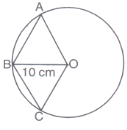
OABC is a rhombus whose three vertices A, B and C lie on a circle with centre O. If the radius of the circle is 10 cm, find the area of the rhombus.
13.
The horizontal distance between two towers is 70m.The angles of depression of the top of the first tower when seen the top of the second tower is 120m, find the height of the first tower.
14.
A tree is broken by the wind.The top struck the ground at an angle of 300 and at a distance of 30m from the root.Find the whole height of the tree.
15.
A boy standing on a horizontal plane finds a bird flying at a distance of 100 m from him at an elevation of 30o. A girl standing on the roof of 20 metre high building, finds the angle of elevation of the same bird to be 45o. Both the boy and the girl are on opposite sides of the bird. Find the distance of bird from the girl. [given \(\sqrt2\) = 1414]
16.
Two concentric circles are of radii 6.5 cm and 2.5 cm. Find the length of chord of the larger circle which is tangent to the smaller circle.
17.
In the figure, PQ is a tangent to a circle with centre O. If \(\angle OAB\) = 30°, find \(\angle ABP\) and \(\angle AOB\).
18.
Find the diameter of a circle whose circumference is equal to the sum of the circumference of the two circles of diameters 36 cm and 20 cm.
19.
It is proposed to build a single circular park equal in area to the sum of areas of two circular parks of diameters 16 m and 12 m in a locality. Find the radius of the new park.
20.
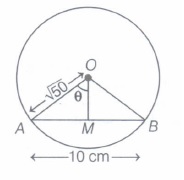
A chord 10 cm long is drawn in a circle whose radius is \(\sqrt { 50 } \) cm.Find the area of the segment.
21.
An Aeroplane at an altitude of 200 m observes the angle of depression of opposite points on the two banks of a river to be \({ 45 }^{ \circ }\) and \({ 60 }^{ \circ }\) .Find width of the river.
22.
A vertical tower is \(2\sqrt { 3 } m\) high and the length of its shadow is 2 m. Find the angle of elevation of the source of light.
23.
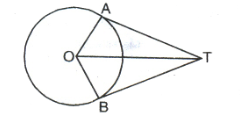
In fig., if \(\angle ATO={ 40 }^{ \circ }\), find\(\angle AOB\).
24.
The length of the tangents drawn from an external point to a circle are _____________
25.
The common point of the tangent and the circle is called
26.
If the diameter of semicircular protractor is 14 cm, then its perimeter is:
30 cm
44 cm
36 cm
40 cm
27.
The area of a circular plot is 9856 sq. m. The cost of fencing the plot at the rate of Rs. 6 per meter will be
Rs. 3456
Rs. 2211
Rs. 2112
Rs. 2000
28.
In fig, area of shaded region is
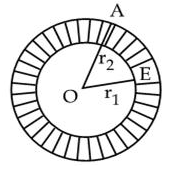
\(\pi \left( { r }_{ 1 }^{ 2 }+{ r }_{ 2 }^{ 2 } \right) \)
\(\pi \left( { r }_{ 1 }+{ r }_{ 2 } \right) \)
\(\pi \left( { r }_{ 1 }-{ r }_{ 2 } \right) \)
\(\pi \left( { r }_{ 2 }^{ 2 }+{ r }_{ 1 }^{ 2 } \right) \)
29.
The value of π is
4.13
11/7
33/6
3.14
30.
If the sum of the areas of two circles with radii R1 and R2 is equal to the area of a circle of radius R, then
\({ R }_{ 1 }^{ 2 }+{ R }_{ 2 }^{ 2 }={ R }^{ 2 }\)
R1 + R2 < R
R1 + R2 = R
\({ R }_{ 1 }^{ 2 }+{ R }_{ 2 }^{ 2 }={ <R }^{ 2 }\)
31.
The shaded part of the circle in the given figure represents a
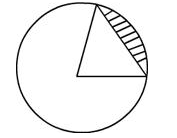
Segment
semi-circle
Sector
Chord
32.
The ——– is the line drawn from the eye of an observer to the point in the object viewed by the observer
Line of sight
Line of sight propagation
Line of symmetry
Line of incidence
33.
A tree is broken by wind and its upper part touches the ground at a point 10 metres from the foot of the tree and makes an angle of 45° with the ground. The entire length of the tree is
20 m
10 (1 + √2) m
10√2 m
10 m
34.
A 20 m long ladder touches the wall at a height of 10 m. The angle which the ladder makes with the horizontal is
30°
45°
60°
90°
35.
From the given figure, find h
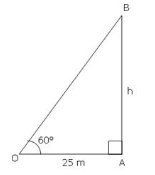
√3 m
25√3m
50√3 m
2 √3 m
36.
A tree casts a shadow 4 m long on the ground, when the angle of elevation of the sun is 450. The height of the tree is:
4.5 m
3 m
5.2 m
4 m
37.
Which of the following is rational?
√3 + √5
√4 + √9
√2 + √4
√6 + √9
38.
A line that intersects a circle in exactly one point is called a
Diameter
Tangent
Radius
Secant
39.
A circle can pass through
3 non- collinear points
3 collinear points
4 collinear points
2 collinear points
40.
Number of tangents, that can be drawn to a circle, parallel to a given chord is
3
zero
Infinite
2
41.
The length of the tangent drawn from a point 8 cm away from the centre of a circle, of radius 6 cm, is :
10 cm
5 cm
√7 cm
2√7 cm
42.
in figure , if ㄥAOB = 125o, then ㄥCOD is equal to
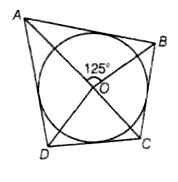
62o
45o
35o
55o
43.
In the given figure, PA and PB are tangents from P to a circle with centre O. If ∠AOB = 130°, then find ∠APB.
40o
55o
50o
60o
1.
Since tangent to a circle is perpendicular to the radius through the point of contact.
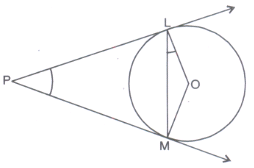
ஃ \(\angle \)OLP = \(\angle \)OMP = 90°
Now, in quad OLPM, we have
\(\angle \)OLP +\(\angle \)LPM + \(\angle \)OMP + \(\angle \)LOM = 360°
⇒ 90° + LPM + 90° + LOM = 360°
⇒ LPM + LOM = 180° ........(i)
In OLM, using angle sum property, we have
\(\angle \)OLM + \(\angle \)OML + \(\angle \)LOM = 180°
\(\angle \)OLM + \(\angle \)OLM + \(\angle \)LOM = 180°
[ ∵ OL = OM = r ⇒ \(\angle \)OLM = \(\angle \)OML, angles opp. to equal sides of a \(\triangle\)]
2\(\angle \)OLM + \(\angle \)LOM = 180° .........(ii)
From (i) and (ii)
\(\angle \)LPM + \(\angle \)LOM = 2 \(\angle \)OLM + \(\angle \)LOM
⇒ \(\angle \)LPM = 2\(\angle \)OLM
2.
Area of the circle having radius 8cm
= π x 8 x 8 = 64cm2
Area of the circle having radius 6 cm
=π x 6 x 6 = 36π cm2
Now, area of the required circle = sum of areas of two circles
⇒ πr2 = 64π + 36π
⇒ πr2 =100π
⇒ r2 = 100
⇒ r = 10
Hence, the radius of the required circle is 10 cm.
3.
5 cm
4.
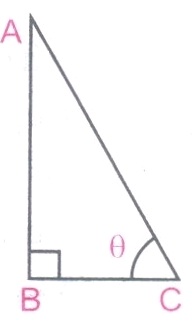
Let AB is pole and BC is its shadow
∴ AB = 6m, BC = 2\(\\ \\ \\ \\ \sqrt { 3 } \) m
In right ΔABC, \(\frac { AB }{ BC } \)=tanፀ
⇒ tanፀ = \(\frac { 6 }{ 2\sqrt { 3 } } \)
⇒ tanፀ = \(\sqrt { 3 } \)
⇒ ፀ = 60o
5.
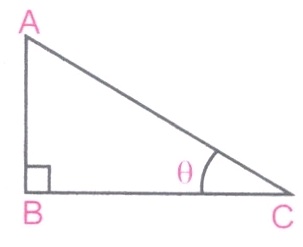
Let AB is tower and BC is its shadow
∴ AB = 20 m and BC = 20\(\sqrt { 3 } \)
In right ΔABC, \(\frac { AB }{ BC } \) = tanፀ
⇒ tanፀ = \(\frac { 20 }{ 20\sqrt { 3 } } \)
⇒ tanፀ = \(\frac { 1 }{ \sqrt { 3 } } \)
⇒ ፀ = 30o
6.
Let AB be a diameter of a given circle and LM and PQ be the tangent lines drawn to the circle at points A and B, respectively.
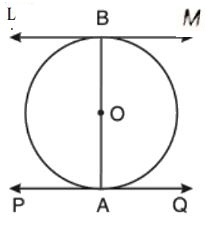
To prove LM || PQ
Proof We know that the tangent at any point of a circle is perpendicular to the radius through the point of contact.
\(\therefore\) OA \(\perp\) PQ and OB \(\perp\) LM
\(\Rightarrow\) AB \(\perp\) PQ
and AB \(\perp\) LM
\(\Rightarrow\) \(\angle\)PAB = 90°
and \(\angle\)ABM = 90°
\(\Rightarrow\) \(\angle\)PAB = \(\angle\)ABM
[each = 90°]
But these are alternate angles.
\(\therefore\) PQ || LM
Hence, the tangents drawn at the ends of a diameter of a circle are parallel.
Hence proved.
7.
Radius of the well = \(\frac { 7 }{ 2 } m=3.5\quad m\)
Volume of the earth taken out \(=\pi { \left( \frac { 7 }{ 2 } \right) }^{ 2 }\times 10\)
\(=\frac { 22 }{ 7 } \times \frac { 7 }{ 2 } \times \frac { 7 }{ 2 } \times 10\)
= 385 m3
Area of the rectangular field = 20 \(\times\) 14
= 280 m2
Area of the top of the well = \(\\ \pi { \left( \frac { 7 }{ 2 } \right) }^{ 2 }\)
\(=\frac { 77 }{ 2 } { m }^{ 2 }\)
Area of the remaining field = \(280-\frac { 77 }{ 2 } \)
\(=\frac { 483 }{ 2 } { m }^{ 2 }\)
Let 'h' is the rise in the level of the field
\(h=\frac { 385 }{ \frac { 483 }{ 2 } } =1.6m\) (approx)
8.
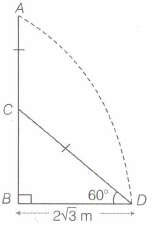
Let AB be the tree whose part AC breaks and touches the ground at D
Then, BD = \(2\sqrt { 3 } m\)
and AC = CD
In right angled \(\Delta \)CBD,
\(cos 60°=\frac { B }{ H } =\frac { BD }{ CD } \)
\(\Rightarrow \frac { 1 }{ 2 } =\frac { 2\sqrt { 3 } }{ CD } \)
\(\left[ \because cos 60°=\frac { 1 }{ 2 } and BD=2\sqrt { 3 } m \right] \)
\(\Rightarrow\) \(CD=2\times 2\sqrt { 3 } =4\sqrt { 3 } \)
\(=4\times 1.732=6.928\ m [\because \sqrt { 3 } =1.732]\)
\(\therefore\) AC = CD = 6.928 m
Again, in right angled \(\Delta \)CBD,
\(tan\quad 60°=\frac { P }{ B } =\frac { BC }{ BD } \)
\(\Rightarrow \sqrt { 3 } =\frac { BC }{ 2\sqrt { 3 } } [\because tan60°=\sqrt { 3 } and BD=2\sqrt { 3 } m]\)
\(\Rightarrow BC=\sqrt { 3 } \times 2\sqrt { 3 } =6 m\)
Now, AB = AC + BC
= 6.928 + 6 = 12.928 m (approx)
Hence, the height of the tree is 12.928 m.
9.
Let BC be the width of the river and A, B be the ends of river such that
AB = 150 m = Length of the bridge
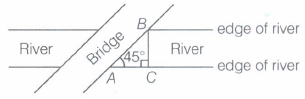
and \(\angle\)BAC = 45 \(°\)
In right angled \(\Delta ACB,\)
\(sin\quad 45°=\frac { P }{ H } \)
\(\Rightarrow \frac { 1 }{ \sqrt { 2 } } =\frac { BC }{ AB } =\frac { BC }{ 150 } \)
\(\therefore BC=\frac { 150 }{ \sqrt { 2 } } \times \frac { \sqrt { 2 } }{ \sqrt { 2 } } \) [by rationalising]
\(=\frac { 150 }{ 2 } \sqrt { 2 } =75\sqrt { 2 } \)
\(\\ =75\times 1.414\quad [\because \sqrt { 2 } =1.414]\)
=106.05 m (approx)
Hence, width of the river is 106.05 m.
10.
Let AB=80 m be the width of the road. On both sides of the road, poles AE = BD = h m are standing. Let C be any point on AB such that from point C, angles of elevation are

\(\angle BCD=60°\), and \(\angle ACE=30°\).
Let BC = x m.
Then, AC = AB - BC = (80 - x)m
In right angled \(\Delta\)CAE, \(\tan 30^{\circ}=\frac{P}{B}=\frac{A E}{A C}\)
\(\begin{aligned} & \Rightarrow \quad \frac{1}{\sqrt{3}}=\frac{h}{80-x} \quad\left[\because \tan 30^{\circ}=\frac{1}{\sqrt{3}}\right] \\ \end{aligned}\)
\(\begin{aligned} & \Rightarrow \quad 80-x=h \sqrt{3} \Rightarrow h \sqrt{3}+x=80 \end{aligned}\) ...(i)
and in right angled \(\Delta\)CBD,
\(\tan 60^{\circ}=\frac{B D}{B C} \Rightarrow \sqrt{3}=\frac{h}{x} \quad\left[\because \tan 60^{\circ}=\sqrt{3}\right]\)
\(\Rightarrow \quad b=\sqrt{3 x}\) ...(ii)
On putting h=\(\sqrt3\)x in Eq. (i), we get
\(\begin{aligned} &\sqrt{3} x(\sqrt{3})+x=80 \Rightarrow 3 x+x=80\\ \end{aligned}\)
\(\Rightarrow\) \(\begin{aligned} &4 x=80 \Rightarrow x=20 \mathrm{~m} \end{aligned}\)
On putting x = 20 m in Eq. (ii), we get
\(h=20 \sqrt{3} \mathrm{~m}\)
Now, AC = 80 - x = 80 - 20 = 60 m
Hence, height of the poles is 20\(\sqrt3\)m and the distances of the point C from the poles are 60 m and 20 m.
11.
Radius (r1) of 1st circle = 19 cm
Radius (r2) or 2nd circle = 9 cm
Let the radius of 3rd circle be r.
Circumference of 1st circle = 2πr1 = 2π (19) = 38π
Circumference of 2nd circle = 2πr2 = 2π (9) = 18π
Circumference of 3rd circle = 2πr
Given that,
Circumference of 3rd circle = Circumference of 1st circle + Circumference of 2nd circle
2πr = 38π + 18π = 56π
\(r=\frac{56 \pi}{2 \pi}=28\)
Therefore, the radius of the circle which has circumference equal to the sum of the circumference of the given two circles is 28 cm.
12.
Since OABC is a rhombus.
∴ OA = AB = BC = CO
Also, OB = OA = OC [radii Of a circle]
∴ We have OA = OB = AB
and 0B = OC = BC
⇒ \(\triangle\)OAB and \(\triangle\)OBC are equilateral triangles and OB is the diagonal of rhombus OABC.
ஃ Area (rhombus OABC) = 2 x area (\(\triangle\)OAB)
[.∴ diagonal divide rhombus in two triangles of equal areas]
= \(\left( 2\times \frac { \sqrt { 3 } }{ 4 } \times { 10 }^{ 2 } \right) \)cm2
[ ∵ area of equilateral triangle = \(\frac { \sqrt { 3 } }{ 4 } \) (side)2]
= \(\left( 2\times \frac { \sqrt { 3 } }{ 4 } \times { 10 }0 \right) \)cm2
= 50\(\sqrt3\) cm2
13.
79.58
14.
51.96m
15.
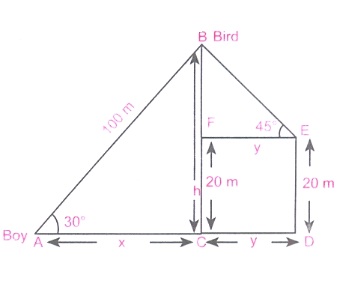
Given: A boy is standing at a distance of 100 m from the bird flying at an elevation of 30o. A girl is standing on the roof of 20 m high building finds the angle of elevation of the bird to be 45o Boy and girl are on opposite side of the bird.
To find: Distance between the bird and the girl i.e., BE.
Solution: In ΔACB,
⇒ \(\frac { h }{ 100 } \) = sin 300 ⇒ h = \(\frac { 1 }{ 2 } \) x 100 = 50 m
⇒ BF = h - 20 = (50 - 20) m = 30 m
In ΔBFE,\(\frac { 30 }{ BE } =sin{ 45 }^{ 0 }\Rightarrow \frac { 30 }{ BE } =\frac { 1 }{ \sqrt { 2 } } \Rightarrow 30\sqrt { 2 } \) = BE
BE = 30 x 1.414 = 42.420 = 42.42 m
16.
Here OA = 6.5 cm and OC = 2.5 cm
\(\therefore \quad AC=\sqrt { { OA }^{ 2 }-{ OC }^{ 2 } } \)
\(=\sqrt { { \left( 6.5 \right) }^{ 2 }-{ \left( 2.5 \right) }^{ 2 } } \)
\(=\sqrt { 42.25-6.25}\) = 6 cm
\(\therefore\) AB = 12 cm
17.
Since the tangent is perpendicular to the radius,
\(\angle OAB=\angle OBA\) (\(\because \) OA = OB)
\(\angle OBA\) = 30°
\(\angle AOB\) = 180° - (30° + 30°)
\(\angle AOB\) = 120°
\(\angle ABP=\angle OBP-\angle OBA\)
= 90° - 30° = 60°
18.
56 cm
19.
10 m
20.
Since OM bisects chord AE
\(\therefore \ A M=\frac{A B}{2}=5 \mathrm{~cm}\)
\(\text { In } \Delta O M A\)
\(\sin \theta=\frac{A M}{O A}=\frac{1}{\sqrt{2}} \quad\left[\because \sin \theta=\frac{\text { perpendicular }}{\text { hypotenuse }}\right]\)
\(\Rightarrow \ \theta=45^{\circ}\)
\(\text { Area of segment }=\text { Area of sector } \Delta A B O-\text { Area of } \Delta O A B\)
= 14.28 cm2
21.
Let P be the position of the aeroplane. Then, PM=200m and let A and B be two points on the two banks of a river such that the angles of depression at A and B are \({ 60 }^{ \circ }\)and \({ 45 }^{ \circ }\) , respectively.
Let Am=x m and BM= y m.
Then, \(\angle XPB=\angle MBP={ 45 }^{ \circ }\) [altenatives angles]
and \(\angle XPB=\angle MBP={ 60 }^{ \circ }\) [altenatives angles]
In right angled \(\Delta AMP,\) \(\tan { { 60 }^{ \circ } } =\frac { PM }{ AM } \)
\(\Rightarrow \sqrt { 3 } =\frac { 200 }{ x } \Rightarrow 200=\sqrt { 3x } \)
\(\Rightarrow x=\frac { 200 }{ \sqrt { 3 } } m \)
In right angled \(\Delta BMP,\)
\(\tan { { 45 }^{ \circ } } =\frac { PM }{ BM } \Rightarrow 1=\frac { 200 }{ y }\)
\(\Rightarrow y=200m \)
Now, width of the river, AB=BM+MA
\(\Rightarrow AB=x+y=\frac { 200 }{ \sqrt { 3 } } +200\)
\( =200\left( \frac { 1 }{ \sqrt { 3 } } +1 \right)\)
\(=200(1.5773)=315.46m. [\because \sqrt { 3 } =1.732]\)
Hence, the width of the river is 315.46m.
22.
60°
23.
\({ 100 }^{ \circ }\)
24.
()
equal
25.
()
point of contact.
26.
(c)
36 cm
27.
(c)
Rs. 2112
28.
(d)
\(\pi \left( { r }_{ 2 }^{ 2 }+{ r }_{ 1 }^{ 2 } \right) \)
29.
(d)
3.14
30.
(a)
\({ R }_{ 1 }^{ 2 }+{ R }_{ 2 }^{ 2 }={ R }^{ 2 }\)
31.
(a)
Segment
32.
(a)
Line of sight
33.
(b)
10 (1 + √2) m
34.
(a)
30°
35.
(b)
25√3m
36.
(d)
4 m
37.
(b)
√4 + √9
38.
(b)
Tangent
39.
(a)
3 non- collinear points
40.
(d)
2
41.
42.
Since, the opposite sides of a quadrilateral circumscribing a circle subtend supplementary angles at the centre of the circle.
i.e ㄥAOB + ㄥCOD = 180o
⇒ ㄥCOD =180o - ㄥAOB
⇒ ㄥCOD = = 180o - 125o = 55o
43.
(c)
50o

10th Standard CBSE Syllabus & Materials
10th Standard CBSE
CBSE 10th Social Science PS - Federalism - New Model Questions Papers Study Material - QB365 Set A
NEW10th Standard CBSE
CBSE 10th Social Science PS - Power Sharing - New Model Questions Papers Study Material - QB365 Set A
NEW10th Standard CBSE
CBSE 10th Social Science GEO - Manufacturing Industries - New Model Questions Papers Study Material - QB365 Set A
NEW10th Standard CBSE
CBSE 10th Social Science GEO - Minerals and Energy Resources - New Model Questions Papers Study Material - QB365 Set A



CBSE 10th Standard CBSE Subjects
CBSE Standards





