
 100% FREE ACCESS
11th Standard CBSE Syllabus & Materials
11th Standard CBSE
CBSE 11th Economics PART-A - Presentation of Data - New Sample Question Papers Study Material - QB365 Set A
NEW11th Standard CBSE
CBSE 11th Economics PART-A - Organisation of Data - New Sample Question Papers Study Material - QB365 Set A
NEW11th Standard CBSE
CBSE 11th Economics PART-A - Collection of Data - New Sample Question Papers Study Material - QB365 Set A
NEW11th Standard CBSE
CBSE 11th Economics PART-A - Introduction to Economics and Statistics - New Sample Question Papers Study Material - QB365 Set A
NEW11th Standard CBSE
CBSE 11th Business Studies International Trade Sample Question Papers Study Material - QB365 Set A
NEW11th Standard CBSE
CBSE 11th Business Studies Evolution and Fundamentals of Business Sample Question Papers Study Material - QB365 Set A

Published on: 05/03/2019
Sets Important Questions
Download CBSE Class 11th Standard CBSE Mathematics question papers, sample papers, important questions, and previous year solved papers in PDF format. Get free study materials, NCERT solutions, and exam preparation resources for Class 11th Standard CBSE Mathematics
Questions + Answers key
Take MCQ Mathematics Test
1.
Decide among the following sets, which sets are subsets of one and another:
A = {x : x ∈ R and x satisfies x2 - 8x + 12 =0}
B = {2,4, 6}, C = {2, 4, 6, 8,............}, D = {6}
2.
Draw the Venn diagram of the following:
A' \(\cap\) (B \(\cup\) C)
3.
Let A = {1, 2, 3, 4, 5, 6}. Insert the appropriate symbol ∈ or ∉ on the blank space:
(i) 5 A
(ii) 8 A
(iii) 0 A
(iv) 4 A
(v) 2 A
(vi) 10 A
4.
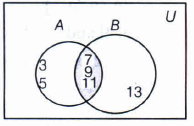
Find \(A\cap B\) , if A = {3,5,7,9,11} and B = {7,9,11,13}. Also, represent it by Venn diagram.
5.
Let A = {1, 2, 3, 4}, B = {5, 6, 7} and C = {7, 8, 9, 10}. Insert the correct symbol ∈ or ∉ in each of the following blanks.
7 ... A
6.
From the sets given below, select empty set, singleton set, infinite set and equal sets.
A = {x : x < 1 and x > 3}
7.
Are the following sets are equal?
A = {x : x is a letter in the word 'REAP'}
B = {x : x is a letter in the word 'PAPER'}
C = {x : x is a letter in the word 'ROPE'}
8.
Write down the subsets of the following sets.
{1,2,3}
9.
Write the following as intervals.
{x : x \(\in\) R, 0 \(\le\) x < 7}
10.
If set A = {1,3,5}, then find the number of elements in P{P(A)}.
11.
Which of the following sets are finite and which are infinite?
The set of lines which are parallel to the X-axis.
12.
Find the union of each of the following pair of sets A = { a, e, i, o, u}, B = {a, b, c}
13.
If U={a,b,c,d,e,f}, A={a,b,c}, B={c,d,e,f}, C={c,d,e}, D={d,e,f}, then tabulate the following set A\(\cap \)D
14.
In a group of 400 people, 250 can speak Hindi and 200 can speak English.How many can speak both Hindi and English?
15.
If A = { 0, 1, 2, 3, 4, 5, 6, 7, 8, 9, 10}, then insert appropriate symbol ∈ or ∉ in each of the following blank space.
-4 ... A
16.
If X = {a,b,c,d} and Y = {f,b,d,g}, then find
X - Y
17.
Write the following as intervals and also represent on the number line
x:x∈R,−5
18.
Draw the Venn diagrams to illustrate the following relationship among sets E, M and U, where E is the set of students studying English in a school, M is the set of students studying Mathematics in the same school and U is the set of all students in that school.
(ii) Not all students study Mathematics, but every student studying English studies Mathematics.
Firstly , make a relation between sets under given condition. Then, it is easy to draw a Venn diagram.
19.
Taking the set of a natural numbers as the universal set, write down the complements of the set.
{x : x is a perfect cube}
20.
Out of 100 students, 15 passed in English, 12 passed in Mathematics, 8 in Science, 4 in English and Science, 4 in all the three.Find how many students passed in Mathematics and Science but not in English?
21.
In a survey of 25 students, it was found that 15 had taken mathematics, 12 had taken physics and 11 had taken chemistry. 5 had taken mathematics and chemistry, 9 had taken mathematics and physics, 4 had taken physics and chemistry and 3 had taken all the three subjects. Find the number of students who had
(i) only chemistry
(ii) only physics
(iii) only mathematics
(iv) physics and chemistry but not mathematics
(v) mathematics and physics but not chemistry
(vi) at least one of the three subjects.
(vii) only one of the subjects.
(viii) none of the subjects.
22.
If A = {3, 5, 7,9, 11}, B = {7, 9, 11, 13}, C = {11, 13, 15} and D = {15, 17};find:
(l) A \(\cap\) B
(ii) B \(\cap\) C
(iii) A \(\cap\) C \(\cap\) D
(iv) A \(\cap\) C
(v) B \(\cap\) D
(vi)A \(\cap\) (B\(\cup\) C)
(vii) A \(\cap\) D
(viil) A \(\cap\) (B \(\cup\) D)
(ix) (A \(\cap\)B) \(\cap\) (B \(\cup\) C)
(x) (A \(\cup\) D) \(\cap\) (B \(\cup\) C)
23.
Let A = {1, 2, {3, 4}, 5}. Which of the following statements are incorrect and why?
(i) {3, 4} ⊂ A
(ii) {3, 4} ∈ A
(iii) {{3, 4}} ⊂ A
(iv) 1 ∈ A
(v) 1⊂ A
(vi) {1, 2, 5} ⊂ A
(vii) {1, 2, 5} ∈ A
(viii) {1, 2, 3} ⊂ A
(ix) ¢ ∈ A
(x) ¢⊂ A
(xi) {¢} ⊂ A.
24.
In a set builder method, the null set is represented by _____.
{}
ф
{x: x\(\ne\)x}
{x : x = x}
25.
Let A = {x : x ∈ R, x ≥ 4}and B = {x : x ∈ R,x < 5}then A \(\cap\) B is _____.
{4}
{4,5}
{5,5}
{5,4}
26.
If A and B are two sets then A \(\cap\) (A \(\cap\) B') =_______.
A
B
A'\(\cap\)B'
ф
27.
If \(A\cap B=B\) then _____.
B⊂A
A=ф
A⊂B
B=ф
28.
The number of subsets of a set containing n elements is _____.
2n - 2
n2
2n
n
1.
Here A = {x : x ∈ R and x satisfies x2 - 8x + 12 = 0}
= {x:x ∈ Rand (x-6)(x-2)=0}
= {2, 6}
B = {2, 4, 6}
C = {2, 4, 6, 8, } and D = {6}
Now A ⊂ B, A ⊂ C, B ⊂ C, D ⊂ A, D ⊂ B and D ⊂ C.
2.
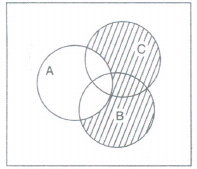
3.
A = { 1, 2, 3, 4, 5, 6}
(i) 5 is an element of set A \(\therefore\)5 ∈ A
(ii) 8 is not an element of set A \(\therefore\)8 ∉ A
(iii) 0 is not an element of set A \(\therefore\) 0 ∉ A
(iv) 4 is an element of set A \(\therefore\) 4 ∈ A
(v) 2 is an element of set A \(\therefore\) 2 ∈ A
(m) 10 is not an element of set A \(\therefore\) 10∉A
4.
We have, A= {3,5,9,11} and B = {7,9,11,13}
\(\because \) \(A\cap B=\{ 3,5,7,9,11\} \cap \{ 7,9,11,13\} \)
\(\therefore \) \(A\cap B=\{ 7,9,11\} \)
5.
7 \(\notin \) A
6.
A = { } =\(\phi \), so it is empty set
7.
No
8.
\(\phi\) , {1}, {2}, {3}, {1, 2} ,{2, 3}, {1,}3, {1,2,3}
9.
{x : x \(\in\) R, 0 \(\le\) x < 7} is the set that contain 0 but not 7. So, it can be represented as an interval whose first end is closed and the other end is open.
So, the interval is [0,7).
10.
Given, A = {1,3,5} n(A) = 3
Number of elements in P(A) = 23 = 8
\(\therefore\) Number of elements in P(P(A)) = 28 = 256
11.
We can draw infinite lines parallel to X-axis.
\(\therefore \) It is an infinite set.
12.
A \(\cup\) B ={a, b, c, e, i, o, u}
13.
\(\phi \)
14.
Let H be the set of people speaking Hindi and E be the set of people speaking English.
\(\therefore\) n(H) = 250, n(E) = 200 and n(H \(\cup\) E) = 400
We have to find n(H \(\cap\) E).
We know that
n(H \(\cup\) E) = n(H) + n(E) - n(H \(\cap\) E)
\(\therefore\) 400 = 250 + 200 - n(H \(\cap\) E)
\(\therefore\) n(H \(\cap\) E) = 450 - 400 = 50.
15.
Given, A = { 0, 1, 2, 3, 4, 5, 6, 7, 8, 9, 10}
Since, -4 is not an element of A, therefore -4 \(\notin \) A
16.
\(X-Y=\{ a,c\} \)
-S.png)
17.
x:x∈R,-5
On the real line, (-5,6) can be graphed aa shown in figure given below
-S.png)
The dark portion on the number line represent (-5,6).
18.
Given E = set of students studying English
M =Set of students studying Mathematics
U= Set of all students
Since, every student studying English studies Mathematics.
\(\therefore \quad \quad E\subset M\subset U\)
Through Venn diagram, we represent it as
-S.png)
19.
{ x : x \(\in \) N and x is not a perfect cube}
20.
\(n(E\cap S\cap \overline { E } )=n(E\cap S)-n(E\cap M\cap S)\)
=74=3
21.
Let M be the set of students who had taken mathematics, Pbe the set of students who had taken physics and C be the set of students who had taken chemistry.
Here n(U) = 25, n(M) = 15, n(P) = 12, n(C) = 11, n(M \(\cap\) C) = 5, n(M \(\cap\) P) = 9, n(P \(\cap\) C) = 4, n(M \(\cap\) P \(\cap\) C)= 3
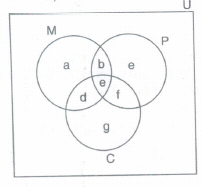
From the Venn diagram, we have
n(M) = a + b + d + e = 15
n(P) = b + c + e + f = 12
n(C) = d + e + f + g = 11
n(M \(\cap\) C) = d + e = 5
n(M \(\cap\) P) = b + e = 9
n(P \(\cap\) C) = e + f = 4
n(M \(\cap\) P \(\cap\) C) = e = 3
Now e = 3
d + e = 5 \(\Rightarrow\) d + 3 = 5 \(\Rightarrow\) d = 5 - 3 \(\Rightarrow\) d = 2
b + e = 9 \(\Rightarrow\) b + 3 = 9 \(\Rightarrow\) b = 9 - 3 \(\Rightarrow\) b = 6
e + f = 4 \(\Rightarrow\) 3 + f = 4 \(\Rightarrow\) f = 4 - 3 \(\Rightarrow\) f = 1
a + b + d + e = 15
\(\Rightarrow\) a + 6 + 2 + 3 = 15 \(\Rightarrow\) a = 15 - 11 = 4
b + c + e + f = 12
\(\Rightarrow\) 6 + c + 3 + 1 = 12 \(\Rightarrow\) c = 12 - 10 = 2
d + e + f + g = l1
\(\Rightarrow\) 2 + 3 + 1 + g = 11\(\Rightarrow\) g = 11 - 6 = 5
\(\therefore\) (i) g = 5
(ii) c = 2
(iii) a = 4
(iv) f = 1
(v) b = 6
(vi) a + b + c + d + e + f + g = 4 + 6 + 2 + 2 + 3 + 1 + 5 = 23
(vii) a + c + g = 4 + 2 + 5 = 11
(viii) 25 - (a + b + c + d + e + f + g) = 25 - 23 = 2
22.
Here A = {3, 5, 7, 9, 11}, B = {7, 9, 11, 13}, C = {11, 13, 15} and D = {15, 17}
(i) A \(\cap\) B = {3, 5, 7,9, 11} \(\cap\) {7, 9, 11, 13}
= {7, 9, 11}
(ii) B \(\cap\) C = {7, 9, 11, 13} \(\cap\) {11, 13, 15}
= {11, 13}
(iii) A\(\cap\)C\(\cap\)D = {3, 5, 7, 9, 11} \(\cap\) {11, 13, 15} \(\cap\){15,17}=ф
(iv) A\(\cap\) C = {3, 5, 7, 9, 11} \(\cap\) {11, 13, 15}
= {11}
(v) B \(\cap\) D = {7, 9, 11, 13} \(\cap\) {15, 17} = ф
(vi) A\(\cap\)(B \(\cup\)C) ={3, 5, 7, 9, 11} \(\cap\) ({7, 9,11, 13} \(\cup\) {11, 13, 15})
= {3, 5, 7, 9, 11} \(\cap\) {7, 9, 11, 13, 15}
= {7, 9, 11}
(vii) A \(\cap\) D
= {3, 5, 7, 9, 11}\(\cap\) {15, 17} = ф
(viii) A \(\cap\) (B \(\cup\)D)
= {3, 5, 7, 9, 11}\(\cap\) ({7,9,11,13}\(\cup\){15,17}
= {3, 5, 7, 9, 11} \(\cap\) {7, 9,11,13,15,17} = {7, 9, 11}
(ix) (A \(\cap\) B)\(\cap\) (B \(\cup\)C)
= ({3, 5, 7, 9, 11} \(\cap\) {7, 9,11,13}) \(\cap\) ({7, 9, 11, 13} \(\cup\) {11, 13, 15})
= {7, 9, 11} \(\cap\) {7, 9, 11, 13, 15}
= {7, 9, 11}
(x) (A \(\cup\)D) \(\cap\) (B \(\cup\)C)
= ({3, 5, 7, 9, 11}\(\cup\) {15, 17}) \(\cap\) ({7, 9, 11, 13}\(\cup\){11, 13, 15})
= {3, 5, 7, 9, 11, 15, 17}\(\cap\) {7, 9, 11, 13, 15}
= {7, 9, 11, 15}
23.
(i) {3, 4} is a member of set A.
\(\therefore\) {3, 4} ∈ A
Hence {3, 4}⊂ A is incorrect.
(ii) {3, 4} is a member of set A.
\(\therefore\){3, 4} ∈ A is correct.
(iii) Here {3, 4} is a member of set A.
\(\therefore\) {{3,4}} is a set
\(\therefore\) {{3,4}} ⊂ A is correct.
(iv) 1 is a member of set A.
\(\therefore\) 1 ∈ A is correct.
(v) 1 is not a set, it is a member of set A.
\(\therefore\) 1⊂ A is incorrect.
(vi) 1, 2, 5 are members of set A.
\(\therefore\) {1, 2, 5} is a subset of set A.
\(\therefore\) {1, 2, 5} ⊂ A is correct.
(vii) 1, 2, 5 are members of set A.
\(\therefore\) {1, 2, 5} is a subset of set A.
\(\therefore\) {1, 2, 5} ∈ A is incorrect.
(viii) 3 is not a member of set A.
\(\therefore\) {1, 2, 3} is not a subset of set A.
\(\therefore\) {1, 2, 3} ⊂ A is incorrect.
(ix) ф is not a member of set A.
\(\therefore\) ф ∈ A is incorrect.
(x) Since ф is subset of every set,
\(\therefore\)ф ⊂ A is correct.
(xi)ф is not a member of set A.
\(\therefore\) {ф} ⊂ A is incorrect.
24.
(c)
{x: x\(\ne\)x}
25.
(a)
{4}
26.
(c)
A'\(\cap\)B'
27.
(a)
B⊂A
28.
(c)
2n

11th Standard CBSE Syllabus & Materials
11th Standard CBSE
CBSE 11th Business Studies Forms of Business Organisation Sample Question Papers Study Material - QB365 Set A
NEW11th Standard CBSE
CBSE 11th Business Studies Business, Trade and Commerce Sample Question Papers Study Material - QB365 Set A
NEW11th Standard CBSE
CBSE 11th Physics Waves Sample Question Papers Study Material - QB365 Set A
NEW11th Standard CBSE
CBSE 11th Physics Kinetic Theory Sample Question Papers Study Material - QB365 Set A



CBSE 11th Standard CBSE Subjects
CBSE Standards









