
 100% FREE ACCESS
7th Standard CBSE Syllabus & Materials
7th Standard CBSE
CBSE 7th Social Science Theme E - Understanding Market - New Sample Question Papers Study Material - QB365 Set A
NEW7th Standard CBSE
CBSE 7th Social Science Theme E - From Barter to Money - New Sample Question Papers Study Material - QB365 Set A
NEW7th Standard CBSE
CBSE 7th Social Science Theme D - The Constitution of India- An Introduction - New Sample Question Papers Study Material - QB365 Set A
NEW7th Standard CBSE
CBSE 7th Social Science Theme D - From the Rulers to the Ruled : Types of Governments - New Sample Question Papers Study Material - QB365 Set A
NEW7th Standard CBSE
CBSE 7th Social Science Theme B - The Age of Reorganisation - New Sample Question Papers Study Material - QB365 Set A
NEW7th Standard CBSE
CBSE 7th Social Science Theme B - The Rise of Empires - New Sample Question Papers Study Material - QB365 Set A

Published on: 31/12/2018
Class 7 Revision Test
Download CBSE Class 7th Standard CBSE Social Science question papers, sample papers, important questions, and previous year solved papers in PDF format. Get free study materials, NCERT solutions, and exam preparation resources for Class 7th Standard CBSE Social Science
Questions + Answers key
Take MCQ Social Science Test
1.
One-horned rhinoceros is found in :
Brahmaputra plain
Amazon basin
Ghaghra plain
None of these
2.
The Cheros were defeated in 1591 by :
Maharana Pratap
Raja Man Singh
Amar Singh
Prithviraj Chauhan
3.
In which year, Humayun recaptured Delhi?
1552
1553
1554
1555
4.
Major reason for inequality is
poverty
lack of resources
Both 'a' and 'b'
None of the above
5.
Chain of markets involves
Produce \(\rightarrow \) Wholesaler\(\rightarrow \) Retailer \(\rightarrow \) Consumer
Produce \(\rightarrow \) Retailer\(\rightarrow \) Wholesaler \(\rightarrow \) Consumer
Producer \(\rightarrow \) Retailer \(\rightarrow \) Consumer
Produce \(\rightarrow \) Consumer
6.
Electronic media includes
Newspapers
Magazines
Radio
All of the above
7.
Tafilalet Oasis in ______ is a large oasis.
Johannesburg
Sudan
Tunisia
Morocco
8.
Which one does not happen when air is heated?
It expands
It becomes lighter
It goes up
It comes down
9.
________ trees like rosewood, ebony and mahogany are common in tropical evergreen forests.
Hardwood
Softwood
Sal wood
Perfume wood
10.
Pan-regional means
one regional unit
spanning single region
not belonging to lands but seas
spanning diverse regions
11.
Name the continent in which the Amazon Basin is located.
12.
What do you mean by Ioo?
13.
What are the two types of health care services discussed in this Chapter?
14.
Why did the Dutch and English East India Companies attempt to control Masulipatnam?
15.
Which were the areas included in Hindustan by Minhaj-i-Siraj in his writings?
16.
Market is a place where we go to buy different things.
17.
India is the second largest producer of medicines in the world
18.
When the water on the surface of the ocean rises and falls alternately, they are called tides
19.
The craftspersons of Bidar could not earn name and fame.
20.
Jatis framed their own rules and regulations to manage the conduct of their members.
21.
"The market works more in favour of the merchants". How?
22.
"We also realise that societies make clear distinction between boys and girls". Explain.
23.
Discuss wind and its types briefly.
24.
Discuss Article 15 of Indian Constitution
25.
How did the Indian craftspersons lose their independence?
26.
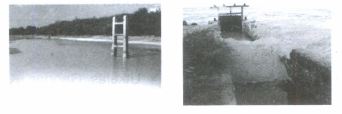
Interpret and compare the two above figures and answer the question Which ruler made it?
27.
Describe the working of the Assembly in brief.
28.
Which are the reasons for continuation of discrimination in a democratic country such as India?
29.
Write the features of temperate grasslands.
30.
Trace out the architectural similarity between the temples at Vrindavan and monuments of Fatehpur Sikri, Agra.
31.
How much profit per shirt did the garment exporter earns?
32.
You can observe this process of local myths and legends receiving wider acceptance even today. Can you find some examples around you?
33.
Why did Alauddin control the prices of goods in Delhi? What did he do for this?
34.
_______________has a very important role in our lives
35.
___________released in the atmosphere creates greenhouse effect.
36.
_______ was considered most poweRajaraja Irful Chola ruler.
37.
To be a girl or boy is an important part of one's ____________
38.
The Mughals used the term Zamindars to describe all __________
39.
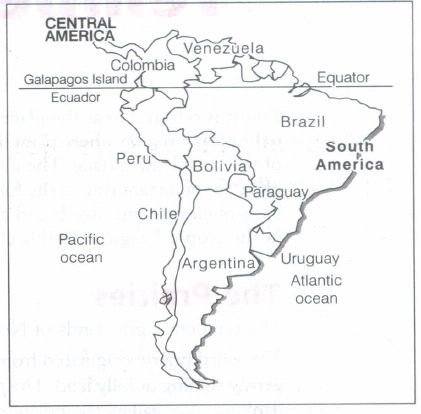
On the polltical map of South America, draw the equator. Mark the countries through which the equator passes.
40.
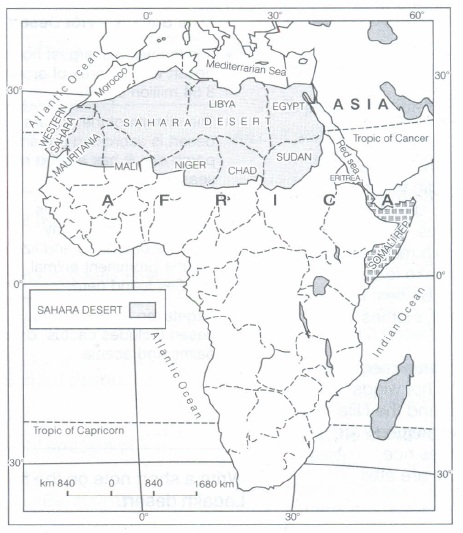
On the outline map of Africa, mark the Sahara desert and any four countries around it.
41.
Paddy is grown in Ganga-Brahmaputra plains.
42.
We cannot go to the centre of the Earth.
43.
Did you notice that the names by which languages are known have changed with time?
44.
What is the role of media in a democracy?
45.
Write a detailed note on the life of the Banjaras as described by the English trader Peter Mundy.
1.
(a)
Brahmaputra plain
2.
(b)
Raja Man Singh
3.
(d)
1555
4.
(c)
Both 'a' and 'b'
5.
(a)
Produce \(\rightarrow \) Wholesaler\(\rightarrow \) Retailer \(\rightarrow \) Consumer
6.
(c)
Radio
7.
(d)
Morocco
8.
(d)
It comes down
9.
(a)
Hardwood
10.
(d)
spanning diverse regions
11.
()
South America.
12.
()
Loo is the hot and dry wind of northern plains of india
13.
()
Healthcare services are divided into two parts
(i) Public health services
(ii) Private health facilities
14.
()
Both the Dutch and English East India Companies attempted to control Masulipatnam as it became the most important port on the Andhra coast.
15.
()
Minhaj-i-Siraj used 'Hindustan' to refer the areas of Punjab, Haryana and the lands between the Ganga and Yamuna.
16.
(a)
17.
(b)
18.
(b)
19.
(b)
20.
(a)
21.
This dependence of weavers on merchants for both raw materials and markets makes merchants powerful. Merchants get what they want and that too at very low prices.
The weavers don't have any way of knowing that to whom their cloth have been sold to. The merchants sell cloth to the garments factories and this is how they are benefitted to a large extent. Weavers invest all their money and sometimes borrow money to buy looms. Weaver and another adult member work for almost 12 hours a day to produce cloth and then too do not earn enough.
This scheme between the merchant and the weaver is an instance of putting out system. Weaving industry in India uses this system.
22.
The examples of growing up of children of Samoan islands and children of Madhya Pradesh clearly explain that there are many different ways of growing up. The societies start making differences between girls and boys from a very young age.
We ourselves have experienced this when we were given different categories of toys to play with. Boys were given cars, trains and girls were given dolls, kitchen sets, etc. Toys became a method of telling children that the two sexes have different futures. The distinction were made in smallest and everyday things like dressing of girls and boys, games they were allowed to play.
23.
Wind is the movement of air from high pressure area to low pressure areas.
There are three types of wind
(i) Permanent Winds The trade winds, westerlies and easterlies are the permanent winds. These blow constantly throughout the year in a particular direction.
(ii) Seasonal Winds These winds change their direction in different seasons. For example, monsoons in India.
(iii) Local Winds These winds blow only during a particular period of the day or year in a small area. For example, land and sea breeze, L00 etc.
24.
Article 15 talks about, prohibition of discrimination on grounds of religion, race, caste, sex or place of birth.
(i) The state shall not discriminate against any citizen on grounds only of religion, race, caste, sex place of birth or any of them.
(ii) No citizen shall, on grounds only of religion, race, caste, sex, place of birth or any of them, be subject to any disability, liability, restriction or condition with regard to
(a) access to shops public restaurants, hotels and places of public entertainment.
(b) the use of wells, tanks, bathing ghats, roads and places of public resort maintained wholly or partly out of state funds or dedicated to the use of general public.
25.
Initially, Indian crafts and textiles were in great demands in the European markets. As a result, the English began to make attempts to control the Indian craftspersons by appointing Indian traders as their agents. They introduced the system of advances under which the weavers had to weave cloth which was only and already promised to European agents. They no longer were able to sell their own cloth or weaving their own patterns. Thus, the Indian craftspersons lost their independence.
26.
The Chola dynasty opened up different activities to increase produce of lands, so they made the fig. I to irrigate crop fields.
27.
Current issues are discussed in the Assembly and decisions are taken on various issues.
During this time MLAs can express their opinion and ask questions related to the issue. They may give suggestions about running of the government.
Those who wish can respond to the same. The concerned ministers reply to the questions and assure the assembly about the steps taken by the government about a issue.
28.
(i) One of the main reasons for continuance of discrimination is that attitudes change very slowly.
(ii) Persons are aware that discrimination is against the law. Still they continue to treat people unequally on the basis of their caste, religion, disability, economic status and sex.
(iii)It is only when people begin to believe that no one is inferior and that every person deserves to be treated with dignity, that attitudes change.
(iv) Establishing equality in a democratic society is a continuous struggle.
(v) Persons as well as various communities in India contribute to remove inequalities
29.
Temperate grasslands are found in mid latitudinal zone and in the interior part of the continents.
Grass here is short and nutritious.
Common animals are wild buffaloes, bisons, antilopes.
30.
The architectural styles of the Mughal palaces at Fatehpur Sikri and temples at Vrindavan are very similar. The interior of temple Govind Deva at Vrindavan consists of intersecting arches that made the high ceiling roof. Similar roofs can be seen in the monument of Fatehpur Sikri.
This style of architecture is from North-West Iran (Khurasan). Apart from architecture, some temples of Vrindavan and monuments of Fatehpur Sikri are made of red sandstone.
31.
The garment exporter sold the shirt at Rs 200 per piece. He has to pay Rs 70 per shirt for the cloth and other raw materials. Wages to worker cost him Rs 15 per shirt whereas cost of running his office accounts for 15 per shirt. The total cost incurred was Rs 100 where as he has sold one shirt at Rs 200. So he has earned profit of Rs 100 per shirt.
32.
India is a land of huge population, illiteracy is still rampant in India. Many local myths and legends have been receiving wider acceptance even today. Some notable amongst them are:
1. India is a place of snake charmers and Black Magic. India have been facing this myth even before there was any temple. But this myth does not dominate or define the identity of India.
2. Indian people are believed ro have bad luck, if any cat crosses their way. This myth is gaining ground even among the literate classes of society.
3. Indian people think of not having milk while leaving for a journey. They instead can take curd. This myth is still much prevalent.
33.
Alauddin paid great importance to his soldiers because it was they who could defend the sultanate from outsiders. He, therefore, decided to pay their salaries in cash rather than iqtas. The soldiers, therefore, would buy their supplies from merchants in Delhi and it was thus feared that merchants would raise their prices. To stop this, Alauddin controlled the prices of goods in Delhi.
34.
()
television
35.
()
Carbon dioxide
36.
()
Rajaraja I
37.
()
Identity
38.
()
Intermediaries
39.
The equator is passes through Ecuador, Colombia, Peru and Brazil.
40.
The answer map isgiven below
41.
The cultivation of paddy requires sufficient water. The Ganga-Brahmaputra plains fulfils this condition because they receive high rainfall.
42.
To reach the centre of the Earth is not possible because one will have to dig a hole 6000 km deep in the ocean. The deepest mine in the world is in South Africa which is just about 4 km deep.
43.
The names of languages which changed over time are as follows
Lahori : Punjabi
Telangani : Telugu
Gujari : Gujarati
Mabari : Tamil
Gauri : Bengali
Hindawi : Hindi
44.
(i) Media plays a very significant role in a democracy. It providers news and discusses events related to the country or world.
(ii) It helps the citizens to know about the working of the government, and if required, bring forth the the problems.
(iii) Media helps the people of around the world to known and understand about what is going on in other parts of the world.
(iv)Media helps by "setting the agenda" and helps people to organize protests
(v) Media propagates the policies and programmes of the government and criticizes the unpopular policies.
(vi) It reports crimes, mishappenings and creates opinion about them as well.
45.
The Life of Banjaras :
Peter Mundy, an English trader who came to India during the early seventeenth century, has described the Banjaras.
(i) In the morning we met a tanda of Banjaras with 14,000 oxen.
(ii) They were all laden with grains such as wheat and rice.
(iii) These Banjaras carry their hold, wives and children, along with them.
One tanda consists of many families Their way of life is similar to that of carriers who continuously travel from place to place. They own their oxen. They are sometimes hired by merchants, but most commonly they are themselves merrhants. They buy grain where it is cheaply available and carry it to places where it is dearer. From there, they again reload their oxen with anything that can be profitably sold in other places.
(iv) In a tanda there may be as many as 6 or 7 hundred persons. They do not travel more than 6 or 7 miles a day that, too, in the cool weather. After unloading their oxen, they turn them free to graze as there is enough land here, and no one is there to forbid them.

7th Standard CBSE Syllabus & Materials
7th Standard CBSE
CBSE 7th Social Science Theme B - New Beginnings : Cities and States - New Sample Question Papers Study Material - QB365 Set A
NEW7th Standard CBSE
CBSE 7th Social Science Theme A - Climates of India - New Sample Question Papers Study Material - QB365 Set A
NEW7th Standard CBSE
CBSE 7th Social Science Theme A - Geographical Diversity of India - New Sample Question Papers Study Material - QB365 Set A
NEW7th Standard CBSE
CBSE 7th Science Earth, Moon and the Sun - New Sample Question Papers Study Material - QB365 Set A



CBSE 7th Standard CBSE Subjects
CBSE Standards




