
 100% FREE ACCESS
7th Standard CBSE Syllabus & Materials
7th Standard CBSE
CBSE 7th Social Science Theme E - Understanding Market - New Sample Question Papers Study Material - QB365 Set A
NEW7th Standard CBSE
CBSE 7th Social Science Theme E - From Barter to Money - New Sample Question Papers Study Material - QB365 Set A
NEW7th Standard CBSE
CBSE 7th Social Science Theme D - The Constitution of India- An Introduction - New Sample Question Papers Study Material - QB365 Set A
NEW7th Standard CBSE
CBSE 7th Social Science Theme D - From the Rulers to the Ruled : Types of Governments - New Sample Question Papers Study Material - QB365 Set A
NEW7th Standard CBSE
CBSE 7th Social Science Theme B - The Age of Reorganisation - New Sample Question Papers Study Material - QB365 Set A
NEW7th Standard CBSE
CBSE 7th Social Science Theme B - The Rise of Empires - New Sample Question Papers Study Material - QB365 Set A

Published on: 31/07/2018
Based on the chapter Soil, some of the important questions are prepared in this question paper.
Teachers please subscribe Now and Create Unlimited 7th Standard Science question papers with answer keys. For subscription, please Click Here.
Download CBSE Class 7th Standard CBSE Science question papers, sample papers, important questions, and previous year solved papers in PDF format. Get free study materials, NCERT solutions, and exam preparation resources for Class 7th Standard CBSE Science
Questions + Answers key
Take MCQ Science Test
1.
Percolation rate is measured in unit
mL/min
min/mL
lit/min
mL/sec
2.
The soil that can be moulded into any shape is
silt
sandy
loamy
clayey
3.
Availability of water and minerals in the soil for maximum absorption by roots is in the
B-horizon
C-horizon
A-horizon
Surface of soil
4.
The microorganisms present in the soil require moisture (water) and nutrients for growth and survival. Choose from the options below, the habitat (place) where the soil has plenty of water and nutrients.
Desert
Forest
Open field
Cricket ground
5.
The water holding capacity is the highest in
sandy soil
clayey soil
loamy soil
mixture of sand and loam
6.
Gardeners gently dig up the soil around the roots of garden herbs (plants) frequently. Give reasons
7.
Why is soil erosion relatively less in dense forests as compared to barren, open fields?
8.
During the summer vacations, Gaurav visited his native village. He observed that farmers were using pesticides in their field. He contacted the village head and explained him the effects of such substances in causing soil pollution. Next day, the. village head called a meeting of all the villagers and convinced the villagers not to use chemicals and pesticides.
(a) Why is there a ban to demand the polythene bags and plastics.
(b) List some substances which pollute the soil.
(c) What are the values shown by Gaurav?
9.
A student visits two types of field and observes that soil from field A has high percolation rate of water, while soil from field 8has low percolation rate. In field 8, paddy crop was grown while in field A, there was no standing crop. Name two types of soil present in two fields.
10.
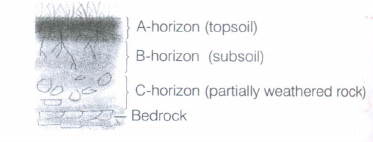
Sketch the cross-section of soil and label the various layers.
11.
How can a farmer convert acidic soil into neutral soil?
12.
Can we make toys with the soil obtained from a field? Explain?
13.
It is necessary to ban the use of polythene bags and plastics. Do you agree? If yes, why?
14.
There is shimmering of air just above the soil during hot summer day. What does the term shimmering indicate?
15.
Give the formula to calculate the absorption percentage.
16.
Soil erosion does not occur easily where the land is covered by vegetation. Do you agree? Explain.
17.
The contamination of soil with waste materials causes soil pollution. Does the use of pesticides in agriculture also contribute to the soil pollution? Explain.
18.
Paddy requires.............soil to grow.
19.
Clay is a the..........rock particle.
20.
Substance like................ and................. pollute the agricultural soil
21.
Soil contains..........,................ and countless............ organisms.
22.
Soil is........ part of our life.
23.
Topsoil contains humus.
24.
Silt is somewhat bigger rock particles than clay.
25.
Erosion of soil is more severe in the barren land.
26.
Cotton is grown in sandy-loam soil.
27.
The removal of upper surface of soil is called soil pollution.
1.
(a)
mL/min
2.
(a)
silt
3.
(c)
A-horizon
4.
(b)
Forest
5.
The water holding capacity is the highest in clayey soil
6.
A gardener often gently digs up the soil around the roots of garden plants or herbs for following reasons
(i) It enables easy root growth.
(ii) For easier percolation of water.
(iii) For aerating the soil enabling air to get into deeper layers of soil.
(iv) For removing the weeds.
7.
In dense forests, the tree cover (canopy) prevents rainwater from directly falling on the ground/soil. Also roots of the vegetation bind the soil particles and hold them together. As a result, soil erosion is minimised. But in barren, open fields, the soil is exposed to the falling rain. The soil particles become loose due to the impact of raindrops and the flow of water carries them away. The flowing water further erodes the soil surface aggravating erosion.
8.
(a) It is because these substances pollute the soil. They also kill the organisms living in the soil.
(b) Substances which pollute the soil are a number of waste products, chemicals, pesticides, polythene bags and plastics.
(c) Alertness, responsibility and ecofriendly nature
9.
Soil in field A is sandy soil while in field B soil is clayey soil which has low percolation rate and water-logging is seen. Since, paddy requires lot of standing water, therefore it is grown in field B.
10.
Labelled sketch of the cross-section of soil is
11.
The farmer can convert acidic soil into neutral soil by adding a small quantity of quicklime or slaked lime solution to the soil
12.
No, soil from a field cannot be used to make toys. In order to make toys, the soil should be clayey.
13.
Polythene bags and plastics pollute the soil as they kill the organisms living in the soil. That's why, it is necessary to ban the use of polythene bags and plastics
14.
The term shimmering means that the air shines with a slightly shaking light.
15.
The absorption percentage of water can be calculated by the formula given below
Percentage of water absorb
\(\frac { amount\quad of\quad water\quad absorted(in\quad ml) }{ amount\quad of\quad soil(in\quad gm) } x100\)
16.
Ans. Yes, soil erosion does not occur easily where the land is covered by vegetation (trees and other plants). It occurs easily in those areas of land which are not covered by vegetation (trees and other plants) or have very little vegetation. If there is vegetation on land,
(i) then the roots of vegetation growing in the soil bind the particles of topsoil firmly. Due to this, the blowing wind and flowing rainwater are not able to carry away topsoil and hence soil erosion does not occur.
(ii) then much of the falling rain hits the trees and plants before it hits the soil. In this way, the cover of vegetation softens the effect of heavy rains on the soil
17.
The contamination of soil with waste materials especially used polythene bags and plastics, pesticides, fertilisers, acid rain industrial chemical wastes, etc., is called soil pollution
Pesticides are the poisonous chemical substances which are sprayed on standing crops to save them from the harmful insects and diseases. Some of these pesticides also mix up with the soil in the fields and pollute it. The grains, fruits and vegetables grown in this polluted soil contain pesticides. When we eat such contaminated grains, fruits or vegetables, the pesticides present in them damage our health also.
18.
()
clayey
19.
()
Smallest
20.
()
Chemicals, pesticides
21.
()
Air, water, living
22.
()
inseparable
23.
(a)
24.
(a)
25.
(a)
26.
(a)
27.
(b)

7th Standard CBSE Syllabus & Materials
7th Standard CBSE
CBSE 7th Social Science Theme B - New Beginnings : Cities and States - New Sample Question Papers Study Material - QB365 Set A
NEW7th Standard CBSE
CBSE 7th Social Science Theme A - Climates of India - New Sample Question Papers Study Material - QB365 Set A
NEW7th Standard CBSE
CBSE 7th Social Science Theme A - Geographical Diversity of India - New Sample Question Papers Study Material - QB365 Set A
NEW7th Standard CBSE
CBSE 7th Science Earth, Moon and the Sun - New Sample Question Papers Study Material - QB365 Set A



CBSE 7th Standard CBSE Subjects
CBSE Standards




