
 100% FREE ACCESS
10th Standard CBSE Syllabus & Materials
10th Standard CBSE
CBSE 10th Social Science ECO - Globalisation and the Indian Economy - New Model Questions Papers Study Material - QB365 Set A
NEW10th Standard CBSE
CBSE 10th Social Science ECO - Money and Credit - New Model Questions Papers Study Material - QB365 Set A
NEW10th Standard CBSE
CBSE 10th Social Science ECO - Sectors of the Indian Economy - New Model Questions Papers Study Material - QB365 Set A
NEW10th Standard CBSE
CBSE 10th Social Science ECO - Development - New Model Questions Papers Study Material - QB365 Set A
NEW10th Standard CBSE
CBSE 10th Social Science PS - Outcomes of Democracy - New Model Questions Papers Study Material - QB365 Set A
NEW10th Standard CBSE
CBSE 10th Social Science PS - Gender, Religion and Caste - New Model Questions Papers Study Material - QB365 Set A

Published on: 05/03/2019
Some Applications of Trigonometry Important Questions
Download CBSE Class 10th Standard CBSE Maths question papers, sample papers, important questions, and previous year solved papers in PDF format. Get free study materials, NCERT solutions, and exam preparation resources for Class 10th Standard CBSE Maths
Questions + Answers key
Take MCQ Maths Test
1.
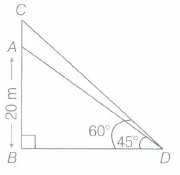
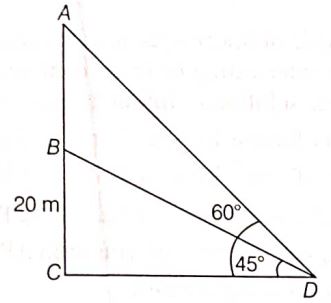
There is a flag staff on a tower of height 20 m. At a point on the ground, the angles of elevation of the foot and top of the ground, the angles of elevation of the foot and top of the flag are 45\(°\) and 60\(°\) respectively. Find the height of the flag staff.
2.
A straight tree is broken due to thunderstorm. The broken part is bent in such a way that the peak of the tree touches the ground at an angle of 60\(°\)at a distance of \(2\sqrt { 3 } m\) Find the whole height of the tree.
3.
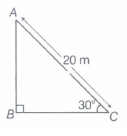
A circus artist is climbing a 20 m long rope, which is tightly stretched and tied from the top of a vertical pole to the ground. Find the height of the pole, if the angle made by the rope with ground level is \(30°\) (see figure)
4.
A pole being broken by the wind, its top struck the ground at an angle of 300, and at a distance of 10m from the foot of the pole.Find the whole height of the pole.
5.
The angles of depression of the top and bottom of a tower as seen from the top of a \(60\sqrt{3}\) m high cliff are 45o and 60o respectively.Find the height of the tower.
6.
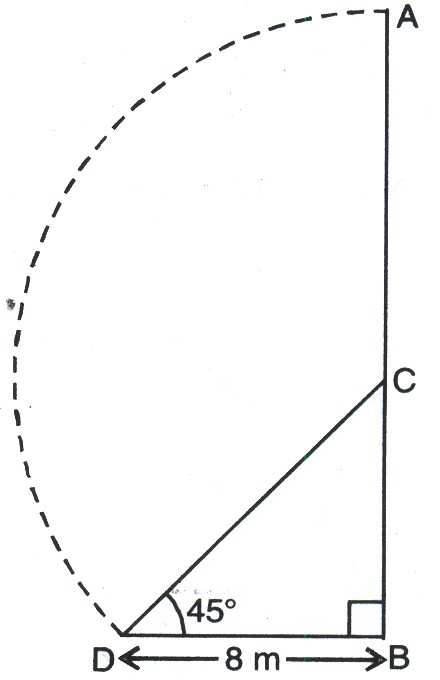
A tree breaks due to storm and the broken part bends so that the top of the tree touches the ground making an angle 45o with it. The distance between the foot of the tree to the point where the top touches the ground is 8 m. Find the height of the tree.
7.
The angle of elevation \(\theta\) of the top of a lighthouse, as seen by a person on the ground, is such that tan \(\theta =\frac { 5 }{ 12 } \). When the person moves a distance of 240 m towards the lighthouse, the angle of elevation becomes \(\phi \) such that tan \(\phi =\frac { 3 }{ 4 } \) . Find the height of the lighthouse.
8.
The angle of elevation of a cloud from a point 60 m above a lake is 30o and the angle of depression of the reflection of the cloud in the lake is 60o . Find the height of the cloud from the surface of the lake.
9.
From the top of a 7 m high building, the angle of elevation of the top of a cable tower is 60o and the angle of depression of its foot is 45o. Determine the height of the tower.
10.
From a point on the ground, the angles of elevation of the bottom and the top of a transmission tower fixed at the top of a 20 m high building are 45° and 60°. Find the height of the tower.
11.
From the first floor of Qutab Minar which is at a height of 25 m from the level ground, a man observes the top of a building at an angle of elevation of \({ 30 }^{ ° }\) and the angle of depression of the base of the building to be \({60 }^{ ° }.\)Calculate the height of the building.
12.
In right angled \(\Delta ABC,AC\) is hypotenuse,\(AB=12 cm\& \angle BAC=30°.\) Then, find the length of the side BC.
13.
A girl of height 100cm stands in front of lamppost and cast a shadow of length \(100\sqrt{3}\)cm on the ground.The angle of elevation of the top of the lamppost is
14.
Find the altitude of the sun, if the shadow of a vertical pole is \(1\over\sqrt{3}\)of its original height.
15.
From a point 100m above lake, the angle of elevation of stationary helicopter is 300 and angle of depression of the helicopter in the lake is 600.Find the height of the helicopter.
16.
The angles of elevation and depression of the top and bottom of a lighthouse from the top of a building, 60m high, are 300 and 600 respectively.
Find:
(i)the difference between the heights of the lighthouse and the building.
(ii)distance between the lighthouse and the building.
17.
A man on the top of a tower observes a trunk at an angle of depression \(\alpha\), where tan \(\alpha={1\over\sqrt{5}}\) and sees that it is moving towards the base of the tower.Ten minutes later the angle of depression of the truck is found to be \(\beta\), where tan \(\beta=\sqrt{5}\) .Assuming that truck moves at a uniform speed, determine how much more time it will take to reach the base of the tower.
18.
Write true and false and justify."The angle of elevation of the top of a tower is 30o. If the height of the tower is doubled, then the angle of elevation of its top will also be doubled."
19.
A circus artist is climbing a rope 12m long which is tightly stretched and tied from the top of a vertical pole to the ground. Find the height of the pole, if the angle made by the rope with the ground is 30o
20.
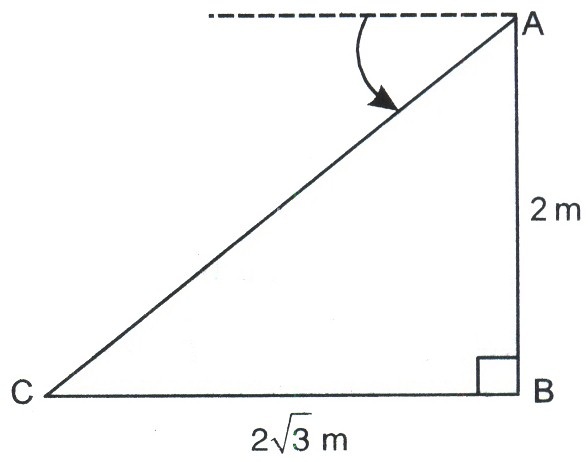
The figure shows the observation of point C from point A. Find the angle of depression from point A.
21.
A boy flying a kite has let out 60 m of string. If the angle of elevation of the kite is 60o , calculate the height of the kite above the ground.
22.
Find the length of the shadow of a 20 m tall pole, on the ground when the sun's elevation is 45o .
23.
A bridge across a river makes as angle of \({ 45 }^{ \circ }\)with the river bank. If the length of the bridge across the river is 150m, then find the width of the river.
24.
From the top of a tower 50 m high the angles of depression of the top and bottom of a pole are observed to be 45o and 60o respectively. Find the height of the pole.
25.
If two towers of height h1 and h2 subtends angles of 60o and 30o respectively at the mid points of line joining their feet, find h1 : h 2
26.
A highway leads to the foot of 300 m high tower. An observatory is set at the top of the tower. It sees a car moving towards it with an angle of depression becomes 60°.
(i) Find the distance travelled by the car during this time.
(ii) How this observatory is helpful to regulate the traffic on the highway?
27.
On a horizontal plane there is a vertical tower with a flag pole on the top of the tower. At a point 9 metres away from the foot of the tower the angles of elevation of the top and bottom of the flag pole are 60o and 30o respectively. Find the heights of the tower and flag pole mounted on it.
28.
If height of a tower and distance of the point of observation from its foot, both are increased by 50%, then angle of elevation of its top..............
29.
The length of the shadow of a tree 10 high, when the sun's elevation is 300 , is ..........
30.
The height of a tower is 10m.The height of its shadow when sun's altitude is 450 , is ...........
31.
The angle formed by the line of sight with horizontal, when the being viewed is above the horizontal level, is called angle of elevation.
32.
The length of shadow of a tree 7 m high, when Sun's elevation is \({ 45 }^{ ° }\)is 7 m.
33.
Two posts are 120m apart and the height of one is double that of the other.If from the middle point of the line joining their feet, an observer finds that the angular elevations of their tops to be complementary, then the height of the poles are \(30\sqrt{2}m\) and \(60\sqrt{2}m\)
34.
Trigonometric ratios are same for the same angles.
1.
Let AB be the tower and AC be the flag staff on the tower. Let D be a point on the ground such that the angles of elevation of foot A and top C of the flag staff are 45\(°\) and 60\(°\) respectively.
Then, we have AB = 20 m, \(\angle ADB=45° and \angle CDB=60°\)
In right angled \(\Delta ABD,\)
\(tan\quad 45°=\frac { AB }{ BD } \left[ \because tan\theta =\frac { P }{ B } \right] \)
\(\Rightarrow 1=\frac { 20 }{ BD } \)
\(\Rightarrow BD=20\quad m \left[ \because tan45°=1 \right] \)
and in right angled \(\Delta CBD,\)
\(tan 60°=\frac { BC }{ BD } \)
\(\sqrt { 3 } =\frac { BC }{ 20 } \left[ \because tan60°=\sqrt { 3 } \right] \)
\(\Rightarrow BC=20\sqrt { 3 } =20\times 1.732 \left[ \because \sqrt { 3 } =1,732 \right] \)
= 34.64 m (approx)
Now, AC = BC - AB = 34.64 - 20
=14.64 m (approx)
Hence, the height of the fleg staff is 14.64 m.
2.
Let AB be the tree whose part AC breaks and touches the ground at D
Then, BD = \(2\sqrt { 3 } m\)
and AC = CD
In right angled \(\Delta \)CBD,
\(cos 60°=\frac { B }{ H } =\frac { BD }{ CD } \)
\(\Rightarrow \frac { 1 }{ 2 } =\frac { 2\sqrt { 3 } }{ CD } \)
\(\left[ \because cos 60°=\frac { 1 }{ 2 } and BD=2\sqrt { 3 } m \right] \)
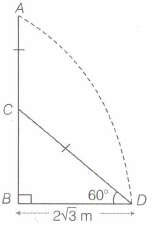
\(\Rightarrow\) \(CD=2\times 2\sqrt { 3 } =4\sqrt { 3 } \)
\(=4\times 1.732=6.928\ m [\because \sqrt { 3 } =1.732]\)
\(\therefore\) AC = CD = 6.928 m
Again, in right angled \(\Delta \)CBD,
\(tan\quad 60°=\frac { P }{ B } =\frac { BC }{ BD } \)
\(\Rightarrow \sqrt { 3 } =\frac { BC }{ 2\sqrt { 3 } } [\because tan60°=\sqrt { 3 } and BD=2\sqrt { 3 } m]\)
\(\Rightarrow BC=\sqrt { 3 } \times 2\sqrt { 3 } =6 m\)
Now, AB = AC + BC
= 6.928 + 6 = 12.928 m (approx)
Hence, the height of the tree is 12.928 m.
3.
In the given figure, AB is the height of the pole and AC = 20 m is the length of rope which is tied from the top of the pole to the ground at point C.
In right angled \(\Delta ABC\) ,
\(sin30°=\frac { AB }{ AC } =\frac { AB }{ 20 } \)
⇒ \(\frac { 1 }{ 2 } =\frac { AB }{ 20 } \Rightarrow AB=\frac { 20 }{ 2 } =10\quad m\)
Hence, the height of the pole is 10 m.
4.
17.32m
5.
Let AB be the tower of height h m and CD be the cliff of height 60\(\sqrt m\) m, such that
\(\angle \)XDA = \(\angle \)DAE = 45o and \(\angle \)XDB = \(\angle \)DBC = 60o
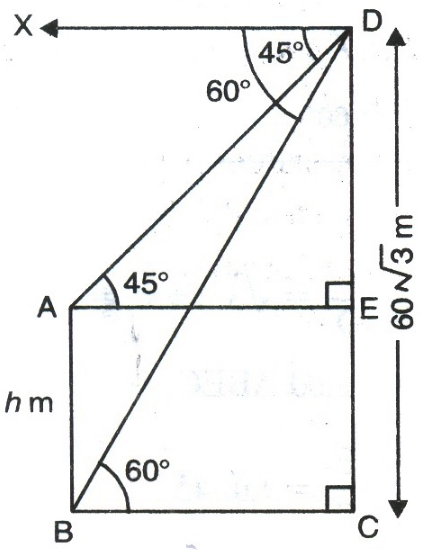
In rt. \(\triangle\)DCB,
\(DC\over BC\)=tan 60o
\(\frac { 60\sqrt { 3 } }{ BC } =\sqrt { 3 } \)
BC = 60m
Now BC = AE = 60m
and DE = DC - CE (or AB)
= \(60\sqrt { 3 } -h\)
Again in rt. \(\triangle\)DEA
\(\angle \)E = 90o
ஃ \(DE\over AE\)=tan 45o
\(\frac { 60\sqrt { 3 } -h }{ 60 } =1\)
⇒ 60\(\sqrt3\) - h = 60
⇒ h = 60\(\sqrt3\) - 60
⇒ h = 60(\(\sqrt3\)-1)
Hence the required height of the tower is 60(\(\sqrt3\)-1)m
6.
Let AB=h m be height of the tree and AC is the part of the broken tree. As ㄥCDB=450 and BD=8 m
Consider rt . angled ΔCBD, we have
tan45o=\(\frac { CB }{ DB } \)
1=\(\frac { CB }{ 8 } \)
⇒ CB=8 m
Also, cos450=\(\frac { DB }{ DC } \)
\(\frac { 1 }{ \sqrt { 2 } } =\frac { 8 }{ DC } \)
⇒ Dc=8\(\sqrt { 2 } \)
Total height of the tree AB=AC+CB
=CD+CB
=8\(\sqrt { 2 } \)m+8m
=8(\(\sqrt { 2 } \) +1)m
7.
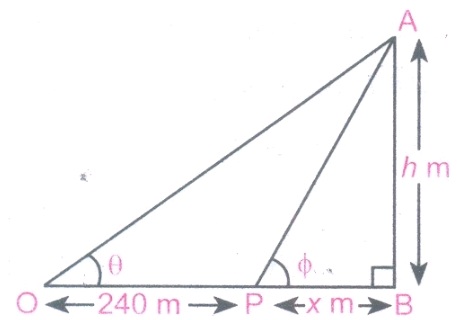
Let height of lighthouse be h meters. From point O angle of elevation is ፀ and from point P is ф, OP = 240 m.
Let PB = x metres ,
tanፀ = \(\frac { 5 }{ 12 } ;tan\phi =\frac { 3 }{ 4 } \)
In right angled ΔOBA,
\(\frac { AB }{ OB } =tan\theta \Rightarrow \frac { h }{ 240+x } =\frac { 5 }{ 12 } \) .......(i)
In right angled ΔPBA,
\(\frac { AB }{ PB } =tan\phi \Rightarrow \frac { h }{ x } =\frac { 3 }{ 4 } \).....(ii)
Dividing (i) by (ii), we get
\(\frac { h }{ 240+x } \times \frac { x }{ h } =\frac { 5 }{ 12 } \times \frac { 4 }{ 3 } \)
⇒ \(\frac { x }{ 240+x } =\frac { 5 }{ 9 } \) ⇒ 9x = 1200 + 5x
⇒ 4x = 1200 ⇒ x = 300
Putting x = 300 in (ii) we get, h = 3/4 x 300 = 225
Hence height of lighthouse is 225 metres.
8.
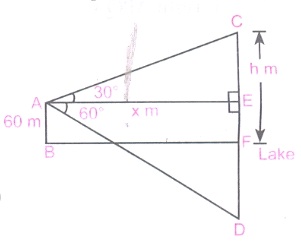
Let height of the cloud C from lake be h m . A is position of the point 60 m above the lake. D is the reflection of the cloud in lake .
Let AE=x m, CF=h m, CE=(h-60)m
DE=(60+h)m.
In right angled triangle AEC
\(\frac { AE }{ EC } \)=cot 300
AE=(h-60)\(\sqrt { 3 } \) .........(i)
In right angled triangle AED,
\(\frac { AE }{ ED } =cot60^{ 0 }\quad \Rightarrow \quad AE=\frac { h+60 }{ \sqrt { 3 } } \) .............(ii)
From (i) and (ii), we get
\((h-60)\sqrt { 3 } =\frac { h+60 }{ \sqrt { 3 } } \)
⇒ 3h-180=h+60 ⇒ 2h=240 ⇒ h=120 m.
∴ Height of the cloud above the lake is 120 m.
9.
Let AD = 7 m be the height of the building and BC = h m be the height of the cable tower. From the top of the building D, the angles of elevation and depression are \(\angle\)CDE = 60o and \(\angle\)EDB = 45o
From the point D, draw a line DE || AB.
Then, \(\angle\)EDB = \(\angle\)ABD = 45o [alternate angles]

Also, let AB = DE = x m be the distance between building and tower.
In right angled \(\Delta\)BAD,
\(\begin{array}{rlrl} \tan 45^{\circ} & =\frac{P}{B}=\frac{A D}{A B} \\ \end{array}\)
\(\begin{array}{rlrl} \Rightarrow \quad 1 & =\frac{7}{x} & {\left[\because \tan 45^{\circ}=1\right]} \end{array}\)
\(\Rightarrow\) x = 7 m ....(i)
and in right angled \(\Delta\)CED,
\(\begin{aligned} & \tan 60^{\circ}=\frac{C E}{D E}=\frac{C B-B E}{A B}[\because C E=C B-B E] \\ \end{aligned}\)
\(\begin{aligned} & \Rightarrow \quad \sqrt{3}=\frac{b-7}{x} \quad\left[\because \tan 60^{\circ}=\sqrt{3}\right\} \\ \end{aligned}\)
\(\begin{aligned} & \Rightarrow \quad b-7=x \sqrt{3} \\ \end{aligned}\)
\(\begin{aligned} & \Rightarrow \quad h=x \sqrt{3}+7 \\ \end{aligned}\)
\(\begin{aligned} & \Rightarrow \quad h=7 \sqrt{3}+7 \quad \text { [from Eq. (i)] } \\ \end{aligned}\)
\(\begin{aligned} & \Rightarrow \quad h=7(\sqrt{3}+1) \mathrm{m} \\ \end{aligned}\)
Hence, the height of the tower is \(7(\sqrt{3}+1) \mathrm{m} .\)
10.
Let BC be the building, AB be the transmission tower and D be the point on the ground from where the angles of elevations are to be measured.
\(\begin{array}{rlrl}
\text { In } \triangle B C D, & \tan 45^{\circ} =\frac{B C}{C D} \\
\end{array}\)
\(\begin{array}{rlrl}
\Rightarrow 1 =\frac{20}{C D} \Rightarrow C D=20 \mathrm{~m}
\end{array}\)
\(\begin{array}{llrl}
\text { In } \triangle A C D, & \tan 60^{\circ} =\frac{A C}{C D}
\end{array}\)
\(\begin{array}{llrl}
\Rightarrow \sqrt{3} =\frac{A B+B C}{C D} \\
\end{array}\)
\(\begin{array}{llrl}
\Rightarrow \sqrt{3} =\frac{A B+20}{20} \\
\end{array}\)
\(\Rightarrow A B =20 \sqrt{3}-20=20(\sqrt{3}-1) \mathrm{m}\)
Thus, the height of the tower is \(20(\sqrt{3}-1) \mathrm{m}\).
11.
33.33 m
12.
Let x m be the length of the side BC.
Given, \(AB=12 cm \& \angle BAC=30°\)
In right angled \(\Delta ABC,\)
\(\tan { 30° } =\frac { BC }{ AB } \)
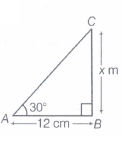
\(\Rightarrow \frac { 1 }{ \sqrt { 3 } } =\frac { x }{ 12 } \left[ \therefore \tan { 30° } =\frac { 1 }{ \sqrt { 3 } } \right] \)
\(\Rightarrow \sqrt { 3 } \times x=12\Rightarrow x=\frac { 12 }{ \sqrt { 3 } } \)
\(\Rightarrow x=\frac { 12 }{ \sqrt { 3 } } \times \frac { \sqrt { 3 } }{ \sqrt { 3 } } \) [by rationalising]
\(=\frac { 12\sqrt { 3 } }{ 3 }\)
\( =4\sqrt { 3 }cm\)
Hence, the length of the side BC is \(4\sqrt { 3 }cm\)
13.
300
14.
600
15.
200m
16.
(i)20m
(ii)34.64m
17.
150 seconds
18.
False,
Since \(\frac { h }{ x } =\tan { { 30 }^{ 0 } } \)
\(\frac { h }{ x } =\frac { 1 }{ \sqrt { 3 } } \)
\(\Rightarrow h=\frac { x }{ \sqrt { 3 } } \)
Let h be changed to 2h
\(\therefore \frac { 2h }{ x } =\tan { \theta } \Rightarrow \frac { 2x/\sqrt { 3 } }{ x } =\tan { \theta } \)
\(\Rightarrow \frac { 2 }{ \sqrt { 3 } } =\tan { \theta } \quad \)
-S.png)
Also \(\tan { { 60 }^{ 0 } } =\sqrt { 3 } \)
\(Since\frac { 2 }{ \sqrt { 3 } } \neq \sqrt { 3 } \)
\(\theta \neq { 60 }^{ 0 }\)
-S.png)
19.
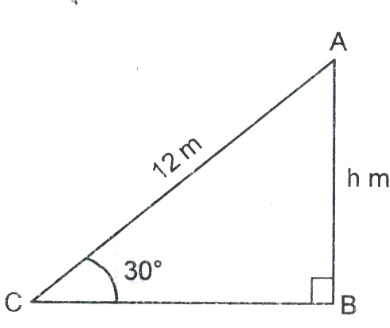
Let AB=h m be the height of the pole
AC=12 m is the length of rope
and ㄥACB=30o
Consider rt. angled ΔABC, we have
sin 300=\(\frac { AB }{ AC } \)
\(\frac { 1 }{ 2 } =\frac { h }{ 12 } \)
h=\(\frac { 12 }{ 2 } \)=6 m
20.
In art. \(\triangle\)ABC, \(\angle\)B = 90°
\(\therefore\) AB = 2 m, BC = \(2\sqrt{3}\)m
Let \(\angle\)ACB = \(\theta\)
\(\therefore\) tan \(\theta={{AB}\over{BC}}={{2}\over{2\sqrt{3}}}\)
tan \(\theta ={{1}\over{\sqrt{3}}}\Rightarrow{\theta}=30°\)
21.
52 m
22.
20 m
23.
\(75\sqrt { 2 } m\)
24.
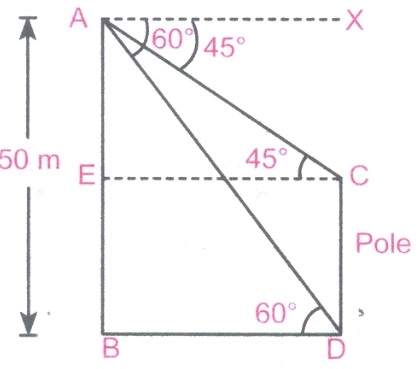
In ΔABD, \(\frac { BD }{ AB } \)=cot 60o
⇒ \(\frac { BD }{ 50 } =\frac { 1 }{ \sqrt { 3 } } \Rightarrow BD\frac { 50 }{ \sqrt { 3 } } \)
BD=EC⇒ EC=\(\frac { 50 }{ \sqrt { 3 } } \)
In ΔAEC, \(\frac { AE }{ EC } \)=tan 45o
⇒ ΔAEC, \(\frac { AE }{ EC } \)=tan 45o
⇒ AE=EC⇒ AE=\(\frac { 50 }{ \sqrt { 3 } } \)m
Now BE=AB-AE=50-\(\frac { 50 }{ \sqrt { 3 } } \)
=\(\frac { 50\sqrt { 3 } -50 }{ \sqrt { 3 } } \)
=\(\frac { 50(\sqrt { 3 } -1) }{ \sqrt { 3 } } \)
DC=BE=\(\frac { 50(\sqrt { 3 } -1) }{ \sqrt { 3 } } \)m
25.
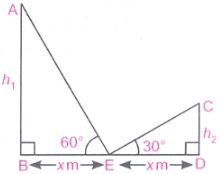
Let AB and CD are towers of height h1 and h2 respectively
If F. is the midpoint of BD then BE = DE = x
In right \(\Delta\)ABE
\(\frac { { h }_{ 1 } }{ x } =\tan { { 60 }^{ o } } \)
\(\Rightarrow\) \({ h }_{ 1 }=\sqrt { 3 } x\) ...(i)
In right \(\Delta\)CDE
\(\frac { { h }_{ 2 } }{ x } =\tan { { 30 }^{ o } } \Rightarrow { h }_{ 2 }=\frac { x }{ \sqrt { 3 } } \)
Now \(\frac { { h }_{ 1 } }{ { h }_{ 2 } } =\frac { \sqrt { 3 } x }{ \frac { x }{ \sqrt { 3 } } } =\frac { 3 }{ 1 } \) \(\Rightarrow\) h1 : h2 = 3 : 1
26.
(i) 14.66 km
(ii) Presence of mind, ability to take promote decisions.
27.
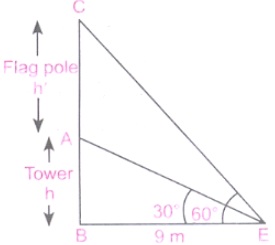
Given: AB be the tower and AC the flag pole on top of the tower.
ㄥCEB=60o, ㄥAEB=30o
To find Height of the tower and the height of the flag pole. Let height of the tower and flag pole be h m and h'm respectively.
Solution: In right ∆ABE
=\(\frac { AB }{ BE } =tan{ 30 }^{ 0 }\Rightarrow \frac { h }{ 9 } =\frac { 1 }{ \sqrt { 3 } } \)
h=\(\frac { 9 }{ \sqrt { 3 } } m=\frac { 9 }{ \sqrt { 3 } } =\frac { 9\sqrt { 3 } }{ 3 } m=3\sqrt { 3 } =5.196\)m .....(i)
In right ΔCBE,
\(\frac { CB }{ BE } =tan600\Rightarrow \frac { h+{ h }^{ ' } }{ BE } =tan60^{ 0 }\)
\(\frac { h+h' }{ BE } =\sqrt { 3 } \)
⇒ h+h'=\(9\sqrt { 3 } \) .......(ii)
\(h'=\frac { 27-9 }{ \sqrt { 3 } } =\frac { 18\times \sqrt { 3 } }{ \sqrt { 3 } \times \sqrt { 3 } } =\frac { 18\sqrt { 3 } }{ 3 } =6\sqrt { 3 } \)m
=6 x 1.732 m=10.392 m
Height of flag pole mounted on tower=10.392 m.
28.
()
remains unchanged
29.
()
\(10\sqrt{3}m\)
30.
()
10m
31.
(a)
32.
(a)
33.
(a)
34.
(a)

10th Standard CBSE Syllabus & Materials
10th Standard CBSE
CBSE 10th Social Science PS - Federalism - New Model Questions Papers Study Material - QB365 Set A
NEW10th Standard CBSE
CBSE 10th Social Science PS - Power Sharing - New Model Questions Papers Study Material - QB365 Set A
NEW10th Standard CBSE
CBSE 10th Social Science GEO - Manufacturing Industries - New Model Questions Papers Study Material - QB365 Set A
NEW10th Standard CBSE
CBSE 10th Social Science GEO - Minerals and Energy Resources - New Model Questions Papers Study Material - QB365 Set A



CBSE 10th Standard CBSE Subjects
CBSE Standards





