
 100% FREE ACCESS
11th Standard CBSE Syllabus & Materials
11th Standard CBSE
CBSE 11th Economics PART-A - Presentation of Data - New Sample Question Papers Study Material - QB365 Set A
NEW11th Standard CBSE
CBSE 11th Economics PART-A - Organisation of Data - New Sample Question Papers Study Material - QB365 Set A
NEW11th Standard CBSE
CBSE 11th Economics PART-A - Collection of Data - New Sample Question Papers Study Material - QB365 Set A
NEW11th Standard CBSE
CBSE 11th Economics PART-A - Introduction to Economics and Statistics - New Sample Question Papers Study Material - QB365 Set A
NEW11th Standard CBSE
CBSE 11th Business Studies International Trade Sample Question Papers Study Material - QB365 Set A
NEW11th Standard CBSE
CBSE 11th Business Studies Evolution and Fundamentals of Business Sample Question Papers Study Material - QB365 Set A

Published on: 05/03/2019
State of Matter Important Questions
Download CBSE Class 11th Standard CBSE Chemistry question papers, sample papers, important questions, and previous year solved papers in PDF format. Get free study materials, NCERT solutions, and exam preparation resources for Class 11th Standard CBSE Chemistry
Questions + Answers key
Take MCQ Chemistry Test
1.
What is meant by elastic collision?
2.
The relation between pressure exerted by an ideal gas(p ideal) and observed pressure (Preal) is given by the equation,\({ P }_{ ideal }={ P }_{ real }+\frac { { an }^{ 2 } }{ { V }^{ 2 } } \)
3.
Two moles of a real gas confined in a 5 L flask exerts a pressure 9.1 atm at a temperature of 27o C .Calculate the value of 'a'. Give the value of b is 0.052 L mol-1
4.
Explain the effect of increasing temperature of a liquid on intermolecular forces operating between its particles. What will happen to the viscosity of a liquid if its temperature is increased?
5.
180 g of steam is contained in a vessel of 25 L capacity under a pressure of 50 bar. Calculate the temperature of the steam. Given that for water vapour, a = 5.46 bar L2mol-2 and b = 0.031 L mol-1.
6.
Pay load is defined as the difference between the mass of the displaced air and the mass of the balloon. Calculate the pay load when a balloon of radius 10 m, mass 100 kg is filled with helium at 1.66 bar at 27oC (Density of air = 1.2 kg m-3 and R = 0.083 bar dm3 K-1 mol-1).
7.
What are ideal and real gases? Out of CO2 and NH3 gases, which is expected to show more deviation from the ideal gas behaviour?
8.
Give an expression for the van der Waals equation. Giv,t the significance of the constants used in the equation. What are their units?
9.
The variation of the vapour pressure of different liquids with temperature is shown in the figure below.
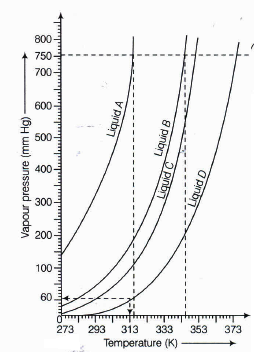
Pressure cooker is used for cooking food at the hill station. Explain in terms of vapour pressure why is it so?
10.
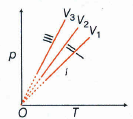
What do you understand by term isochore? Given below is the plot of pressure (p) versus temperature (T) for a certain volume of ideal gases I, II and III respectively. Give the correct order of volumes V1, V2 and V3.
11.
Pressure versus volume graph for a real gas and an ideal gas are shown in figure. Answer the following questions on the basis of the graph.
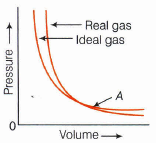
Interpret the behaviour of real gas with respect to ideal gas at high pressure.
12.
Rohan takes an open pan to cook vegetables and pulses at a hill station while Sohan cooks pulses and vegetables in a pressure cooker at the same place.The gas cylinder of Rohan lasts for only 15 days whereas Sohan uses one gas cylinder per month.
What is reason for delay in cooking by Rohan?
13.
A density of a gas is found to be 6.46 g dm-3 at 25o C and 5 bar pressure. What will be its density at STP?
14.
At 25°C and 760 mm of Hg pressure a gas occupies 600 mL volume. What will be its pressure at a height where temperature is 10°C and volume of the gas is 640 mL?
15.
A certain amount of a gas at 27°C and 1 bar pressure occupies a volume of 25 m3. If the pressure is kept constant and the temperature is raised to 77oC, what will be the volume of the gas?
16.
Density of a gas is found to be 5.46 g/dm3 at 27 C and 2 bar pressure. What will be its density at STP?
Notes: STP mean at 1 bar and 273 K, so compare the density at 27\(^{o}\) C and 2 bar with density at STP by using the relation d = pM/RT
17.
A large flask fitted with a stop-cock is evacuated and weighted; it mass is found to be 134.567g. It is then filled to a pressure of 735 mm at 31oC with a gas of unknown molecular mass and then reweighted; it mass is 137.456 g. The flask is then filled with water and weighed again; its mass is now 1067.9 g. Assuming that the gas is ideal, calculate the molar mass of the gas.
18.
0.64 g of an oxide of sulphur occupies 0.224 L at 2 bars and 273oC. Identify the compound.Also, find out the mass of one molecular of the gas.
19.
Compare the temperature of 3 moles of SO2 at 15 bar occupying a volume of 10 L obtained by the ideal gas equation and van der Waals equation. (a = 6.7 bar L2 mol-2, b = 0.0564 L mol-1).
20.
Write expression for Boyle temperature and critical temperature in terms of van der Waals constants.Which one is greater for a particular gas?
21.
The van der Waals constants for two gases are as follows
| Gas | a(atmL2mol-2) | b(L mol-1) |
| X | 1.39 | 0.0391 |
| Y | 3.59 | 0.0427 |
Which of them is more easily liquefiable and which has a greater molecular size?
22.
A gas that follows Boyle's law, Charle's law and Avogadro's law is called an ideal gas.Under what condition a real gas would behave ideally?
23.
The magnitude of surface tension of liquid depends on the attractive forces between the molecules. Arrange the following in increasing order of surface tension water, alcohol (C2H5OH) and hexane [CH3(CH2)4CH3].
24.
Which of the following gases will have the lowest rate of diffusion?
H2
N2
F2
O2
25.
In van der Waals equation of state for a non-ideal gas the net force of attaction among the molecules is given by
\(\frac{an^2}{V^2}\)
P+\(\frac{an^2}{V^2}\)
P-\(\frac{an^2}{V^2}\)
-\(\frac{an^2}{V^2}\)
26.
Which of the following is the correct mathematical relation for Charles law at constant pressure?
V\(\alpha\)T
V\(\alpha\)t
V\(\alpha\)\(\frac{1}{2}\)
all of above
1.
Collision in which there is no loss of kinetic energy but there is transfer of energy, is called elastic collision.
2.
If units of p = atm, units of V = dm3 ,units of n = mol then,units of
\(a=\frac { { pV }^{ 2 } }{ { n }^{ 2 } } =\frac { atm.({ dm }^{ 3 })^{ 2 } }{ (mol)^{ 2 } } =atm \ dm^{ 6 } \ mol^{ -2 }\)
3.
\(\left( P+\frac { { an }^{ 2 } }{ { V }^{ 2 } } \right) (V-nb)=nRT\)
\(a=\left( \frac { nRT }{ V-nb } -p \right) \times \frac { { V }^{ 2 } }{ { n }^{ 2 } }\)
\( n=2 mo,V=5 \ L,p=9.1 atm,T=273+27=300 K\)
\(R=0.082L\ atm \ { mol }^{ -1 }K^{ -1 }\)
\(\\ a=\left( \frac { 2\times 0.0082\times 300 }{ (5-2\times 0.052) } -9.1 \right) \times \frac { { (5) }^{ 2 } }{ { (2) }^{ 2 } }\)
\(=\frac { 49.2 }{ 4.896 } -9.1\times \frac { 25 }{ 4 } =(10.05\times 9.1)\times \frac { 25 }{ 4 }\)
\( =5.94 \ atm \ L^{ 2 } \ mol^{ -2 }\)
4.
As the temperature of a liquid increases, kinetic energy of the molecules increases which can overcome intermolecular forces. So, the liquid can flow more easily, this results in decrease in viscosity of the liquid.
5.
T = 1513.33K
6.
Radius of the balloon = 10 m
\(\therefore\)Volume of the balloon = \(\frac{4}{3}\pi\)r2 = \(\frac{4}{3}\times\frac{22}{7}\times\)(10m)3 = 4190.5 m3
Volume of He filled at 1.66 bar and 27°C = 4190.5 m3
Calculation of mass of He
PV = nRT = \(\frac { w }{ M } \)RT
or \(w\) = \(\frac{MPV}{RT}\) = \(\frac { (4\times { 10 }^{ -3 }kgmol^{ -1 })(1.66bar)(4190.5\times 103dm^{ 3 }) }{ (0.083bardm^{ 3 }K^{ -1 }mol^{ -1 })(300K) } \)
= 1117.5 kg
Total mass of the balloon along with He = 100 + 1117.5 = 1217.5 kg
Maximum mass of the air that can be displaced by balloon to go up = Volume x Density
= 4190.5 m3 x 1.2 kg m-3 = 5028.6 kg
\(\therefore\) Pay load = 5028.6 - 1217.5 kg = 3811.1 kg
7.
Ideal Gas: A gas that follows Boyle's law, Charles' law and Avogadro law strictly, is called an ideal gas. It is assumed that intermolecular forces are not present between the molecules of an ideal gas.
Real Gases: Gases which deviate from ideal gas behaviour are known as real gases. NH3 is expected to show more deviation. Since NH3 is polar in nature and it can be liquified easily.
8.
\(\left( p+\frac { { n }^{ 2 }a }{ { V }^{ 2 } } \right) \)(V - nb) = nRT
When n is the no. of moles present and' a' and 'b' are known as van der Waals constants.
constants.
Significance of van der Waals constants
van der Waals constant ' a': 'a' is related to the magnitude of the attractive forces among the molecules of a particular gas. Greater the value of 'a', more will be the attractive forces.
Unit of 'a' = L2 mol-1
van der Waals Constant 'b': 'b' determines the volume occupied by the gas molecules
which depends upon size of molecule.
Unit of 'b' = L mol-1.
9.
A liquid boils when vapour pressure becomes equal to atmospheric pressure. At hill station, atmospheric pressure is low. Therefore, liquid boils at a lower temperature and cooking is not perfect. In a pressure cooker, the pressure inside the cooker increases and the liquid boils at a higher temperature.
10.
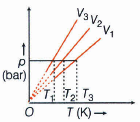
Isochore is plot of p vs T for a definite amount of a gas at constant volume. It is a graphical representation of Gay-Lussac or Amonton's law. For different isochores at different volumes, draw a line parallel to the temperature axis representing a constant pressure and cutting the three isochores at T1, T2, T3 respectively. From the graph we find that T1 > T2 > T3. As V \(\propto \) T at constant p.
Thus, V1 > V2 > V3
11.
At high pressure, the real gas shows large deviations from ideal behaviour as the curves are far apart.
12.
The atmosphere pressure is less at hill station due to which water boils below 100\(^{0}\)C and vegetables and pulses take ling time in cooking
13.
From ideal gas equation we have,
\(pV=nRT \ or \ p=\frac { m }{ v } \times \frac { RT }{ M } =\frac { dRT }{ M } \)
\( d \ =\frac { pM }{ RT } \)
\( or \ d\alpha \frac { p }{ T } \ [R \ and \ M \ constant \ for \ a \ given \ gas]\)
\( \frac { { d }_{ 1 } }{ { d }_{ 2 } } =\frac { { p }_{ 1 } }{ { p }_{ 2 } } \times \frac { { T }_{ 2 } }{ { T }_{ 1 } } or \ { d }_{ 2 }=\frac { { d }_{ 1 }\times { p }_{ 2 }\times { T }_{ 1 } }{ { p }_{ 1 }\times { T }_{ 2 } }\)
\( { d }_{ 1 }=6.46 \ g \ { dm }^{ -3 },\ { p }_{ 1 }=5bar,\)
\({ T }_{ 1 }=273+25=298k\)
\( { d }_{ 2 }=?,\ { p }_{ 2 }=1 \ bar,{ T }_{ 2 }=27k\)
\( { d }_{ 2 }=\frac { 6.46g{ dm }^{ -3 }\times 1 \ bar\times 298k }{ 5 \ bar\times 273k }\)
\( =1.41 \ g{ dm }^{ -3 }\)
14.
P1 = 760 mm Hg, V1 = 600 mL
T1 = 25 + 273 = 298 K
V2 = 640 mL and T2=10 + 273 = 283 K
According to combined gas law,
\(\frac { { P }_{ 1 }V_{ 1 } }{ { T }_{ 1 } } =\frac { { P }_{ 2 }V_{ 2 } }{ { T }_{ 2 } } \)
\(\Rightarrow \) P2 = \(\frac { { p }_{ 1 }{ V }_{ 1 }{ T }_{ 2 } }{ { T }_{ 1 }{ V }_{ 2 } } \)
\(\Rightarrow \) P2 = \(\frac { (760 \ mm \ Hg)\times (600 \ mL)\times (283K) }{ (640mL)\times (298K) } \)
= 676.6 mm Hg
15.
From the available data:
V1 = 25 m3 T1 = 27 + 273 = 300K
V2 = ? T2 = 77 + 273 = 350K
Since the pressure of the gas is constant, Charles' law is applicable
\(\frac { { V }_{ 1 } }{ { V }_{ 2 } } =\frac { { T }_{ 1 } }{ T_{ 2 } } \) or V2=\(\frac { { V }_{ 1 }\times { V }_{ 2 } }{ { T }_{ 1 } } \)
v2 = \(\frac { \left( { 25m }^{ 3 } \right) \times \left( 350 \right) K }{ (300K) } \) = 29.17 m3.
16.
Density, d = pM/RT
For same gas at different temperatures and pressures
\(\cfrac { { d }_{ 2 } }{ d_{ 1 } } =\cfrac { { p }_{ 2 }{ T }_{ 1 } }{ { p }_{ 1 }{ T }_{ 2 } }\)
\( { d }_{ 2 }=\cfrac { { p }_{ 2 }{ T }_{ 1 }d_{ 1 } }{ { p }_{ 1 }{ T }_{ 2 } } \)
\(\cfrac { 1\times 300\times 5.46 }{ 2\times 273 } \)
= 3 g dm-3
17.
80.25 mol-1
18.
Compound = SO2 Mass of one molecule of gas = 1.07 x 10⁻²²g
19.
Temperature by ideal gas equation = 602.4 K
Temperature by van der waals equations = 153.38 k
20.
()
The temperature at which a real gas obeys ideal gas law over an appreciable range of pressure, is called Boyle temperature or Boyle point.
The temperature above which a gas cannot be liquefied.
21.
()
Greater the value of 'a' more easily the gas is liquefiable. Similarly, y, greater the value of 'be, greater is the molecular size. Hence, gas 'Y' will be more easily liquefiable and will have greater molecular size.
22.
()
A low pressure and high temperature, a real gas behaves as an ideal gas.
23.
()
In hexane, there are only London forces between the molecules. The forces are very weak. H-bonding is stronger in H2O in comparison to C2H5 OH. Hence, the increasing order of surface tension is hexane < alcohol < water.
Greater is the attractive forces between the molecules, greater is the magnitude of surface tension of liquid.
24.
(c)
F2
25.
(a)
\(\frac{an^2}{V^2}\)
26.
(a)
V\(\alpha\)T

11th Standard CBSE Syllabus & Materials
11th Standard CBSE
CBSE 11th Business Studies Forms of Business Organisation Sample Question Papers Study Material - QB365 Set A
NEW11th Standard CBSE
CBSE 11th Business Studies Business, Trade and Commerce Sample Question Papers Study Material - QB365 Set A
NEW11th Standard CBSE
CBSE 11th Physics Waves Sample Question Papers Study Material - QB365 Set A
NEW11th Standard CBSE
CBSE 11th Physics Kinetic Theory Sample Question Papers Study Material - QB365 Set A



CBSE 11th Standard CBSE Subjects
CBSE Standards









