
 100% FREE ACCESS
11th Standard CBSE Syllabus & Materials
11th Standard CBSE
CBSE 11th Economics PART-A - Presentation of Data - New Sample Question Papers Study Material - QB365 Set A
NEW11th Standard CBSE
CBSE 11th Economics PART-A - Organisation of Data - New Sample Question Papers Study Material - QB365 Set A
NEW11th Standard CBSE
CBSE 11th Economics PART-A - Collection of Data - New Sample Question Papers Study Material - QB365 Set A
NEW11th Standard CBSE
CBSE 11th Economics PART-A - Introduction to Economics and Statistics - New Sample Question Papers Study Material - QB365 Set A
NEW11th Standard CBSE
CBSE 11th Business Studies International Trade Sample Question Papers Study Material - QB365 Set A
NEW11th Standard CBSE
CBSE 11th Business Studies Evolution and Fundamentals of Business Sample Question Papers Study Material - QB365 Set A

Published on: 30/07/2018
From the chapter State of Matter, some of the important questions are covered in this question paper. The questions are covers from the book back and the previous year questions.
Teachers can examine their student’s knowledge. They can prepare plenty of question paper with answer key. For subscription, please Click Here.
Download CBSE Class 11th Standard CBSE Chemistry question papers, sample papers, important questions, and previous year solved papers in PDF format. Get free study materials, NCERT solutions, and exam preparation resources for Class 11th Standard CBSE Chemistry
Questions + Answers key
Take MCQ Chemistry Test
1.
Isotherms of carbon dioxide at various temperatures are represented in the figure. Answer the following questions based on the figure.
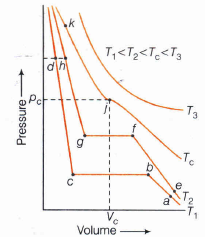
What portion of the isotherm at T1 represent liquid and gaseous CO2 at equilibrium?
2.
Calculate the total and average kinetic energy of 32 g methane molecules at 27oC(R = 8.314 JK-1 mol-1 )
3.
Calculate the total presure in a mixture of 4 g of 02 and 2 g of H2 confined to a total volume of 1 L at 0oC (R = 0.0821 L atm mol-1).
4.
A balloon is filled with hydrogen at room temperature. It will burst if pressure exceeds 0.2 bar. If at 1 bar pressure the gas occupies 2.27 L volume, upto what volume can the balloon be expanded?
5.
Write expression for Boyle temperature and critical temperature in terms of van der Waals constants.Which one is greater for a particular gas?
6.
What is SI unit of surface tension?
7.
The pressure exerted by saturated water vapor is called aqueous tension.what correction term will you apply to the total pressure to obtain a pressure of the dry gas?
8.
How much time would it take to distribute one Avogadro number of wheat grains if 1010 grains are distributed each secon.
9.
Explain the physical significance of van derWaals' parameters.
10.
What is the difference between normal boiling point and standard boiling point?
11.
Name two intermolecular force that exists between HF molecules in a liquid state.
12.
What is the value of gas constant in SI units?
13.
Calculate the temperature of 4.0 moles of a gas occupying 5 dm3 at 3.32 bar (R = 0.083 bar dm3 k-1 mol-1)
14.
Calculate the total number of electrons present in 1.4g of dinitrogen gas. Convert the given mass into mole with the help of the formula, moles = \(\frac { mass }{ molecular\ mass } \) 1 mole = \(6.022\times { 10 }^{ 23 }molecule\)
15.
Critical temperature for carbon dioxide and methane are 31.1o C and -81.9o C respectively.Which of these has stronger intermolecular forces and why?
16.
Compressibility factor, Z of a gas is given as \(Z=\frac { pV }{ nRT } \) What is the value of Z an ideal gas?
17.
Explain the effect of increasing temperature of a liquid on intermolecular forces operating between its particles. What will happen to the viscosity of a liquid if its temperature is increased?
18.
Prove that the excluded volume 'b' is four times the actual volume of the gas molecules.
19.
Density of a gas is found to be 5.46 g/dm3 at 27 C and 2 bar pressure. What will be its density at STP?
Notes: STP mean at 1 bar and 273 K, so compare the density at 27\(^{o}\) C and 2 bar with density at STP by using the relation d = pM/RT
20.
Calculate the total pressure in a mixture of 8 g of dioxygen and 4 g of dihydrogen confined in a vessel of 1 dm3 at 27\(^{o}\)C. (R = 0.083 bar dm3 K-1 mol-1)
21.
A student forgot to add the reaction mixture to the round bottom flask at 27\(^{o}\) C but instead, he/she placed the flask on the flame. After a lapse of time, he realized his mistake and using a pyrometer he found the temperature of the flask was 477 C. What fraction of air would have been expelled out?
1.
Between 'b' and 'c' is the portion of isotherm at which liquid CO2 is in equilibrium with gaseous CO2.
2.
Total K.E = 74826 J Average K.E, K.E = 6.1 x 10⁻²¹ J mole-1 J
3.
Pt = 25.21 atm
4.
According to Boyle's law, \({ p }_{ 1 }{ V }_{ 1 }={ p }_{ 2 }{ V }_{ 2 }\)
\(1bar\times 2.27L=0.2bar\times { V }_{ 2 }\)
\(or \ { V }_{ 2 }=\frac { 1bar\times 2.27L }{ 0.2bar }\)
\( =11.35L\)
Since, balloon burst at 0.2 bar pressure, the volume of balloon should be less than 11.35 L.
5.
()
The temperature at which a real gas obeys ideal gas law over an appreciable range of pressure, is called Boyle temperature or Boyle point.
The temperature above which a gas cannot be liquefied.
6.
()
Unit of surface tension is Nm-1
7.
()
pdrygas = pmoist gas (i.e total pressure)-aqueous tension.
8.
()
Time required = \(\frac { Total\ grains }{ grains\ distributed } =\frac { 6.022\times { 10 }^{ 23 } }{ { 10 }^{ 10 } } \)
= 6.022\(\times \)1013
\(=\frac { 6.022\times { 10 }^{ 13 } }{ 365\times 24\times 60\times 60 }\)
\(=1.909\times { 10 }^{ 6 }yr\)
9.
()
a is measure of magnitude of intermolecular forces of attraction while b is a measure of the effective volume of the gas molecules.Value of a and b depends upon the characteristics of a gas.
10.
()
When the external pressure is equal to one atmosphere pressure, the boiling point is called normal boiling point. When the external pressure is 1 bar, it is called standard boiling point.
11.
()
HF molecules are polar covalent molecules.In a liquid state, there are dipole-dipole interactions and H-bonding.
12.
()
8.314 JK-1 mol = -1
13.
Apply ideal gas equation, pV = nRT
\(T=\frac { pV }{ Rn } =\frac { 3.32 \ bar\times 5{ dm }^{ 3 } }{ 0.083 \ bar \ { dm }^{ 3 }{ k }^{ -1 }{ mol }^{ -1 }\times 4 \ mol } \)
\(T=50 \ k \)
14.
\({ n }_{ { N }_{ 2 } }=\frac { 14 }{ 28 } =0.05mol\)
\( 1mol=6.022\times { 10 }^{ 23 } \ molecules\)
\( 0.05mol=0.05\times 6.022\times { 10 }^{ 23 }\)
\(=0.3011\times { 10 }^{ 23 }\quad molecules\)
\( 1 \ molecules \ of \ { N }_{ 2 } \ contains \ -14 \ electrons\)
\( 0.3011\times { 10 }^{ 23 } \ 0.3011\times { 10 }^{ 23 } \ will \ contain\)
\( =0.3011\times { 10 }^{ 23 }\times 14=4.2154\times { 10 }^{ 23 } \ electrons\)
15.
Critical temperature is the temperature above which the gas cannot liquefied, how so ever high pressure may be applied.
Higher the critical temperature, more easily the gas can be liquefied i,e stronger are the intermolecular forces.Hence,CO2 has stronger intermolecular forces than CH4
16.
For ideal gas,compressibility factor, Z = 1
17.
As the temperature of a liquid increases, kinetic energy of the molecules increases which can overcome intermolecular forces. So, the liquid can flow more easily, this results in decrease in viscosity of the liquid.
18.
Consider two molecules to be spherical, if r is the radius of the molecules then the distance of closest approach between the two molecules = 2r (as shown in Figure). This is the distance between the centres of their nuclei.
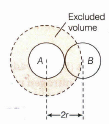
Since the molecules cannot come closer than distance 2r, the excluded volume for a pair of molecules = volume of sphere of radius 2r
\(=\frac { 4 }{ 3 } \pi { \left( 2r \right) }^{ 3 }=8\times \frac { 4 }{ 3 } \pi { r }^{ 3 }\)
\(\therefore \) Excluded volume per molecules (b)
\(=\frac { 1 }{ 2 } \left( 8\times \frac { 4 }{ 3 } \pi { r }^{ 3 } \right) =4\times \frac { 4 }{ 3 } \pi { r }^{ 3 }\)
But \(\frac { 4 }{ 3 } \pi { r }^{ 3 }={ V }_{ m }\), i.e. the actual volume of the gas molecule.
\(\therefore \) b = 4Vm
19.
Density, d = pM/RT
For same gas at different temperatures and pressures
\(\cfrac { { d }_{ 2 } }{ d_{ 1 } } =\cfrac { { p }_{ 2 }{ T }_{ 1 } }{ { p }_{ 1 }{ T }_{ 2 } }\)
\( { d }_{ 2 }=\cfrac { { p }_{ 2 }{ T }_{ 1 }d_{ 1 } }{ { p }_{ 1 }{ T }_{ 2 } } \)
\(\cfrac { 1\times 300\times 5.46 }{ 2\times 273 } \)
= 3 g dm-3
20.
Moles of O2, nO2 = \(\cfrac{mass}{mol.wt.}=\cfrac{8}{32}=0.25mol\)
[mol.wt. of O2 = 16\(\times\)2 = 32]
Moles of H2, nH2 = \(\cfrac{4}{2}=2.0mol\)
[mol.wt. of H2 = 1 \(\times\)2 = 2 ]
Total number of moles = 0.25 + 2.0 = 2.25mol
Pressure, p = \(\cfrac{nRT}{V}\)
\(\cfrac { 2.25mol\times 0.083bar \ dm^{ 3 }K^{ -1 }mol^{ -1 }\times 300K) }{ (1 \ dm^{ 3 }) } \)
p = 56.025 bar
21.
Suppose volume of the air in flask = V cm3 at 27\(^{o}\) C (300K).
V1 = Vcm3 , V2 = ?, T1= 300 K, T2 = 750 K
\(\cfrac { { V }_{ 1 } }{ { T }_{ 1 } } =\cfrac { { V }_{ 2 } }{ { T }_{ 2 } } \)
or \(\cfrac { { V } }{ 300 } =\cfrac { { V }_{ 2 } }{ { 750 } } \)
or \(300{ V }_{ 2 }=750V\)
or \({ V }_{ 2 }=2.5V\) (final volume)
Volume expelled = 2.5 V - V = 1.5 V
Fraction of air expelled = \(\cfrac{1.5 V}{2.5 V}=0.6\)

11th Standard CBSE Syllabus & Materials
11th Standard CBSE
CBSE 11th Business Studies Forms of Business Organisation Sample Question Papers Study Material - QB365 Set A
NEW11th Standard CBSE
CBSE 11th Business Studies Business, Trade and Commerce Sample Question Papers Study Material - QB365 Set A
NEW11th Standard CBSE
CBSE 11th Physics Waves Sample Question Papers Study Material - QB365 Set A
NEW11th Standard CBSE
CBSE 11th Physics Kinetic Theory Sample Question Papers Study Material - QB365 Set A



CBSE 11th Standard CBSE Subjects
CBSE Standards









