
 100% FREE ACCESS
11th Standard CBSE Syllabus & Materials
11th Standard CBSE
CBSE 11th Economics PART-A - Presentation of Data - New Sample Question Papers Study Material - QB365 Set A
NEW11th Standard CBSE
CBSE 11th Economics PART-A - Organisation of Data - New Sample Question Papers Study Material - QB365 Set A
NEW11th Standard CBSE
CBSE 11th Economics PART-A - Collection of Data - New Sample Question Papers Study Material - QB365 Set A
NEW11th Standard CBSE
CBSE 11th Economics PART-A - Introduction to Economics and Statistics - New Sample Question Papers Study Material - QB365 Set A
NEW11th Standard CBSE
CBSE 11th Business Studies International Trade Sample Question Papers Study Material - QB365 Set A
NEW11th Standard CBSE
CBSE 11th Business Studies Evolution and Fundamentals of Business Sample Question Papers Study Material - QB365 Set A

Published on: 31/07/2018
Based on the chapter Structural Organisation, some of the important questions are prepared in this question paper. It covers one mark, two, three and five marks questions from the book back and creative questions.
Download CBSE Class 11th Standard CBSE Biology question papers, sample papers, important questions, and previous year solved papers in PDF format. Get free study materials, NCERT solutions, and exam preparation resources for Class 11th Standard CBSE Biology
Questions + Answers key
Take MCQ Biology Test
1.
Distinguish between cardiac muscles and striated muscles
2.
Distinguish between dense regular and dense irregular connective tissue
3.
Why the scientists decalcify the bones?
4.
What are collateral glands and what is their function?
5.
Write the mode of locomotion in frog
6.
Why are blood , bone and cartilage callde connective tissues?
7.
In earthworm, from which segment intestine starts and where it ends?
8.
How does earthworm spoll the playgrounds?
9.
How does the skin of the frog is suitable for respiration?
10.
Name of the layers of the dermis of frog.
11.
What is the shape of setae in earthworm ?
12.
Which connective tissue is presents under the skin ?
13.
Write the origin and function of epithelial tissues
14.
A muscular fiber tapers at both the ends and does not show striations. Name the muscle fiber.
15.
Name the type of fibres present in areolar tissues
16.
Describe the structure of adipose tissue briefly with the help of diagram.
17.
Difference between blood plasma and serum.
18.
Mention the similarities between Cardiac and skeletal muscles.
19.
Why is the body cavity of cockroach called haemocoel? Name the different layer of body wall in it.
20.
Describe the features of exoskeleton of cockroach
21.
Distinguish between a male frog and female frog.
22.
Differences Between Blatta orientalis (oriental cockroach) and peripalnata americana (Aamerican cockroach).
23.
Stratified epithelial cells have limited role in secreation . Justify their role in our skin
1.
Difference between cardiac muscles and striated muscles
| cardiac muscles | striated muscles |
| Present in heart | Attached to bones in all parts of the body like limbs , jaws etc., |
| Striation are faint | Striations are pronminents |
| Involuntary function | Voluntary in function |
| Intercalated discs are present | Intercalated dics are absent |
2.
Differences between dense regular and dense irregular connective tissue are given below
| dense regular connective tissue | dense irregular connective tissue |
| The cells and fiber are arranged compactly and the orientation of fiber shows a regular patten |
The cells and fiber are arranged compactly but, the fiber are not oriented in a regular patten |
| The collagen fiber bundles are in parallel rows | The fibers run in different direction |
3.
The bones have excessive calcification . So it is difficult to sty living cells in an untreated bones. For their study , the bone id first decacified in the same way as architecture of the matrix is studied after drying up of the living materials.
4.
Collateral glands are two highly branched tubular glands in cockroach, which are unequal in size. Both the glands open on the dorsal side of the genital chamber. The secretion produced by these glands forms the oothecal case of the ootheca.
5.
Swimming, leaping and walking are the modes of locomotion in frog.
6.
Blood, Bone and cartilage are called connective tissue because
(i) they connect different tissues and organs
(ii) provide support to other structures of the animal body
7.
In earthworm, intestine starts from the 15th segment onwards and continues till the last segment.
8.
The earthworms make burrows in the soil of playground. This spoils the ground.
9.
The skin in frog is richly supplied with blood and provides extensive surface for respiration.
10.
Layers of the dermis of frog are
(i) The upper stratum spongiosum
(ii) The lower startum compactum
11.
Setae are S-shaped structures present in the epidermal pits of the earthworm.
12.
Dense areolar and adipose connective tissue
13.
Origin Ectoderm , endoderm and mesoderm
Function Protection . secretion and absorption
14.
Smooth muscle fibres taper at both ends. They do not show any striation.
15.
Areolar tissue is the loose connective tissue made up of a sticky matrix with fibers like white collagen and yellow elastic fibers and abundant mucin content.
16.
Adipose tissue is a flat storing connective tissue.Its matrix is packed with the large, spherical or oval fat cells or adipocytes.The fibres are few in number and form a loose network for supporting fat laden cells.
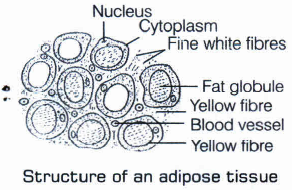
This tissue is found in the subcutaneous parts, in the mesenteries, covering of the heart and around the blood vessels and kidneys.The adipose tissue mainly stores reserve food.It acts as shock absorbing cushions around the heart, kidneys, eyeball, etc.
17.
Difference between blood plasma and serum.
| Blood plasma | Blood serum |
| It is the fluid minus blood corpuscles | It is liquid minus clotting elements and corpuscles |
| It is faint yellow in color | It is pale yellow in color |
| It contains fibrinogen and other clotting factors | it lacks fibrinogen and other clotting factors |
| It takes part in blood clotting | It does not take part in blood clotting |
18.
Similarities between cardiac and skeletal muscles The cardiac and skeletal muscles both are made up of elongated fibres, which have numerous myofibrils. The myofibrils of the cardiac muscles have the same structure as those of skeletal muscle and are made up of actin and myosin filaments. The cardiac and skeletal muscles fibres have dark and light bands.
19.
The body cavity of cockroach is filled with haemolymph so, it is called haemocoel. Cuticle, epidermis and basement membrane are layer of body wall in cockroach.
20.
The entire body of cockroach is covered by a hard chitinous exoskeleton (brown in colour) made of touch plates called sclerites. These are formed of chitin, a polymer of acetone cocaine polysaccharide molecule. The exoskeleton protects the body and provides space for the attachment of muscles.
21.
Differences between male and female frog
| Male frog | Female frog |
| Vocal cords are present on ventrolateral side of throat | Vocal sacs are absent |
| Croaking is more louder | Croaking is less louder |
| Forelimbs are stouter and more muscular | Forelimbs are less muscular |
| Amplexusory pads are present on ventral side of index fingers |
Amplexusory pads are absent |
| During breeding season, abdomen does not change much | Abdomen gets swollen during breeding season as it is full of ova released from mature ovaries. |
22.
Differences between Blatta orientals and Periplaneta americana are
| Blatta orientals | Periplanata Americana |
| Brownish-black to black coloured | Shining brown-cloured |
| 20-25 mm, smaller in size | 35-40 mm, larger in size |
| Less capable of lying | Good capacity of flying |
| Forewings are vestigial Hindwings are absent. | In both sexes, both pairs of wings are well-developed. |
| Ootheca is black-coloured | Oootheca is grey-coloured |
23.
Features: Stratified epithelium is made up of many layers of cells. In the skin the innermost layers are made of cuboidal or squamous cells. The outer layers are made of keratinised epithelium. Keratinised epithelium cells have lost their nucleus and contain a lot of keratin that help in protection.
Role in the skin:
Keratinised stratified epithelium is found in the skin because-
1. This epithelium contains dead cells with a lot of insoluble protein called keratin therefore providing the epidermis of the skin with protection against germs and desiccation.
2. They have a minimum role in secretions in the skin.
3. The secretions in the skin are due to glandular epithelium and not by the keratinised stratified epithelium.


11th Standard CBSE Syllabus & Materials
11th Standard CBSE
CBSE 11th Business Studies Forms of Business Organisation Sample Question Papers Study Material - QB365 Set A
NEW11th Standard CBSE
CBSE 11th Business Studies Business, Trade and Commerce Sample Question Papers Study Material - QB365 Set A
NEW11th Standard CBSE
CBSE 11th Physics Waves Sample Question Papers Study Material - QB365 Set A
NEW11th Standard CBSE
CBSE 11th Physics Kinetic Theory Sample Question Papers Study Material - QB365 Set A



CBSE 11th Standard CBSE Subjects
CBSE Standards









