
 100% FREE ACCESS
11th Standard CBSE Syllabus & Materials
11th Standard CBSE
CBSE 11th Economics PART-A - Presentation of Data - New Sample Question Papers Study Material - QB365 Set A
NEW11th Standard CBSE
CBSE 11th Economics PART-A - Organisation of Data - New Sample Question Papers Study Material - QB365 Set A
NEW11th Standard CBSE
CBSE 11th Economics PART-A - Collection of Data - New Sample Question Papers Study Material - QB365 Set A
NEW11th Standard CBSE
CBSE 11th Economics PART-A - Introduction to Economics and Statistics - New Sample Question Papers Study Material - QB365 Set A
NEW11th Standard CBSE
CBSE 11th Business Studies International Trade Sample Question Papers Study Material - QB365 Set A
NEW11th Standard CBSE
CBSE 11th Business Studies Evolution and Fundamentals of Business Sample Question Papers Study Material - QB365 Set A

Published on: 31/07/2018
Based on the chapter System of Particles and Rotational Motion, some of the important questions are prepared in this question paper. It covers one mark, two, three and five marks questions from the book back and creative questions.
For parents, Please subscribe and get the plenty of question with answer for your children practice. For Subscription please Click here.
Download CBSE Class 11th Standard CBSE Physics question papers, sample papers, important questions, and previous year solved papers in PDF format. Get free study materials, NCERT solutions, and exam preparation resources for Class 11th Standard CBSE Physics
Questions + Answers key
Take MCQ Physics Test
1.
Does angular momentum of a body in translatory motion is zero?
2.
In which case centre of mass of a body lie outside it? Give one example.
3.
A horizontal disc rotating about a vertical axis perpendicular to its plane and passing through centre makes 180 rpm. A small lump of wet mud of mass 10 g falls on disc lightly and sticks to it at a distance of 8 cm from its axis. If now the disc with mud makes 150 rpm only, calculate the moment of inertia of the disc.
4.
The moment of inertia of a disc about its diameter is \(\frac { { MR }^{ 2 } }{ 4 } \) , what will be its moment of inertia, an axis tangential to it and parallel to one of its diameter? [where M is mass of the disc and R is its radius.]
5.
Why in hand driven grinding machine, a handle is put near the circumference of the stone or wheel?
6.
Why is a wrench of longer arm preferred in comparison to a wrench of shorter arm?
7.
What happens to the moment of force about a point, if the line action of the force moves towards the point?
8.
Find centre of mass of a triangular lamina.
9.
In which case of mass of a body lie outside it? Give one example.
10.
Explain how a cat is able to land on its feet after a fall taking the advantage of principle of conservation of angular momentum?
11.
A solid cylinder of mass 20 kg rotates about its axis with angular speed of 100 rad/s. The radius of cylinder is 0.25m. What is KE of rotation of cylinder?
12.
Centre of gravity of a body on the earth coincides with its centre of mass for a small object and for a large object, it may not. What is the qualiative meaning of small and large in this regards? For which following two of them coincides, a building, a pond, a lake, a mountain.
13.
Why does a solid sphere have smaller moment of inertia than a hollow cylinder of same mass and radius about an axis passing through their axis of symmetry?
14.
If a cube is melted and is casted into a sphere, does moment of inertia about an axis through centre of mass increase or decrease.
15.
In a flywheel, most of the mass is concentrated at the rim. Explain why?
16.
A particle is moving on the x-axis with a linear velocity of 2 m/s. What will be its angular momentum about the origin?
17.
A door is hinged at one end and is free to rotate about a vertical axis. Does its weight cause any torque about its axis? Give reason for your answer .
18.
A man stands on a rotating platform with his arms stretched horizontally holding a 5 kg weight in each hand. The angular speed of the platform in 30 rpm. The man then brings his arms close to his body with the distance of each weight from the axis changing from 90 cm to 20 cm. The moment of inertia of the man together with the platform may be taken to be constant and equal to 7.6 kg-m2.
(a) What is his new angular speed? (Neglect friction)
(b) Is kinetic energy conserved in the process? If not, from where does the change come about?
19.
A solid disc and a ring, both of radius 10 cm are placed on a horizontal table simultaneously, with initial angular speed equal to \(10\ \pi\ rad{ s }^{ -1 }\). Which of the two will start to roll earlier? The coefficient of kinetic friction is \({ \mu }_{ k }\)= 0.2 ?
20.
In given pulley mass system, mass m1 = 500 g, m2 = 460 g and the pulley has a radius of 5 cm. When released from rest, heavier mass falls through 7.50 cm in 5 s. There is no slippage between pulley and string.
(i) What is magnitude of acceleration of mass?
(ii) What is magnitude of pulley's angular acceleration?
21.
Explain why friction is necessary to make the disc in figure rolling in the direction indicated.
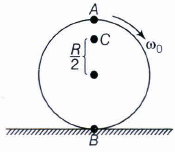
(i) Give the direction of frictional force at Band the sense of frictional torque before perfect rolling begins.
(ii) What is the force of friction after perfect rolling begins?
22.
A car weighs 1800 kg. The distance between its front and back axles is 1.8 m. Its centre of gravity is 1.05 m behind the front axle. Determine the force exerted by the level ground on each front wheel and each back wheel.
23.
A rope of negligible mass is wound round a hollow cylinder of mass 3 kg and radius 40 cm. What is the angular acceleration of the cylinder if the rope is pulled with a force of 30 N ? What is the linear acceleration of the rope ? Assume that there is no slipping.
1.
Angular momentum of a body is measured with respect to certain origin.
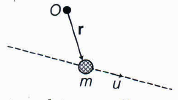
So, a body in translatory motion can have angular momentum.
It will be zero, if origin lies on the line of motion of particle.
2.
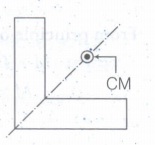
If geometrical centre of a body lies outside it, then centre of mass of body lies outside the body.
Centre of mass of a L-shaped lamina lies outside it on the line of symmetry.

3.
\(I=3.2\times { 10 }^{ -8 }kg-{ m }^{ 2 }\).
4.
\(\frac { 5 }{ 4 } { MR }^{2}\)
5.
For a given force, torque can be increased if the perpendicular distance of the point of application of the force from the axis of rotation is increased.
Hence, the handle put near the circumference produces maximum torque.
6.
The torque applied on the nut by the wrench is equal to the force multiplied by the perpendicular distance from the axis of rotation. Hence, to increase torque a wrench of longer arm is preferred.
7.
Moment of force = force x the perpendicular distance of the line of action of force from the axis of rotation. Hence, the moment of force about a point decreases if the line of action of the force moves towards that point.
8.
For any planar solid, centre of mass always lies at its geometrical centre.
Geometrical centre of a triangle is intersection point of its media.
So, for any given triangular lamina
Centre of mass is at its centroid, point of intersection is media.
9.
If geometrical centre of a body lies outside it, then centre of mass of body lies outside the body. Centre of mass of a L-shaped lamina lies outside it on the line of symmetry.
10.
When a cat falls to ground from a height, it stretches its body alongwith the tail so that its moment of inertia become high. Since,\(I\omega \) is to remain constant, the value of angular speed \(\omega \) decreases and therefore the cat is able to land on the ground gently.
11.
M = 20 Kg, \(\omega =100rad/s,R=0.25m\).
Moment of inertia of cylinder about its own axis
\(=\frac { 1 }{ 2 } MR^{ 2 }=\frac { 1 }{ 2 } \times 20\times { \left( 0.25 \right) }^{ 2 }\)
Rotational KE \(=\frac { 1 }{ 2 } { I\omega }^{ 2 }\)
\(=\frac { 1 }{ 2 } { I\omega }^{ 2 }=\frac { 1 }{ 2 } \times 0.625\times { \left( 100 \right) }^{ 2 }=3125J\).
12.
Centre of mass and centre of gravity are two different concepts. But if g goes not vary from one part of body to other than CG and CM coincides.
So, when vertical height of the object is very small compared to a radius of earth, we call object small, otherwise, we call it extended. In above context, building and pond are small objects and a deep lake and a mountain are large extend objects.
13.
All mass of a hollow cylinder at a distance R from axis of rotation. Whereas in case of a sphere, most of mass lies at a distance less than R from axis of rotation. As moment of inertia is \(\sum M_{ i }{ R }_{ i }^{ 2 }\), so sphere as a lower value of moment of inertia.
14.
Moment of inertia of a sphere is less than that of a cube of same mass.
15.
Concentration of mass at the rim increases the moment of inertia and thereby brings uniform motion.
16.
Zero
17.
As torque = r \(\times \) F
That means torque produced by force is in a plane perpendicular plane containing rand F.
So, if door is in xy-plane, torque produced by weight is in ± z-direction,
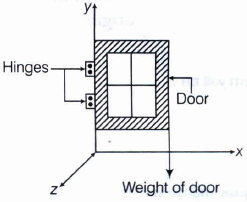
It is never about an axis passing through y-direction.
18.
(a) Moment of inertia of man and platform system
Ii = 7.6 kg-m2
Change in moment of inertia of man and platform system when he stretches his hands to a distance of 90 cm = \(2\times mr^{ 2 }=2\times 5\times { \left( 0.9 \right) }^{ 2 }\)
= 8.1 kg-m2
Ii = I + 8.1 = 7.6 + 8.1 = 15.7 kg-m2
Initial angular velocity,\({ \omega }_{ i }=30rpm\)
Initial angular momentum of system,
\({ L }_{ i }=I_{ i }{ \omega }_{ i }=15.7kg-{ m }^{ 2 }\times 30rpm\)
When man folds his hands to a distance of 20 cm,
Moment of inertia of man =\(2\times { mr }^{ 2 }=2\times 5\times { \left( 0.2 \right) }^{ 2 }\)
\(=0.4kg-{ m }^{ 2 }\)
So, final moment of inertia of man and platform system
= 7.6 + 0.4 = 8 kg-m2
Final angular momentum of system
\({ L }_{ f }=I_{ f }{ \omega }_{ f }=8\times { \omega }_{ f }\)
Equating initial and final values
\({ L }_{ i }={ L }_{ f }\)
\(\Rightarrow { \omega }_{ f }=\frac { 15.7\times 30 }{ 8 } \)
= 58.88 rpm.
(b) KE is not conserved in process.
Kfinal > Kinitial
Muscular work done by the man in folding his arms is converted into KE.
19.
Thus, the force of friction \({ \mu }_{ k }\)mg produces an acceleration a in the centre of mass. So, the equation of motion for centre of mass is
\({ \mu }_{ k }\) mg = ma
The torque due to force of friction is \({ \mu }_{ k }mg\times R\). It produces angular retardation given by
\({ \mu }_{ k }mgR=-I\alpha \)
Rolling begins when
\(v=R\omega \)
But v = 0 + at = \({ \mu }_{ k }gt\)
and \(\omega ={ \omega }_{ 0 }+\alpha t={ \omega }_{ 0 }-\frac { { \mu }_{ k }mgR }{ I } t\) [using Eq. (ii)]
or \(\frac { v }{ R } ={ \omega }_{ 0 }-\frac { { \mu }_{ k }mgR }{ I } t\Rightarrow \frac { { \mu }_{ k }gt }{ R } ={ \omega }_{ 0 }-\frac { { \mu }_{ k }mgRt }{ I } x = {-b \pm \sqrt{b^2-4ac} \over 2a}\)
or \(\frac { { \mu }_{ k }gt }{ R } \left[ 1+\frac { { mR }^{ 2 } }{ I } \right] ={ \omega }_{ 0 }\quad or\quad t=\frac { R{ \omega }_{ 0 } }{ { \mu }_{ k }g\left[ 1+\frac { { mR }^{ 2 } }{ I } \right] } \)
For a disc, \(I={ mR }^{ 2 }/2\quad \)
\(\therefore t=\frac { R{ \omega }_{ 0 } }{ { 3\mu }_{ k }g } =\frac { 0.01\times 10\pi }{ 3\times 0.2\times 9.8 } =0.53s\)
For a ring, \(I={ mR }^{ 2 }\)
\(\therefore \ t=\frac { R{ \omega }_{ 0 } }{ { 2\mu }_{ k }g } =\frac { 0.01\times 10\pi }{ 3\times 0.2\times 9.8 } =0.80s\).
20.
(i) a = 6 x 10⁻² m/s2
(ii) \(\alpha \) = 1.20 rad/s2
21.
To roll a disc, one require a linear velocity which can be provided only by a tangential force. As frictional force is the only tangential force in this case, so it is necessary for the rolling of the disc. Initially, friction will be kinetic.
(i) As frictional force at B opposes the angular velocity of B.So, frictional force is in the forward direction, the sense of frictional torque is such as to oppose the angular motion and produce some linear motion, so that the condition of pure rolling (vCM = Rw) should be fulfilled.
(ii) After pure rolling starts there will be no need of friction, so friction force will become zero.
22.
Total mass of the car = 1800kg
Let m and (900-m)kg be the masses of each front wheel and each back wheel, respectively.
Distance of centre of gravity from the back axle = 1.80-1.05 = 0.75m
Taking torque about centre of gravity,
\(m\times 1.05=(900-m)\times 0.75\)
\(\\ 1.05m+0.75m=900\times 0.75\)
\(1.80m=900\times 0.75\)
\(\\ m=\frac { 900\times 0.75 }{ 1.80 } =375kg\)
\( \therefore \ (900-m)=900-375=525kg\)
\(\\ \therefore \ Weight\ of\ each\ front\ wheel(w_{ 1 })={ m }_{ 1 }g\)
\({ (w }_{ 1 })=375\times 9.8=3675N\)
Forced exerted by the level ground on each front wheel.
= force exerted by each front wheel on the level ground \({ (w }_{ 1 })=3675N\)
Weight of each back wheel (\({ w }_{ 2 }\))=525 x 9.8= 5145N
Forced exerted by the level ground on each back wheel = 5145N.
23.
Torque on cylinder, \(\tau =force\times radius\)
\(=30\times 40=12N-m\)
Moment of inertia of hollow cylinder about its axis
\(I={ MR }^{ 2 }=3\times { \left( 0.4 \right) }^{ 2 }=0.48kg-{ m }^{ 2 }\)
Also, \(\tau =I\alpha \Rightarrow \alpha \frac { \tau }{ I } \)
\(\therefore \alpha =\frac { 12 }{ 0.48 } =25{ s }^{ -2 }\)
Linear acceleration of rope
\(\alpha =\frac { F }{ m } =\frac { 30 }{ 3 } =10m/{ s }^{ 2 }\).

11th Standard CBSE Syllabus & Materials
11th Standard CBSE
CBSE 11th Business Studies Forms of Business Organisation Sample Question Papers Study Material - QB365 Set A
NEW11th Standard CBSE
CBSE 11th Business Studies Business, Trade and Commerce Sample Question Papers Study Material - QB365 Set A
NEW11th Standard CBSE
CBSE 11th Physics Waves Sample Question Papers Study Material - QB365 Set A
NEW11th Standard CBSE
CBSE 11th Physics Kinetic Theory Sample Question Papers Study Material - QB365 Set A



CBSE 11th Standard CBSE Subjects
CBSE Standards









