
 100% FREE ACCESS
11th Standard CBSE Syllabus & Materials
11th Standard CBSE
CBSE 11th Economics PART-A - Presentation of Data - New Sample Question Papers Study Material - QB365 Set A
NEW11th Standard CBSE
CBSE 11th Economics PART-A - Organisation of Data - New Sample Question Papers Study Material - QB365 Set A
NEW11th Standard CBSE
CBSE 11th Economics PART-A - Collection of Data - New Sample Question Papers Study Material - QB365 Set A
NEW11th Standard CBSE
CBSE 11th Economics PART-A - Introduction to Economics and Statistics - New Sample Question Papers Study Material - QB365 Set A
NEW11th Standard CBSE
CBSE 11th Business Studies International Trade Sample Question Papers Study Material - QB365 Set A
NEW11th Standard CBSE
CBSE 11th Business Studies Evolution and Fundamentals of Business Sample Question Papers Study Material - QB365 Set A

Published on: 15/12/2018
NCERT Grade 11 Chemistry Chapter 11, The p-block elements deals with elements of the p-block of the modern periodic table. The variation in properties of the p-block elements due to the influence of d and f electrons in the inner core of the heavier elements makes their chemistry interesting.
After studying this chapter, students will be able to appreciate the general trends in the chemistry of p-block elements; describe the trends in physical and chemical properties of group 13 and 14 elements; explain anomalous behaviour of boron and carbon; describe allotropic forms of carbon; know the chemistry of some important compounds of boron, carbon and silicon; list the important uses of group 13 and 14 elements and their compounds.
Concepts such as Group 13 Elements: The Boron Family, Atomic Radii, Ionization Enthalpy, Electronegativity, Physical Properties, Chemical Properties, Important Trends and Anomalous Properties of Boron, Some Important Compounds of Boron, Borax, Orthoboric acid, Diborane, Uses of Boron and Aluminium and their Compounds, Group 14 Elements: The Carbon Family, Electronic Configuration, Covalent Radius, Ionization Enthalpy, Electronegativity, Physical Properties, Chemical Properties, Important Trends and Anomalous Behaviour of Carbon, Allotropes of Carbon, Diamond, Graphite, Fullerenes, Uses Of Carbon, Some Important Compounds of Carbon And Silicon, Carbon Monoxide, Carbon Dioxide, Silicon Dioxide,
Silicones, Silicates and Zeolites will be studied in detail through this chapter with the help of diagrammatic representations, graphical formats and equations.
NCERT Grade 11 Chemistry Chapter 11, The p-block elements is a part of Unit 11. Unit 8, Unit 9, Unit 10 and Unit 11 in combination; hold a weightage of 16 marks in the final examination.
Download CBSE Class 11th Standard CBSE Chemistry question papers, sample papers, important questions, and previous year solved papers in PDF format. Get free study materials, NCERT solutions, and exam preparation resources for Class 11th Standard CBSE Chemistry
Questions + Answers key
Take MCQ Chemistry Test
1.
Name the member of group 14 that forms the most acidic oxide
2.
Why the elements of the second row(first short period) show a number of difference in properties from other members of their respective families?
3.
Explain the differences in properties of diamond and graphite based upon their structures.
4.
Explain the following
BF3 does not hydrolyse.
5.
Among group 14 elements name the elements having tendency to from \(p\pi -p\pi \) bonds.
6.
What happens when boric acid is heated?
7.
Why do boron halides form addition compounds with NH3?
8.
Give reason for Carbon has a strong tendency for catenation as compared to silicon.
9.
Rationalise the given statement and give chemical reactions:
Lead(IV) Chloride is highly unstable towards heat.
10.
How does electron deficient compound BF3 achieve electronic saturation , i.e fully ooccupied outer electron shells?
11.
Give reason why boron and aluminium tend to form covalent compounds
12.
What are Fullerenes? How are they prepared?
13.
If the starting material for the manufacture of silicons is RSiCl3 write the structure of the product formed.
14.
Write balanced equation for
\(B_{ 2 }H_{ 6 }+{ H }_{ 2 }O\rightarrow \)
15.
Explain the Aluminium wire is used to make transmission cables.
16.
Silicon shows a diagonal relation with
magnesium
phosphorous
carbon
boron
17.
Which of the following is a purely acidic oxide?
Si02
Sn02
PbO
Mn02
18.
Silicon carbide (SiC) is known as
quartz
tridynite
corundum
carborundum
19.
Carbon-60 contains
20 pentagons and 12 hexagons
12 pentagons and 20 hexagons
30 pentagons and 30 hexagons
24 pentagons and 36 hexagons
20.
Which of the following compound is an important catalyst as well as a Lewis acid?
Al2S2
BF3
S4N4
N2H4
1.
()
Among monoxides, CO is neutral and GeO is acidic while among dioxides, CO2, SiO2 are acidic, GeO2 is also acidic but less acidic than SiO2 .
2.
()
The difference in he properties of the first member of a group from those of the other members are due to
(i) this smaller size of the atom
(ii) presence of one inner shell of only two electrons and
(iii) absence of d-orbitals.
3.
| Diamond | Graphite |
| Diamond is the hardest substance on earth. | Graphite is soft and slippery |
| In diamond carbon is Sp3- hybridized | In Graphite carbon is Sp2- hybridized |
| Since all the electrons in diamond are firmly held in C-C,6 bonds there are no free electrons in diamond crystal Therefore diamond is bad conductor of electricity | Since only three electrons of each carbon are used in making hexagonal rings of graphite, fourth valence electron is free to move thus graphite is a good conductor of electricity |
| Because of high refractive index diamond can reflect and refract the light. | Graphite is a black substance and possess a metallic lustre |
4.
Unlike other boron halides, BF3 does not hydrolyze completely, however, it form boric acid and fluoroboric acid. This is because the HF first formed reacts with H3BO3
\({ BF }_{ 3 }{ 3H }_{ 2 }O\longrightarrow { { H }_{ 3 } }{ BO }_{ 3 }+3HF\times 4\)
\({ H }_{ 2 }{ BO }_{ 3 }+4HF\longrightarrow { H }^{ + }{ [{ BF }_{ 4 }] }^{ - }{ 3H }_{ 2 }O\times 3\)
\(4{ BF }_{ 3 }+3{ H }_{ 2 }O\longrightarrow { H }_{ 2 }{ BO }_{ 3 }+3{ [{ BF }_{ 4 }] }^{ - }+3{ H }^{ + }\)
5.
Carbon have the tendency to from \(p\pi -p\pi \) bonds.
6.
\(H_3BO_3\xrightarrow[]{\triangle}HBO_2\xrightarrow[]{\triangle}B_2O_3\)
7.
Boron halides are lewis acids and can accept a pair of electrons from amines to form addition product.
8.
The catenation is maximum in carbon and decreases down the group. With increase in atomic size, electronegativity decreases and due to this, tendency to show catenation decreases, C-C bond enthalpy (348kJ mol-1) is greater than Si-Si bond enthalpy (297kJmol- 1). Therefore, C-C bond is stronger than Si-Si bond. That's why carbon has much higher tendency for catenation than silicon.
9.
Lead(IV)chloride on heating decomposes to give lead(II) chloride and Cl2 because lead in +2 oxidation state is more stable than in +4 oxidation state.
PbCl4(l)\(\longrightarrow \)PbCl2(s) + Cl2(g)
10.
BF3 achieve it by the following ways
(i) Multiple bonding or \(p\pi -p\pi \) back bonding e.g BF3 in which a lone pair of electron present in 2p-orbits of one of the fluorine atoms may be transferred to the vacant p-orbital on the bottom atom.
(ii) Formation of complexes in which electrons are received from a donor molecule,e.g F3B\(\longleftarrow \)NH3 .Boron compounds, thus behave as Lewis acids.
11.
Sum of the three ionization enthalpies of both the elements are very high. Thus they have no tendency to lose electrons to form ionic compound. Instead they form covalent compounds.
12.
Fullerenes are the allotropes of carbon. Its structure is like a soccer ball.
They are prepared by heating graphite in electric arc in presence of inert gases such as helium or argon.
13.
Hydrolysis of alkyltrichlorosilanes gives cross-linked silicons.
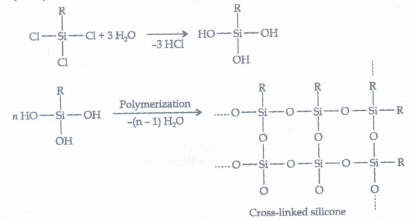
14.
\(B_{ 2 }H_{ 6 }+{ 6H }_{ 2 }O\rightarrow 2{ H }_{ 3 }BO_{ 3 }+6{ H }_{ 2 }\)
Orthoboric acid
15.
Aluminium possesses high electrical conductivity. Therefore, it is used in making transmission cables. Further on weight to weight basis conductivity of aluminium is twice as Cu.
16.
(d)
boron
17.
(a)
Si02
18.
(d)
carborundum
19.
(b)
12 pentagons and 20 hexagons
20.
(d)
N2H4

11th Standard CBSE Syllabus & Materials
11th Standard CBSE
CBSE 11th Business Studies Forms of Business Organisation Sample Question Papers Study Material - QB365 Set A
NEW11th Standard CBSE
CBSE 11th Business Studies Business, Trade and Commerce Sample Question Papers Study Material - QB365 Set A
NEW11th Standard CBSE
CBSE 11th Physics Waves Sample Question Papers Study Material - QB365 Set A
NEW11th Standard CBSE
CBSE 11th Physics Kinetic Theory Sample Question Papers Study Material - QB365 Set A



CBSE 11th Standard CBSE Subjects
CBSE Standards









