
 100% FREE ACCESS
7th Standard CBSE Syllabus & Materials
7th Standard CBSE
CBSE 7th Social Science Theme E - Understanding Market - New Sample Question Papers Study Material - QB365 Set A
NEW7th Standard CBSE
CBSE 7th Social Science Theme E - From Barter to Money - New Sample Question Papers Study Material - QB365 Set A
NEW7th Standard CBSE
CBSE 7th Social Science Theme D - The Constitution of India- An Introduction - New Sample Question Papers Study Material - QB365 Set A
NEW7th Standard CBSE
CBSE 7th Social Science Theme D - From the Rulers to the Ruled : Types of Governments - New Sample Question Papers Study Material - QB365 Set A
NEW7th Standard CBSE
CBSE 7th Social Science Theme B - The Age of Reorganisation - New Sample Question Papers Study Material - QB365 Set A
NEW7th Standard CBSE
CBSE 7th Social Science Theme B - The Rise of Empires - New Sample Question Papers Study Material - QB365 Set A

Published on: 30/07/2018
Based on the current academic syllabus, some of the important questions are prepared from the chapter The Triangle and Its Properties.
Download CBSE Class 7th Standard CBSE Mathematics question papers, sample papers, important questions, and previous year solved papers in PDF format. Get free study materials, NCERT solutions, and exam preparation resources for Class 7th Standard CBSE Mathematics
Questions + Answers key
Take MCQ Mathematics Test
1.
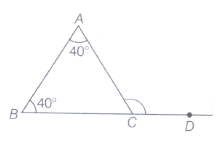
The two interior opposite angles of an exterior angle of a triangle are 40° and 40°. Find the measure of the exterior angle.
2.
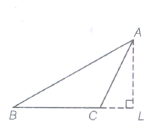
Will an altitude always lie in the interior of a triangle? If you think that this need not be true, draw a rough sketch to show such a case.
3.
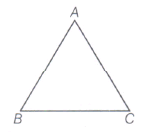
Write the six elements (i.e. the 3 sides and the 3 angles) of \(\triangle ABC\).
4.
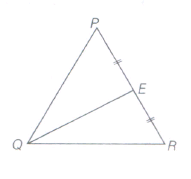
Draw rought sketches of \(\triangle PQR\),where QE is a median.
5.
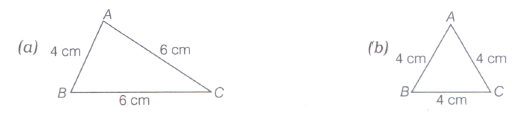
Look at the following given figures and classify each of the triangle according to its sides.
6.
Megha drives 7 km North from a point, then takes a left and drives a distance of 15 km to reach her destination. What will be the least distance between the starting point and end point of her journey?
7.
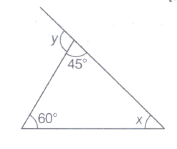
In the given figure, find the measures of \(\angle X\ and\angle Y.\)
8.
Find the perimeter of the rectangle whose length is 40 cm and a diagonal is 41 cm.
9.
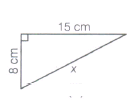
Find the unknown length x in the following figures.
10.
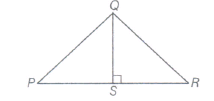
Verify by drawing a diagram, if the median and altitude of an isosceles triangle can be same.
11.
If one angle of a triangle is 60° and the other two angles are in the ratio 1: 3. Then, find the angles.
12.
One of the exterior angles of a triangle is 112° and the interior opposite angles are in the ratio 3 : 4. Find the interior opposite angles.
13.
In a\(\triangle ABC\), AD is the bisector of \(\angle A\) meeting BC at D,CF⊥AB and E is the mid-point of AG. Then, median of the triangle is
AD
BE
FC
DE
14.
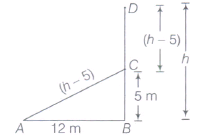
The top of a broken tree touches the ground at a distance of 12 m from its base. If the tree is broken at a height of 5 m from the ground, then the actual height of the tree is
25 m
13 m
18 m
17 m
15.
In a right angled \(\triangle ABC\),if \(\angle B=90^0\) BG = 3cm and AC = 5 cm, then the length of side AB is
3 cm
4 cm
5 cm
6 cm
16.
If the exterior angle of a triangle is 130° and its interior opposite angles are equal, then measure of each interior opposite angle is
55°
65°
50°
60°
17.
In the given figure, DEF is a right angled triangle with \(\angle E=90^0\) What type of angles are \(\angle D\ and \angle F\)?
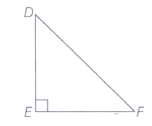
They are equal angles
They form a pair of adjacent angles
They are complementary angles
They are supplementary angles
18.
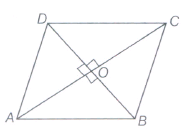
In the adjacent figure, the diagonals of ABCD are AC = 16cm, BD = 30 cm, then perimeter of the rhombus is equal to_____________.
19.
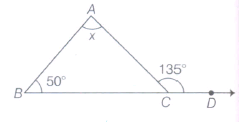
In the adjacent figure, the value of x is___________.
20.
If one angle of a triangle is equal to the sum of other two, then the measure of that angle is_____________.
21.
Median is also called___________in an equilateral triangle.
22.
A triangle is said to be____________if each one of its sides are of the same length.
23.
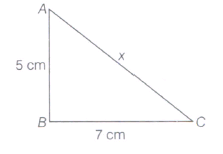
In the following figure, the value of x is equal to 9cm.
24.
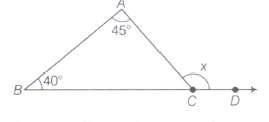
In the following figure, the value of x = 85°.
25.
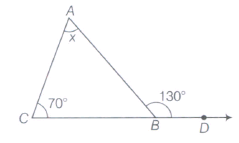
In the following figure, the value of x = 60°.
26.
It is possible to have a triangle in which each angle is less than 60°.
27.
Sum of the measures of three angles of a triangle is greater than 180°.
1.
As per the given information in the question, we can draw the following figure:
Exterior angle = \(\angle DCA\),interior angles,\(\angle A=40^0\) and \(\angle B=40^0\)
We know that, the sum of interior opposite angles is equal to the exterior angle.
\(\therefore\angle A+\angle B=\angle DCA\Rightarrow40^0+40^0=\angle DCA\Rightarrow\angle DCA=80^0\)
Hence, the exterior angle is 80°.
2.
An altitude does not alwayslie in the interior of a triangle.\(\triangle ABC\) is an obtuse angled triangle such that \(\angle C\) is obtuse and AI is the altitude fromA.
Clearly, L is not a point on BC but on BC produced.
So, altitude AI lie in the exterior of the triangle.
3.
The six elements i.e. the three sides and the three angles of \(\triangle ABC\) are as follows:
sides \(\bar{AB},\bar{BC},\bar{CA}\)
Angles \(\angle ABC,\angle BAC,\angle BCA\)
4.
In the adjacent figure, we have \(\triangle PQR\) We know that, a median connects a vertex of a triangle to the mid-point of the opposite side. On joining Q and mid-point of PR, i.e. E.We get the required median QE.
5.
(a) In the given figure,\(\bar { AC } =6cm,\bar { BC } =6cm\bar { ,AB } =4cm,\) \(\quad \because \bar { AC } =\bar { BC } \)
Hence, \(\triangle ABC\) is an isosceles triangle.
(b) In the given figure, \(\bar { AC } =4cm,\bar { AB } =4cm,\bar { BC } =4cm\) \(\because \bar { AC } =\bar { AB } =\bar { BC } \)
Hence, \(\triangle ABC\) is an equilateral triangle.
6.
According to the given information, we have a \(\triangle OAB\) right angled at A.
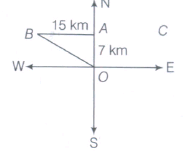
Now, least distance from 0 to B is the hypotenuse OB of \(\triangle OAB\).
OB2 = OA2+ AB2[by Pythagoras theorem]
\(\Rightarrow\) OB2 = 72 + 152= 49 + 225 \(\Rightarrow\) OB2 = 289
\(\Rightarrow\) OB= 17 km
Hence, the least distance from O to B is 17 km.
7.
Since, \(\angle Y\) and 450 form a linear pair.
So, \(\angle y+45°=180°\)
\(\Rightarrow\angle y=180°-45°\)
\(\Rightarrow\angle y=135°\)
The sum of all angles in a triangle is equal to 180°.
So, \(45^0+60^0+\angle x=180°\)
\(\Rightarrow 105^0+\angle x=180°\)
\(\Rightarrow\angle x=180°-105°\)
=75°
8.
Let ABCD be a rectangle, whose length, AB = 40 cm and diagonal AC = 41 cm
In right angled \(\triangle ABC\), by using Pythagoras property,
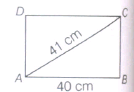
AC2 = AB2 + BC2 =>BC2 = AC2 - AB2
\(\Rightarrow\) BC2 = (41)2 -(40)2
\(\Rightarrow\) BC2 =1681-1600 => BC2 =81
\(\Rightarrow BC=\sqrt81=9\)
Now, perimeter of the rectangle = 2 (AB + BC) [∵ perimeter of a rectangle = 2 (l + b)]
= 2 (40 + 9) = 2 \(\times\) 49 =98
Hence, the perimeter of the rectangle is 98 cm.
9.
Let given triangle be \(\triangle ABC\) and \(\triangle ABC\) a right angled at B.
Again, let AC = x cm
Given, AB = 8 cm, BC = 15 cm
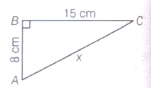
In \(\triangle ABC\), by using Pythagoras property,
AC2 = AB2 + BC2
\(\Rightarrow\) x2 = (8)2 + (15)2 = 64 + 225
\(\Rightarrow\) x2=289 \(\Rightarrow x=\sqrt 289=17\)
Hence, the unknown length of x is 17 cm.
Hence, the value of unknown length of x is 25.
10.
Draw a line segment Be. By paper folding locate the perpendicular bisector of BC.The folded crease meets BC at D, its mid-point.
Take any point A on this perpendicular bisector. Join AB and Ae. Thus, the triangle obtained is an isoscelesMBC in which AB = AC.
Since, D is the mid-point of BC, so, AD is its median. Also, AD is perpendicular bisector of Be. So, AD is the altitude of \(\triangle ABC\).
Thus, it is verified that the median and altitude of an isoscelestriangle are same.
11.
As per the given information in the question, one angle of a triangle is 60°. Let the other two angles be x and 3x.
We know that, the sum of all angles in a triangle is equal to 180°.
So, x+3x+600=180°
\(\Rightarrow\) 4x + 60° =180°
\(\Rightarrow\) 4x =180° - 60°
\(\Rightarrow\) 4x =120°
\(\Rightarrow x=\frac{120^0}{4}=30^0\)
x=300
So, angles will be x = 30° and 3x = 3 x 30° = 90°
Hence, the two angles are 90° and 30°.
12.
The two interior opposite angles are 480 and 640.
13.
(c)
FC
14.
(c)
18 m
15.
(b)
4 cm
16.
(b)
65°
17.
(c)
They are complementary angles
18.
()
68 cm
19.
()
850
20.
()
90°
21.
()
altitude
22.
()
equilateral
23.
(b)
24.
(a)
25.
(a)
26.
(b)
27.
(b)

7th Standard CBSE Syllabus & Materials
7th Standard CBSE
CBSE 7th Social Science Theme B - New Beginnings : Cities and States - New Sample Question Papers Study Material - QB365 Set A
NEW7th Standard CBSE
CBSE 7th Social Science Theme A - Climates of India - New Sample Question Papers Study Material - QB365 Set A
NEW7th Standard CBSE
CBSE 7th Social Science Theme A - Geographical Diversity of India - New Sample Question Papers Study Material - QB365 Set A
NEW7th Standard CBSE
CBSE 7th Science Earth, Moon and the Sun - New Sample Question Papers Study Material - QB365 Set A



CBSE 7th Standard CBSE Subjects
CBSE Standards




