
 100% FREE ACCESS
11th Standard CBSE Syllabus & Materials
11th Standard CBSE
CBSE 11th Economics PART-A - Presentation of Data - New Sample Question Papers Study Material - QB365 Set A
NEW11th Standard CBSE
CBSE 11th Economics PART-A - Organisation of Data - New Sample Question Papers Study Material - QB365 Set A
NEW11th Standard CBSE
CBSE 11th Economics PART-A - Collection of Data - New Sample Question Papers Study Material - QB365 Set A
NEW11th Standard CBSE
CBSE 11th Economics PART-A - Introduction to Economics and Statistics - New Sample Question Papers Study Material - QB365 Set A
NEW11th Standard CBSE
CBSE 11th Business Studies International Trade Sample Question Papers Study Material - QB365 Set A
NEW11th Standard CBSE
CBSE 11th Business Studies Evolution and Fundamentals of Business Sample Question Papers Study Material - QB365 Set A

Published on: 05/03/2019
Thermodynamics Important Questions
Download CBSE Class 11th Standard CBSE Chemistry question papers, sample papers, important questions, and previous year solved papers in PDF format. Get free study materials, NCERT solutions, and exam preparation resources for Class 11th Standard CBSE Chemistry
Questions + Answers key
Take MCQ Chemistry Test
1.
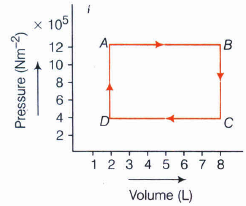
The figure given below represents pV diagram of different stages of a thermodynamic process.Calculate the work done in each stage and also the network done in the complete cyclic process.
2.
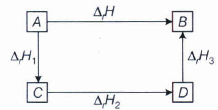
Enthalpy is an extensive property. In general, if enthalpy of an overall reaction A\(\rightarrow \) B along one route is \(\Delta _{ r }H \ and \ \Delta _{ r }H_{ 1 },\Delta _{ r }H_{ 2 },\Delta _{ r }H_{ 3 }....\)represent enthalpies of intermediate reactions leading to product B. What will be the relation between \(\Delta _{ r }H\) overall reaction and \(\Delta _{ r }H_{ 1 },\Delta _{ r }H_{ 2 }\) .....etc., for intermediate reactions.
3.
Sodium carbonate, Na2 CO3 can be obtained by heating sodium hydrogen carbonate, NaHCO3 as 2 NaHCO3(s) \(\longrightarrow \) Na2CO3 (s) + CO2(g).The essential data are
NaHCO3(s) Na2CO3 (s) Na2(g) H2O(g)
| \(\triangle _{ f }{ H }^{ o }\)(KJ mol-1) | -947.7 | -1130.9 | -393.51 | -241.82 |
| \({ S }_{ m }^{ o }\)(J mol-1) | 102.1 | 136 | 188.83 | 213.74 |
Calculate the temperature above which NaHCO3 decomposes to give products at 1 bar.
4.
At 60°C, dinitrogen tetroxide is 50 per cent dissociated. Calculate the standard free energy change at this temperature and at one atmosphere.
5.
When 20.0 g of ammonium nitrate (NH4NO3) is dissolved in 125 g of water in a coffee cup calorimeter. (Treat heat capacity of water as the heat capacity of the calorimeter and its contents).
6.
Sonu heard in the class about the first law of thermodynamics, according to which energy can neither be created nor destroyed but can be converted from one form to another. He tried to apply this law on the appliances working around him like an electrical fan or a heater, hydroelectric power plant etc.
(i) Can you apply the first law of thermodynamics on electrical fan or a heater? If yes explain how?
(ii) How does the first law of thermodynamics apply to a hydroelectric power plant?
(iii) When a stone falls from a height, it hits the object or breaks our head. How does first law of thermodynamics apply here?
(iv) What values are associated with sonu?
7.
1g of graphite is burnt in a bomb calorimeter in excess of oxygen at 298 K and 1 atmospheric pressure according to the equation C (graphite) + O2 (g) → CO2 (g)
During the reaction, temperature rises from 298 K to 299 K. If the heat capacity of the bomb calorimeter is 20.7kJ/K, what is the enthalpy change for the above reaction at 298 K and 1 atm?
8.
When two moles of C2(g) are burnt, 3129 kJ of heat is liberated. Calculate the heat of formation ofC2H6(g). \(\triangle _{ f }H\) for CO2(g) and H2O(l) are -393.5 and -286 kJ mot-1 respectively.
9.
Calculate the enthalpy of the reaction:
10.
Calculate the enthalpy of formation of acetic acid(CH3COOH)if its enthalpy of combustion of CO2(g) and H2O(l) are-393.5 and -285.9 KJ mol-1 respectively.
11.
Calculate the standard Gibbs energy change for the formation of propane at 298 K.
3 C (graphite) + 4H2(g) → C3H8 (g)
\(\triangle _{ f }{ H }^{ o }for\quad propane,{ C }_{ 3 }{ H }_{ 8 }(g)=270.2J{ K }^{ -1 }{ mol }^{ -1 }\)
\({ S }_{ m }^{ o }C(graphite)=5.70J{ K }^{ -1 }{ mol }^{ -1 }\)
\( and \ { S }_{ m }^{ 0 }{ H }_{ 2 }(g)=130.7J{ K }^{ -1 }{ mol }^{ -1 }\)
12.
The enthalpy of vaporization of liquid diethyl ether (C2H5)20 is 26.0 KJ mol-1 at its boiling point (35.0oC). Calculate \(\triangle \)So for the conversion of Liquid to vapour and
13.
Express the change in internal energy of a system when
(i) No work is done on the system, but q amount of heat is taken out from the system and given to the surroundings. What type of wall does the system have?
(ii) W amount of work is done by the system and q amount of heat is supplied to the system. What type of system would it be?
14.
The equilibrium constant for a reaction is one or more if \(\triangle { G }^{ \ominus }\) for it is less than zero. Explain.
15.
How is entropy of a substance related to temperature?
16.
A sample of 1.0 mole of a monatomic ideal gas is taken through a cyclic process of expansion and compression as shown in the figure. What will be the value of \(\Delta H\) for the cycle as a whole?
17.
Starting with the thermodynamic relationship G = H - TS, derive the following relationship
\(\Delta G=-T\Delta S_{ total }\)
18.
Calculate the standard enthalpy of formation of C2H4 (g) from the following thermochemical equation.
\({ C }_{ 4 }{ H }_{ 8 } \ (g)+{ 6O }_{ 2 } \ (g)\longrightarrow { 4CO }_{ 2 }+4{ H }_{ 2 }O\)
Given that \({ \Delta }_{ f }{ H }^{ \Theta } \ of \ { CO }_{ 2 } \ (g), \ { H }_{ 2 }O \ (g)\) as - 395.5 and -249 kJ mol-1 respectively.
19.
At 298 K, Kp for the reaction, N2O4(g) \(\leftrightharpoons \) 2NO2(g) is 0.98. Predict whether the reaction is spontaneous or not.
20.
Given, \({ N }_{ 2 }(g)+{ 3H }_{ 2 }(g)\longrightarrow 2{ NH }_{ 3 }(g); \Delta ,{ H }^{ o }=-92.4 \ kJ \ { mol }^{ -1 }\)
What is the standard enthalpy of formation of NH3 gas?
21.
Increase in enthalpy of the surroundings is equal to decrease in enthalpy of the system. Will the temperature of system and surroundings be the same when they are in thermal equilibrium?
22.
Which one is the correct unit for entropy?
KJ mol
JK-1 mol
JK-1 mol -1
KJ mol-1
23.
For an endothermic reaction ______.
\(\Delta\)H is-ve
\(\Delta\)H is+ve
\(\Delta\)H is zero
none of these
24.
For a cyclic process, the change in internal energy of the system is ______.
always +ve
equal to zero
always -ve
none of the above
25.
As per the available data: ______.
CH4(g) + 2O2(g) \(\rightarrow \) CO2(g) + 2H2O(l); \(\triangle \)C \(H^{ \ominus }\) = -890.3 KJ mol-1
C(s) + O2(g) \(\rightarrow \) CO2(g) \(\triangle \)C \(H^{ \ominus }\)=-393.5 KJ mol-1
H2(g) + 1/2O2(g) \(\rightarrow \) H2O (l); \(\triangle \)C\(H^{ \ominus }\)= -285.8 KJ mol-1
26.
The enthalpies of all elements in their standard states are: _______.
unity
zero
<0
different for each element
1.
\(Process \ A \ \longrightarrow \ B(expansion),\)
\( p=12\times { 10 }^{ 5 }{ Nm }^{ -2 },\triangle V=8-2=6L\)
\( =6\times { 10 }^{ -3 }{ m }^{ 3 }\)
\( \therefore \ Work \ done \ = \ -p\triangle V\)
\( = -\left( 12\times { 10 }^{ 5 } \right) \times \left( 6\times { 10 }^{ -3 } \right) J=-7200 \ J\)
\(Process \ B \ \longrightarrow \ C.No \ change \ in \ volume,i.e \ \triangle V=0\)
\(\therefore Work \ done \ = \ 0\)
\( Process \ C\longrightarrow \ D(contraction)\)
\( \triangle V=8-2=6L=6\times { 10 }^{ -3 }m^{ 3 },p=4\times { 10 }^{ 5 }{ Nm }^{ -2 }\)
\( Work \ done\)
\( p\triangle V=\left( 4\times { 10 }^{ 5 } \right) \left( 6\times { 10 }^{ -3 } \right) =2400 \ J\)
\(Process \ D\longrightarrow A.\ No \ change \ in \ volume,\ i.e.\ \triangle V=0\)
\( \therefore Work \ done=0\)
\(\therefore Net \ work \ done \ in \ the \ complete \ cyclic \ process\)
\(=-7200+2400 \ J=-4800 \ J\)
\(Minus \ sign \ shows \ that \ net \ work \ has \ been \ done \ by \ the \ gas.\)
2.
In general, if enthalpy of an overall reaction A\(\rightarrow \) B along one route is \(\Delta _{ r }H \ and \ \Delta _{ r }H_{ 1 },\Delta _{ r }H_{ 2 },\Delta _{ r }H_{ 3 }....\) representing enthalpies of reactions leading to same product B along another route, then we have
\(\Delta _{ r }H=\Delta _{ r }H_{ 1 }+\Delta _{ r }H_{ 2 }+\Delta _{ r }H_{ 3 }+....\)
Note
For a general reaction Hess's law of constant heat summation can be represented as
3.
2 NaHCO3(s) \(\longrightarrow \) Na2CO3 (s) + CO2(g) + H2O(g)
\({ \triangle }_{ r }{ H }^{ o }={ \triangle }_{ f }{ H }^{ o }({ Na }_{ 2 }{ CO }_{ 3 })+{ \triangle }_{ f }{ H }^{ o }({ CO }_{ 2 })+{ \triangle }_{ r }{ H }^{ o }({ H }_{ 2 }O)-2{ \triangle }_{ f }{ H }^{ o }({ S }_{ m }^{ o }(NaHCO_{ 3 })\)
\(=-1130+(-393.51)+(-241.82)-2X(-947.7)\)
\( =-1766.23+1895.4=129.17KJ{ mol }^{ -1 }\)
\( { \triangle }_{ r }{ S }^{ o }={ \triangle }_{ r }{ S }_{ m }^{ o }({ Na }_{ 2 }{ CO }_{ 3 })+{ S }_{ m }^{ o }({ CO }_{ 2 })+{ S }_{ m }^{ o }({ H }_{ 2 }O)-2{ S }_{ m }^{ o }(NaHCO_{ 3 })\)
\(=136.0+188.83+231.74-2\times102.1\)
\( =538.57-204.2=334.37J{ K }^{ -1 }{ mol }^{ -1 }\)
From second law of thermodynamics \({ \triangle }_{ r }{ S }^{ o }=\frac { { \triangle }_{ r }{ H }^{ o } }{ T } \)
\(\therefore T=\frac { { \triangle }_{ r }{ H }^{ o } }{ { \triangle }_{ r }{ S }^{ o } } =\frac { 129.17 }{ 334.37\times{ 10 }^{ -3 } } =386.3 \ K\)
Reaction will be spontaneous above 386.3 K.
4.
\(N_{ 2 }{ O }_{ 4 }(g)\leftrightharpoons 2NO_{ 2 }(g)\)
If N2O4 is 50% dissociated,d, the mole fraction of both the substances is given by
\(x_{ N_{ 2 }O_{ 4 } }=\frac { 1-0.5 }{ 1+0.5 } \Rightarrow x_{ NO_{ 2 } }=\frac { 2\times 0.5 }{ 1+0.5 }\)
\( p_{ N_{ 2 }O_{ 4 } }=\frac { 0.5 }{ 1.5 } \times 1atm,\ p_{ NO_{ 2 } }=\frac { 1 }{ 1.5 } \times 1atm\)
The equilibrium constant Kp is given by
\(K_{ p }=\frac { (p_{ NO_{ 2 } })^{ 2 } }{ p_{ { N }_{ 2 }{ O }_{ 4 } } } =\frac { 1.5 }{ (1.5)^{ 2 }(0.5) } =1.33atm\)
Since,
\(\Delta _{ r }G^{ \circ }=-RT \ ln \ K_{ p }\)
\( \Delta _{ r }G^{ \circ }=(-8.314 \ JK^{ - } \ mol^{ - })\times (333K)\times (2.303)\times (0.1239)\)
\( =-763.8 \ kJmol^{ -1 }\)
5.
A heat capacity of water = heat capacity of calorimeter, the heat gained by water = heat lost by calorimeter
\(=125\times (296.5-286.4)\times 4.184 \ J=5282J=5.282kJ\)
6.
(i) Yes in an electrical fan, the electrical energy is converted into mechanical work that moves the blades.In a heater, electrical is converted into heat energy.
(ii) Running water of river or lake has kinetic energy. By stopping the flow in the dam, the kinetic energy is converted into potential energy.When the water is allowed to fall on the turbine,it is converted into kinetics energy which is then converted into mechanical work that runs the turbine and ultimately converted into electrical energy.
(iii) The stone at a height has potential energy. When it falls its potential energy is converted into kinetic energy and hence, is associated with force that hits the object or breaks our head.
(iv) sonu is intelligent, curious, practical and scientific.
7.
Suppose q is the quantity of heat from the reaction mixture and CV is the heat capacity of the calorimeter, then the quantity of heat absorbed by the calorimeter.
q = CV × ∆T
Quantity of heat from the reaction will have the same magnitude but opposite sign because the heat lost by the system (reaction mixture) is equal to the heat gained by the calorimeter.
q = –CV × ∆T = – 20.7 kJ/K × (299 – 298) K = – 20.7 kJ
(Here, negative sign indicates the exothermic nature of the reaction) Thus, ∆U for the combustion of the 1g of graphite = – 20.7 kJK–1 For combustion of 1 mol of graphite,
\(=\frac { 12.0gmol^{ -1 }\times (-20.7kJ) }{ 1g }\)
= – 2.48 ×10² kJ mol–1 , Since ∆ ng = 0, ∆ H = ∆ U = – 2.48 ×10² kJ mol–1
8.
The heat of combustion of C2H6(g) per mole (\(\triangle H\)) = \(\frac { -3129 }{ 2 } =-1564.5KJ\)
The combustion equation may be written as :
\({ C }_{ 2 }H_{ 6 }(g)+\frac { 7 }{ 2 } O_{ 2 }(g)\longrightarrow 2CO_{ 2 }(g)+3{ H }_{ 2 }O(l);\triangle H=-1564.5KJ\)
\(\triangle H=\sum { { \triangle }_{ f } } { H }^{ \ominus }(products)-\sum { { \triangle }_{ f } } { H }^{ \ominus }(reactants)\)
\(=[2{ \triangle }_{ f }{ H }^{ \ominus } \ CO_{ 2 }(g)+3{ \triangle }_{ f }{ H }^{ \ominus } \ { H }_{ 2 }O(l)]\)
\(-\left[ { \triangle }_{ f }{ H }^{ \ominus }C_{ 2 }H_{ 6 }(g)+\frac { 7 }{ 2 } { \triangle }_{ f }{ H }^{ \ominus }O_{ 2 }(g) \right] \)
On substituting the values in the above equation
1564.5 = [2 x (- 393.5) + 3 (- 286)] - [\({ \triangle }_{ f }{ H }^{ \ominus }C_{ 2 }H_{ 6 }\)(g) + zero]
- 1564.5 = - 787 - 858 - \({ \triangle }_{ f }{ H }^{ \ominus }C_{ 2 }H_{ 6 }\)(g)
or \({ \triangle }_{ f }{ H }^{ \ominus }C_{ 2 }H_{ 6 }\)(g) - 787 - 858 + 1564.5 = - 80.5 k].
9.
N2O4(g) + 3co(g) \(\longrightarrow \) N2O(g) + 3CO2(g)
Given that ; \(\triangle _{ f }\) HCO (g) = -110 KJ mol-1; \(\triangle _{ f }\)HCO2(g) = -393 KJ mol-1
\(\triangle _{ f }\)HN2O(g) = 81 KJ mol-1 \(\triangle _{ f }\) HN2O4(g) = 9.4 KJ mol-1
Enthalpy of reaction (\(\triangle _{ f }\)H) = [81 + 3(-393)] - [9.7 + 3(-110)] = [81 - 1179] - [9.7-330] = 778 -KJ mol-1
10.
The equation are :
(i) \( \mathrm{CH}_3 \mathrm{COOH}(l)+2 \mathrm{O}_2(g) \rightarrow 2 \mathrm{CO}_2(g)+2 \mathrm{H}_2 \mathrm{O}(l) \)
\( \Delta \mathrm{H}=-867 k J \)
\( \text { (ii) } \mathrm{C}(\mathrm{s})+\mathrm{O}_2(g) \rightarrow \mathrm{CO}_2(g) \Delta \mathrm{H}=-393.5 k J\)
(ii) \(\mathrm{C}(\mathrm{s})+\mathrm{O}_2(g) \rightarrow \mathrm{CO}_2(g) \Delta H=-393.5 k J\)
(iii) \(H_2(g)+\frac{1}{2} O_2(g) \rightarrow H_2 O(l) \Delta H=-285.9 k J\)
The required equation is
\( 2 \mathrm{C}(s)+2 \mathrm{H}_2(g)+\mathrm{O}_2(g) \rightarrow \mathrm{CH}_3 \mathrm{COOH}(l) \)
\( \Delta H=\text { ? }\)
Multiply eq.(ii) by 2 and (iii) by 2 and add
\( 2 \times(i i) 2 \mathrm{C}(s)+2 \mathrm{O}_2(g) \rightarrow 2 \mathrm{CO}_2(g) \)
\(\Delta H=-787.0 k J \)
\(2 \times(i i i) 2 \mathrm{H}_2(g)+\mathrm{O}_2(g) \rightarrow 2 \mathrm{H}_2 \mathrm{O}(\mathrm{l})\)
\(\Delta H=-571.8 k J\)
Adding (iv) \(2 \mathrm{C}(\mathrm{s})+2 \mathrm{O}_2(\mathrm{~g}) \rightarrow 2 \mathrm{CO}_2(\mathrm{~g})+2 \mathrm{H}_2 \mathrm{O}(\mathrm{l})\)
\(\Delta H=-1358.8 k J\)
Subtract eq.(i) from eq.(iv)
(i) \(\mathrm{CH}_3 \mathrm{COOH}(l)+2 \mathrm{O}_2(g) \rightarrow 2 \mathrm{CO}_2(g)+2 \mathrm{H}_2 \mathrm{O}(l)\)
\(\Delta H=-867.0 k J\)
Subtracting \(2 \mathrm{C}(s)+2 \mathrm{H}_2(g) \mathrm{O}_2(g) \rightarrow \mathrm{CH}_3 \mathrm{COOH}(l)\)
\(\Delta H=-491.8 k J\)
11.
\(3 C (graphite) + 4H2(g) -> C3H8 (g)\)
\(\triangle _{ r }S=\sum { { s }_{ m }^{ o } } (products)-{ S }_{ m }^{ o }(reactants){ 3 }{ H }_{ 8 }(g)-{ 3S }_{ m }^{ o }[C(graphite)]+{ 4S }_{ m }^{ o }[{ H }_{ 2 }]\)
\(\triangle _{ r }S={ S }_{ m }^{ o }[{ C }]\)
= (270.2 - 3 x 5.70 - 4 x 130.7)JK-1mol-1
= (270.2 - 17.10 - 522.80) JK-1 mol-1
= (270.2 - 539.90)
= -269.7 JK-1mol-1
\(\triangle _{ r }{ H }^{ o }={ \triangle }_{ f }{ H }^{ o }product-{ \triangle }_{ f }{ H }^{ o }reactants\\ \triangle _{ r }{ H }^{ o }={ \triangle }_{ f }{ H }^{ o }({ C }_{ 3 }{ H }_{ 8 })-4{ \triangle }_{ f }{ H }^{ o }[{ H }_{ 2 }(g)]\)
\( -3{ \triangle }_{ f }{ H }^{ o }[C(graphite)]\)
\(\triangle _{ r }{ H }^{ o }=-103.8KJ{ mol }^{ -1 }\)
\(\triangle _{ r }{ G }^{ o }=\triangle _{ r }{ H }^{ o }-T\triangle _{ r }{ S }^{ o }\)
\( =\left( -103.8-\frac { 298X(-269.7) }{ 1000 } \right) KJ \ { mol }^{ -1 }\)
\(=(-103.80+80.370)KJ{ mol }^{ -1 }=-23.43KJ{ mol }^{ -1 } \)
12.
For vaporization of diethyl ether
\(\therefore \ \triangle _{ vap }{ S }^{ o }=\frac { \triangle _{ vap }{ H }^{ o } }{ T }\)
\( \triangle _{ vap }{ H }^{ o }=26.0kJ \ mo{ l }^{ -1 }, \ T=273+35=308K\)
\(\triangle _{ vap }{ S }^{ o }=\frac { 26.0\times{ 10 }^{ 3 }J{ mol }^{ -1 } }{ 308K } =84.4J{ K }^{ -1 }{ mol }^{ -1 }\)
13.
(i) If work done is zero, the first law reduced to \(\Delta U=-q.\) For such a system, the walls must be thermally conducting.
(ii) If W≠0 and q≠0, then from first law of thermodynamics
ΔU=q−W (as work is done by the system)
Thus, it is a closed system.
14.
\(\triangle _{ r }{ G }^{ \ominus }\) = -RT InK, thus if \(\triangle { G }^{ \ominus }\) is less than zero i.e., it is negative, then InK will be positive and hence K will be greater than one.
15.
On increasing temperature, entropy of a substance increases.
16.

The net enthalpy change, ΔH for a cyclic process, is zero as enthalpy change is a state function.
17.
\(G=H-TS,\quad G_{ 1 }=H_{ 1 }-TS_{ 1 },{ G }_{ 2 }=H_{ 2 }-TS_{ 2 }\)
\( G_{ 2 }-G_{ 1 }=H_{ 2 }-H_{ 1 }-T({ S }_{ 2 }-S_{ 1 })\)
\( \Delta G=\Delta H-T\Delta S\)
\( \Delta S_{ total }=\Delta S_{ sys }+\Delta S_{ sure }\)
\( \Rightarrow \Delta S_{ total }=\Delta S_{ sys }-\frac { q }{ T } \)
\( \Rightarrow T\Delta S_{ total }=T\Delta S_{ sys }-q=T\Delta S_{ sys }-\Delta H\)
\(T\Delta S_{ total }=-\Delta G\Rightarrow \Delta G=-T\Delta S_{ total }\)
18.
\({ \Delta }_{ f }{ H }^{ \Theta } \ of \ { O }_{ 2 } \ (g)=0\) by convention
\({ \Delta }_{ f }{ H }^{ - }=\Sigma { \Delta }_{ f }{ H }^{ \Theta } \ (products) \ -\Sigma { \Delta }_{ f }{ H }^{ \Theta } \ (reactants)\)
Substituting the given values
\(-2646=[4(-393.5)+4\times (-249.0)]-[{ \Delta }_{ f }{ H }^{ \Theta } \ { C }_{ 4 }{ H }_{ 8 })+0]\)
\( = -1574 \ -996] \ -{ \Delta }_{ f }{ H }^{ \Theta } \ ({ C }_{ 2 }{ H }_{ 4 })\)
\( = -2570 = \ { \Delta }_{ f }{ H }^{ \Theta } \ ({ C }_{ 2 }{ H }_{ 4 })\)
\(or \ { \Delta }_{ f }{ H }^{ \Theta } \ ({ C }_{ 2 }{ H }_{ 4 } \ = \ 2646 \ - \ 2570 \ = \ 76 \ kJ \ { mol }^{ -1 }\)
19.
ΔrG∘ = −2.303 RT logKp
Here Kp= 0.98, i.e. Kp < 1 therefore, ΔrG∘ is positive. Hence, the reaction is non-spontaneous.
20.
Given, \({ N }_{ 2 }(g)+{ 3H }_{ 2 }(g)\longrightarrow 2{ NH }_{ 3 }(g); \ { \Delta }_{ r }{ H }^{ o }\)
= -92.4 kJ mol-1
Chemical reaction for the enthalpy of formation of NH3 (g) is as follows.
\(\frac { 1 }{ 2 } { N }_{ 2 }(g)+\frac { 3 }{ 2 } { H }_{ 2 }(g)\longrightarrow { NH }_{ 3 }(g)\)
Therefore, \({ \Delta }_{ f }{ H }^{ o }=\frac { -92.4 }{ 2 } =-46.2 \ kJ\ { mol }^{ -1 }\)
21.
Yes, the temperature of system and surroundings be the same when they are in thermal equilibrium.
22.
(c)
JK-1 mol -1
23.
(b)
\(\Delta\)H is+ve
24.
(b)
equal to zero
25.
(a)
CH4(g) + 2O2(g) \(\rightarrow \) CO2(g) + 2H2O(l); \(\triangle \)C \(H^{ \ominus }\) = -890.3 KJ mol-1
26.
(b)
zero

11th Standard CBSE Syllabus & Materials
11th Standard CBSE
CBSE 11th Business Studies Forms of Business Organisation Sample Question Papers Study Material - QB365 Set A
NEW11th Standard CBSE
CBSE 11th Business Studies Business, Trade and Commerce Sample Question Papers Study Material - QB365 Set A
NEW11th Standard CBSE
CBSE 11th Physics Waves Sample Question Papers Study Material - QB365 Set A
NEW11th Standard CBSE
CBSE 11th Physics Kinetic Theory Sample Question Papers Study Material - QB365 Set A



CBSE 11th Standard CBSE Subjects
CBSE Standards









