
 100% FREE ACCESS
11th Standard CBSE Syllabus & Materials
11th Standard CBSE
CBSE 11th Economics PART-A - Presentation of Data - New Sample Question Papers Study Material - QB365 Set A
NEW11th Standard CBSE
CBSE 11th Economics PART-A - Organisation of Data - New Sample Question Papers Study Material - QB365 Set A
NEW11th Standard CBSE
CBSE 11th Economics PART-A - Collection of Data - New Sample Question Papers Study Material - QB365 Set A
NEW11th Standard CBSE
CBSE 11th Economics PART-A - Introduction to Economics and Statistics - New Sample Question Papers Study Material - QB365 Set A
NEW11th Standard CBSE
CBSE 11th Business Studies International Trade Sample Question Papers Study Material - QB365 Set A
NEW11th Standard CBSE
CBSE 11th Business Studies Evolution and Fundamentals of Business Sample Question Papers Study Material - QB365 Set A

Published on: 30/07/2018
Based on the chapter Thermodynamics, some of the important questions are covered in this question paper. The questions are prepared from the book back and PTA question.
Download CBSE Class 11th Standard CBSE Chemistry question papers, sample papers, important questions, and previous year solved papers in PDF format. Get free study materials, NCERT solutions, and exam preparation resources for Class 11th Standard CBSE Chemistry
Questions + Answers key
Take MCQ Chemistry Test
1.
A sample of 1.0 mole of a monatomic ideal gas is taken through a cyclic process of expansion and compression as shown in the figure. What will be the value of \(\Delta H\) for the cycle as a whole?
2.
Standard molar enthalpy of formation, \({ \Delta }_{ f }{ H }^{ o }\) is just a special case of enthalpy of reaction, \({ \Delta }_{ r }{ H }^{ o }\). Is the \({ \Delta }_{ f }{ H }^{ o }\) for the following reaction same as \({ \Delta }_{ f }{ H }^{ o }\) ? Give reason for your answer.
CaO(s) + CO2(g)\(\longrightarrow \)CaCO3(s);
\({ \Delta }_{ f }{ H }^{ o }=-178.3 \ kJ \ { mol }^{ -1 }\)
3.
Calculate the entropy change in surroundings when 1.00 mol of H2O(l) is formed under standard conditions..\(\Delta _{ f }H^{ \circ }=-286kJmol^{ -1 }\)
4.
The value of \({ \Delta }_{ f }{ H }^{ \Theta }\) for NH3 is -91.8 kJ mol-1. Calculate enthalpy change for the following reaction.
\(2{ NH }_{ 3 } \ (g)\longrightarrow { N }_{ 2 }(g) \ + \ { 3H }_{ 2 }(g)\)
5.
500 J of heat was supplied to a system at constant volume. It resulted in the increase of temperature of the system from 20oC and 25oC. What is the change in internal energy of the system?
6.
Expansion of a gas in vacuum is called free expansion. Calculate the work done and the change in internal energy when 1L of ideal gas expands isothermally into vacuum until its total volume is 5 L?
7.
Given that \(\Delta H\) = 0 for mixing of two gases. Explain whether the diffusion of these gases into each other in a closed container is a spontaneous process or not?
8.
Increase in enthalpy of the surroundings is equal to decrease in enthalpy of the system. Will the temperature of system and surroundings be the same when they are in thermal equilibrium?
9.
Standard vaporisation enthalpy of benzene at boiling point is 30.8 KJ mol-1. For how long would 100W electric heater have to operate in order to vaporise a 100g sample at that temperature
(power = energy/time and 1W = 1Js-1)?
10.
What an ideal gas expands into vacuum, there is neither adsorption nor evolution of heat. Why?
11.
In the equation, \({ N }_{ 2 }(g)+3{ H }_{ 2 }(g)\rightleftharpoons 2N{ H }_{ 3 }(g)\) what would be the sign of work done?
12.
Heat capacity (Cp) is an extensive property but specific heat (C) is an intensive property. What will be the relation between Cp and C for 1mole of water?
13.
Calculate the standard enthalpy of formation of CH3OH(l) from the following data:
\( CH_{ 3 }OH(l)+\frac { 3 }{ 2 } O_{ 2 }(g)\rightarrow CO_{ 2 }(g)+2H_{ 2 }O(l);\Delta _{ r }{ H }^{ o }=-726 \ kJ \ { mol }^{ -1 }\)
\( C_{ (graphite) }+O_{ 2 }(g)\rightarrow CO_{ 2 }(g);\Delta _{ c }{ H }^{ o }=-393 \ kJ \ { mol }^{ -1 }\)
\( H_{ 2 }(g)+\frac { 1 }{ 2 } O_{ 2 }(g)\rightarrow H_{ 2 }O(l);\Delta _{ f }{ H }^{ o }=-286 \ kJ \ { mol }^{ -1 }\)
14.
An intimate mixture of Fe2O3 and Al is used in a solid fuel rocket. Calculate the fuel value per gram and fuel value pre cc of mixture.Heats of formation and densities are as follows.
\({ \triangle }_{ f }H\)(Al2O3) = 399 kcal/mol, \({ \triangle }_{ f }H\)(Fe2O3) = 199 kcal/mol (Density of Fe2O3 = 5.2g/cc. Density of Al =2.7g/cc)
15.
Calculate the standard Gibbs energy change for the formation of propane at 298 K.
3 C (graphite) + 4H2(g) → C3H8 (g)
\(\triangle _{ f }{ H }^{ o }for\quad propane,{ C }_{ 3 }{ H }_{ 8 }(g)=270.2J{ K }^{ -1 }{ mol }^{ -1 }\)
\({ S }_{ m }^{ o }C(graphite)=5.70J{ K }^{ -1 }{ mol }^{ -1 }\)
\( and \ { S }_{ m }^{ 0 }{ H }_{ 2 }(g)=130.7J{ K }^{ -1 }{ mol }^{ -1 }\)
16.
A man takes a diet equivalent to 10000 kJ per day and does work, in expending his energy in all forms equivalent to 12500 kJ per day. What is change in internal energy per day?If the energy lost was stored as sucrose (1632 kJ pre 100g), how many days should it take to lose 2kg of his weight?(Ignore water loss)
17.
Use the following data to calculate \(\Delta _{ lattice }H^{ \circleddash } \ forNaBr.\Delta _{ sub }H^{ \circleddash }\)for sodium metal
= 108.4 KJ mol-1 ,ionisation enthalphy of sodium
= 495 KJ mol-1 , electron gain enthalphy of bromine.
= -325 KJ mol-1 , bond dissociation enthalpy of bromine
= 192 KJ mol-1 , \(\Delta _{ sub }H^{ \circleddash }\)for NaBr(s) = -360.1KJ mol-1
This question is based upon the concept of Born-Haber cycle as well as Hess's law. Following steps are used to solve this problem.
\(Na(s)\rightarrow Na(g);\Delta _{ sub }H^{ \circleddash }\)
\( Na(s)\rightarrow Na^{ + }(g)+e^{ - }(g);IE\)
\(\frac { 1 }{ 2 } Br_{ 2 }(g)\rightarrow Br(g);\Delta _{ diss }H^{ \circleddash }\)
\( Br(g)+e^{ - }(g)\rightarrow Br^{ - }(g);\Delta _{ eg }H^{ \circleddash }\)
\(Applying\quad Hess'law\)
\( \Delta _{ f }H^{ \circleddash }=\Delta _{ sub }H^{ \circleddash }+IE+\Delta _{ diss }H^{ \circleddash }+\Delta _{ eg }H^{ \circleddash }+U\)
18.
Sodium carbonate, Na2 CO3 can be obtained by heating sodium hydrogen carbonate, NaHCO3 as 2 NaHCO3(s) \(\longrightarrow \) Na2CO3 (s) + CO2(g).The essential data are
NaHCO3(s) Na2CO3 (s) Na2(g) H2O(g)
| \(\triangle _{ f }{ H }^{ o }\)(KJ mol-1) | -947.7 | -1130.9 | -393.51 | -241.82 |
| \({ S }_{ m }^{ o }\)(J mol-1) | 102.1 | 136 | 188.83 | 213.74 |
Calculate the temperature above which NaHCO3 decomposes to give products at 1 bar.
19.
For oxidation of iron, \(4Fe(s)+{ 3O }_{ 2 }(g)\rightarrow 2{ Fe }_{ 2 }{ O }_{ 3 }(s)\) entropy change is -549.4 JK-1mol-1 at 298K. Inspite of negative entropy change of this reaction, why is the reaction spontaneous? (\({ \triangle }_{ r }{ H }^{ \circleddash }\)for this reaction is -1648 x 103 Jmol-1)
1.

The net enthalpy change, ΔH for a cyclic process, is zero as enthalpy change is a state function.
2.
The standard enthalpy change for the formation of one mole of a compound from its elements in their most stable states (reference states) is called standard molar enthalpy of formation, \({ \Delta }_{ f }{ H }^{ o }\) .
\(Ca(s)+C(s)+\frac { 3 }{ 2 } { O }_{ 2 }(g)\longrightarrow Ca{ CO }_{ 3 }(s);{ \Delta }_{ f }{ H }^{ o }\)
This reaction is different from the given reaction.
Hence, \({ \Delta }_{ r }{ H }^{ o }\neq { \Delta }_{ f }{ H }^{ o }\)
3.
Enthalpy change for the formation of 1 mole of H2O(l),
\(H_{ 2 }(g)+\frac { 1 }{ 2 } O_{ 2 }(g)\rightarrow H_{ 2 }O(l);\Delta _{ f }H^{ \circ }=-286kJ \ mol^{ -1 }\)
Energy released in the above reaction, is absorbed by the surroundings.
It means
\(q_{ surr }=+286kJ \ mol^{ -1 }\)
\(\Delta S=\frac { q_{ surr } }{ T } =\frac { +286kJ \ mol^{ -1 } }{ 298 \ K } \)
\( =0.9597kJ \ K^{ -1 }mol^{ -1 }\)
\(=959.7 \ JK^{ -1 }mol^{ -1 }\)
4.
Given, \(\frac { 1 }{ 2 } { N }_{ 2 }(g)+{ \frac { 3 }{ 2 } }{ H }_{ 2 }(g)\longrightarrow { NH }_{ 3 }(g);\)
\({ \Delta }_{ f }{ H }^{ \Theta }=-91.8 \ kJ \ { mol }^{ -1 }\)
(\({ \Delta }_{ f }{ H }^{ \Theta }\) means enthalpy of formation of 1 mole of NH3)
\(\therefore\) Enthalpy change for the formation of 2 moles of NH3
\({ N }_{ 2 }(g)+{ 3H }_{ 2 }(g)\rightarrow { 2NH }_{ 3 }(g);\)
\({ \Delta }_{ f }{ H }^{ \Theta }=2\times -91.8=-183.6 \ kJ \ { mol }^{ -1 }\)
And for the reverse reaction. \(2{ NH }_{ 3 }(g)\longrightarrow { N }_{ 2 }(g)+{ 3H }_{ 2 }(g);{ \Delta }_{ f }{ H }^{ \Theta }=+183.6 \ kJ \ { mol }^{ -1 }\) Hence, the value of \({ \Delta }_{ f }{ H }^{ \Theta }\) for NH3 is +183.6 kJ mol-1
5.
At constant volume, Δ V = 0 . Applying Δ U = q + w = q + P Δ V , we get Δ U = q = 500 J
6.
\(Work \ done,\ W=-{ p }_{ ext }({ V }_{ 2 }-{ V }_{ 1 })\)
\(As \ { p }_{ ext }=0,\ so \ w=-0(5-1)=0\)
\( For \ isothermal \ expansion,\)
\( \triangle U=0 \ as \ \triangle T=0\)
7.
It is a spontaneous process because although ΔH=0, i.e., energy factor has no role to play but randomness increases, i.e. randomness factor favours the process.
8.
Yes, the temperature of system and surroundings be the same when they are in thermal equilibrium.
9.
\({ \Delta }_{ vap }{ H }^{ o }(benzene)=30.8 \ kJ \ { mol }^{ -1 }\)
Molar mass of benzene,
\({ C }_{ 6 }{ H }_{ 6 }=(6\times 12+6\times 1)g \ { mol }^{ -1 }=78 \ g \ { mol }^{ -1 }\)
Energy needed to vaporise benzene 394
\(=30.8 \ kJ \ { mol }^{ -1 }\times \frac { 100 \ g }{ 78 \ g \ { mol }^{ -1 } } =39.49 \ kJ\)
So \(Time=\frac { energy }{ power } =\frac { 39.49 kJ }{ 100 \ W } =\frac { 39.49\times { 10 }^{ 3 } \ J }{ 100 \ J{ s }^{ -1 } } \)
= 394.9 s = 6.6 min
10.
In an ideal gas, there are no intermolecular forces of attraction. Hence, no energy is required to overcome these forces. Moreover, when a gas expands aganist vacuum, work done is Zero (because pext=0). Hence, internal energy of the system does not change, i.e. there is neither absorption nor evolution of heat.
11.
The sign of work done will be positive, i.e. work will be done on the system due to a decrease in volume.
12.
Specific heat, C=4.18Jg−1K−1 (for water)
Heat capacity, Cp=18 × 4.18JK−1=75.24JK−1
13.
Required reaction for the formation of methanol is as follows.
\(C(s)+2H_{ 2 }(g)+\frac { 1 }{ 2 } O_{ 2 }(g)\rightarrow CH_{ 3 }OH(l);\Delta _{ f }H^{ 0 }=?\)
Multiplying Eq. (iii) by 2 we have
\( 2H_{ 2 }(g)+O_{ 2 }(g)\rightarrow 2H_{ 2 }O(l);\Delta _{ f }H^{ 0 }=-572 \ kJ \ mol^{ -1 }\)
Summing up the Eqs. (ii)and (iv), we get
\( C(s)+2H_{ 2 }(g)+20_{ 2 }(g)\rightarrow CO_{ 2 }(g)+2H_{ 2 }O(l);\Delta _{ f }H^{ 0 }=-965 \ kJ \ mol^{ -1 }\)
Reversing Eq. (i), we get
\( CO_{ 2 }(g)+2H_{ 2 }O(g)\rightarrow CH_{ 3 }OH(l)+\frac { 3 }{ 2 } O_{ 2 }(g);\Delta _{ r }H^{ 0 }=+726 \ kJ \ mol^{ -1 }\)
Adding Eqs. (v) and(vi) we get the required equation
\(C(s)+2H_{ 2 }(g)+\frac { 1 }{ 2 } O_{ 2 }(g)\rightarrow CH_{ 3 }OH(l);\Delta _{ f }H^{ 0 }=-965+726 \ kJ \ mol^{ -1 }\)
14.
\(2 \mathrm{Al}+\mathrm{Fe}_2 \mathrm{O}_3 \longrightarrow \mathrm{Al}_2 \mathrm{O}_3+2 \mathrm{Fe}, \Delta H=?
\)
Given, \(2 \mathrm{Al}+\frac{3}{2} \mathrm{O}_2 \longrightarrow \mathrm{Al}_2 \mathrm{O}_3, \Delta H=399.0 \mathrm{kcal}\)
\(2 \mathrm{Fe}+\frac{3}{2} \mathrm{O}_2 \longrightarrow \mathrm{Fe}_2 \mathrm{O}_3, \Delta H=-199.0 \mathrm{kcal}\)
Subtracting Eq (ii) from Eq (i) ie, Eq (i) - Eq (ii)
\(\underbrace{2 \mathrm{Al}+\mathrm{Fe}_2 \mathrm{O}_3}_{\text {Fuel mixture }} \longrightarrow \begin{aligned}
2 \mathrm{Fe}+\mathrm{Al}_2 \mathrm{O}_3 . \\
\Delta H=-200 \mathrm{kcal}
\end{aligned}\)
Molecular weight of fuel mixture
\(=(2 \times 27)+(2 \times 56)+48=214 \mathrm{~g}\)
\(\because 214 \mathrm{~g}\) mixture produces \(=200 \mathrm{kcal}\) heat
\(\therefore 1 \mathrm{~g} \text { mixture produces }=\frac{200}{214}=0.9346 \mathrm{kcal} / \mathrm{g}\)
Also, volume of fusion mixture
\( =\text { volume of } \mathrm{Al}+\text { volume of } \mathrm{Fe}_2 \mathrm{O}_3 \)
\( =\frac{54}{2.7}+\frac{160}{5.2}=20+30.76 =50.76 \mathrm{~mL}\)
50.76 mL mixture produces = 200 kcal
1 mL mixture produces = 200/50.76 = 3.94 kcal/mL
15.
\(3 C (graphite) + 4H2(g) -> C3H8 (g)\)
\(\triangle _{ r }S=\sum { { s }_{ m }^{ o } } (products)-{ S }_{ m }^{ o }(reactants){ 3 }{ H }_{ 8 }(g)-{ 3S }_{ m }^{ o }[C(graphite)]+{ 4S }_{ m }^{ o }[{ H }_{ 2 }]\)
\(\triangle _{ r }S={ S }_{ m }^{ o }[{ C }]\)
= (270.2 - 3 x 5.70 - 4 x 130.7)JK-1mol-1
= (270.2 - 17.10 - 522.80) JK-1 mol-1
= (270.2 - 539.90)
= -269.7 JK-1mol-1
\(\triangle _{ r }{ H }^{ o }={ \triangle }_{ f }{ H }^{ o }product-{ \triangle }_{ f }{ H }^{ o }reactants\\ \triangle _{ r }{ H }^{ o }={ \triangle }_{ f }{ H }^{ o }({ C }_{ 3 }{ H }_{ 8 })-4{ \triangle }_{ f }{ H }^{ o }[{ H }_{ 2 }(g)]\)
\( -3{ \triangle }_{ f }{ H }^{ o }[C(graphite)]\)
\(\triangle _{ r }{ H }^{ o }=-103.8KJ{ mol }^{ -1 }\)
\(\triangle _{ r }{ G }^{ o }=\triangle _{ r }{ H }^{ o }-T\triangle _{ r }{ S }^{ o }\)
\( =\left( -103.8-\frac { 298X(-269.7) }{ 1000 } \right) KJ \ { mol }^{ -1 }\)
\(=(-103.80+80.370)KJ{ mol }^{ -1 }=-23.43KJ{ mol }^{ -1 } \)
16.
Energy taken by a man = 10000 kJ
Change in internal energy per day = 12500 - 10000 = 2500 kJ
The energy is lost by the man as he expends more energy than he takes.Now 100g of sugar corresponds to energy = 1632 kJ loss in energy.
2000g of sugar corresponds to energy = \(\frac { 1632\times 2000 }{ 100 } \)
= 32640 kJ
Number of days required to lose 2000g of weight or 32640 kJ of energy = \(\frac { 32640 }{ 2500 } \) = 13days
17.
Given that \(\Delta _{ sub }H^{ \circleddash }\) for Na metal = 108.4KJ mol-1
IE of Na = 496KJ mol-1 , \(\Delta _{ eg }H^{ \circleddash }\) of
Br = -325KJ mol-1,\(\Delta _{ diss }H^{ \circleddash }\) of Br = 192KJ mol-1
\(\Delta _{ f }H^{ \circleddash }\)for NaBr = -360.1 KJ mol-1
Born-Harber cycle for the formation of NaBr is as
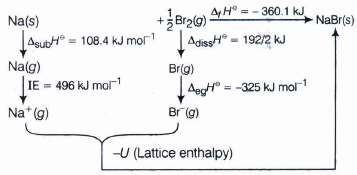
By applying Hess's law,
\(\Delta _{ f }H^{ \circleddash }=\Delta _{ sub }H^{ \circleddash }+IE+\Delta _{ diss }H^{ \circleddash }+\Delta _{ eg }H^{ \circleddash }+U\)
-360.1 = 108.4 + 496 + 96 (-325_-U
U= + 735.5 KJ mol-1
18.
2 NaHCO3(s) \(\longrightarrow \) Na2CO3 (s) + CO2(g) + H2O(g)
\({ \triangle }_{ r }{ H }^{ o }={ \triangle }_{ f }{ H }^{ o }({ Na }_{ 2 }{ CO }_{ 3 })+{ \triangle }_{ f }{ H }^{ o }({ CO }_{ 2 })+{ \triangle }_{ r }{ H }^{ o }({ H }_{ 2 }O)-2{ \triangle }_{ f }{ H }^{ o }({ S }_{ m }^{ o }(NaHCO_{ 3 })\)
\(=-1130+(-393.51)+(-241.82)-2X(-947.7)\)
\( =-1766.23+1895.4=129.17KJ{ mol }^{ -1 }\)
\( { \triangle }_{ r }{ S }^{ o }={ \triangle }_{ r }{ S }_{ m }^{ o }({ Na }_{ 2 }{ CO }_{ 3 })+{ S }_{ m }^{ o }({ CO }_{ 2 })+{ S }_{ m }^{ o }({ H }_{ 2 }O)-2{ S }_{ m }^{ o }(NaHCO_{ 3 })\)
\(=136.0+188.83+231.74-2\times102.1\)
\( =538.57-204.2=334.37J{ K }^{ -1 }{ mol }^{ -1 }\)
From second law of thermodynamics \({ \triangle }_{ r }{ S }^{ o }=\frac { { \triangle }_{ r }{ H }^{ o } }{ T } \)
\(\therefore T=\frac { { \triangle }_{ r }{ H }^{ o } }{ { \triangle }_{ r }{ S }^{ o } } =\frac { 129.17 }{ 334.37\times{ 10 }^{ -3 } } =386.3 \ K\)
Reaction will be spontaneous above 386.3 K.
19.
One decides the spontaneity of a reaction by considering
\(\triangle { S }_{ total }(\triangle { S }_{ sys }+\triangle { S }_{ surr })\). For calculating ∆Ssurr, we have to consider the heat absorbed by the surroundings which is equal to – \({ \triangle }_{ r }{ H }^{ \circleddash }\). At temperature T, entropy change of the surroundings is
\(\triangle { S }_{ surr }=\frac { { \triangle }_{ r }{ H }^{ \circleddash } }{ T } \) (At constant pressure)
\( =\frac { (-1648\times { 10 }^{ 3 }J{ mol }^{ -1 } }{ 298K } \)
= 5530.20 JK-1mol-1
Thus, total entropy change for this reaction
\(\triangle { S }_{ total }=5530 \ J{ K }^{ -1 }{ mol }^{ -1 }+(-549.4 \ J{ K }^{ -1 }{ mol }^{ -1 })\)
\(=4980.6\ J{ K }^{ -1 }{ mol }^{ -1 }\)
This shows that the above reaction is spontaneous.

11th Standard CBSE Syllabus & Materials
11th Standard CBSE
CBSE 11th Business Studies Forms of Business Organisation Sample Question Papers Study Material - QB365 Set A
NEW11th Standard CBSE
CBSE 11th Business Studies Business, Trade and Commerce Sample Question Papers Study Material - QB365 Set A
NEW11th Standard CBSE
CBSE 11th Physics Waves Sample Question Papers Study Material - QB365 Set A
NEW11th Standard CBSE
CBSE 11th Physics Kinetic Theory Sample Question Papers Study Material - QB365 Set A



CBSE 11th Standard CBSE Subjects
CBSE Standards









