
 100% FREE ACCESS
7th Standard CBSE Syllabus & Materials
7th Standard CBSE
CBSE 7th Social Science Theme E - Understanding Market - New Sample Question Papers Study Material - QB365 Set A
NEW7th Standard CBSE
CBSE 7th Social Science Theme E - From Barter to Money - New Sample Question Papers Study Material - QB365 Set A
NEW7th Standard CBSE
CBSE 7th Social Science Theme D - The Constitution of India- An Introduction - New Sample Question Papers Study Material - QB365 Set A
NEW7th Standard CBSE
CBSE 7th Social Science Theme D - From the Rulers to the Ruled : Types of Governments - New Sample Question Papers Study Material - QB365 Set A
NEW7th Standard CBSE
CBSE 7th Social Science Theme B - The Age of Reorganisation - New Sample Question Papers Study Material - QB365 Set A
NEW7th Standard CBSE
CBSE 7th Social Science Theme B - The Rise of Empires - New Sample Question Papers Study Material - QB365 Set A

Published on: 30/07/2018
Based on the chapter Towns, Traders And Crafts Persons, some of the important questions are prepared in this question paper.
Download CBSE Class 7th Standard CBSE Social Science question papers, sample papers, important questions, and previous year solved papers in PDF format. Get free study materials, NCERT solutions, and exam preparation resources for Class 7th Standard CBSE Social Science
Questions + Answers key
Take MCQ Social Science Test
1.
A zamindar is also called as
Adhikari
Subadar
Sipahsalar
Samanta
2.
Market streets are called by the name of
Hatta
Batta
Sadar
Suba Sadar
3.
Pilgrims who flocked to the temples also made
houses
shops
hotels
donations
4.
A town near to Thanjavur which produced cloth is
Chembur
Tiruvannamalai
Madurai
Uraiyur
5.
Which river flows near the town Thanjavur?
Krishna
Kaveri
Tungbhadra
Godawari
6.
Why did the Dutch and English East India Companies attempt to control Masulipatnam?
7.
How did the European Companies gain control of the sea trade?
8.
How was Hampi described by the Portuguese traveller?
9.
What was the use of Mandapas or pavilions?
10.
You are planning a journey from Surat toWest Asia in the 17th century. What are the arrangements you will make?
11.
How was Hampi during the 15th to 16th centuries? What led to its destruction?
12.
In what ways was craft production in cities like Calcutta different from that in cities like Thanjavur?
13.
Who lived in the 'Black Towns' in cities such as Madras?
14.
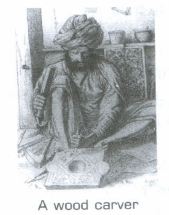
Observe the picture and answer the following questions. Does this create environmental hazards?
15.
How did the Indian craftspersons lose their independence?
16.
Huge banking houses at Surat was owned by __________
17.
A place where goods from diverse production centres are bought and sold is __________
18.
Hampi fell into ruins after __________
19.
Cultural activities, particularly dancing in temples were done by________.
20.
The Rajarajeshvara temple was constructed in ___________
21.
Surat was an important trading port on the Bay of Bengal.
22.
Merchants preferred to travel individually rather than in caravans.
23.
English East India Company shifted its headquarters in 1668 to Bombay from Masulipatnam.
24.
The Dutch built the fort at Surat.
25.
The craftspersons of Bidar could not earn name and fame.
26.
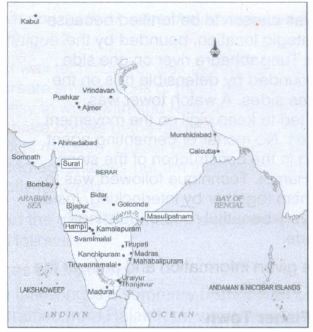
On an outline map of India, mark the following.
(a) Surat
(b) Masulipatnam
(c) Hampi
1.
(d)
Samanta
2.
(a)
Hatta
3.
(d)
donations
4.
(d)
Uraiyur
5.
(b)
Kaveri
6.
()
Both the Dutch and English East India Companies attempted to control Masulipatnam as it became the most important port on the Andhra coast.
7.
()
The European Companies used their naval power to gain control of the sea trade and forced Indian traders to work as their agent.
8.
()
Hampi was described as a very strong city fortified with walls and towers by the Portuguese traveller
9.
()
The kings used to hold court in Mandapas or pavilions
10.
Surat is the gateway for journey and trade with West Asia via the Gulf of Ormuz.
I will make the following arrangements.
i) A confirmed reservation of seat in one of the ships travelling on the route to West Asia.
ii) Dry fruits in huge amount.
ii) Two sets of clothes and all other necessary items.
iii) Letter of approval to go that place.
iv) A life-saving jacket.
v) Medicines
vi) Water bottles
vii) Money
11.
i) Between 15th to 16th centuries, Hampi was in its heyday. It emerged an important commercial and cultural activities. A collective Muslim merchants group called Moors, Chettis and Agents of European traders such as the Portuguese visited the markets of Hampi. Temples in Hampi were the hub of cultural activities.
ii) Temple dancers performed before the deities, royalty and masses in the many-pillared halls in Visupaksha temple. Mahanavami was important festival. Hampi fell into ruins after the defeat of Vijayanagara in 1565 by the Deccani Sultans.
12.
The craft production in Thanjavur was in form of inlay work in copper and silver. While in Calcutta it was in the form of cotton textiles, jute textiles and silk textiles.
13.
Merchants, anisans (such as weavers), native traders and craftspersons lived in the Black Towns established by the European companies within the new cities of Bombay, Calcutta and Madras. It was a part of the larger town. The 'blacks' or native traders and craftspersons were confined here while the 'white' rulers stayed in other areas.
14.
The large-scale use of wood is not good for the environment as it leads to deforestation and soil erosion.
15.
Initially, Indian crafts and textiles were in great demands in the European markets. As a result, the English began to make attempts to control the Indian craftspersons by appointing Indian traders as their agents. They introduced the system of advances under which the weavers had to weave cloth which was only and already promised to European agents. They no longer were able to sell their own cloth or weaving their own patterns. Thus, the Indian craftspersons lost their independence.
16.
()
Kathiawad Seths
17.
()
emporium
18.
()
1565
19.
()
devadasis
20.
()
Thanjavur
21.
(b)
22.
(b)
23.
(b)
24.
(b)
25.
(b)
26.

7th Standard CBSE Syllabus & Materials
7th Standard CBSE
CBSE 7th Social Science Theme B - New Beginnings : Cities and States - New Sample Question Papers Study Material - QB365 Set A
NEW7th Standard CBSE
CBSE 7th Social Science Theme A - Climates of India - New Sample Question Papers Study Material - QB365 Set A
NEW7th Standard CBSE
CBSE 7th Social Science Theme A - Geographical Diversity of India - New Sample Question Papers Study Material - QB365 Set A
NEW7th Standard CBSE
CBSE 7th Science Earth, Moon and the Sun - New Sample Question Papers Study Material - QB365 Set A



CBSE 7th Standard CBSE Subjects
CBSE Standards




