
 100% FREE ACCESS
11th Standard CBSE Syllabus & Materials
11th Standard CBSE
CBSE 11th Economics PART-A - Presentation of Data - New Sample Question Papers Study Material - QB365 Set A
NEW11th Standard CBSE
CBSE 11th Economics PART-A - Organisation of Data - New Sample Question Papers Study Material - QB365 Set A
NEW11th Standard CBSE
CBSE 11th Economics PART-A - Collection of Data - New Sample Question Papers Study Material - QB365 Set A
NEW11th Standard CBSE
CBSE 11th Economics PART-A - Introduction to Economics and Statistics - New Sample Question Papers Study Material - QB365 Set A
NEW11th Standard CBSE
CBSE 11th Business Studies International Trade Sample Question Papers Study Material - QB365 Set A
NEW11th Standard CBSE
CBSE 11th Business Studies Evolution and Fundamentals of Business Sample Question Papers Study Material - QB365 Set A

Published on: 01/08/2018
The chapter Transport in Plants contains the important question in CBSE 11th Standard Biology. It covers one mark, two, three and five marks questions from the book back and creative question.
Download CBSE Class 11th Standard CBSE Biology question papers, sample papers, important questions, and previous year solved papers in PDF format. Get free study materials, NCERT solutions, and exam preparation resources for Class 11th Standard CBSE Biology
Questions + Answers key
Take MCQ Biology Test
1.
A plant if transpiring rapidly, will it show root pressure also?
2.
How are companion cells helpful to sieve tubes?
3.
If the concentration of salt in the soil is not too high, the plants may wilt even if the field is thoroughly irrigated. Explain.
4.
When does wilting occur?
5.
A gardener forgot to water a potted for a day during summer, what will happen to the plant? Do you think it reversible? If yes, how?
6.
Enumerate the effect of increased and decreased solute concentration on water potential inside the cells
7.
Mention one similarity between transport proteins and enzymes proteins.
8.
Mention the type of molecular movement which is highly selective and also requires special membrane proteins, but works without the requirement of energy.
9.
The plant cell cytoplasm is surrounded by both cell wall and cell membrane. The specificity of transport of substances are mostly across the cell membrane, because __________________.
10.
Differentiate between turgor pressure and osmotic pressure.
11.
Which of these is a semipermeable membrane and which is selectively permeable?
(i) Animal bladder
(ii) Plasmalemma
(iii) Tonoplast
(iv) Parchment membrane
(v) Egg membrane
12.
Explain why pure water has the maximum water potential
13.
Distinguish between exosmosis and endosmosis
14.
What are the different factors that affect the rate of diffusion?
15.
Observe the diagram and answer the following.
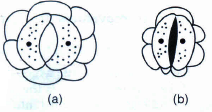
(a) Are these types of guard cells observed in monocot or in dicot plants?
(b) Which of these shows a higher water content?
(c) Which element plays an important role in the opening and closing of stomata?
16.
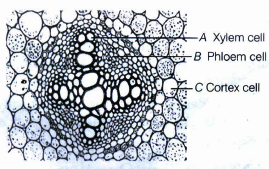
The diagram shows a transverse section of the central portion of a root of a dicotyledonous plant.
(i) Through which tissue are sugars and amino acids transported?
(ii) Why is the movement through phloem bidirectional?
17.
Explain how and in what form are the carbohydrates synthesised leaves in order to reach long distance parts in a plant.
18.
Briefly, describe water potential. what are at the factors affecting it?
19.
Observe the given figure and answer the following questions.
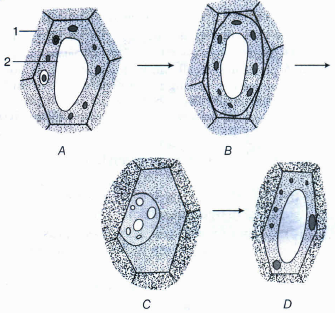
(i) State the nature of the solution marked (1).
(ii) What process has been depicted in figures C to D?
(iii) What will be present in the space marked as (2)?
(iv) In which figures turgor pressure will be zero?
(v) In which figures wall pressure will be positive?
20.
(i) With the help of well-labeled diagrams, describe the process of plasmolysis in plants, giving appropriate examples.
(ii) Explain what will happen to a plant cell if it is kept in a solution having higher water potential.
21.
Define transpiration pull diagrammatically explain the route of transpiration pull and ascent of sap in plants.
1.
()
No, a rapidly transpiring plant does not show any root pressure
2.
()
The companion cells are connected to the sieve tubes by plasmodesmata and provide them with proteins, ATP and other nutrients.
3.
()
Plants fail to absorb water from the soil if the water potential is high and thus show wliting
4.
()
Wilting occurs whenever the turgor pressure in non-lignified plant cells falls towards zero, as a result of diminished water in the cells
5.
()
(i) The plant would show wilting.
(ii) Yes, it is reversible; when water is supplied, the roots absorb water and the cells regain their turgidity.
6.
()
Increased solute concentration decreases water potential, while decreased solute concentration increases water potential
7.
()
They are specific for a substance.
8.
()
Facilitated passive diffusion
9.
()
Cell membrane is semipermeable.
10.
| Turgor Pressure (TP) | Osmotic Pressure (OP) |
| It is the amount of pressure found inside a cell solely due to its water content |
It is the amount of pressure that must be applied in order to prevent the passage of solvent due to osmosis (i.e., depend on solute concentration of cell) |
11.
Semipermeable membrane Animal bladder, parchment paper and egg membrane
Selectively permeable Plasmalemma and tonoplast
12.
Water molecules possess kinetic energy. In liquid and gaseous form, they are in random motion that is both rapid and constant. The greater the concentration of water in system., the greater is its kinetic energy or water potential. Hence, pure water has the greatest water potential. The water potential is denoted by the Greek symbol psi or \(\Psi \) and is expressed in pressure units, Pascal (Pa).
13.
Difference between exosmosis and endosmosis are
| Exosmosis | Endosmosis |
| The outward flow of water from the cell when placed in more concentrated solution like sugar solution (hypertonic) |
The inflow of solvent (water) into a cell from outside when cell is placed in distilled water |
| Cell shrinks in this case and becomes flaccid in nature | Cell swells up in this case and becomes turgid in nature |
14.
Factors affecting the rate of diffusion are
(i) temperature
(ii) pressure
(iii) gradient of concentration
(iv) permeability of membrane
15.
(a) In dicot plants.
(b) (i) Shows higher water content.
(c) Potassium.
16.
(i) Sugars and amino acids are transported by phloem tissue, i.e., ' .part B which are found alternating between the central core of xylem tissue.
(ii) Direction of Transport'.
17.
Long distance transport of organic and inorganic substances occurs from leaves to other parts of plant through phloem (vascular tissue found in plants). As the site of production is far away from the site of absorption, the bulk flow is operated due to positive hydrostatic pressure gradient.
18.
Water potential is the potential energy of water relative to pure free water (e.g., deionised water). It quantifies the tendency of water to move from one area to another due to osmosis, gravity, mechanical pressure or matrix effects including surface tension. Water potential is measured in units of pressure and is commonly represented by the Greek letter \(\Psi \)(psi). This concept has proved useful especially in understanding the water movement within plants, animals and soil.
Water potential of a cell is affected by both solute and pressure potential. The relationship between them is as follows
\({ \Psi }_{ w }={ \Psi }_{ s }+{ \Psi }_{ p }\)
19.
(i) The solution marked as (1) will be hypertonic (more concentrated) due to which cell shrinks.
(ii) From C to D, figure is showing the process of deplasmolysis as shrinked cell has again regained its original shape.
(iii) In space marked as (2) hypotonic solution and water is present.
(iv) Turgor pressure will be zero in figure Band Cbecause cell is in a flaccid condition.
(v) Wall pressure will be positive in- figure A and D because in these figure cell wall is exerting equal and opposite pressure against the expanding protoplasm.
20.
(i) Plasmolysis occurs when water moves out of the cell and the cell membrane of a plant cell shrinks away from its cell wall. This occurs when the cell is kept in a
solution that is hypertonic (has more solutes) to the protoplasm. Water moves out from the cell through diffusion and causes the protoplasm to shrink away from the walls. In such situation, cell becomes plasmolysed.
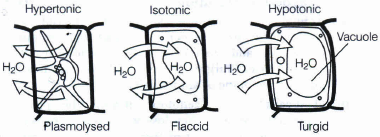
When the cell is placed in an isotonic solution. There is no flow of water towards inside or outside. If the external solution balances the osmotic pressure of the
cytoplasm, it is said to be isotonic. When the water flows into the cell and out of the cell or in equilibrium the cell is called flaccid.
(ii) When the plant cell is kept in a solution having high water potential (hypotonic solution or dilute solution as compared to cytoplasm), water diffuses into the
cell causing the cytoplasm to build up a pressure against the wall, called turgor pressure.
The pressure exerted by the protoplasts due to entry of water against the rigid walls is called pressure potential \(({ \psi }_{ p })\) Because of the rigidity of the cell wall,
the cell does not rupture. This turgor pressure is ultimately responsible for enlargement of cells.
21.
Transpiration pull is the phenomenon which takes place when thousands of transpiring mesophyll cells withdraw water from the xylem by generating a negative pressure in the water column and exerting an upward pull over the water column.This pull is further transmitted to the roots in search of more water.

11th Standard CBSE Syllabus & Materials
11th Standard CBSE
CBSE 11th Business Studies Forms of Business Organisation Sample Question Papers Study Material - QB365 Set A
NEW11th Standard CBSE
CBSE 11th Business Studies Business, Trade and Commerce Sample Question Papers Study Material - QB365 Set A
NEW11th Standard CBSE
CBSE 11th Physics Waves Sample Question Papers Study Material - QB365 Set A
NEW11th Standard CBSE
CBSE 11th Physics Kinetic Theory Sample Question Papers Study Material - QB365 Set A



CBSE 11th Standard CBSE Subjects
CBSE Standards









