
 100% FREE ACCESS
11th Standard CBSE Syllabus & Materials
11th Standard CBSE
CBSE 11th Economics PART-A - Presentation of Data - New Sample Question Papers Study Material - QB365 Set A
NEW11th Standard CBSE
CBSE 11th Economics PART-A - Organisation of Data - New Sample Question Papers Study Material - QB365 Set A
NEW11th Standard CBSE
CBSE 11th Economics PART-A - Collection of Data - New Sample Question Papers Study Material - QB365 Set A
NEW11th Standard CBSE
CBSE 11th Economics PART-A - Introduction to Economics and Statistics - New Sample Question Papers Study Material - QB365 Set A
NEW11th Standard CBSE
CBSE 11th Business Studies International Trade Sample Question Papers Study Material - QB365 Set A
NEW11th Standard CBSE
CBSE 11th Business Studies Evolution and Fundamentals of Business Sample Question Papers Study Material - QB365 Set A

Published on: 05/03/2019
Trigonometric Functions Important Questions
Download CBSE Class 11th Standard CBSE Mathematics question papers, sample papers, important questions, and previous year solved papers in PDF format. Get free study materials, NCERT solutions, and exam preparation resources for Class 11th Standard CBSE Mathematics
Questions + Answers key
Take MCQ Mathematics Test
1.
Find the following values: sin 36°
2.
Find the general solutions of the following equations:
tan x + tan 2x + tan 3x = tan x tan 2x tan 3x
3.
A railway train is travelling on a circular track of 1500 m radius at the speed of 60 km/hr. Through what angle in degrees does it turn in 10 seconds?
4.
If sin α + sin β = a and cosα + cosβ = b,then prove that sin(α+β) \(=\frac { 2ab }{ { a }^{ 2 }+{ b }^{ 2 } } \)
5.
Find the value of \(sin7\frac { { 1 }_{ \circ } }{ 2 } .\)
6.
The minute hand of a watch is 1.8 cm long.How far does its trip move in 30 min?
7.
Prove that \(\cos 2\alpha \cos2\beta +{\sin }^{ 2 }\left( \alpha -\beta \right) -{ \sin }^{ 2 }\left( \alpha +\beta \right) =\cos2(\alpha +\beta )\)
8.
Show that
\(cos\left( \frac { \pi }{ 4 } -\theta \right) cos\left( \frac { \pi }{ 4 } -\phi \right) -sin\left( \frac { \pi }{ 4 } -\theta \right) sin\left( \frac { \pi }{ 4 } -\phi \right) =sin\left( \theta +\phi \right) .\)
9.
If \(sin\theta =-\frac { 3 }{ 5 } and\quad \pi <\theta <\frac { 3\pi }{ 2 } \), then find the value of \(\frac { sec\theta -cot\theta }{ tan\theta -cosec\theta } \).
10.
Find the value of \(sin^{ 2 }\frac { \pi }{ 6 } +cos^{ 2 }\frac { \pi }{ 6 } +sin^{ 2 }\frac { \pi }{ 4 } \)
11.
A tree stands vertically on a hill side which makes an angle of 15\(^{o}\)with the horizontal. From a point on the ground 35m down the hill from the base of the tree, the angle of elevation of the hop of tree is 60\(^{o}\). Find the height of the tree.
12.
If \(\underset { x\longrightarrow b }{ lim } \cfrac { { x }^{ 3 }-{ b }^{ 3 } }{ x-b } =\underset { x\longrightarrow 1 }{ lim } \cfrac { { x }^{ 4 }-1 }{ x1 } \)Find all possible value of b.
13.
If in a \(\triangle \)ABC, \( \frac { 1 }{ a+b } +\frac { 1 }{ b+c } +\frac { 3 }{ a+b+c } \) prove that c = 60\(^{o}\)
14.
Prove that \({ cot }^{ 4 }\theta +{ cot }^{ 2 }\theta ={ cosec }^{ 4 }\theta -{ cosec }^{ 2 }\theta \)
15.
If sin A=\(\frac { 3 }{ 5 } \), 0
tan (A - B)
16.
The angles of a triangle are in A.P. The number of grades in the least is to the number of radians in the greatest as 40:\(\pi\) Find the angles in degrees.
17.
Find sin\({x\over2},cos{x\over2} and \ tan {x\over2}\) in each of the following: cos x =\({-1\over3},x \) x in quadrant III.
18.
Find the general solutions of the following equations:
4 sin x sin 2x sin 4x = sin 3x
19.
Prove the following:
\({cos9x - cos 5x\over sin17x - sin 3x}=-{sin 2x\over cos 10x}\)
20.
Find the general solutions of\(\sqrt{3}\) sin x-cos x =2 ______.
X = n\(\pi +{\pi\over 6}+(-1)^n{\pi\over2}\)
X = n\(\pi -{\pi\over 6}+(-1)^n{\pi\over2}\)
X = n\(\pi +{\pi\over 6}+(-1)^{n+1}{\pi\over2}\)
None
21.
If A, B, C are in A.P. then \({sinA-sinC\over cosC-cosA}\) is equal to ______.
sin B
cot B
sin 2B
cot 2B
22.
If tan \(\theta={\alpha\over \alpha+1}\) and tan \(\phi ={1\over 2\alpha+1}\) , then (A+ B) is equal to ______.
0
\(\pi\over4\)
\(\pi\over6\)
\(\pi\over2\)
23.
sin6\(\theta\) + cos6\(\theta\) + 3 sin2\(\theta\) cos2\(\theta\) is equal to ______.
0
1
4
2
24.
In a ΔABC if a = 5, b = 6 and c = 5, then ∠B is ______.
cos-1 \(\left( \frac { 7 }{ 24 } \right) \)
cos-1\(\left( \frac { 7 }{ 25 } \right) \)
cos-1 \(\left( \frac { 7 }{30 } \right) \)
None
1.
We know that sin 36°= \(\sqrt{1-cos^236^o}\)
\(=\sqrt{1-({\sqrt{5}+1\over 4})^2}\)
\(={\sqrt{10-2\sqrt{5}}\over4}\)
sin 36°\(={\sqrt{10-2\sqrt{5}}\over4}\)
2.
x =\({n\pi\over 3},n \in z\)
3.
6° 21' 49\(1\over 11\)''
4.
\({ a }^{ 2 }+{ b }^{ 2 }=2+2cos(\alpha -\beta )\)
\(and\quad ab=\left[ 2sin\left( \cfrac { \alpha +\beta }{ 2 } \right) cos\left( \cfrac { \alpha -\beta }{ 2 } \right) \right] \left[ 2cos\left( \cfrac { \alpha +\beta }{ 2 } \right) cos\left( \cfrac { \alpha -\beta }{ 2 } \right) \right] \)
\(=\left[ 2sin\left( \left( \cfrac { \alpha +\beta }{ 2 } \right) \right) cos\left( \cfrac { \alpha -\beta }{ 2 } \right) \right] \left[ 2co{ s }^{ 2 }(\cfrac { \alpha -\beta }{ 2 } ) \right]\)
\(=si{ n }^{ 2 }\left( \cfrac { \alpha +\beta }{ 2 } \right) \left[ 2co{ s }^{ 2 }\cfrac { \alpha -\beta }{ 2 } \right] \)
\(=sin(\alpha +\beta )\left[ 2co{ s }^{ 2 }(\cfrac { \alpha -\beta }{ 2 } ) \right] \)
\( for\quad eq.(i)\)
\({ a }^{ 2 }+{ b }^{ 2 }=2+2\left[ 2co{ s }^{ 2 }(\cfrac { \alpha -\beta }{ 2 } )-1 \right] =4co{ s }^{ 2 }\left( \cfrac { \alpha -2 }{ 2 } \right) \)
\(=\cfrac { 2ab }{ sin(\alpha +\beta ) } \)
\(\Rightarrow sin(\alpha +\beta )=\frac { 2ab }{ { a }^{ 2 }+{ b }^{ 2 } } \)
5.
\(sin7\frac { { 1 }^{ \circ } }{ 2 } =sin\frac { { 15 }^{ \circ } }{ 2 } =\sqrt { \frac { 1-cos{ 15 }^{ \circ } }{ 2 } } =\sqrt { \frac { 1-\frac { \sqrt { 3+1 } }{ 2\sqrt { 2 } } }{ 2 } } \)
\(=\quad \sqrt { \frac { 4-\sqrt { 6-\sqrt { 2 } } }{ 2\sqrt { 2 } } } \)
6.
In 60 min,the minute hand of a watch completes one rotation i.e. it rotates through \(360^{0}\)
∴ Angle traced by the minute hand in 1 min \(=(\cfrac { 360 }{ 60 } { ) }^{ 0 }={ 6 }^{ 0 }\)
∴ Angle traced by the minute hand in 30min
\(=(30\times 6)^{ 0 }=18{ 0 }^{ 0 }=(180\times \cfrac { \pi }{ 180 } { ) }^{ c }={ \pi }^{ c }\)
\(\because \quad \theta =\cfrac { Arv }{ Radius } \Rightarrow \pi =\cfrac { Arc }{ 1.8 }\)
\(\therefore \quad Arc=\cfrac { 22 }{ 7 } \times 1.8=5.66\quad cm\)
7.
cos 2α cos 2β + sin(α−β+α+β) sin[α−β−(α+β)]
= cos 2α cos 2β + sin 2α sin(−2β)
= cos 2α cos 2β − sin 2α sin 2β
8.
Use the formula of cos (A+B).
9.
Here, \(\pi <\theta <\frac { 3\pi }{ 2 } \) , it means \(\quad \theta \)lies in third quadrant.
We have,
\(sin\theta =-\frac { 3 }{ 5 } the\quad cosec\quad \theta =\frac { 1 }{ sin\theta } =\frac { 1 }{ -\frac { 3 }{ 5 } } =-\frac { 5 }{ 3 } \)
\(Now,\quad { sin }^{ 2 }\theta +{ cos }^{ 2 }\theta =1\quad \Rightarrow \quad \left( -\frac { 3 }{ 5 } \right) ^{ 2 }+{ cos }^{ 2 }\theta =1\)
\(\Rightarrow \quad { cos }^{ 2 }\theta =1-\frac { 9 }{ 25 } =\frac { 16 }{ 25 } \Rightarrow cos\theta =\pm \sqrt { \frac { 16 }{ 25 } } \)
\(\Rightarrow \quad cos\theta =\pm \frac { 4 }{ 5 } \)
Since \(\theta \) lies in third quadrant. So, cos\(\theta \) is negative.
\(\therefore \quad cos\theta =-\frac { 4 }{ 5 } \Rightarrow sec\theta =\frac { 1 }{ cos\theta } =-\frac { 5 }{ 4 }\)
\(tan\theta =\frac { sin\theta }{ cos\theta } =\frac { -\frac { 3 }{ 5 } }{ -\frac { 4 }{ 5 } } =\frac { 3 }{ 5 } \times \frac { 5 }{ 4 } =\frac { 3 }{ 4 } and\quad cot\theta =\frac { 1 }{ tan\theta } =\frac { 1 }{ \frac { 3 }{ 4 } } =\frac { 4 }{ 3 } \)
On putting the value in given expression, we get
\(\frac { sec\theta -cot\theta }{ tan\theta -cosec\theta } =\frac { \left( -\frac { 5 }{ 4 } -\frac { 4 }{ 3 } \right) }{ \left( \frac { 3 }{ 4 } +\frac { 5 }{ 3 } \right) } =\frac { \left( \frac { -15-16 }{ 12 } \right) }{ \left( \frac { 9+20 }{ 12 } \right) } =-\frac { 31 }{ 29 } \)
10.
\(sin^{ 2 }\frac { \pi }{ 6 } +cos^{ 2 }\frac { \pi }{ 6 } +sin^{ 2 }\frac { \pi }{ 4 } =\left( \frac { 1 }{ 2 } \right) ^{ 2 }+\left( \frac { \sqrt { 3 } }{ 2 } \right) ^{ 2 }+\left( \frac { 1 }{ \sqrt { 2 } } \right) ^{ 2 }\)
\(=\frac { 1 }{ 4 } +\frac { 3 }{ 4 } +\frac { 1 }{ 2 } =\frac { 1+3+2 }{ 4 } =\frac { 6 }{ 4 } =\frac { 3 }{ 2 } \)
11.
According to given information, we have the following figure.
In \(\triangle ARQ\), we have
\(\angle RAQ={ 60 }^{ \circ }and\quad \angle ARQ={ 90 }^{ \circ }\)
\(\therefore \angle AQR={ 30 }^{ \circ }\)
Now, in \(\triangle AQP\), we have \(\angle PAQ={ 45 }^{ \circ }\) and \( \angle AQP={ 30 }^{ \circ }\)
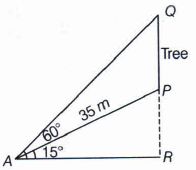
Using sine rule in \(\triangle APQ\), we get
\(\frac { AP }{ \sin { \angle AQP } } =\frac { PQ }{ \sin { \angle PAQ } } \Rightarrow PQ=35\sqrt { 2 } m\).
12.
\(\underset { x\longrightarrow b }{ lim } \cfrac { { x }^{ 3 }-{ b }^{ 3 } }{ x-b } =\underset { x\longrightarrow 1 }{ lim } \cfrac { { x }^{ 4 }-1 }{ x1 } \)
13.
We have, \( \frac { 1 }{ a+b } +\frac { 1 }{ b+c } +\frac { 3 }{ a+b+c } \)
\(\Rightarrow \frac { b+c+a+c }{ (a+c)(b+c) } =\frac { 3 }{ a+b+c } \Rightarrow \frac { a+b+2c }{ (a+c)(b+c) } =\frac { 3 }{ a+b+c } \)
\( \Rightarrow (a+b+2c)(a+b+c)=3(a+c)(b+c)\)
\(\Rightarrow { a }^{ 2 }+b^{ 2 }-{ c }^{ 2 }=ab\)
\(\Rightarrow \frac { \quad { a }^{ 2 }+b^{ 2 }-{ c }^{ 2 } }{ 2ab } =\frac { ab }{ 2ab } \)
\(\Rightarrow cosC=\frac { 1 }{ 2 } =cos60°\quad \therefore \angle C=60°\)
14.
LHS= \({ cot }^{ 4 }\theta +{ cot }^{ 2 }\theta \)
\(=\left( { cot }^{ 2 }\theta \right) ^{ 2 }+\left( { cot }^{ 2 }\theta \right) =\left( { cosec }^{ 2 }\theta -1 \right) ^{ 2 }+{ cot }^{ 2 }\theta \quad [\because 1+{ cot }^{ 2 }\theta ={ cosec }^{ 2 }\theta ]\)
\(={ cosec }^{ 4 }\theta +1-2{ cosec }^{ 2 }\theta +{ cosec }^{ 2 }\theta -1\)
\(={ cosec }^{ 4 }\theta -{ cosec }^{ 2 }\theta \)
= R.H.S
15.
\(cos\quad A\quad =\quad \sqrt { 1-\frac { 9 }{ 25 } } =\frac { 4 }{ 5 } ,\)
\(\\ sin\quad B=\quad -\sqrt { 1-\frac { 144 }{ 169 } } =-\frac { 5 }{ 13 } \)
\(tan(A-B)\quad =\quad \frac { 16 }{ 63 } \)
16.
Let the angles of the triangle be
(a - d)o, ao and (a + d)o, Then a - d + a + a + d = 180°
\(\Rightarrow 3a=180^o \Rightarrow a=60^o\)
So angles are (60-d)o, 60° and (60+ d)o,
Now
\({number \ of \ grades \ in \ the \ least \ angle \over number \ of \ radians \ in \ the \ greatest \ angle}={40\over \pi}\)
\(\therefore {(60-d)\times {10\over 9}\over(60+d)\times {\pi\over 180}}={40\over \pi}\)
\(\Rightarrow\)600-10d= 120+2d
\(\Rightarrow\)12d= 480
\(\Rightarrow\)d=40
Thus angles of the triangle are (60 - 40)°, 60° and (60+ 40)° i.e. 20°, 60° and 100°.
17.
Here cos x =\({-1\over3},x\) in quadrant III.
Now \(\pi\)
So\(x\over2\) lies in second quadrant.
\(\therefore\) sin \(x\over2\) is positive and cos\(x\over2\),tan\(x\over2\) are negative.
Now cos \({x\over2}=-{\sqrt{1+cos \ x\over 2}}=\sqrt{1-{1\over3}\over2}\)
\(=-\sqrt{1\over\sqrt{3}}\times {\sqrt{5}\over \sqrt{5}}={-\sqrt{3}\over3}\)
sin\({x\over2}={\sqrt{1+cos \ x\over 2}}=\sqrt{1-{1\over3}\over2}\)
\(=\sqrt{2\over3}\times {\sqrt{3}\over\sqrt{3}}={\sqrt{6}\over3}\)
tan \({x\over2}={sin{x\over2}\over cos{x\over2}}={\sqrt{2\over3}\over-\sqrt{1\over \sqrt{3}}}=-\sqrt{2}\)
18.
x=n\(\pi \ or \ x=n\pi\pm {\pi\over3},n \in z\)
19.
We have
L.H.S. =\({cos9x - cos 5x\over sin17x - sin 3x}\)
\(={-2sin({9x+5x\over 2})sin ({9x+5x\over 2})\over 2cos({17x+3x\over2})sin({17x+3x\over2})}\)
\(\left[\begin{array}{c} \because \cos \mathrm{C}-\cos \mathrm{D}=-2 \sin \frac{\mathrm{C}+\mathrm{D}}{2} \sin \frac{\mathrm{C}-\mathbf{D}}{2} \\ \sin \mathrm{C}-\sin \mathrm{D}=2 \cos \frac{\mathrm{C}+\mathrm{D}}{2} \sin \frac{\mathrm{C}-\mathrm{D}}{2} \end{array}\right]\)
\(={-2sin7xsin2x\over 2cos10xsin7x}=-{sin 2x\over cos 10x} = R.H.S\)
20.
(a)
X = n\(\pi +{\pi\over 6}+(-1)^n{\pi\over2}\)
21.
(b)
cot B
22.
(b)
\(\pi\over4\)
23.
(b)
1
24.
(b)
cos-1\(\left( \frac { 7 }{ 25 } \right) \)

11th Standard CBSE Syllabus & Materials
11th Standard CBSE
CBSE 11th Business Studies Forms of Business Organisation Sample Question Papers Study Material - QB365 Set A
NEW11th Standard CBSE
CBSE 11th Business Studies Business, Trade and Commerce Sample Question Papers Study Material - QB365 Set A
NEW11th Standard CBSE
CBSE 11th Physics Waves Sample Question Papers Study Material - QB365 Set A
NEW11th Standard CBSE
CBSE 11th Physics Kinetic Theory Sample Question Papers Study Material - QB365 Set A



CBSE 11th Standard CBSE Subjects
CBSE Standards









