
 100% FREE ACCESS
11th Standard CBSE Syllabus & Materials
11th Standard CBSE
CBSE 11th Economics PART-A - Presentation of Data - New Sample Question Papers Study Material - QB365 Set A
NEW11th Standard CBSE
CBSE 11th Economics PART-A - Organisation of Data - New Sample Question Papers Study Material - QB365 Set A
NEW11th Standard CBSE
CBSE 11th Economics PART-A - Collection of Data - New Sample Question Papers Study Material - QB365 Set A
NEW11th Standard CBSE
CBSE 11th Economics PART-A - Introduction to Economics and Statistics - New Sample Question Papers Study Material - QB365 Set A
NEW11th Standard CBSE
CBSE 11th Business Studies International Trade Sample Question Papers Study Material - QB365 Set A
NEW11th Standard CBSE
CBSE 11th Business Studies Evolution and Fundamentals of Business Sample Question Papers Study Material - QB365 Set A

Published on: 30/07/2018
From the chapter Trigonometric Functions, some of the important questions are covered in this question paper. It covers the questions based on the book back and creative questions.
Download CBSE Class 11th Standard CBSE Mathematics question papers, sample papers, important questions, and previous year solved papers in PDF format. Get free study materials, NCERT solutions, and exam preparation resources for Class 11th Standard CBSE Mathematics
Questions + Answers key
Take MCQ Mathematics Test
1.
\(If\quad sin\quad A=\cfrac { 3 }{ 5 } ,0
2.
If θ is an acute angle and tanθ \(=\frac { 1 }{ \sqrt { 7 } } \) then find the value of \(\cfrac { cose{ c }^{ 2 }\theta -se{ c }^{ 2 }\theta }{ cose{ c }^{ 2 }\theta +se{ c }^{ 2 }\theta } \)
3.
If \(\frac { sin(x+y) }{ sin(x-y) } =\frac { a+b }{ a-b } \) then show that \(\frac { sin(x+y) }{ sin(x-y) } =\frac { a+b }{ a-b } \)
4.
Prove that \(\cos 2\alpha \cos2\beta +{\sin }^{ 2 }\left( \alpha -\beta \right) -{ \sin }^{ 2 }\left( \alpha +\beta \right) =\cos2(\alpha +\beta )\)
5.
Show that
\(cos\left( \frac { \pi }{ 4 } -\theta \right) cos\left( \frac { \pi }{ 4 } -\phi \right) -sin\left( \frac { \pi }{ 4 } -\theta \right) sin\left( \frac { \pi }{ 4 } -\phi \right) =sin\left( \theta +\phi \right) .\)
6.
Prove that sin(n+1) x sin(n+2) x + cos(n+1) x. cos(n+2) x = cosx
7.
Prove that \(\frac { sin\quad 5x+sin3x }{ cos\quad 5x+cos\quad 3x } \)=tan 4x
8.
Show that \(\sqrt { 2+\sqrt { 2+\sqrt { 2+2cos8\theta =2cos\theta . } } } \)
9.
Prove that \(\frac { { cos15 }^{ 0 }+{ sin15 }^{ 0 } }{ { cos15 }^{ 0 }-{ sin15 }^{ 0 } } =\sqrt { 3 } \)
10.
Prove that
\(\frac { sin(A-B) }{ cosA\quad cosB } +\frac { sin(B-C) }{ cosB\quad cosC } +\frac { sin(C-A) }{ cosC\quad cosA } =0\)
11.
A tree stands vertically on a hill side which makes an angle of 15\(^{o}\)with the horizontal. From a point on the ground 35m down the hill from the base of the tree, the angle of elevation of the hop of tree is 60\(^{o}\). Find the height of the tree.
12.
Evaluate \(\underset { x\longrightarrow 1 }{ lim } \cfrac { (x-1)(x+1)({ x }^{ 2 }-2) }{ (x-1)({ x }^{ 2 }-4x-1) } =\cfrac { 1 }{ 2 } \)
13.
Prove that \(co{ s }^{ 2 }A+co{ s }^{ 2 }(A+\cfrac { 2\pi }{ 3 } )+co{ s }^{ 2 }(A-\cfrac { 2\pi }{ 3 } )=\cfrac { 3 }{ 2 } \)
14.
If \(cos\theta =\frac { -3 }{ 5 } and\quad \pi <\theta <\frac { 3\pi }{ 2 } \), then find the values of remaining trigonometric functions and hence evaluate \(\frac { cosec\theta +cot\theta }{ sec\theta -tan\theta } \).
15.
If \(cos \left( \theta +\phi \right) = m\quad cos\quad \left( \theta -\phi \right) \)then find the value of \(\frac { 1-m }{ 1+m } cot\quad \phi .\)
1.
\(Cos\quad A=\sqrt { 1-si{ n }^{ 2 } } A\)
\(=\sqrt { 1-\cfrac { 9 }{ 25 } =\sqrt { \cfrac { 16 }{ 25 } =\cfrac { 4 }{ 5 } } } \)
\(\Rightarrow tanA=\cfrac { 3 }{ 4 } \)
\(Also,sinB=-\sqrt { 1-co{ s }^{ 2 } } B\)
\(=-\sqrt { 1-\cfrac { 144 }{ 169 } =-\sqrt { \cfrac { 25 }{ 169 } } =-\cfrac { 5 }{ 13 } } \)
\(=tan B=\cfrac { 5 }{ 12 } \)
\(Now, tan(A-B)=\cfrac { tanA-tanB }{ 1+tanAtanB } =\cfrac { 16 }{ 63 } \)
\(and\quad cot(A+B)=1\)
\(\Rightarrow \frac { cotAcotB-1 }{ cotB+cotA } =1\)
\(\Rightarrow cotAcotB-=cotA+cotB\)
\(\Rightarrow cotAcotB-cot\quad A-cotB=1\)
\( \Rightarrow cotAcotB-cotA-cotB+1=2\)
\(\Rightarrow cotA(cotB-1)-(cotB-1)=2\)
\(\Rightarrow (cotB-1)(cotA-1)=2\)
2.
\(\frac { 3 }{ 4 } \)
3.
given, \(\frac { sin(x+y) }{ sin(x-y) } =\frac { a+b }{ a-b } \)
using componendo and dividendo rule,we get
\(\frac { sin(x+y)+sin(x-y) }{ sin(x+y)-sin(x-y) } =\frac { a+b+a-b }{ a+b-a-b }\)
\( \\ \Rightarrow \frac { 2sin\left( \frac { x+y+x-y }{ 2 } \right) .cos\left( \frac { x+y-x+y }{ 2 } \right) }{ 2cos\left( \frac { x+y+x-y }{ 2 } \right) .sin\left( \frac { x+y-x+y }{ 2 } \right) } =\frac { 2a }{ 2b } \)
\(\left[ sinA+sinB=2sin\frac { A+B }{ 2 } .cos\frac { A-B }{ 2 } and\quad sinA-sinB=2cos\frac { A+B }{ 2 } .sin\frac { A-b }{ 2 } \right] \)
\(\Rightarrow \frac { sin\quad x.cos\quad y }{ cos\quad x.sin\quad y } =\frac { a }{ b } \Rightarrow \quad \frac { tan\quad x }{ tan\quad y } =\frac { a }{ b }\)
Hence proved.
4.
cos 2α cos 2β + sin(α−β+α+β) sin[α−β−(α+β)]
= cos 2α cos 2β + sin 2α sin(−2β)
= cos 2α cos 2β − sin 2α sin 2β
5.
Use the formula of cos (A+B).
6.
\(LHS\quad =\quad sin\quad (n+1)x\quad sin\quad (n+2)x\quad +\quad cos\quad (n+1)x.cos\quad (n+2)x\)
\(= cos\quad (n+1)x.cos(n+2)x+sin(n+1)x.sin(n+2)x\)
\(= cos\quad [(n+1)x-(n+2)x]\)
7.
LHS = \(\frac { sin\quad 5x+sin3x }{ cos\quad 5x+cos\quad 3x } \)
\(=\frac { 2sin\left( \frac { 5x+3x }{ 2 } \right) cos\left( \frac { 5x-3x }{ 2 } \right) }{ 2scos\left( \frac { 5x+3x }{ 2 } \right) cos\left( \frac { 5x-3x }{ 2 } \right) }\) [by formulae]
\(=\frac { sin4x\quad cosx }{ cos4x\quad cosx } \)
= tan4x = RHS
Hence proved
8.
\(LHS=\sqrt { 2+\sqrt { 2+\sqrt { 2+2cos8\theta } } }\)
\(= \sqrt { 2+\sqrt { 2+\sqrt { 2(1+cos8\theta ) } } }\)
\(= \sqrt { 2+\sqrt { 2+\sqrt { 2(1+2cos^{ 2 }4\theta -1) } } } \)
\(= \sqrt { 2+\sqrt { 2+\sqrt { 4cos^{ 2 }4\theta } } } =\sqrt { 2+\sqrt { 2+2cos4\theta } } \)
\(= \sqrt { 2+\sqrt { 2(1+cos4\theta ) } } =\sqrt { 2+\sqrt { 2(1+2cos^{ 2 }2\theta -1) } } \)
\(= \sqrt { 2+\sqrt { 4cos^{ 2 }2\theta } } =\sqrt { 2+2cos2\theta } \)
\(= \sqrt { 2(1+cos2\theta } =\sqrt { 2(1+2cos^{ 2 }\theta -1) } \)
\(= \sqrt { 4cos^{ 2 }\theta } =\quad 2cos\theta \)
Hence Proved.
9.
\(LHS=\frac { { cos15 }^{ 0 }+{ sin15 }^{ 0 } }{ { cos15 }^{ 0 }-{ sin15 }^{ 0 } } =\frac { \frac { { cos15 }^{ 0 } }{ { cos15 }^{ 0 } } +\frac { { sin15 }^{ 0 } }{ { cos15 }^{ 0 } } }{ \frac { { cos15 }^{ 0 } }{ { cos15 }^{ 0 } } -\frac { { sin15 }^{ 0 } }{ { cos15 }^{ 0 } } } \)
\(=\frac { 1+{ tan15 }^{ 0 } }{ 1-{ tan15 }^{ 0 } } \quad \left[ tan\theta =\frac { sin\theta }{ cos\theta } \right]\)
\(=\frac { { tan45 }^{ 0 }+{ tan15 }^{ 0 } }{ 1-{ tan45 }^{ 0 }{ tan15 }^{ 0 } } \left[ { tan45 }^{ 0 }=1 \right] \)
\(=tan({ 45 }^{ 0 }+{ 15 }^{ 0 })\left[ tan(A+B)=\frac { tanA+tanB }{ 1-tanAtanB } \right] \)
\(={ tan60 }^{ 0 }=\sqrt { 3 } =RHS\)
10.
\(LHS=\quad \frac { sin(A-B) }{ cosA\quad cosB } +\frac { sin(B-C) }{ cosB\quad cosC } +\frac { sin(C-A) }{ cosC\quad cosA }\)
\(\frac { cosC\quad sin(A-B)+cosA\quad sin(B-C)+cosB\quad sin(C-A) }{ cosA \quad cosB \quad cosC }\)
\(=\frac { sinA\quad cosB\quad cosC-cosA\quad cosC\quad sinB+cosA\quad cosC\quad sinB-cosA\quad cosB\quad sinC+cosB\quad cosA\quad sinC-cosB\quad cosC\quad sinA }{ cosA\quad cosB\quad cosC }\)
\(=\frac { 0 }{ cosA\quad cosB\quad cosC } \)
\(=0=RHS\)
11.
According to given information, we have the following figure.
In \(\triangle ARQ\), we have
\(\angle RAQ={ 60 }^{ \circ }and\quad \angle ARQ={ 90 }^{ \circ }\)
\(\therefore \angle AQR={ 30 }^{ \circ }\)
Now, in \(\triangle AQP\), we have \(\angle PAQ={ 45 }^{ \circ }\) and \( \angle AQP={ 30 }^{ \circ }\)
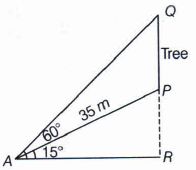
Using sine rule in \(\triangle APQ\), we get
\(\frac { AP }{ \sin { \angle AQP } } =\frac { PQ }{ \sin { \angle PAQ } } \Rightarrow PQ=35\sqrt { 2 } m\).
12.
\(\underset { x\longrightarrow 1 }{ lim } \cfrac { (x-1)(x+1)({ x }^{ 2 }-2) }{ (x-1)({ x }^{ 2 }-4x-1) } =\cfrac { 1 }{ 2 } \)
13.
\(LHS=\frac { 1 }{ 2 } \left[ 2co{ s }^{ 2 }A+2co{ s }^{ 2 }(A+\frac { 2\pi }{ 3 } )+2co{ s }^{ 2 }(A-\frac { 2\pi }{ 3 } ) \right] \)
\(=\frac { 1 }{ 2 } \left[ 1-cos\quad 2A+\{ 1+co{ s }^{ 2 }(A+\frac { 2\pi }{ 3 } )+\{ 1+co{ s }^{ 2 }(A-\frac { 2\pi }{ 3 } \right] \)
\(=\frac { 1 }{ 2 } \left[ 1+cos\quad 2A+\{ 1+co{ s }(2A+\frac { 4\pi }{ 3 } )+cos(2A-\frac { 4\pi }{ 3 } ) \right] \)
\( =\frac { 1 }{ 2 } \left[ 3+cos2A=2cos2Acos\frac { 4\pi }{ 3 } \right] \)
\(=\frac { 1 }{ 2 } \left[ 3+cos2A+2cos2a(\frac { -1 }{ 2 } ) \right] \)
\(=\frac { 3 }{ 2 } =RHS\)
14.
\(We\quad have,\quad { sin }^{ 2 }\theta =1-{ cos }^{ 2 }\theta =1-(-\frac { 3 }{ 5 } )^{ 2 }=\frac { 16 }{ 25 } \)
\(\Rightarrow sin\theta =\pm \frac { 4 }{ 5 } ;\quad but\quad sin\theta \quad is\quad -ve\quad in\quad third\quad quadrant.\)
\(\therefore sin\theta =-\frac { 4 }{ 5 } ;\quad sec\theta =\frac { 1 }{ cos\theta } =\frac { -5 }{ 3 } ;\quad cosec\theta =\frac { 1 }{ sin\theta } =\frac { -5 }{ 4 } \)
\(tan\theta =\frac { sin\theta }{ cos\theta } =\frac { \frac { -4 }{ 5 } }{ \frac { -3 }{ 5 } } =\frac { 4 }{ 3 } \quad and\quad cot\theta =\frac { 1 }{ tan\theta } =\frac { 1 }{ (\frac { 4 }{ 3 } ) } =\frac { 3 }{ 4 }\)
\(Now,\quad \frac { cosec\theta +cot\theta }{ sec\theta -tan\theta } =\frac { -\frac { 5 }{ 4 } +\frac { 3 }{ 4 } }{ -\frac { 5 }{ 3 } -\frac { 4 }{ 3 } } =\frac { \frac { -2 }{ 4 } }{ \frac { -9 }{ 3 } } =\frac { 1 }{ 6 } \)
15.
We have, \(cos \left( \theta +\phi \right) = m\quad cos\left( \theta -\phi \right) \)
\(\Rightarrow \frac { 1 }{ m } =\frac { cos\left( \theta -\phi \right) }{ cos\left( \theta +\phi \right) } \)
Now, \(\frac { 1-m }{ 1+m } =\frac { cos\quad \left( \theta -\phi \right) -cos\quad \left( \theta +\phi \right) }{ cos\quad \left( \theta -\phi \right) +cos\left( \theta +\phi \right) } =tan\quad \theta \quad tan\quad \phi \\ \\ \)
Ans. tan \(\theta \).

11th Standard CBSE Syllabus & Materials
11th Standard CBSE
CBSE 11th Business Studies Forms of Business Organisation Sample Question Papers Study Material - QB365 Set A
NEW11th Standard CBSE
CBSE 11th Business Studies Business, Trade and Commerce Sample Question Papers Study Material - QB365 Set A
NEW11th Standard CBSE
CBSE 11th Physics Waves Sample Question Papers Study Material - QB365 Set A
NEW11th Standard CBSE
CBSE 11th Physics Kinetic Theory Sample Question Papers Study Material - QB365 Set A



CBSE 11th Standard CBSE Subjects
CBSE Standards









