
 100% FREE ACCESS
7th Standard CBSE Syllabus & Materials
7th Standard CBSE
CBSE 7th Social Science Theme E - Understanding Market - New Sample Question Papers Study Material - QB365 Set A
NEW7th Standard CBSE
CBSE 7th Social Science Theme E - From Barter to Money - New Sample Question Papers Study Material - QB365 Set A
NEW7th Standard CBSE
CBSE 7th Social Science Theme D - The Constitution of India- An Introduction - New Sample Question Papers Study Material - QB365 Set A
NEW7th Standard CBSE
CBSE 7th Social Science Theme D - From the Rulers to the Ruled : Types of Governments - New Sample Question Papers Study Material - QB365 Set A
NEW7th Standard CBSE
CBSE 7th Social Science Theme B - The Age of Reorganisation - New Sample Question Papers Study Material - QB365 Set A
NEW7th Standard CBSE
CBSE 7th Social Science Theme B - The Rise of Empires - New Sample Question Papers Study Material - QB365 Set A

Published on: 31/07/2018
Based on the current academic syllabus, some of the important questions are prepared from the chapter Weather, Climate and Adaptations of Animals to Climate.
Download CBSE Class 7th Standard CBSE Science question papers, sample papers, important questions, and previous year solved papers in PDF format. Get free study materials, NCERT solutions, and exam preparation resources for Class 7th Standard CBSE Science
Questions + Answers key
Take MCQ Science Test
1.
The animals living in rainforest adapt themselves to the climate present there. How are they adapted to there climatic conditions?
2.
Write two common adaptive features of a polar bear which help in keeping it warm.
3.
Name two animals each that live in polar regions and tropical rainforests.
4.
Explain with examples, why we find animals of certain kind living in particular climatic conditions.
5.
Which of the two changes frequently, weather or climate?
6.
When the water droplets come in the form of crystals of ice, it is called
fog
snowfall
rainfall
smog
7.
Elephant has
long beak
large ears
striped skin
fat layer under skin
8.
Red-eyed frog have
small eyes
green eyes
bulging eyes
no-eyes
9.
Humidity in climate is due to
rainfall
amount of water vapour in the air
snowfall
wind
10.
A carnivore with stripes on its body moves very fast while catching its prey. It is likely to be found in
polar regions
deserts
oceans
tropical rainforests
11.
_____________ are good swimmers.
12.
Elephant uses its ____________ as a nose.
13.
____________ shows camouflage.
14.
Polar bears _________ during extreme ___________ seasons.
15.
A place receives very little rainfall and the temperature is high throughout the year, the climate of that place will be ___________ and ____________
16.
Maximum and minimum temperature is recorded at which time of the day?
17.
Mention two adaptive features of penguin that help it in swimming.
18.
How is fog formed?
19.
When sun rays fall on the earth, what does it provide?
20.
A fish dies when taken out of water, whereas a wall lizard will die if kept under water. Mention the term used to describe such abilities that allow fish and lizard to survive in their respective habitats.
21.
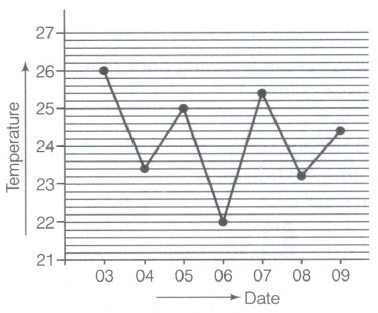
The following graph shows the change in temperature. Answer according to the reading of graph.
(a) Draw a table and fill the temperature change of each day.
(b) Which day show the highest temperature?
(c) Which day shows the minimum temperature?
22.
In a class, the teacher was explaining a concept from weather and climate chapter. Anand got confused and slowly asked his teacher to repeat again. She smiled and started again. In equatorial belt the climate is hot and wet. It has evergreen rainforest and variety of plants. Similarly the vegetation of tropical region also has variations. The forest located between two tropics is called tropical forest. Desert shows arid region and only xerophytes are observed. These plants show specific modification for their survival in this arid region.
(a) Which type of forest is formed in equatorial region?
(b) What are the variation in vegetation seen in tropical forest?
(c) Give some adaptations of plants that are formed in desert.
(d) Some places conifers are seen. What are these places?
(e) What values do we observe in the teacher and Anand?
23.
Tropical rainforests are cool and humid throughout the year because of heavy rains all the time.
24.
It is easy to predict weather rather than climate.
25.
Penguins huddles together to keep themselves warm.
26.
Toucan can change the colour of its feather.
27.
Sun rays fall direct on equator line.
1.
The animals that live in tropical rainforests are herbivorous that are able to eat the vegetation, rich in rainforest.
Most of the tropical rainforest animals walk on the land or are adapted to live on trees. The animals living in rainforest have good eyesight and hearing capacity to catch their prey as well as to protect themselves from predators.
2.
Adaptive features of a polar bear that help in keeping it warm are as follows
(i) They have two thick layers of white fur.
(ii) They have layer of fat under their skin.
3.
Polar regions Polar bear/penguin/ reindeer/musk oxen.
Tropical rainforests Red-eyed frog /elephants lion-tailed macaque/ lion and tiger.
4.
Climate has a profound effect on all living organisms. Animals are adapted to survive in the conditions in which they live. Animals living in very cold and hot climate must possess special features to protect themselves against the extreme cold or heat, e.g. animals living in polar regions have adaptations such as white fur, strong sense of smell, thick skin, lot of fats to protect it from cold, wide, large paws for swimming, etc.
5.
Weather changes frequently in a very short period of time.
6.
(b)
snowfall
7.
(b)
large ears
8.
(c)
bulging eyes
9.
(b)
amount of water vapour in the air
10.
(d)
tropical rainforests
11.
()
Penguins
12.
()
trunk
13.
()
Chameleon
14.
()
hibernates, winter
15.
()
hot, dry
16.
When the temperature due to the sun's heat reaches to its maximum level it is called maximum temperature and when it goes down to the lowest level it is called minimum temperature.
17.
Adaptive features of penguin that help it in swimming are as follows
(i) It has streamlined body.
(ii) It has webbed feet.
18.
During winters when the temperature falls after sunset, it causes condensation of water vapours near the ground. These droplets hanging in the air form fog.
19.
Sun provides light as well as heat on the earth.
20.
Adaptation is the term used to describe such ability. Animals are adapted to survive in the conditions in which they live. So, fish dies when taken out of water while wall lizard dies if kept under water.
21.
(a) Table showing the reading of temperature from the graph:
| Date | Maximum temperature |
|---|---|
| 03/11/14 | 26.0oC |
| 04/11/14 | 23.5oC |
| 05/11/11 | 25.0oC |
| 06/11/14 | 22.0oC |
| 07/11/14 | 25.5oC |
| 08/11/14 | 23.3oC |
| 09/11/14 | 24.4oC |
(b) The highest temperature is seen on 3rd November, 2014.
(c) The lowest temperature or minimum temperature was seen on 06th November, 2014.
22.
(a) Evergreen rainforest with the greatest variety of plants are seen in equational region.
(b) In tropical regions, vegetation varies from broad leaves evergreen trees to tropical deciduous trees to grassland.
(c) The plants in the arid of desert regions have modified leaves covered with hair or waxy coating and an extensive root system.
(d) Conifers are maintained and adapted to withst and snow fall and shortage ofwater in colder belt.
(e) Anand is observant and sincere boy. He is not afraid to ask question in the class.
23.
(b)
24.
(b)
25.
(a)
26.
(a)
27.
(a)

7th Standard CBSE Syllabus & Materials
7th Standard CBSE
CBSE 7th Social Science Theme B - New Beginnings : Cities and States - New Sample Question Papers Study Material - QB365 Set A
NEW7th Standard CBSE
CBSE 7th Social Science Theme A - Climates of India - New Sample Question Papers Study Material - QB365 Set A
NEW7th Standard CBSE
CBSE 7th Social Science Theme A - Geographical Diversity of India - New Sample Question Papers Study Material - QB365 Set A
NEW7th Standard CBSE
CBSE 7th Science Earth, Moon and the Sun - New Sample Question Papers Study Material - QB365 Set A



CBSE 7th Standard CBSE Subjects
CBSE Standards




