Published Date: 2026-01-01
Top 10 Question Paper Mistakes Teachers Should Avoid
Learn the top 10 exam paper mistakes teachers should avoid and how to create balanced, clear, and effective question papers.
Designing a good question paper is both an art and a science. A well-structured paper evaluates students fairly, while a poorly designed one can confuse students and affect results.
Many teachers unknowingly make exam paper mistakes that lead to inconsistent evaluation, student stress, and poor academic outcomes.
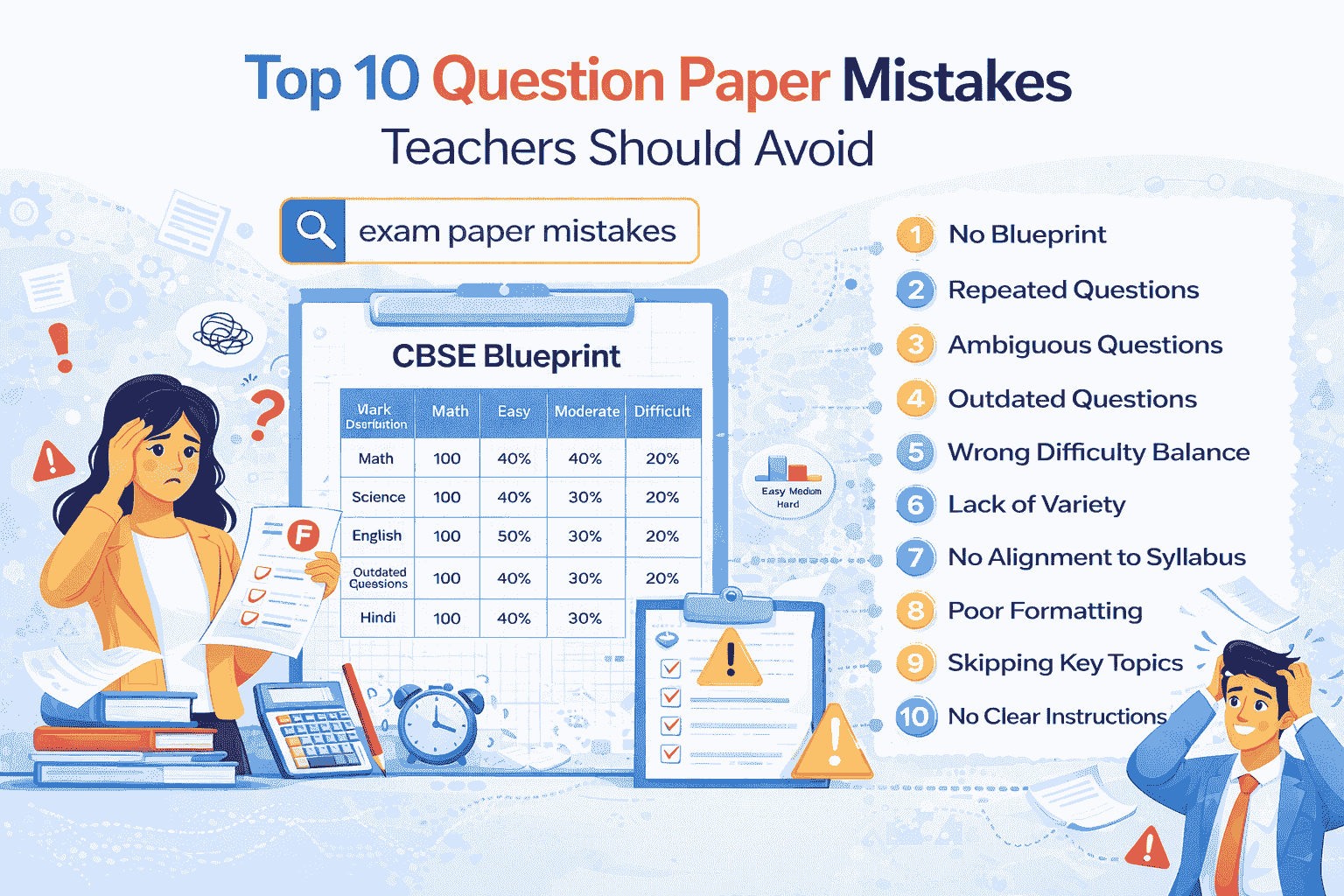
Creating papers without a structured blueprint leads to unbalanced question distribution and missing topics.
Too many high-mark or low-mark questions affect fairness and time management.
Repetition reduces syllabus coverage and makes papers predictable.
Including questions outside the syllabus leads to confusion and unfair evaluation.
Ambiguous questions can result in multiple interpretations and incorrect answers.
Missing instructions cause confusion and time mismanagement.
Using only one type (e.g., MCQs) limits skill assessment.
Messy formatting reduces readability and wastes student time.
Skipping review leads to incorrect questions and wrong marking.
Avoiding exam paper mistakes is essential for maintaining quality and fairness in assessments. By following structured methods and using the right tools, teachers can create effective and balanced question papers.
 Blog
Blog