
12th Standard CBSE Syllabus & Materials
12th Standard CBSE
CBSE 12th Biology Sexual Reproduction in Flowering Plants Assertion and Reason Study Material - QB365 Set D
NEW12th Standard CBSE
CBSE 12th Biology Sexual Reproduction in Flowering Plants Assertion and Reason Study Material - QB365 Set C
NEW12th Standard CBSE
CBSE 12th Biology Sexual Reproduction in Flowering Plants Assertion and Reason Study Material - QB365 Set B
NEW12th Standard CBSE
CBSE 12th Biology Sexual Reproduction in Flowering Plants Assertion and Reason Study Material - QB365 Set A
NEW12th Standard CBSE
CBSE 12th Standard Biology Sexual Reproduction in Flowering Plants Sample Question Papers Study Material - QB365 Set 1
NEW12th Standard CBSE
CBSE 12th Chemistry d- and f- Block Elements Important Questions And Answers Study Material - QB365 Set B

Published on: 27/07/2018
Some of the important questions are prepared from this chapter Electrostatics. In this question paper, questions are prepared from the book back and creative question.
Download CBSE Class 12th Standard CBSE Physics question papers, sample papers, important questions, and previous year solved papers in PDF format. Get free study materials, NCERT solutions, and exam preparation resources for Class 12th Standard CBSE Physics
Questions + Answers key
Take MCQ Physics Test
1.
In which orientation, a dipole placed in a uniform field is in (i) stable (ii) unstable equilibrium?
2.
How does a torque affect the dipole in an electric field?
3.
How much is the dipole moment of non-polar molecule?
4.
How much work is done in moving a 500\(\mu C\) charge between two points on an equipotential surface?
5.
The middle point of a conductor is earthed and its ends are maintained at a potential difference of 220V. What is the potential at the two ends and at the middle point?
6.
How many picofarads are there in a farad?
7.
Can we give as much charge to a capacitor as we wish?
8.
Why is a space ship entering the ionosphere not sufficiently heated, though temperature at the top of ionosphere is nearly 700K?
9.
In small drops o same size are charged to V volt each. They coalesce to form a bigger drop. Calculate the capacity and potential of the bigger drop.
10.
A metal oil of negligible thickness is introduced between two plates of a capaitor at the centre. What will be the new capacitance of the capaitor?
11.
What is the effect of temperature on dielectric constant?
12.
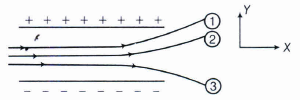
The given figure shows tracks of three charged particles in a uniform electrostatic field. Give the signs of the three charges. Which particle has the highest charge to mass ratio?
13.
At a particular point, electric field depends upon
Source charge Q only
test charge qo only
both Q and q0
neither Q nor qo
14.
Electric field due to a single charge is
asymmetric
cylindrically symmetric
spherically symmetric
None of the above
15.
Electric dipole moment is
scalar
neither scalar vector
a vector directed from -q to +q
a vector directed from +q to -q
16.
At a given distance from the centre of electic dipole, field intensity on axial line is k times the field intensity on equatorial line, where K =
2
3
4
1
17.
Electrostatic potential V at a point, distant r from a charge q varies as
q/r2
q2/r
q/r
q2/r2
18.
The correct relation between electric intensity E and electric potential V is
\(E=-{dV\over dr}\)
\(E={dV\over dr}\)
\(V=-{dE\over dr}\)
\(V={dE\over dr}\)
19.
1 G eV = x eV, where x is
106
103
1012
109
20.
A uniform electric field of 100 N/C exists in vertically upward direction. The decrease in electric potential as one goes up through a height of 20cm is
20 V
120 V
5 V
Zero
21.
1 stat-Coulomb = ......... Coulomb
\(3\times 10^9\)
\(3\times 10^{-9}\)
\({1\over3}\times 10^9\)
\({1\over 3}\times 10^{-9}\)
22.
The cause of charging is actual transfer of protons
actual transfer of protons
actual transfer of electrons
actual transfer of neutrons
none of the above
1.
If \theta is angle between \( \overrightarrow { P } \ and\ \overrightarrow { E } , then \theta =0^o\) for stable equilibrium, \( \theta=180^o\) for unstable equilibrium.
2.
Torque tries to align the dipole along the field.
3.
Zero
4.
Zero. As \(W = q\Delta V= 500\mu C \times 0 = 0 \)
5.
Potential at the middle point is zero. The values of potential at the two ends of the conductor must be +110V and -110V, So that potential difference across the two ends is 110-(-110) = 220V.
6.
1F = 1012pF
7.
No, the maximum charge that can be given to a capacitor is determined by the capacity of the condenser.
8.
This is because density of air in ionosphere is so low that very few molecules only bombard the spaceship.
9.
Let r be the radius of each small drop and R be the radius of bigger drop.
As volume of bigger drop = volume of n small drops
\({4\over 3}\pi R^3=n\times{4\over 3}r^3\)
\(R=n^{1/3}r\)
Also, potential of bigger drop = \(total \ charge\over capacity\)
\(V={nq\over 4\pi\epsilon_o R}={nq\over 4\pi\epsilon_on^{1/3}r}=n^{2/3}{q\over 4\pi\epsilon_o r}\)
\(=n^{2/3}\) times the potential of each small drop.
10.
On introducing a thin metal oil, d is halved. Arrangement is equivalent to two condensor each of capacity 2 C in series.
\({1\over C_s}={1\over 2C}={1\over 2C}={1\over C}\)
\(C_s=C\)
Capacity is unchanged.
11.
Dielectric constant varies inversely with temperature, i.e., dielectric constant decreases with rise in temperature.
12.
We know that a positively charged particle is attracted towards the negatively charged plate and a negatively charged plate and a negatively charged particle is attracted towards the positively charged plate.
Here particle 1 and 2 are attraced positive that mean 1 and 2 are negatively charged. 3 is attracted towards negatively charged plate so it is positively charged.
As the deflection in the path of a charged particle is directly proportional to the charge/mass ratio
\(y\propto \ \frac { q }{ m } \)
Here, the deflection in particle 3 is maximum. so, the charge to mass ratio of particle 3 is maximum.
13.
(a)
Source charge Q only
14.
(c)
spherically symmetric
15.
(c)
a vector directed from -q to +q
16.
(a)
2
17.
(c)
q/r
18.
(a)
\(E=-{dV\over dr}\)
19.
(d)
109
20.
(a)
20 V
21.
(d)
\({1\over 3}\times 10^{-9}\)
22.
(b)
actual transfer of electrons

12th Standard CBSE Syllabus & Materials
12th Standard CBSE
CBSE 12th Chemistry d- and f- Block Elements Important Questions And Answers Study Material - QB365 Set A
NEW12th Standard CBSE
CBSE 12th Chemistry Chemical Kinetics Important Questions And Answers Study Material - QB365 Set B
NEW12th Standard CBSE
CBSE 12th Chemistry Chemical Kinetics Important Questions And Answers Study Material - QB365 Set A
NEW12th Standard CBSE
CBSE 12th Chemistry Electrochemistry Important Questions And Answers Study Material - QB365 Set C



CBSE 12th Standard CBSE Subjects
CBSE Standards










