
 100% FREE ACCESS
12th Standard CBSE Syllabus & Materials
12th Standard CBSE
CBSE 12th Economics Government Budget and the Economy Previous year Question Papers Study Material - QB365 Set A
NEW12th Standard CBSE
CBSE 12th Computer Science Interface Python with MySQL - New Previous year Question Papers Study Material - QB365 Set A
NEW12th Standard CBSE
CBSE 12th Computer Science Database Concept - New Previous year Question Papers Study Material - QB365 Set A
NEW12th Standard CBSE
CBSE 12th Computer Science Data Communication - New Previous year Question Papers Study Material - QB365 Set A
NEW12th Standard CBSE
CBSE 12th Computer Science Data Structures - New Previous year Question Papers Study Material - QB365 Set A
NEW12th Standard CBSE
CBSE 12th Computer Science Functions - New Previous year Question Papers Study Material - QB365 Set A

Published on: 30/07/2026
Download CBSE Class 12th Standard CBSE Biology question papers, sample papers, important questions, and previous year solved papers in PDF format. Get free study materials, NCERT solutions, and exam preparation resources for Class 12th Standard CBSE Biology
Questions + Answers key
Take MCQ Biology Test
1.
An individual has tested positive for AIDS infection.
(i) Discuss the ways in which the individual could have caught this infection.
(ii) State two ways of prevention from AIDS.
2.
Why is the possibility of human female suffering from hemophilia rare? Explain
3.
In dogs, black coat colour is dominant over white. What coloured dog will you choose to breed with a given back dog, in order to find its genotype. What is this type of cross known as?
4.
With the help of a Punnett square, find the percentage of homozygous tall plants in a F2 population involving a true-breeding tall and a true-breeding dwarf pea plant.
5.
Name two plants each, that have
(i) one ovule in the ovary and
(ii) more than one ovule in the ovary.
6.
(i) Explain the phenomenon of multiple allelism and codominance taking ABO blood groups as an example.
(ii) What is the phenotype of the following?
(a) lAi
(b) ii
7.
What is amniocentesis? Justify the statutory ban on it.
8.
How does a bisexual flowering plant ensure cross pollination? Explain.
9.
How are assisted reproductive technologies helpful to humans? How are ZIFT and GIFT different from intra uterine transfers? Explain.
10.
11.
12.
Layers of an ovum from outside to inside are
corona radiata, zona pellicida and vitelline membrane
Zona pellucida, corona radiata and vitelline membrane
vitelline membrane, zona pellucida and crona radiata
zona pellucida, vitelline membrane and corona radiata
13.
The number of chromosomes in a mature gamete gets halved during
Formation of first polar body
Formation of second polar body
Meiosis II
Division of secondary oocyte and spermatocyte
14.
Which is correct for Turners's syndrome?
It is a case of monosomy
It causes sterlity in females.
Absence of Barr body
All of the above.
15.
Transfer of pollen grains from anther to stigma of another flower on the same plant called
Autogamy
Genogamy
Geitonogamy
Karyogamy
16.
ABO blood groups in humans in controlled by a gene I. It has three alleles- I(a) I(b) and i. Since there are three different alleles, six different genotypes are possible. How many phenotypes can occur.
Two
Three
One
Four
17.
Embryo sac is to ovule __________ is to an anther
Stamen
Filament
Pollen grain
Androecium
18.
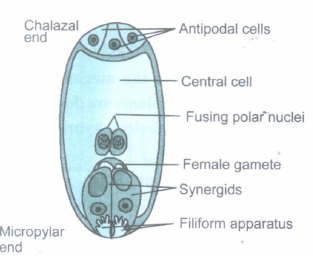
A fully developed embryo sac
A fully-developed and mature embryo sac is shown above.
(a) Name the cell from which it has developed.
(b) What is the ploidy level of its nuclei?
(c) What is filiform apparatus? Mention its significance.
19.
Study the given figure
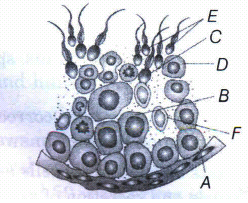
(i) Pick out and name the cells that undergo spermiogenesis.
(ii) Name 'A' and 'B' cells. What is the difference between them with reference to the number of chromosome?
(iii) Pick out and name the motile cells.
(v) What is 'F' cell? Mention its function?
(iv) Name the structure of which the given diagram is a part?
20.
A cross was carried out between two pea plants homozygous dominant for yellow and round seeds with homozygous recessive for the same trait. The Fy progeny of such a cross showed phenotypic ratio of 9:3:3:1.
(i) State the different laws of Mendel that could be derived from such a cross.
(ii) Write the possible genotypes for the progeny for such a cross having
(a) yellow and wrinkled seeds
(b) green and round seeds
21.
(a) Explain the menstrual phase in a human female. State the levels of ovarian and pituitary hormones during this phase.
(b) Why is follicular phase in the menstrual cycle also referred as proliferative phase? Explain.
(c) Explain the events that occur in a graafian follicle at the time of ovulation and thereafter.
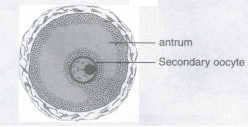
(d) Draw a graafian follicle and label antrum and secondary oocyte.
22.
23.
Assertion: Flowers are the structures related to sexual reproduction in flowering plants.
Reason: Various embryological processes of plants occur in a flower.
Codes:
(a) If both Assertion and Reason are true and Reason is the correct explanation of Assertion.
(b) If both Assertion and Reason are true but Reason is not the correct explanation of Assertion.
(c) If Assertion is true but Reason is false.
(d) If both Assertion and Reason are false.
24.
Assertion (A) : When the two genes in a dihybrid cross are situated on the same chromosome, the proportion of parental gene combinations is much higher than non-parental type.
Reason (B) : Higher parental gene combination can be attributed to crossing over between two genes.
(a) If both A and Rare true and R is the correct explanation of A
(b) It both A and R are true, but R is not the correct explanation of A
(c) If A is true, but R is false
(d) If A is false, but R. is true
25.
Assertion (A) Lactational amenorrhea is the natural method of contraception.
Reason (R) It increases the phagocytosis of sperm.
(a) If both A and R are true and R is the correct explanation of the A
(b) If both A and R are true, but R is not the correct explanation of the A
(c) If A is true, but R is false.
(d) If A is false, but R is true
1.
(i) AIDS infection can be contracted by
(a)Transfusion of HIV positive blood.
(b)Sexual intercourse with infected partner.
(c) Sharing needles or surgical instruments.
(ii)(a) Avoiding intercourse with unknown/multiple partners.
(b)Using condoms during intercourse.
2.
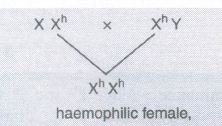
Rare because mother should be atleast carrier and father haemophilic (non viable at later stage).
3.
(i) A white colour dog will be chosen.
(ii) White colour is recessive; a homozygous white do, that breeds true will be chosen.
(iii) Such a cross is called test cross.
4.
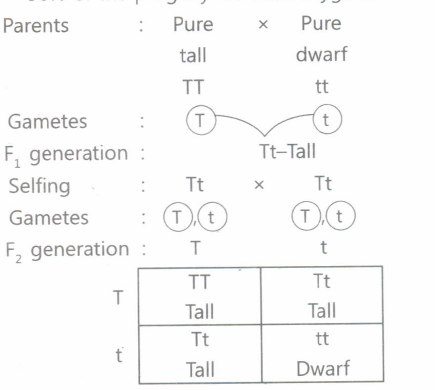
Phenotypic ratio : 3 Tall : 1 Dwarf Genotypic ratio : 1 TT : 2 Tt : 1 tt
Two-thirds of the tall progeny is heterozygous.
It is because the gene for tallness (T) is dominant and expresses itself in the heterozygous condition, Tt.
5.
(i) Mango, Wheat, Maize
(ii) Papaya, Orchids, Watermelon
6.
(a) Multiple allelism is the phenomenon of occurrence of a gene in more than two allelic forms on the same locus. In ABO blood group in humans one gene I has three alleles IA,IB,
I∘/i.
Co-dominance is the phenomenon in which both alleles express themselves when present together. We inherit any two alleles for the blood group. When the genotype is IAIB the individual has AB blood group since both 1'' and IB equally influence the formation of antigens A and B.
(b) (i) IA-blood group-A
(ii) ii-blood group-O
7.
1. Amniocentesis is the pre-natal diagnostic technique, in which a sample of amniotic fluid from the womb of a pregnant woman is taken during early stages of embryo development and the cells are cultured and analysed.
2. Any chromosomal disorder or a metabolic error can be detected and if necessary MTP can be advised.
3. But this technique is misused for knowing the sex of the foetus followed by female foeticide.
8.
The outbreeding devices are as follows:
(i) Self-incompatibility is the genetic mechanism that prevents self-pollen from fertilising the ovule by inhibiting pollen germination or retarding the growth of pollen tube.
(ii) Certain plant species produce male and female flowers on different plants, i.e. the plants are dioecious; this prevents both autogamy and geitonogamy.
(iii) Pollen release and stigma receptivity are not synchronised; either the anthers mature first on the pistil / gynoecium matures first.
(iv) The anthers and stigma of a flower are placed in such a way that the pollen of the flower cannot fall on the stigma of the same flower. (any three)
9.
The assisted reproductive technologies enable the infertile couples to have children.
lIFT refers to the method of embryo transfer in the test tube baby programme, in which the zygote or embryo upto 8-blastomeres is transferred into the fallopian tube.
GIFT refers to the transfer of an ovum collected from a donor female into the fallopian tube of another female, who cannot produce an ovum, but can provide suitable conditions for fertilisation and pregnancy.
Intrauterine transfer refers to the transfer of embryo with more than 8-blastomeres into the uterus of a female.
10.
(d)
11.
(d)
12.
(a)
corona radiata, zona pellicida and vitelline membrane
13.
(a)
Formation of first polar body
14.
(d)
All of the above.
15.
(c)
Geitonogamy
16.
(d)
Four
17.
(c)
Pollen grain
18.
(a) Megaspore
(b) Haploid
(c) (i) Filiform apparatus refers to the special cellular thickenings in the synergids, towards micropylar tip.
(ii) They play an important role in guiding the pollen tube to enter one of the synergids.
19.
(i) A-Spermatids, undergo spermiogenesis
(ii) A-Spermatids, B-Spermatogonium.
Spermatogonium (B) are diploid and have 46 chromosomes in humans, while spermatids (A) are haploid and have 23 chromosomes in case of human male.
(iii) E-spermatozoa, are motile cells
(iv) F-Sertoli cell, it provides nutrition to the germ cells
(v) Seminiferous tubule.
20.
(i) The given cross in the question is a dihybrid cross. Based upon this, Mendel proposed a law of independent assortment.
(ii) The possible genotype of the progeny in the above given dihybrid cross is
(a) Yellow and wrinkled seeds YYrr, Yyrr, Yyrr
(b) Green and round seed yyRR, yyRr, yyrR.
21.
(a) Menstrual phase occurs when released ovum not fertilised, break down of endometrial lining (of the uterus) and its blood vessel form the liquid that comes out through the vagina, lasts for 3 to 5 days.
(b) Primary follicle grows into graafian follicle under the influence of LH & FSH , regeneration of endometrium (under the influence of estrogen).
(c) Graafian follicle ruptures to release the ovum (secondary oocyte) r remaining parts of the Graafian follicle transform into corpus luteum.
(d)
22.
23.
(a) If both Assertion and Reason are true and Reason is the correct explanation of Assertion.
Explanation:
Embryological processes occur in ovary, which is a part of flower.
24.
(c) If A is true, but R is false
25.
(c) If A is true, but R is false.

12th Standard CBSE Syllabus & Materials
12th Standard CBSE
CBSE 12th Computer Science Python Revision Tour I - New Previous year Question Papers Study Material - QB365 Set A
NEW12th Standard CBSE
CBSE 12th Business Studies Planning Important Questions And Answers Study Material - QB365 Set A
NEW12th Standard CBSE
CBSE 12th Business Studies Business Environment Important Questions And Answers Study Material - QB365 Set A
NEW12th Standard CBSE
CBSE 12th Business Studies Principles of Management Important Questions And Answers Study Material - QB365 Set A



NCERT Books

Syllabus

Exam Pattern

Sample Question Papers

Previous year Question Papers

Important Notes

MCQ Practice test

NCERT Exemplers

Case study Questions

Image Based Questions

Passage based Questions

HOT Questions

Value Based Questions

Model Questions Papers
NCERT ( Book Back ) Questions

Assertion and Reason
Important Questions And Answers

CBSE 12th Standard CBSE Subjects
CBSE Standards








