
12th Standard CBSE Syllabus & Materials
12th Standard CBSE
CBSE 12th Economics Government Budget and the Economy Previous year Question Papers Study Material - QB365 Set A
NEW12th Standard CBSE
CBSE 12th Computer Science Interface Python with MySQL - New Previous year Question Papers Study Material - QB365 Set A
NEW12th Standard CBSE
CBSE 12th Computer Science Database Concept - New Previous year Question Papers Study Material - QB365 Set A
NEW12th Standard CBSE
CBSE 12th Computer Science Data Communication - New Previous year Question Papers Study Material - QB365 Set A
NEW12th Standard CBSE
CBSE 12th Computer Science Data Structures - New Previous year Question Papers Study Material - QB365 Set A
NEW12th Standard CBSE
CBSE 12th Computer Science Functions - New Previous year Question Papers Study Material - QB365 Set A

Published on: 30/07/2026
Download CBSE Class 12th Standard CBSE Biology question papers, sample papers, important questions, and previous year solved papers in PDF format. Get free study materials, NCERT solutions, and exam preparation resources for Class 12th Standard CBSE Biology
Questions + Answers key
Take MCQ Biology Test
1.
What do you technically call the water that you drink and the kernel that you eat in a tender coconut?
2.
Name the cell from which the endosperm of coconut develops. Give the characteristic features of endosperm of coconut.
3.
Name the product of fertilisation that forms the kernel of coconut. How does the kernel of coconut. How does the kernel differ from coconut water?
4.
Write the cellular contents carried by the pollen tube. How does the pollen tube. How does the pollen tube gain its energy into the embryo sac?
5.
Cleistogamous flowers of Commelina are invariably autogamous. Mention its one advantage and one disadvantage to the plant.
6.
Mention an advantage and a disadvantage of a cleistogamous flower.
7.
Embryo sac is to ovule __________ is to an anther
Stamen
Filament
Pollen grain
Androecium
8.
From the recent studies, it was found that one of the common fruit banana is one the verge of extinction, as a new fungal disease is plaguing banana plants.
(i) State what could be the possible reasons against this condition
(ii) Describe the phenomenon reasons against this condition
(iii) Suggest a technique to overcome this forthcoming problem.
9.
Difference between male and female gametophyte are:
10.
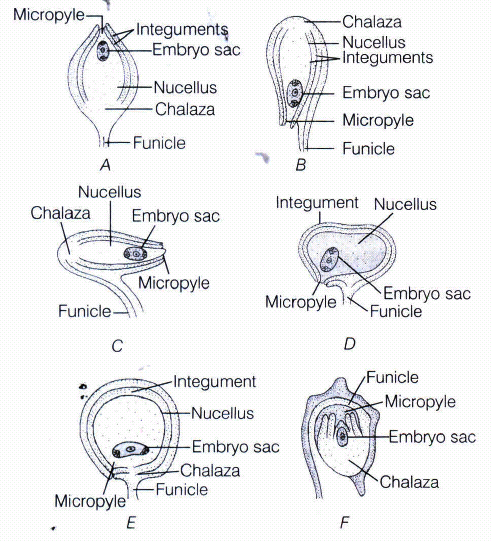
On the basis of relative position of funicle, chalaza and micropyle, the ovules can be classified into following six types. Identify the type of ovule from the diagrams given below and name them.
11.
Differentiate between endosperm and perisperm, give one example of each
12.
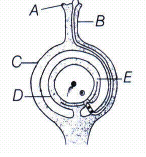
In the diagram given below, identify the parts of the flower and mention the post-fertilisation changes shown in the parts
13.
Name the following activities:
(a) Removal of anthers from the bisexual flower bud to make it a female flower.
(b) Covering of such flowers whose anthers have been removed to prevent contamination of its stigma with unwanted pollen.
(c) Sprinkling of desired pollen grains over the stigma of such flower.
14.
(a) Draw the longitudinal section of il\flower showing growth of pollen tube upto the embryo sac. Label the following parts :
(i) Stigma (ii) Pollen tube (ill)Integument
(iv) Chalazal end (v) Nucellus (vi) Synergids
(b) What is double fertilisation in Angiosperms? Why is it so called ?
15.
Draw a labelled diagram of a mature pollen grain.
16.
(a) Describe in sequence the process of microsporogenesis in angiosperms.
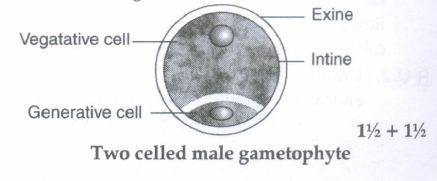
(b) Draw a labelled diagram of two celled final structure formed.
17.
Does self-incompatibility impose any restrictions on autogamy? Give reason and suggest the method of pollination in such plants.
18.
Read the following and answer any four questions from (i) to (v) given below:
In angiosperms, the pollen grains are being transferred from the anther to the stigma and is termed pollination. This phenomenon was first discovered by Camerarius (1694) in the end of seventeenth century. Pollen grains are immobile. They cannot reach the stigma by themselves. An external agent is required for this. The pollination is mainly of two types-self pollination and cross pollination.
The diagram given below shows two plants of the same species showing different types of pollination.
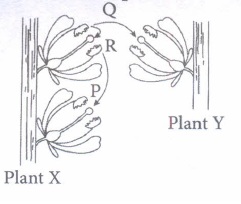
(i) What is transferred between the plants in the process indicated by arrow P?
| (a) Ova | (b) Pollen | (c) Nutrients | (d) Seeds |
(ii) Which of the following statements is correct regarding processes P,Q and R?
(a) Processes P, Q and R introduce genetic variability in the offspring of sexually reproducing plants X andY.
(b) Wind serves as agent for process Q if plants X and Y belong to Genus Salvia.
(c) Flowers of plants X and Y need to produce odour and nectar for completion of processes P and Q if they-are entomophilous.
(d) If plants X and Y belong to Genus Cannabis, then their flowers need to produce sticky and heavy pollens in very small amount for accomplishment of process Q.
(iii) Identify the processes P,Q and R.
| P | Q | R |
| (a) Geitonogamy | Xenogamy | Autogamy |
| (b) Allogamy | Chasmogamy | Cleistogamy |
| (c) Autogamy | Geitonogamy | Xenogamy |
| (d) Geitonogamy | Allogamy | Autogamy |
(iv) In Catharanthus, the growth of style brings the stigma in contact of ripe anthers present on the mouth of corolla tube. This is an example of
| (a) homogamy | (b) cleistogamy | (c) geitonogamy | (d) xenogamy. |
(v) Which of the given processes represents a type of pollination that would result in greater adaptability of the particular species to potential environmental changes?
| (a) P | (b) Q | (c) R | (d) All of these |
19.
Read the following and answer any four questions from (i) to (v) given below:
Many adaptations are found in flowers to achieve certain kind of pollination. The pollination achieved by insects is known as entomophily. The given diagram shows the cross-section of an anther of an insect pollinated flower.
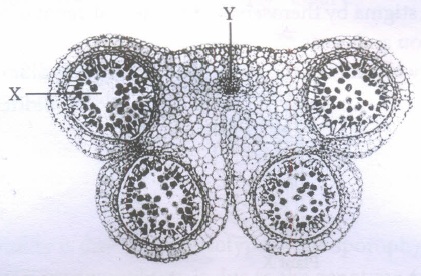
(i) Which of the following is/are the function(s) of structure Y?
A. To carry waste products away from the anther.
B. To supply oxygen to the cells of the anther.
C. To transport food and mineral salts to the anther.
D. To supply water to the anther.
| (a) C only | (b) C and D only | (c) A, Band D only | (d) A,B,C and D |
(ii) Which of the following most accurately describes the structures found in compartment X?
(a) They contain two haploid nuclei resulting from meiosis
(b) They contain two haploid nuclei resulting from mitosis
(c) They contain two haploid male gametes resulting from mitosis
(d) They contain a vegetative nucleus and pollen tube nucleus
(iii) Which of the following is a distinctive characteristic of insect-pollinated flower?
(a) All of them have nectar guides on their flowers
(b) They produce sugary fruit
(c) Their pollen grains tend to have rough surfaces
(d) They produce abundant quantities of pollen to
make up for pollen grains that might be removed by the wind
(iv) Which of the following are likely characteristics of the structures found in X and stamens of this plant?
| Structure of X | Stamens |
| (a) Abundant and light | Pendulous |
| (b) Rough surfaces | Non-pendulous |
| (c) Light and sticky | Pendulous |
| (d) Coarse and sticky | Protrude outside the flower |
(v) Spiny or sticky pollen grains and large, attractively coloured flowers are associated with
| (a) hydrophily | (b) entomophily | (c) ornithophily | (d) anemophily |
20.
Assertion: Self-sterility inhibits self pollination.
Reason: Dichogamy is the condition in which only self pollination occurs
Codes:
(a) Both assertion and reason are true and reason is the correct explanation of assertion.
(b) Both assertion and reason are true but reason is not the correct explanation of assertion.
(c) Assertion is true but reason is false.
(d) Both assertion and reason are false
1.
Primary endosperm cell forms the kernel of coconut.
Difference
The kernel of coconut is the cellular endosperm, while the coconut water is the free-nuclear endosperm.
2.
Primary endosperm cell forms the kernel of coconut.
Difference
The kernel of coconut is the cellular endosperm, while the coconut water is the free-nuclear endosperm.
3.
Primary endosperm cell forms the kernel of coconut.
Difference
The kernel of coconut is the cellular endosperm, while the coconut water is the free-nuclear endosperm.
4.
1. Pollen tube carries two male gametes and the vegetative nucleus.
2. Pollen tube grows through the tissues of stigma and style to reach the ovary.
3. It enters the ovule through the micropyle and then enters the embryo sac through the filiform apparatus of one of the synergids.
5.
Advantage
Since cleistogamous flowers are autogamous, there is an assured seed-set.
Disadvantage
Continued self-pollination leads to inbreeding depression.
6.
Advantage
1. Since cleistogamous flowers are autogamous, there is an assured seed-set.
Disadvantage
1. Continued self-pollination leads to inbreeding depression.
7.
(c)
Pollen grain
8.
(i) Banana appear to have been around as long ago as 10,000 years but because of human controlled asexual reproduction, bananas have very low genetic variety. Their gene pool is becoming have very stringent. As bananas produce no seeds,there is no way for them to diversity their do not have genetic makeup. As a result, they do not have the genetic capability to defend themselves against the funal pathogen. That's why, they are speculated on the verge of extinction within few (approximately 10 years.
(ii) The phenomenon by which fruits develop without fertilisation is called parthenocarpy
(iii) Genetic engineering might be the suggested possible technique to overcome the above-mentioned problem. Though this technique, fungal-resistant genes can be introduced in bananas to protect them from becoming extinct.
9.
| Male gramtophyte | Female gametophyte |
| It is derived from a microspore, which is produced inside the pollen chamber of anther. | It is derived from a megaspore, which is formed inside the nucellus of an ovule |
| The microspores are shed at maturity and transferred from anthers to stigma by the process called pollination. | The megaspores do not shed from the ovule. They develop to form embryo sac within the ovule. |
| The mature male gametophyte is 3-celled | The mature female gametophyte is 7-celled. |
10.
A-Orthotropous ovule
B-Anatropous ovule
C-Hemianatropous
D-Campylotropous ovule
E-Amphitropous ovule
F-Circinotropous ovule
11.
| Endosperm | Perisperm |
| It develops from primary endosperm nuclei. |
It represents the persistant remains of the nucellus in the seed |
| Endosperm develops first, followed by an embryo developement | It is a part that belongs to a seed |
| The PEN undergoes successive three nuclear division to give rise to free nuclei | It is usually dry |
| This division is followed by cytokinesis and endosperm becomes cellular, e.g corn | No cytokinesis occurs, e.g. coffee. |
12.
| Parts | Post-fertilisation change |
| A-Stigma B-Style |
Both degenerate |
| C-Ovary | Fruit |
| D-Ovule | Seed |
| E-Integuments | Seed coat |
13.
(a) Emasculation
(b) Bagging
(c) Artificial pollination.
14.
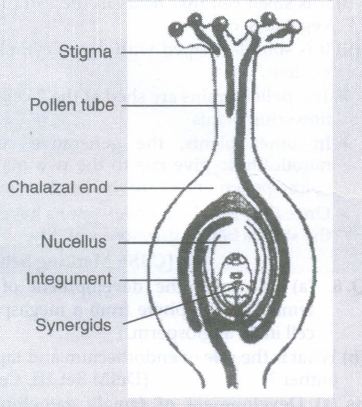
(a) One of the male gametes moves towards the egg cell and fuses with its nucleus thus completing syngamy. This results in the formation of a diploid cell-the zygote, the other male gamete moves
towards the two polar nuclei located in central cell and fuses with them to produce a triploid primary endosperm nucleus Since two types of fusions take place in an embryo sac the phenomenon is known as double fertilization.
(b) There occur two gametic fusions or fertilization in the female gametophyte or embryo sac of angiosperms i.e., one male gamete fuses with the egg to form zygote and the other male gamete fuses with the secondary nucleus to form the primary endosperm nucleus. The former fertilization is called as syngamy and the latter as the triple fusion. Thus, fertilization occurs twice in the same embryo sac, therefore, this is called as the double fertilization. This phenomenon is unique in angiosperms and is not found in any other group of plant kingdom other than angiosperms.
15.
Exine: It can withstand high temperature/strong acids/alkali. It protects pollens.
Intine: It is a thin and continuous layer made up of cellulose and pectin. The intine produces pollen tube.
Vegetative cell: It is bigger and has abundant food reserve.
Generative cell: It divides mitotically to give rise to two male gametes
16.
(a)The process of formation of microspores or pollen grains from microspore or pollen mother cell(MMC or PMC) by meiosis is called micro-sporogenesis. It takes place in pollen sacs or microsporangia of each anther lobe.
The cellsof sporogenious tissue of microsporangium functions as potential MMC/PMC in the anther. They undergo meiosis and as a result form four microspores or pollen grains arranged tetrads. The
pollen grains separate from the tetrads and give rise to two celled male gametophytes while still in situ. In the majority of angiosperms the pollenis released from the anther at 2 celled stage while in some at 3-celled stage as the generative cell divides
(b) to form 2 male gametes
17.
Yes, self-incompatibility impose restrictions on autogamy. The reason for this may be as majority of flowering plants produce hermaphrodite flowers and when pollen grains come in contact with stigma of the flower they continue self-pollination. Such type of continued self-pollination results in inbreeding depression. That's why flowering plants have developed many devices to discourage self-pollination and to encourage cross-pollination. One of the major ways prevent self-pollination is self-pollination is self-sterility or self-incompatibility, i.e. in some bisexual flowers, if the pollen grains fall on the stigma of the same flowers, germination does not occur. But the same pollen grains germinate when they fall on the stigma of other flowers of the same species. It is a genetical mechanism to prevent self-pollination and promote cross-pollination
18.
(i) (b)
(ii) (c) : In the given figure, processes P, Q and R represent geitonogamy (self pollination), xenogamy (cross pollination) and autogamy (self pollination), respectively. Pollinating agents are required for accomplishment of processes P and Q but no agent is required for process R. Out of P, Q and R, only Q is responsible for introducing genetic variability as it is cross pollination between different plants of same species. Salvia is insect pollinated whereas Cannabis is wind pollinated plant.
(iii) (a) : In the given figure, processes P, Q and R represent geitonogamy (self pollination), xenogamy (cross pollination) and autogamy (self pollination), respectively. Pollinating agents are required for accomplishment of processes P and Q but no agent is required for process R. Out of P, Q and R, only Q is responsible for introducing genetic variability as it is cross pollination between different plants of same species. Salvia is insect pollinated whereas Cannabis is wind pollinated plant.
(iv) (a) : Homogamy occur in chasmogamous or open flowers where anthers and stigmas are brought together by growth, bending or folding.
(v) (b)
19.
(i) (b): Y is a vascular bundle comprising xylem that transports water and mineral salts to the anther, and phloem that transports sugars to the anther.
(ii) (b): X contains pollen grains. Pollen grain contains two haploid nuclei resulting from mitosis, a generative nucleus and pollen tube/vegetative nucleus.
(iii) (c): Rough surfaces on pollen grains help them to cling onto the surface of insect pollinators.
(iv) (b): Insect-pollinated plants tend to have pollen with rough surfaces to allow them to cling more readily onto the body of insect pollinators. Their stamens are unlikely to be pendulous nor protrude outside the flower, since the pollen is not intended to be released into the air and carried away by the wind.
(v) (b): Entomophily type of pollination takes place through the agency of insects. The entomophilous flowers are brightly coloured and fragmented to attract the insects. Their pollen grains are sticky or spiny to easily get attached with the body of pollinators. When the insects visit the flowers, their body gets dusted with pollen grains, and when they fly and visit other flowers, they brush against the stigma which being sticky, at once receives the pollen grains from their body. Thus, cross-pollination is achieved.
20.
(c) Self-sterility is the condition in which the pollen of a flower has no fertilizing effect on the stigma of the same flower. Cross-pollination is thus the only method in them for the production of seeds. In many bisexual flowers the anther and stigma often mature at different times. This condition is known as dichogamy. Dichogamy often stands as a barrier to self pollination. There are two conditions of dichogamy.
(i) protogyny - when the gynoecium matures earlier than the anthers of the same flowers
(ii) protandry - when the anthers mature earlier than the stigma of the same flower. In both cases only cross pollination is possible.

12th Standard CBSE Syllabus & Materials
12th Standard CBSE
CBSE 12th Computer Science Python Revision Tour I - New Previous year Question Papers Study Material - QB365 Set A
NEW12th Standard CBSE
CBSE 12th Business Studies Planning Important Questions And Answers Study Material - QB365 Set A
NEW12th Standard CBSE
CBSE 12th Business Studies Business Environment Important Questions And Answers Study Material - QB365 Set A
NEW12th Standard CBSE
CBSE 12th Business Studies Principles of Management Important Questions And Answers Study Material - QB365 Set A



NCERT Books

Syllabus

Exam Pattern

Sample Question Papers

Previous year Question Papers

Important Notes

MCQ Practice test

NCERT Exemplers

Case study Questions

Image Based Questions

Passage based Questions

HOT Questions

Value Based Questions

Model Questions Papers
NCERT ( Book Back ) Questions

Assertion and Reason
Important Questions And Answers

CBSE 12th Standard CBSE Subjects
CBSE Standards








