
12th Standard CBSE Syllabus & Materials
12th Standard CBSE
CBSE 12th Economics Government Budget and the Economy Previous year Question Papers Study Material - QB365 Set A
NEW12th Standard CBSE
CBSE 12th Computer Science Interface Python with MySQL - New Previous year Question Papers Study Material - QB365 Set A
NEW12th Standard CBSE
CBSE 12th Computer Science Database Concept - New Previous year Question Papers Study Material - QB365 Set A
NEW12th Standard CBSE
CBSE 12th Computer Science Data Communication - New Previous year Question Papers Study Material - QB365 Set A
NEW12th Standard CBSE
CBSE 12th Computer Science Data Structures - New Previous year Question Papers Study Material - QB365 Set A
NEW12th Standard CBSE
CBSE 12th Computer Science Functions - New Previous year Question Papers Study Material - QB365 Set A

Published on: 30/07/2026
Download CBSE Class 12th Standard CBSE Biology question papers, sample papers, important questions, and previous year solved papers in PDF format. Get free study materials, NCERT solutions, and exam preparation resources for Class 12th Standard CBSE Biology
Questions + Answers key
Take MCQ Biology Test
1.
What are chasmogamous flowers? Can cross-pollination occur in cleistogamous flowers? Give reasons for your answer.
2.
What is meant by monosporic development of female gametophyte?
3.
The probability of fruit set in a self-pollinated bisexual flower of a plant is far greater than a dioecious plant explain
4.
What is fruit production without fertilisation called?
5.
Why do you think that the zygote is dormant for sometime in a fertilised ovule?
6.
Name the parts of an angiosperm flower in which development of male and female gametophyte takes place.
7.
Devices for self-pollination are
Dicliny or unisexuality
Dichogamy
heterostyly
None of these
8.
Pick the odd one out
Chalazogamy
Porogamy
Mesogamy
Allogamy
9.
In angiosperms, pollen tubes liberate their male gametes into the
Central cell
Antipodal cell
Egg cell
Synergids
10.
Egg apparatus consists of
egg
egg and polar nuclei
Egg and synergids
Egg and antipodal cells
11.
All flowering plants show sexual reproduction. In the flowering plant male, the reproductive part is androecium while the female reproduction part is gynoecium. The male reproduction part consists of filament and anther. the proximal end of the filament attached to the thalamus. A typical end of the filament is attached to the thalamus. A typical angiosperm anther is bilobed. The anther is a four
sided structure consisting of 4 microsporangia appear near-circular in outline. It is surrounded by 4 layers. calls of the sporogenesis anther mature and dehydrated, the microspores dissociate from each
other and develop in the pollen grain. pollen grain Tepresents the male gametophytes. pollen grain made up of two-layer.
1.Wite accessory and essential parts of a flowers.
2.List out four layers of anther wall write its functions
3.Defincd micro sprogcnesis
4.Differentiatc Cxine and intinc
12.
13.
Read the following and answer any four questions from (v) to (v) given below:
A typical angiospermic ovule is a small structure attached to the placenta by means of a stalk called funicle. The body of the ovule fuses with funicle in the region called hilum. Each ovule has one or two protective envelopes called integuments. Integuments encircle the nucellus except at the tip where a small opening called the micropyle is formed. Mature ovules are classified on the basis of funiculus. It can be orthotropous, anatropous, hemitropous, campylotropous, etc.
(i) The body of the ovule consists of a mass of parenchymatous cells called
| (a) integuments | (b) nucellus | (c) hilum | (d) funiculus |
(ii) Refer to the given figure and select the correct statement regarding it.
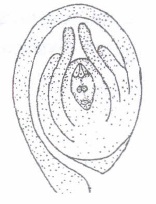
(a) This type of ovule is found in cactus.
(b) The micropyle comes to lie close to the funiculus due to unilateral growth of ovule.
(c) It is most common type of ovule found in the members of Chenopodiaceae
(d) It is half inverted ovule.
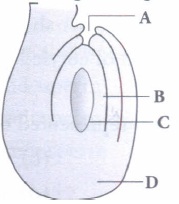
(iii) Identify the parts labelled as A, B, Cand D in the given figure and select the correct option
| A | B | C | D |
| (a) Chalaza | Female gametophyte | Embryo sac | Micropyle |
| (b) Chalaza | Nucellus | Embryo sac | Micropyle |
| (c) Micropyle | Egg | Embryo sac | Chalaza |
| (d) Micropyle | Nucellus | Embryo sac | Chalaza |
(iv) Mature ovules are classified on the basis of funiculus. If micropyle lie close to the funiculus, the ovule is termed as
| (a) orthotropous | (b) anatropous | (c) hemitropous | (d) campylotropous |
(v) In Asphodelus, ovule is
| (a) unitegmic | (b) tritegmic | (c) bitegmic | (d) ategmic |
14.
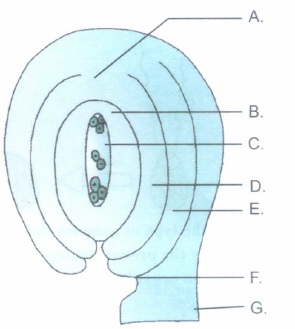
The diagram of an anatropous ovule is presented above.
(a) Give the technical term for ovule.
(b) Identify and name the part that
(i) attaches the ovule to the placenta
(ii) remains as perisperm in some seeds.
(iii) forms the testa of seed.
(iv) represents the basal part of the ovule.
(v) represents the female gametophyte.
15.
The pollen grains may be shed at the two-celled stage (as in 60 per cent of angiosperms) or in the three-celled stage (as in the remaining species). When once shed, the pollen grains must land on the correct type of stigma before they lose viability, to effect fertilisation.
(a) The period for which the pollen grains remain viable is highly variable depending on the species. Substantiate the statement with two examples.
(b) Mention two environmental factors, which affect the pollen viability.
1.
1. Chasmogamous flowers are the bisexual, open flowers with exposed anthers and stigma.
2. Cross-pollination cannot occur in cleistogamous flowers because they remain in bud throughout their life and form seeds via self-pollination.
2.
An embryo sac is called monosporic because it develops from one of the four megaspores formed from the division of megaspore mother cell.
3.
1. In a self-pollinated bisexual flower, the anthers and sigma lie close to each other and when the anthers dehisce, the pollen grains fall on the stigma and pollination is effected even in the absence of a pollinator.
2. But in dioecious plants, an agent or a pollinator is necessary.
4.
Parthenocarpy.
5.
There is an adaptation in angiospermic plants to provide assured nutrition to the developing embryo. Most zygotes divide only after certain amount of endosperm is formed. Therefore, zygote remains dormant for sometime in a fertilised ovule.
6.
1. Male gametophyte - In the Anther (microsporangia) and later on the stigma and style.
2. Female gametophyte - inside the ovule.
7.
(d)
None of these
8.
(d)
Allogamy
9.
(d)
Synergids
10.
(c)
Egg and synergids
11.

12.
13.
(i) (b)
(ii) (a) : The given figure is of circinotropous ovule where funiculus coiled around the ovule. It is found in the Family Cactaceae.
(iii) (d) : Given figure represents an anatropous ovule where· A, B, C and D represent micropyle, nucellus, embryo sac and chalaza respectively.
(iv) (b) : Depending upon the configuration and orientation of the body of ovule in relation to funiculus, there are six types of ovule - orthotropous (atropous, erect), anatropous (inverted), hemitropous (half inverted), campylotropous (body curved), amphitropous (both body and embryo sac curved) and circinotropous (funiculus coiled around the ovule). Anatropous or inverted ovule is the most common type of ovule found in angiosperms (in 80% of angiosperm families). Here, body of the ovule gets inverted and micropyle is on lower side. Further micropyle and funiculus lie side by side and micropyle is close to hilum.
(v) (b)
14.
(a) Megasporangium
(b) (i) G. Funicle
(ii) B. Nucellus
(iii) E. Outer integument
(iv) A. Chalaza
(v) C. Embryo sac.
15.
(a) (i) Pollen grains of cereals (rice, wheat, etc.) lose viability within 30 minutes after release.
(ii) Pollen grains of members of Leguminosae, Rosaceae and Solanaceae remain viable for many months.
(b) Humidity and temperature.

12th Standard CBSE Syllabus & Materials
12th Standard CBSE
CBSE 12th Computer Science Python Revision Tour I - New Previous year Question Papers Study Material - QB365 Set A
NEW12th Standard CBSE
CBSE 12th Business Studies Planning Important Questions And Answers Study Material - QB365 Set A
NEW12th Standard CBSE
CBSE 12th Business Studies Business Environment Important Questions And Answers Study Material - QB365 Set A
NEW12th Standard CBSE
CBSE 12th Business Studies Principles of Management Important Questions And Answers Study Material - QB365 Set A



NCERT Books

Syllabus

Exam Pattern

Sample Question Papers

Previous year Question Papers

Important Notes

MCQ Practice test

NCERT Exemplers

Case study Questions

Image Based Questions

Passage based Questions

HOT Questions

Value Based Questions

Model Questions Papers
NCERT ( Book Back ) Questions

Assertion and Reason
Important Questions And Answers

CBSE 12th Standard CBSE Subjects
CBSE Standards








