
 100% FREE ACCESS
12th Standard CBSE Syllabus & Materials
12th Standard CBSE
CBSE 12th Economics Government Budget and the Economy Previous year Question Papers Study Material - QB365 Set A
NEW12th Standard CBSE
CBSE 12th Computer Science Interface Python with MySQL - New Previous year Question Papers Study Material - QB365 Set A
NEW12th Standard CBSE
CBSE 12th Computer Science Database Concept - New Previous year Question Papers Study Material - QB365 Set A
NEW12th Standard CBSE
CBSE 12th Computer Science Data Communication - New Previous year Question Papers Study Material - QB365 Set A
NEW12th Standard CBSE
CBSE 12th Computer Science Data Structures - New Previous year Question Papers Study Material - QB365 Set A
NEW12th Standard CBSE
CBSE 12th Computer Science Functions - New Previous year Question Papers Study Material - QB365 Set A

Published on: 01/08/2018
Based on the chapter Organisms and Populations, some of the important questions are prepared in this question paper. It covers questions from the book back and PTA question.
Download CBSE Class 12th Standard CBSE Biology question papers, sample papers, important questions, and previous year solved papers in PDF format. Get free study materials, NCERT solutions, and exam preparation resources for Class 12th Standard CBSE Biology
Questions + Answers key
Take MCQ Biology Test
1.
Which bacteria live on the human skin?
2.
What does stratification of community depict?
3.
What does ecological niche of an organism represent?
4.
Give one example where animal-plant interaction involves co-evolution.
5.
Name the type of interaction between a whale and the barnacles growing on its back.
6.
Define heliophytes and sciophytes. Name plant from your locality that is either heliophyte or sciophyte.
7.
What is Resource partitioning? Give an example.
8.
Differentiate between immigration and emigration.
9.
Distinguish between ectotherms and endotherms.
10.
Explain why very small animals are rarely found in polar region.
11.
How do snails, seeds, bears, zooplanktons, fungi and bacteria adapt to conditions unfavourable for their survival?
12.
Describe any three reproductive strategies that organisms have evolved in relation to a particular set of selective pressures.
13.
Name six major terrestrial biomes of the world.
14.
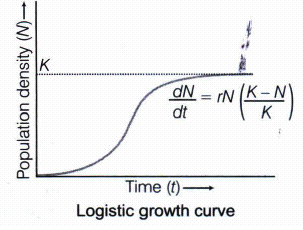
A population od Paramecium caudatum was grown in a culture medium. After 5 days the culture medium became overcrowded with Paramecium and had depleted nutrients.
What will happen to the population and what type of growth curve will the population attain?Draw the growth curve.
15.
Define commensalism. Describe any four examples.
16.
Some organism are tolerant to a narrow range of salinity
eurhaline
stenohaline
neither(a) nor (b)
saline
17.
A protozoan reproduces by binary fission. What will be the number of protozoans in its population after six generations?
128
24
64
32
18.
Niche is defined as the
position of species in a community in relation to other species
place where organism lives
place where organism lives and performs its duty
place where population perform their duties
19.
The amount of fresh water of the earth frozen as polar or glacial ice is
0.5%
0.02%
0.01%
1.97%
2.5%
20.
Popluation density of terrestrial organism is measured in terms of individual per
meter3
meter4
meter
meter2
21.
Keystone species deserve protection because these
are capable of surviving in harsh environmental conditions
indicate presence of certain minerals in the soil
have become rare due to overexploitation
play an important role in supporting other species.
22.
Select the statement which explains best parasitism.
One organism is benefitted.
Both the organisms are benefitted
One organism is benefitted, other is not affected
One organism is benefitted, other is affected.
23.
Animals have the innate ability to escape from predation. Examples for the same are given below. Select the incorrect example.
colour change in chamaeleon
enlargement of body size by swallowing air in puffer fish
poison fangs in snakes
melanism in months
24.
What is a keystone species?
A common species that has plenty of biomass, yet has a fairly low impact on the community's organization
A race species that has minimal impact on the biomass and on other species in the community
A dominant species that constitutes a larger proportion of the biomass and which affects many other species
A species which makes up only a small proportion of the total biomass of community, yet has a huge impact on the community's organization and survival.
25.
Lichens are well known combination of an alga and a fungus where fungus has
an epiphytic relationship with the alga
a parasitic relationship with the alga
a symbiotic relationship with the alga
a saprophytic relationship with alga
1.
()
Staphylococcus aureus
2.
()
Stratification of a community depicts vertical layering of vegetation.
3.
()
Ecological niche of an organism represents the range of conditions it can tolerate, the resources it utilises and its functional role in the ecosystem.
4.
()
The mediterranean orchid, Ophrys and its pollinators (bumble bees and bees) have co-evolved.
5.
()
Commensalism.
6.
Heliophytes are those plants which grow in strong light so are commonly called Sun plants e.g. sunflower, while sciophytes are those plants which prefer to grow in lower light intensities or shade loving plants e.g. money plant, fir etc.
7.
Resource partitioning:
If two species compete for the same resource, they could avoid competition by choosing different times for feeding or
different foraging patterns, e.g. five closely related species of warblers living on the same tree have been shown to coexist and avoid competition by behavioural differences in their foraging activities
8.
| Immigration | Emigration |
| Immigration refers to the number of individuals of the same species coming into a habitat from elsewhere during the time period under consideration. This adds to the population size. | Emigration refers to the number of individuals of the same species that have left the given population during the time period under consideration. This reduces the population size |
9.
| Ectotherms | Endotherms |
| Ectotherms are those animals whose body temperature changes to match with that of the environment in which they are living. | Endotherms are those animals whose body temperature is maintained relatively constant by physiological regulation. |
10.
Heat loss or heat gain is a function of surface area.
Since small animals (like humming birds) have a larger surface area relative to their volume, they tend to lose body heat very fast, when it is cold outside.
They spend more energy to generate body heat through metabolism; considering the cost and benefit of maintaining a constant internal temperature, small animals (humming birds) are not found in polar regions.
11.
Ways to adapt unfavourable conditions are:
(i) Snails undergo aestivation (summer sleep) to avoid summer related problems.
(ii) Bears undergo hibernation (winter sleep) during winter.
(iii) Zooplanktons enter a stage of suspended development called diapause.
(iv) Bacteria and fungi slow down their metabolic rate and from thick-walled spores germinate when the conditions become suitable.
12.
Reproductive strategies:
(i) Some organisms breed only once in their life time-e.g. Bamboo, Pacific Salmon.
(ii) Some produce a large number of small-sized offspring-Oysters.
(iii) Some breed many times during their life time-e.g. birds.
(iv) Some produce a small number of large sized offspring, e.g. Mammals.
13.
(i) Tropical rainforest
(ii) Deciduous forest
(iii) Desert
(iv) Coniferous forest
(v) Agricultural fields
(vi) Grassland.
14.
Initially, after a lag phase, the population will grow in an exponential manner as the nutrients and space will be abundant. When the food sources get depleted, the population density starts decreasing and ends in an asymptote phase, then the population density reaches the carrying capacity (maximum number of given environment can sustain indefinitely).
The population shows a pattern of logistic growth giving an S-shaped curve. where, K-carrying capacity, N=population density at time 't', r = Intrinsic rate of natural increase
15.
Commensalism:
Commensalism is defined as an interspecific interaction where one species is benefitted, while the other species is neither benefitted nor harmed, e.g.
(i) Orchids grow as epiphytes on mango or other fruit trees.
Orchids are benefitted by getting a shelter, while the tree is neither benefitted nor damaged.
(ii) Barnacles growing on the whale are benefitted to move where food is available.
(iii) The cattle egrets always forage near to where the cattle animals graze; the cattle animals stir up the ground and the insects are flushed' out from the vegetation and make it easy for the egrets to catch them.
(iv) The clown fish living among sea anemones get protection from their predators, which stay away from the stinging tentacles of the sea anemone
16.
(b)
stenohaline
17.
(c)
64
18.
(c)
place where organism lives and performs its duty
19.
(d)
1.97%
20.
(d)
meter2
21.
(d)
play an important role in supporting other species.
22.
(d)
One organism is benefitted, other is affected.
23.
(c)
poison fangs in snakes
24.
(d)
A species which makes up only a small proportion of the total biomass of community, yet has a huge impact on the community's organization and survival.
25.
(c)
a symbiotic relationship with the alga

12th Standard CBSE Syllabus & Materials
12th Standard CBSE
CBSE 12th Computer Science Python Revision Tour I - New Previous year Question Papers Study Material - QB365 Set A
NEW12th Standard CBSE
CBSE 12th Business Studies Planning Important Questions And Answers Study Material - QB365 Set A
NEW12th Standard CBSE
CBSE 12th Business Studies Business Environment Important Questions And Answers Study Material - QB365 Set A
NEW12th Standard CBSE
CBSE 12th Business Studies Principles of Management Important Questions And Answers Study Material - QB365 Set A



CBSE 12th Standard CBSE Subjects
CBSE Standards










