
 100% FREE ACCESS
12th Standard CBSE Syllabus & Materials
12th Standard CBSE
CBSE 12th Economics Government Budget and the Economy Previous year Question Papers Study Material - QB365 Set A
NEW12th Standard CBSE
CBSE 12th Computer Science Interface Python with MySQL - New Previous year Question Papers Study Material - QB365 Set A
NEW12th Standard CBSE
CBSE 12th Computer Science Database Concept - New Previous year Question Papers Study Material - QB365 Set A
NEW12th Standard CBSE
CBSE 12th Computer Science Data Communication - New Previous year Question Papers Study Material - QB365 Set A
NEW12th Standard CBSE
CBSE 12th Computer Science Data Structures - New Previous year Question Papers Study Material - QB365 Set A
NEW12th Standard CBSE
CBSE 12th Computer Science Functions - New Previous year Question Papers Study Material - QB365 Set A

Published on: 27/07/2018
In this question paper, some of the important one mark, two and five marks questions from the chapter Sexual Reproduction in Flowering Plants are covered. The questions are prepared from the book back and previous year questions.
Download CBSE Class 12th Standard CBSE Biology question papers, sample papers, important questions, and previous year solved papers in PDF format. Get free study materials, NCERT solutions, and exam preparation resources for Class 12th Standard CBSE Biology
Questions + Answers key
Take MCQ Biology Test
1.
Differentiate between : perisperm and pericarp
2.
Name the protective substance present in the pollen envelope to tide over adverse conditions.
3.
Name the component cells of the 'egg apparatus' in an embryo sac.
4.
Why are non-albuminous seeds so-called?
5.
Why do the pollen grains of Vallisneria have a mucilaginous covering?
6.
How do flowers of Vallisneria get pollinated?
7.
How many microsporangia are present in a typical anther of an angiosperm?
8.
Define ornithophily, chiropterophily and malacophily.
9.
What are the zoophily, zoophilous flowers and entomophilous flowers? List the characters of entomophilous flowers.
10.
Explain any two ways by wich apomictic seeds get developed.
11.
Observe the figure carefully and the answer of the following question:
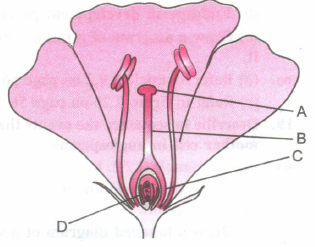
(a) Write whether ovary is superior or inferior?
(b) What is the type of flower - hypogynous, perigynous or epigynous?
(c) What type of ovule is shown the figure?
(d) What changes occur in C after fertilization?
(e) What does A, B, C, D represent in the figure.
12.
Draw a traverse sectional view of an apple and label the following parts along with their technical names:
(i) Edible part
(ii) Enclose the embryo
(iii) Forms the fruit wall.
13.
Which one of the following is surrounded by a callose wall?
Male gamete
Egg
Pollen grain
Microspore mother cell
14.
In some plants anthers and stigma grow and mature at the same time. This phenomenon is called
Homogamy
Syngamy
Allogamy
Fusion
15.
Which one of the following represents an ovule, where the embryo sac becomes horse-shoe shaped and the funiculus and micropyle are close to each other?
Amphitropous
Circinotropous
Atropous
Anatropous
16.
Through which cell of the embryo sac, does the pollen tube enter the embryo sac?
Egg cell
Persistent synergid
Degenerated synergid
Central Cell
17.
The pollen tube usually enters the embryo sac
Through one of the synergids
By directly penetrating the egg
Between one synergid and central cell
By knocking off the antipodal cells
18.
An ovule which becomes curved so that the nucellus and embryo sac lie at right angles to the funicle is
Campylotropous
Anatropous
Orthotropous
Hemitropous
19.
In a flowering plant, archesporium gives rise to
only the wall of the sporangium
both wall and the sporogenous cells
wall and the tapetum
Only tapetum and sporogenous cells
20.
Insect-pollinated flowers are characterized by
Large number of pollens
Dry and smooth pollens
Sticky and rough pollens
Heavy pollens
21.
In angiosperms, pollen tubes liberate their male gametes into the
Central cell
Antipodal cell
Egg cell
Synergids
22.
Egg apparatus consists of
egg
egg and polar nuclei
Egg and synergids
Egg and antipodal cells
1.
()
After fertilization, the wall of ovary is transformed into wall of fruit which is called pericarp. The ovule is transformed into seed, in which the nucellus some times remains persistent as perisperm. Thus, the perisperm lies below the testa and tegmen
2.
()
Sporopollenin.
3.
()
One female gamete and two male synergids.
4.
()
Non-albuminous seeds have no residual endosperm, as it completely consumed during development of embryo.
5.
()
The pollen grains of Vallisneria are released into water; the mucilaginous covering protects them from wetting the consequent decay.
6.
()
Vallisneria shows true hydrophily, i.e. pollination by water
7.
()
Four
8.
Ornithophily. Pollination carried out by small birds is called ornithophily. e.g. Australian plants.
Chiropterophily. It is pollination by bats. e.g. Sausage tree.
Marcophily. Snails also bring pollination, it is termed malacophily.
9.
Zoophily: Pollination by animals is called Zoophily.
Zoophilous flowers: Insect pollinated flowers are called entomophilous flowers.
Entomophilous flowers: Insect pollinates flowers are called entomophilous flowers.
Character of Entomophilous flowers
(1) The flowers are of large size.
(2) Corolla of flowers is brightly coloured.
(3) In some cases the calyx is petaloid.
(4) Bracts may become bright coloured.
(5) Some flowers are very fragrant.
(6) They may bear honey secreting glands.
(7) The pollen grains are heavy with rough and spiny surface.
(8) The stigmatic surface is sticky.
(9) Pollen grains may be joined to form pollinia.
10.
(i) Certain nucellar cells around the embryo sac divide, protrude into embryo sac and develop into embryos, e.g. Citrus, mango, etc.
(ii) The diploid egg cell of the embryo sac, formed without meiosis develops into embryo without fertilisation.
11.
(a) Ovary is superior
(b) Flower is hypogynous because all the floral arise from thalamus below the level of ovary
(c) Ovule is anatropous because it is completely inverted. The micropyle is near the hilum and faces down towards the placenta.The embryo sac is straight.
(d) The ovary of the flower gets converted into fruit after fertilization.
(e) A = Stigma, B = Style, C = Ovary and D = Ovule
12.
(i) Thalamus
(ii) Seed
(iii) Pericarp (in places of epicarp)
13.
(d)
Microspore mother cell
14.
(b)
Syngamy
15.
(a)
Amphitropous
16.
(c)
Degenerated synergid
17.
(a)
Through one of the synergids
18.
(d)
Hemitropous
19.
(b)
both wall and the sporogenous cells
20.
(c)
Sticky and rough pollens
21.
(d)
Synergids
22.
(c)
Egg and synergids

12th Standard CBSE Syllabus & Materials
12th Standard CBSE
CBSE 12th Computer Science Python Revision Tour I - New Previous year Question Papers Study Material - QB365 Set A
NEW12th Standard CBSE
CBSE 12th Business Studies Planning Important Questions And Answers Study Material - QB365 Set A
NEW12th Standard CBSE
CBSE 12th Business Studies Business Environment Important Questions And Answers Study Material - QB365 Set A
NEW12th Standard CBSE
CBSE 12th Business Studies Principles of Management Important Questions And Answers Study Material - QB365 Set A



CBSE 12th Standard CBSE Subjects
CBSE Standards










