
 100% FREE ACCESS
12th Standard CBSE Syllabus & Materials
12th Standard CBSE
CBSE 12th Economics Government Budget and the Economy Previous year Question Papers Study Material - QB365 Set A
NEW12th Standard CBSE
CBSE 12th Computer Science Interface Python with MySQL - New Previous year Question Papers Study Material - QB365 Set A
NEW12th Standard CBSE
CBSE 12th Computer Science Database Concept - New Previous year Question Papers Study Material - QB365 Set A
NEW12th Standard CBSE
CBSE 12th Computer Science Data Communication - New Previous year Question Papers Study Material - QB365 Set A
NEW12th Standard CBSE
CBSE 12th Computer Science Data Structures - New Previous year Question Papers Study Material - QB365 Set A
NEW12th Standard CBSE
CBSE 12th Computer Science Functions - New Previous year Question Papers Study Material - QB365 Set A

Published on: 25/10/2025
Download CBSE Class 12th Standard CBSE Accountancy question papers, sample papers, important questions, and previous year solved papers in PDF format. Get free study materials, NCERT solutions, and exam preparation resources for Class 12th Standard CBSE Accountancy
Questions + Answers key
Take MCQ Accountancy Test
1.
Azad, Vijay and Amit are partners sharing profits and losses in the proportion of \(\frac{1}{4}, \frac{1}{8} \text { and } \frac{10}{16}\). Calculate the new profit sharing ratio between continuing partners if (a) Azad retires; (b) Vijay retires; (c) Amit retires.
2.
Distinguish between calls-in-arrears and calls-in-advance.
3.
Madhu, Neha and Tina are partners sharing profits in the ratio of 5:3:2. Calculate new profit sharing ratio and gaining ratio if
1. Madhu retires
2. Neha retires
3. Tina retires
4.
The capital of the firm of Anu and Benu is Rs. 1,00,000 and the market rate of interest is 15%. Annual salary to partners is Rs. 6,000 each. The profits for the last 3 years were Rs. 30,000; Rs. 36,000 and Rs. 42,000. Goodwill is to be valued at 2 years purchase of the last 3 years’ average super profits. Calculate the goodwill of the firm.
5.
Mohan and Sohan are partners in a firm sharing profits and losses in the ratio of 3:2. They admit Rohan as a new partner for 1/5th share. The goodwill of the firm is valued at RS.30,000. Goodwill already appears in the books at RS.15,000. Rohan brings in 60% of his share of goodwill and RS.1,20,000 as his capital in cash. The amount of goodwill brought in cash is withdrawn by the concerned partners to the extent of 30% of what is credited to them. The profits for the first year of new partnership amounted to RS.60,000.
Give necessary journal entries to adjust goodwill and to distribute profits.
6.
X, Y and Z entered into partnership on 1st July, 2014 to share profits and losses in the ratio of 3 : 2 : 1. X personally guaranteed that Z's share of profit after charging interest on capital @ 6% would not be less than Rs.36,000 per annum.The capital contributed by X - Rs.2,00,000, Y - Rs.1,00,000 and z - Rs.1,00,000.
Profit for the year ended on 31st March, 2015 was rs.1,38,000. Prepare profit and loss appropriation account.
7.
Out of (i), partner's loan appears on the liabilities side of the balance sheet of the firm and the capital account of such partner shows a debit balance, how will you deal with such a loan?
8.
Pass the necessary Journal entries for the following transactions on the dissolution of the firm of P and Q after the various assets (other than cash) and outside liabilities have been transferred to Realisation Account :
(i) Bank Loan Rs. 12,000 was paid.
(ii) Stock worth Rs. 16,000 was taken over by partner Q.
(iii) Partner P paid a creditor Rs. 4,000.
(iv) An asset not appearing in the books of accounts realised Rs. 1,200.
(v) Expenses of realisation Rs. 2,000 were paid by partner Q.
(vi) Profit on realisation Rs. 36,000 was distributed between P and Q in 5 : 4 ratio.
9.
A, B and C were partners sharing profits in the ratio of 6:4:5. Their capitals were A Rs.1,00,000, B-Rs.80,000 and C-Rs.60,000. On 1st April 2009, B retired from the firm and the new profit sharing ratio between A and C was decided as 11:4. On B's retirement the goodwill of the firm was valued at Rs.1,80,000. Showing your calculations clearly, pass necessary journal entry for the treatment of goodwill on B's retirement.
10.
Given below is the Balance Sheet of A and B, who are carrying on partnership business as on March 31,2017. A and B share profits in the ratio of 2:1.
| Liabilities | Amount(Rs.) | Assets | Amount(Rs.) | |
|---|---|---|---|---|
| Bills Payable | 10,000 | Cash in hand | 10,000 | |
| Sundry creditors | 58,000 | Cast at bank | 40,000 | |
| Outstanding expenses | 2,000 | Sundry debtors | 60,000 | |
| Capitals | Stock | 40,000 | ||
| A | 1,80,000 | Plant and machinery | 1,00,000 | |
| B | 1,50,000 | 3,30,000 | Building | 1,50,000 |
| 4,00,000 | 4,00,000 | |||
C is admitted as a partner on the date of the balance sheet on the following terms:
1. C will bring in Rs 1,00,000 as his capital and Rs 60,000 as his share of goodwill for 1/4 share in profits.
2. Plant is to be appreciated to Rs 1,20,000 and the value of buildings is to be appreciated by 10%.
3. Stock is found overvalued by Rs 4,000.
4. A provision for doubtful debts is to be created at 5% of debtors.
5. Creditors were unrecorded to the extend of Rs 1,000.
Record revaluation Account, partners’ capital accounts, and the Balance
Sheet of the constituted firm after admission of the new partner.
11.
Explain why it is considered better to make a partnership agreement in writing.
12.
P, Q and R commenced business on 1st April, 2013 with capitals of 5,00,000, Rs 4,00,000 and Rs3,00,000 respectively. profits and losses were shared in the ratio of 4:3:3. Interest on capitals was paid at 5% per annum. During 2013-14 and 2014-15, they earned profit of Rs2,00,000 and Rs2,50,000 (before allowing interest on capital). Drawings of each partner were Rs50,000 per year. On 31st March, 2015, the firm was dissolved. Creditors on that date were Rs 1,20,000. The assets realised Rs13,00,000 net. Give necessary accounts to close the books of the firm.
13.
Batra Ltd issued 20,000 shares of Rs 100 each at a premium pf Rs 25 per share, payable as follows
Rs 20 per share on application
Rs 45 per share on allotment (including premium Rs15)
Rs 60 per share on first and final call (including premium Rs 10)
The issue was oversubscribed by 10,000 shares. Applications of 8,000 shares were allotted only 1,000 shares and applications of 1,000 shares were sent letters of regret. Excess amount received at the time of application was to be adjusted only against and overpayments exceeding the amount due on allotment were to be Pass necessary entries in the books of the firm.
14.
'Software Ltd.' Invited applications for issuing 70,000 equity shares of Rs.10 each on which Rs.7 per share were called up, which payable as follows:
On application - Rs.2 per share
On allotment - Rs.3 per share
On first call - The balance
The amount was received as follows:
On 40,000 shares - Rs.7 per share
On 20,000 shares - Rs.5 par share
On 10,l000 shares - Rs.2 per share
The directors for feited 30,000 shares on which less Rs.7 per share were received. Later on the forfeited shares were re-issued at Rs.5 per share, as Rs.7 per share were received. Later on the forfeited shares were re-issued at Rs.5 per share, as Rs.7 per share paid up.
Pqss necessary journal entries for the above transactions in the company.
15.
X and Y were partners in a firm sharing profits in the ratio of 3:2 on 31.3.2014 their Balance Sheet was as follows:
| Liabilities | Rs | Assets | Rs | |
|---|---|---|---|---|
| Sundry Creditors | 50,000 | Land and Building | 1,00,000 | |
| Bills Payable | 20,000 | Machinery | 80,000 | |
| Outstanding Expenses | 10,000 | Stock | 1,00,000 | |
| Capital Accounts | Debtors | 40,000 | ||
| X | 1,80,000 | Cash | 10,000 | |
| y | 70,000 | 2,50,000 | ||
| 3,30,000 | 3,30,000 | |||
On the above date Z was admitted as a new partner in the firm for 1/4 share in the profits on the following terms:
(i)Z will bring Rs.1,20,000 for his capital and Rs.20,000 for his share as premium for goodwill.
(ii)Machinery was to be depreciated by 10% and land and Building was to be appreciated by Rs.30,000.
(iii)Stock was overvalued by Rs.20,000
(iv)A provision of 5% was to be created for doubtful debts.
(v)Salary outstanding was Rs.5,000
Prepare Revaluation Account,Partners' Capital Accounts and the Balance Sheet of the new firm.
16.
John Ibrahm, a partner in Modern Tours and Travels withdrew money during the year ending March 31, 2017 from his capital account, for his personal use. Calculate interest in drawings in each of the following alternative situations, if rate of interest is 9 per cent per annum.
(a) If he withdrew Rs. 3,000 per month at the beginning of the month.
(b) If an amount of Rs. 3,000 per month was withdrawn by him at the end of each month.
(c) If the amounts withdrawn were : Rs. 12,000 on June 01, 2016, Rs. 8,000; on August 31, 2016, Rs. 3,000; on September 30, 2016, Rs. 7,000, on November 30, 2016, and Rs. 6,000 on January 31, 2017.
17.
Archie,Betty and Veronica are partners sharing profits in the ratio of 3:2:1 With effect from 1st April 2015 they decide to share profits in the ratio of 2:2:1 Their balance sheet as at 31st March,2015
| Liabilities | Amt(Rs) | Assets | Amt (Rs) | |
|---|---|---|---|---|
| Creditors | 1,00,000 | Cash | 62,000 | |
| Outstanding Expenses | 12,000 | Debtors | 50,000 | |
| Capital A/cs | Stock | 75,000 | ||
| Archie | 3,75,000 | Plant and macheinery | 3,25,000 | |
| Betty | 2,25,000 | Land and building | 4,00,000 | |
| Vernoica | 2,00,0000 | 8,00,000 | ||
| 9,12,000 | 9,12,000 | |||
For the above purpose ,it was agreed that
(a) Plant and machinery should be written down by Rs 25,000.
(b)Stock is found overvalued by 10% It was decided to reduce its value accordingly
(c)Land and building has to be appreciated by 25%.(d)Creditors amounting to be Rs 5,500 are not likely to claim their amount.
(d)Creditors amounting to Rs 5,500 are not likely to claim their account.
(e) Goodwill at the time of reconstitution, is to be valued at 3 years purchase of average profits of last five years,which were Rs 22,500.
You are required to give effect to the above adjustments.
(i) By opening revaluation account
(ii) By passing a single adjustment entry
18.
Versha Ltd. purchased the running business of Vikram Ltd. consisting of total assets of ₹10,00,000 and liabilities of ₹2,00,000. Versha Ltd. paid ₹2,00,000 immediately in cash and balance by issuing 7,000 shares of ₹100 each at a premium of ₹20 per share. The goodwill account will be debited by
₹2,40,000
₹8,00,000
₹2,00,000
Nil
19.
Elite Ltd. issued ₹20,000, 9% debentures of ₹100 each at a discount of 10%, redeemable at a premium. On issue of these debentures. 'loss on issue of debentures. account' was debited with ₹4,00,000. The premium on redemption of debentures is
₹4,00,000
₹2,00,000
₹ 6,00,000
₹10,00,000
20.
Maira Ltd. took over assets of ₹12,00,000 and liabilities of ₹4,00,000 of Subav Ltd. for an agreed purchase consideration of ₹9,00,000. The amount was payable by issue of 11% debentures of 100 each at 10% discount. The number of debentures issued will be
₹9,000
₹10,000
₹8,000
₹11,000
21.
X and Y share profits in the ratio of 3:2. Z was admitted as a partner who sets 1/5 share. New profit sharing ratio, if Z acquires 3/20 from X and 1/20 from Y would be:
9 : 7 : 4
8 : 8 : 4
6 : 10 : 4
10 : 6 : 4
22.
If company wants to calculate amount forfeited on reissued shares, then which amongst the given formula will be used?
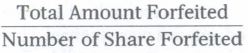
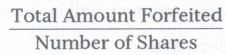
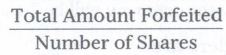

23.
Capital which is called only at the time of winding-up of the company is called
capital reserve
reserve capital
secure capital
authorised capital
24.
When an asset is taken over by a partner, his capital account is
debited
credited
no entry will be passed
None of the above
25.
Partners may dissolve a firm by mutual agreement. This is specified in Section of the Act.
39
40
41
42
26.
Decrease in liability at the time of retirement of partner is
debited to revaluation account
credited to revaluation account
debited to goodwill account
Both (b) and (c)
27.
The ratio in which ·the retiring partner's share of goodwill is debited to the capital accounts of continuing partners' is
old ratio
new ratio
gaining ratio
sacrificing ratio
28.
'N and 'B' were partners in a firm. They share profits in 2 : 3 ratio. They close their accounts on 31st December every year. 'Nwithdrew a fixed sum of Rs.2,000 at the beginning of every month starting form 1st July, 2017. You have to calculate interest on drawings while rate of interest is 12%.
Rs.420
Rs.720
Rs.440
Rs.580
29.
In a firm, 10% of net profit after deducting all adjustments, including reserve is transferred to general reserve. The net profit after all adjustments but before transfer to general reserve is t 44,000. Calculate the amount which is to be transferred to reserve
Rs.2,500
Rs.4,000
Rs.4,400
Rs.2,200
30.
On the reconstitution of a firm change in the value of assets is called ________
Revaluation of assets
Reassessment of assets
Devaluation of assets
Reassessment of liabilities
31.
The circumstances when change in profit sharing ratio is needed:
All of these
When new partner admitted
When existing partner’s decide
When existing partner retires
32.
A person who declares by word of mouth as partner of the firm is called:
Active partner
Estople partner
Dormant partner
Nominal partner
33.
Loss on realization is:
Debited to partners capital A/c
Credited to partners capital A/c
Debited to realization A/c
Credited to realization A/c
34.
Partners equity is effected due to:
Retirement of a partner
Admission of a partner
Death of a partne
All of above
35.
At the time of admission an incoming partner contributes as goodwill:
In cash
Does not pay cash
May or may not pay cash for good will
None of these
36.
Share allotment is a:
Personal a/c
real a/c
nominal a/c
37.
Which is not a method to calculate the goodwill?
Average Profit Method
super profit method
Regular profit method
Capitalization method
38.
Read the following hypothetical extract of Rehan Limited and answer the given questions on the basis of the same:
| YEAR | 2020 | 2019 | 2018 |
|---|---|---|---|
| AMOUNT | (IN Rs.) | (IN Rs.) | (IN Rs.) |
| Outstanding Expense | 50,000 | 40,000 | 25,000 |
| Prepaid Expense | 3,00,000 | 2,50,000 | 3,50,000 |
| Trade Payables | 18,00,000 | 16,00,000 | 14,00,000 |
| Inventory | 12,00,000 | 10,00,000 | 11,00,000 |
| Trade Receivables | 11,00,000 | 8,00,000 | 10,00,000 |
| Cash in hand | 17,00,000 | 12,00,000 | 15,00,000 |
| Revenue from operations | 24,00,000 | 18,00,000 | 20,00,000 |
| Gross Profit Ratio | 12% | 15% | 18% |
1.Current Ratio for the year 2020 will be_______________ (Choose the correct alternative)
| (a) 2:1 | (b) 1.8:1 | (c) 2.32:1 | (d) 2.4:1 |
2.Quick Ratio for the year 2018 will be______________(Choose the correct alternative)
| (a) 1.75:1 | (b) 1.8:1 | (c) 0.94:1 | (d) 1.25:1 |
3.Inventory turnover ratio for the year 2020 will be______(Choose the correct alternative)
| (a) 1.62times | (b) 1.82 times | (c) 1.55time | (d) 1.92 times |
4.Cost of Revenue from Operations for the year 2020 would be ________(Choose the correct alternative)
| (a) Rs.21,12,000 | (b) Rs.21,13,000 | (c) Rs.21,15,000 | (d) Rs.21,17,000 |
39.
Read the following hypothetical text and answer the given questions:
Amit and Mahesh were partners in a fast-food corner sharing profits and losses in ratio 3:2. They sold fast food items across the counter and did home delivery too. Their initial fixed capital contribution was Rs.1,20,000 and Rs.80,000 respectively. At the end of first year their profit was Rs. 1,20,000 before allowing the remuneration of Rs..3,000 per quarter to Amit and Rs..2,000 per half year to Mahesh. Such a promising performance for first year was encouraging, therefore, they decided to expand the area of operations. For this purpose, they needed a delivery van, a few Scotties and an additional person to support. Six months into the accounting year they decided to admit Sundaram as a new partner and offered him 20% as a share of profits along with monthly remuneration of Rs. 2,500. Sundaram was asked to introduce Rs.1,30,000 for capital and Rs..70,000 for premium for goodwill. Besides this Sundaram was required to provide Rs.1,00,000 as loan for two years. Sundaram readily accepted the offer. The terms of the offer were duly executed and he was admitted as a partner
1.Remuneration will be transferred to _______________ of Amit and Mahesh at the end of the accounting period.
| (a) Capital account. | (b) Loan account. |
| (c) Current accoun | (d) None of the above. |
2.Upon the admission of Sundaram the sacrifice for providing his share of profits would be done
| (a) by Amit onl | (b) by Mahesh only |
| (c) by Amit and Mahesh equally | (d) by Amit and Mahesh in the ratio of 3:2. |
3.Sundaram will be entitled to a remuneration of _____________at the end of the year.
4.While taking up the accounting procedure for this reconstitution the accountant of the firm Mr. Suraj Marwaha faced a difficulty. Solve it be answering the following: For the amount of loan that Sundaram has agreed to provide, he is entitled to interest thereon at the rate of ____________.
1.
Share of partners \(=\frac{1}{4}: \frac{1}{8}: \frac{10}{16} \text { or } \frac{4: 2: 10}{16}\)
= 4 : 2 : 10 or 2 : 1 : 5
(a) If Azad retires, Vijay and Amit's share = 1 : 5
(b) If Vijay retires, Azad and Amit's share = 2 : 5
(c) It Amit retires, Azad and Vijay's share = 2 : 1
2.
Differnce between calls-in-arrears and calls-in-advance are as follows:
| Basis | Calls-in-arrears | Calls-in-advance |
|---|---|---|
| Meaning | It is the amount called-up by the company but not paid by shareholders. | It is the amount not called-up by the company but paid by shareholders |
| Interest | Interest @ 10% is charged from members | Interest @ 12% is given to members. |
| Disclosure | Amount is shown by way of deduction from called-up capital | Amount is shown as a separate item |
3.
Given old ratio among Madhu : Neha : Tina as 5 : 3 : 2
1. If Madhu retires, new profit sharing Ratio between Neha and Tina will be
Neha : Tina = 3:2 and Gaining Ratio of Neha and Tina =3:2
2. If Neha retires new profit sharing Ratio between Madhu and Tina will be
Madhu : Tina = 5:2
Gaining Ratio of Madhu and Tina = 5:2
3. If Tina retires, new profit sharing ratio between Madhu and Neha will be:
Madhu : Neha = 5:3
Gaining ratio of Madhu and Neha = 5:3
4.
Interest on capital = \(1,00,000 \times \frac{15}{100} =\text { Rs. } 15,000\) ..(i)
Add: partner’s salary = Rs. 6,000 × 2 = Rs. 12,000 ...(ii)
Normal Profit(i+ii) = Rs. 27,000
Average Profit = Rs. 30,000+Rs.36,000+Rs.42,000=\(\text { Rs. } \frac{1,08,000}{3}\)
= Rs. 36,000
Super Profit = Average Profit–Normal Profit
= Rs. 36,000–Rs. 27,000
= Rs. 9,000
Goodwill = Super Profit × No of years’ purchase
= Rs. 9,000 × 2
= Rs. 18,000
5.
Sacrificing ratio=3:2 and new ratio=12:8:5
6.
Profit transferred to capital accounts: X = Rs.53,000, Y = Rs.40,000, Z = Rs.27,000
7.
Partner 's capital account and partner's loan account are not transferred to realisation account.
8.
(i) Dr. Realisation A/c; Cr. Cash A/c by Rs. 12,000
(ii) Dr. Q's Capital A/c, Cr. Realisation A/c by Rs. 16,000
iii) Dr. Realisation A/c; Cr. p's Capital A/c by 4,000
(iv) Dr. Cash A/c, Cr. Realisation A/c by Rs. 1,200
(v) Dr. Realisation A/c, Cr. Q's Capital A/c by Rs. 2,000
(vi) Dr. Realisation A/c Rs. 36,000, Cr.P's Capital A/c by Rs. 20,000 and Q's Capital A/c Rs. 16,000.
9.
A's gain 5/15 and B's Sacrifice 4/15; Dr.A's Capital A/c Rs.60,000; Cr.B's Capital A/c Rs.48,000 and C's Capital Rs.12,000.
10.
| Particulars | Amount(Rs.) | Particulars | Amount(Rs.) | |
|---|---|---|---|---|
| Stock in hand | 4,000 | Plant and machinery | 20,000 | |
| Provision for doubtful debts | 3,000 | Buildings | 15,000 | |
| Creditors | ||||
| profit on revaluation | 1,000 | |||
| transferred to: | ||||
| A’s Capital | 18,000 | |||
| B’s Capital | 9,000 | 27,000 | ||
| 35,000 | 35,000 | |||
| Date 2017 |
Particulars | A(Rs.) | B(Rs.) | C(Rs.) | Date | Particulars | A(Rs.) | B(Rs.) | C(Rs.) |
|---|---|---|---|---|---|---|---|---|---|
| March | Balance | 2,38,000 | 1,79,000 | 1,00,00 | March 31 | Balabce b/d | 1,80,000 | 1,50,000 | |
| Bank | 1,00,000 | ||||||||
| Goodwill | 40,000 | 20,000 | |||||||
| Revaluatio | 18,000 | 9,000 | |||||||
| 2,38,000 | 1,79,000 | 1,00,000 | 2,38,000 | 1,79,000 | 1,00,000 |
| Liabilities | Amount(Rs.) | Assets | Amount(Rs.) | ||
|---|---|---|---|---|---|
| Bills Payable | 10,000 | Cash in hand | 10,000 | ||
| Sundry Creditors | 59,000 | Cash at bank | 2,00,000 | ||
| Outstanding Expenses | 2,000 | Sundry Debtors | 60,000 | ||
| Capitals | Less: Provision for | 3,000 | 57,000 | ||
| A | 2,38,000 | doubtful debts | |||
| B | 1,79,000 | Stock | 36,000 | ||
| C | 1,00,000 | 5,17,000 | Plant and Machinery | 1,20,000 | |
| Buildings | 1,65,000 | ||||
| 5,88,000 | 5,88,000 | ||||
11.
A partnership deed forms the basis of a partnership firm. A partnership deed consists of all the pre-determined terms and conditions that are agreed to by all the partners while forming the partnership. Generally the following details are included in a partnership deed.
1. Objective of business of the firm
2. Name and address of the firm
3. Name and address of all partners
4. Profit and loss sharing ratio
5. Contribution to capital by each partner
6. Rights, types of roles and duties of partners
7. Duration of partnership
8. Rate of interest on capital, drawings and loans
9. Salaries, commission, if payable to partners.
10. Rules regarding admission, retiring, death and dissolution of the firm, etc. It ensures the
A partnership deed can both be oral or written. Although, it is not compulsory to form partnership agreement in writing under the Partnership Act of 1932, however, written partnership deed is more desirable than the oral agreements. This is because it ensures the smooth functioning of the business of the partnership firm. It helps in avoiding disputes and misunderstandings among the partners. Also, it helps in settling t the disputes (as the case may be) among the partners, as written partnership deed can be referred to anytime. If written partnership deed is duly signed and registered under Partnership Act, then it can be used as evidence in the court of law. Moreover, any changes (if needed) in the partnership deed cannot be made without the consent of all the partners of the firm. Therefore, it is desirable to form partnership deed in writing because of the merits associated with written documents over its oral counterparts.
12.
Balance sheet on the date of dissolution is not given. Further, partners' capitals and book value of assets on the date of dissolution are also not given. Hence, first of all balances of partners' capital are ascertained. After that, balance sheet on the date of dissolution, i.e. 31st March, 2015, will be prepared to ascertain the value of assets.
Dr Partners' Capital Account Cr
| Date | Particulars | P(Rs) | Q(Rs) | R(Rs) | Date | Particulars | P(Rs) | Q(Rs) | R(Rs) |
|---|---|---|---|---|---|---|---|---|---|
|
2014 Mar 31 |
To Bank A/c (Drawings) | 50,000 | 50,000 | 50,000 |
2013 Apr 1 2015 Mar 31 |
By Bank A/c | 5,00,000 | 4,00,000 | 3,00,000 |
| To Balance c/d | 5,31,000 | 4,12,000 | 3,07,000 | By interest on Capital A/c | 25,000 | 20,000 | 15,000 | ||
| By Profit and loss A/c | 56,000 | 42,000 | 42,000 | ||||||
| (Net Profit) (Rs2,00,000-60,000) | |||||||||
| 8,81,000 | 4,42,000 | 3,57,000 | 8,81,000 | 4,62,000 | 3,57,000 | ||||
| Date | Particulars | P(Rs) | Q(Rs) | R(Rs) | Date | Particulars | P(Rs) | Q(Rs) | R(Rs) |
|---|---|---|---|---|---|---|---|---|---|
|
2015 Mar 31 |
To Bank A/c (Drawings) | 50,000 | 50,000 | 50,000 |
2014 Apr 1 2015 Mar 31 |
By Bank A/c | 5,00,000 | 4,00,000 | 3,00,000 |
| To Balance c/d | 5,82,550 | 4,38,850 | 3,28,600 | By interest on Capital A/c | 26,550 | 20,600 | 15,350 | ||
| By Profit and loss A/c | 75,000 | 56,250 | 56,250 | ||||||
| (Net Profit) (Rs2,50,000-60,500) | |||||||||
| 8,81,000 | 4,42,000 | 3,57,000 | 8,81,000 | 4,62,000 | 3,57,000 | ||||
Net profit= Total profit- Interest on capital
| Liabilities | Amt(Rs) | Assets | Amt(Rs) | |
|---|---|---|---|---|
| Creditors | 1,20,000 | Sundry assets | 14,70,000 | |
| Capital A/cs | (Balancing figure) | |||
| P | 5,82,550 | |||
| Q | 4,38,850 | |||
| R | 3,38,600 | 13,50,000 | ||
| 14,70,000 | 14,70,000 | |||
|
|
||||
Dr Realisation Account Cr
| Particulars | Amt(Rs) | Particulars | Amt(Rs) | |
|---|---|---|---|---|
| To Sundry Assets A/c | 14,70,000 | By Creditors A/c | 1,20,000 | |
| To Bank A/c (Creditors paid) | 1,20,000 | By Bank A/c (Sundry assets realised) | 13,00,000 | |
| By Loss Transferred To | ||||
| P's Capital A/c | 68,000 | |||
| Q's Capital A/c | 51,000 | |||
| R's Capital A/c | 51,000 | 1,70,000 | ||
| 15,90,000 | 15,90,000 | |||
Dr Partners' Capital Account (After realisation) Cr
| Particulars | P(Rs) | Q(Rs) | R(Rs) | Particulars | P(Rs) | Q(Rs) | R(Rs) |
|---|---|---|---|---|---|---|---|
| To Bank A/c (Drawings) | 68,000 | 51,000 | 51,000 | By balance b/d | 5,82,550 | 4,38,850 | 3,28,600 |
| To Balance c/d (Balance figure) | 5,14,550 | 3,87,850 | 2,77,600 | ||||
| 5,82,550 | 4,38,850 | 3,28,600 | 5,82,550 | 4,38,850 | 3,28,600 |
Dr Bank Account Cr
| Particulars | Amt(Rs) | Particulars | Amt(Rs) | |
|---|---|---|---|---|
| To Realisation A/c (Sundry assets realised) | 13,00,000 | By Realisation A/c (Creaditors paid) | 1,20,000 | |
| By P's Capital A/c | 5,14,550 | |||
| By Q's Capital A/c | 3,87,850 | |||
| By R's Capital A/c | 2,77,600 | |||
| 13,00,000 | 13,00,000 | |||
13.
JOURNAL
| Date | Particulars | LF | Amt(Dr) | Amt(Cr) | |
|---|---|---|---|---|---|
| Bank A/c \((30,000\times20)\) | Dr | 6,00,000 | |||
| To Equity Application A/c | 6,00,000 | ||||
| (Being application money received on 30,000 shares) | |||||
| Share Application A/c | Dr | 6,00,000 | |||
| To Share Capital A/c \((20,000\times20)\) | 4,00,000 | ||||
| To Share Allotment A/c` | 85,000 | ||||
| To Bank A/c(Wn1) | 1,15,000 | ||||
| (Being application money transferred to capital at the time of allotment and the excess adjusted in allotment and balance refunded) | |||||
| Share Allotment A/c | Dr | 9,00,000 | |||
| To Share Capital A/c \((20,000\times30)\) | 6,00,000` | ||||
| To Securities Premium Reserve A/c \((20,000\times15)\) | 3,00,000 | ||||
| (Being allotment money due) | |||||
| Bank A/c | Dr | 8,15,000 | |||
| To Share Allotment A/c(WN 2) | 8,15,000 | ||||
| (Being the balance of allotment money received) | |||||
| Share First and Final Call A/c | Dr | 12,00,000 | |||
| To Share Capital A/c\((20,000\times50)\) | 10,00,000 | ||||
| To Securities Premium Reserve A/c\((20,000\times10)\) | 2,00,000 | ||||
| (Being final call money due) | |||||
| Bank A/c | Dr | 12,00,000 | |||
| To Share First and Final Call A/c | 12,00,000 | ||||
| (Being final call money received) | |||||
14.
Capital Reserve Rs.60,000, i.e., Rrs.1,20,000 (Share Forfeiture) - Rs.60,000 (Loss on Reissue)
[Hint: Cash at Bank: Rs.1,40,000 (Application) + Rs.1,80,000 (Allotment i.e., Rs.2,10,000 - Rs.30,000), + Rs.80,000 (First call, i.e., Rs.1,40,000 - Rs.60,000)
+ Rs.1,50,000 (Reissue)].
15.
Loss on Revaluation Rs.5,000; Capital A/cs:X Rs.1,89,000, Y Rs.76,000 and Z Rs.1,20,000; Cash Balance Rs.1,50,000; Balance Sheet Total Rs.4,70,000.
[Hints: In case of fixed capital, entries (exalt capital)will be based through partners current A/c.]
16.
(a) As a fixed amount of Rs. 3,000 per month is withdrawn at the beginning of the month, interest on drawings will be calculated for an average period of \(6\frac{1}{2}\) months.
Interest on drawings = Rs \(\frac{36,000 \times 9 \times 13 \times 1}{100 \times 2 \times 12}\)
= Rs. 1,755
(b) As the fixed amount of Rs. 3,000 per month is withdrawn at the end of each month, interest on drawings will be calculated for an average period of \(5\frac{1}{2}\) months.
\(=\frac{\operatorname{Rs} .36,000 \times 9 \times 11 \times 1}{100 \times 2 \times 12}\)
= Rs. 1,485
(C) Statements showing Calculation of Interest on Drawings
| Date | Amount withdrawn (RS.) |
Period (in months) | (Interest) (Rs.) |
| Jun. 1, 2016 | 12,000 | 10 | \(12,000 \times \frac{9}{100} \times \frac{10}{12}=900\) |
| Aug. 31, 2016 | 8,000 | 7 | \(8,000 \times \frac{9}{100} \times \frac{7}{12}=420\) |
| Sept. 30, 2016 | 3,000 | 6 | \(3,000 \times \frac{9}{100} \times \frac{6}{12}=135\) |
| Nov. 30, 2016 | 7,000 | 4 | \(7,000 \times \frac{9}{100} \times \frac{4}{12}=210\) |
| Jan. 31, 2017 | 6,000 | 2 | \(6,000 \times \frac{9}{100} \times \frac{2}{12}=90\) |
| Total Interest | 1,755 |
17.
(i) Profit on revaluation = Rs 73,000
(ii) Betty and Veronica's gaining ratio=2:1 Debit Betty and Vernoica with Rs 9,367 and Rs 4,683 respectively and Credit Archie with Rs14,050.
18.
(a)
₹2,40,000
19.
(b)
₹2,00,000
20.
(b)
₹10,000
21.
(a)
9 : 7 : 4
22.
23.
(b)
reserve capital
24.
(a)
debited
25.
(b)
40
26.
(b)
credited to revaluation account
27.
(c)
gaining ratio
28.
29.
(b)
Rs.4,000
30.
(a)
Revaluation of assets
31.
(a)
All of these
32.
(b)
Estople partner
33.
(a)
Debited to partners capital A/c
34.
(d)
All of above
35.
(c)
May or may not pay cash for good will
36.
(c)
nominal a/c
37.
(a)
Average Profit Method
38.
1. (c) 2.32:1 2
2. (b) 1.75:1 3
3. (d) 1.92 times 4
4. (a) Rs.21,12,000
39.
1. (c) Current Account 2
2. (d) By Amit and Mahesh in the ratio of
3: 2 3 Rs.15,000
4. 6% p.a.

12th Standard CBSE Syllabus & Materials
12th Standard CBSE
CBSE 12th Computer Science Python Revision Tour I - New Previous year Question Papers Study Material - QB365 Set A
NEW12th Standard CBSE
CBSE 12th Business Studies Planning Important Questions And Answers Study Material - QB365 Set A
NEW12th Standard CBSE
CBSE 12th Business Studies Business Environment Important Questions And Answers Study Material - QB365 Set A
NEW12th Standard CBSE
CBSE 12th Business Studies Principles of Management Important Questions And Answers Study Material - QB365 Set A



NCERT Books

Syllabus

Exam Pattern

Sample Question Papers

Previous year Question Papers

Important Notes

MCQ Practice test

NCERT Exemplers

Case study Questions

Image Based Questions

Passage based Questions

HOT Questions

Value Based Questions

Model Questions Papers
NCERT ( Book Back ) Questions

Assertion and Reason
Important Questions And Answers

CBSE 12th Standard CBSE Subjects
CBSE Standards








