
 100% FREE ACCESS
12th Standard CBSE Syllabus & Materials
12th Standard CBSE
CBSE 12th Economics Government Budget and the Economy Previous year Question Papers Study Material - QB365 Set A
NEW12th Standard CBSE
CBSE 12th Computer Science Interface Python with MySQL - New Previous year Question Papers Study Material - QB365 Set A
NEW12th Standard CBSE
CBSE 12th Computer Science Database Concept - New Previous year Question Papers Study Material - QB365 Set A
NEW12th Standard CBSE
CBSE 12th Computer Science Data Communication - New Previous year Question Papers Study Material - QB365 Set A
NEW12th Standard CBSE
CBSE 12th Computer Science Data Structures - New Previous year Question Papers Study Material - QB365 Set A
NEW12th Standard CBSE
CBSE 12th Computer Science Functions - New Previous year Question Papers Study Material - QB365 Set A

Published on: 25/10/2025
Download CBSE Class 12th Standard CBSE Biology question papers, sample papers, important questions, and previous year solved papers in PDF format. Get free study materials, NCERT solutions, and exam preparation resources for Class 12th Standard CBSE Biology
Questions + Answers key
Take MCQ Biology Test
1.
Write the functions of
(i) cry lAc gene
(ii) RNA interference (RNAi)
2.
What are cry genes? In which organisms are they present?
3.
Match the following
| A | B | |
| i) | Bt toxin | Human alpha lactalbumin |
| ii) | CryIAc& cryIIAb | Emphysema |
| iii) | CryIAb1 | Bacillus thuringiensis |
| iv) | α-1 –antitrypsin | Corn borer |
| v) | Produce of transgenic cow Rosie | cotton bollworms |
4.
Shahid a two years old baby is deficient in his immune system since birth. His father was told that this was due to an enzyme deficiency which is crucial for the immune system to function. Name the enzyme, the cause of its deficiency and the cure of the disease?
5.
What will happen if some how the pH of the gut of caterpillar is sustained acidic rather than basic (alkaline) and they are subjected to carry – protein produced by Bacillus thurin giensis?
6.
Name the insect pest that is killed by the product of cry IAc gene.
7.
Describe the responsibility of GEAC set up by the Indian Government.
8.
State the consequence when Meloidegyne incognita consumes cells with RNAi gene.
9.
Name any two Indian traditional herbal medicines.
10.
State the cause of adenosine deaminase enzyme deficiency.
11.
How is a mature, functional insulin hormone different from its pro-hormone form?
12.
What is GMO? List any five possible advantages of GMO to a farmer.
13.
How did Eli Lilly Company go about preparing the human insulin? How is the insulin thus produced different from that produced by the functional human gene?
14.
What is the source of complementary strand in mRNA silencing?
15.
Transgenic animals are the animals in which a foreign gene is expressed. Such animals can be used to study the fundamental biological process/phenomenon as well as for producing products useful for mankind. Give one example for each type.
16.
Why is the use of probes considered better than conventional diagnostic tools for disease diagnosis?
17.
How is 'Rosie'considered different from a normal cow? Explain.
18.
A multinational company outside India tried to sell new varieties of turmeric without proper patent rights. What is an act referred to?
19.
Name the Indian variety of rice patented by an American company
20.
Name the cry genes that control cotton bollworm and corn border, respectively.
21.
'Genetically modified plants are considered to be superior to non-genetically modified plants. Explain giving three reasons why?
22.
What are Cry-proteins? With the help of a suitable example, explain how it acts as a biological pesticide.
23.
(a) What are transgenic animals?
(b) Name the transgenic animal having the largest number amongst all the existing transgenic animals.
(c) Mention any three purposes for which these animals are produced.
24.
Expand 'ELISA'. Why is this method preferred over conventional methods of diagonsis of the disease?
25.
Why is molecular diagnosis preferred over conventional methods? Name any two techniques giving one use of each.
26.
How did an American Company, Elr Lily use the knowledge of r-DNA technology to produce human insulin?
27.
List three molecular diagnostic techniques that help detect pathogens from suspected patients.
Mention the advantage of these techniques over conventional methods.
28.
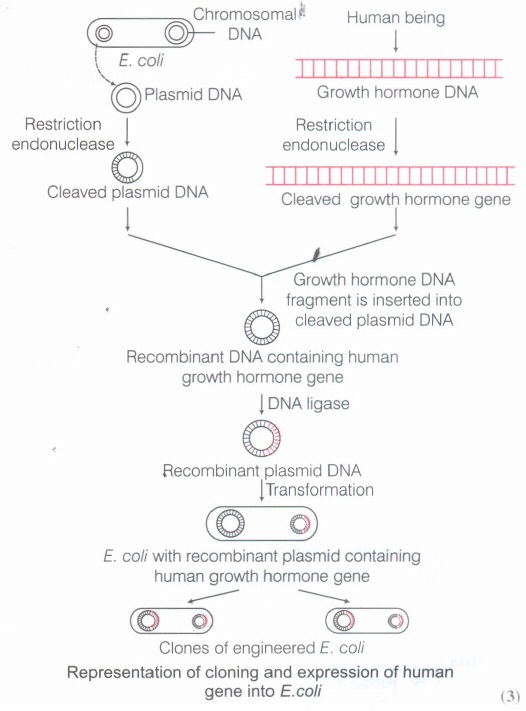
Diagrammatically represent the experimental steps in cloning and expressing a human gene (say the gene for growth hormone) into a bacterium like E. coli.
29.
Explain how transgenic animals serve as model for human diseases?
30.
Name the biological product made in transgenic animal to treat emphysema. Explain the same.
1.
(i) cry lAc codes for toxic insecticidal protein as inactive pro toxins in Bacillus thuringinesis. This toxin may kill the cotton bollworm.
(ii) RNA interference is associated with silencing of specific mRNA and is a method of cellular defence in eukaryotes
2.
cry genes are the genes found in the bacterium "Bacillus thuringiensis. These genes encode for protein crystals. that contam a toxic insecticidal protein called Bt toxin.
3.
| A | B | |
| i) | Bt toxin | Bacillus thuringiensis |
| ii) | CryIAc& cryIIAb | cotton bollworms |
| iii) | CryIAb1 | Corn borer |
| iv) | α-1 –antitrypsin | Emphysema |
| v) | Produce of transgenic cow Rosie | Human alpha lactalbumin |
4.
Enzyme ADA (adenosine deaminase) Cause- deletion of a gene for ADA Cure of the disease-
a) bone marrow transplant
b) Enzyme replacement therapy
c) Gene therapy on lymphocytes
d) Introduction of gene from bone marrow cells producing ADA in to cells at early embryonic stage (for permanent cure)
5.
Bt toxin protein (Cry-protein) exists in its inactive form as pro-toxin. When it enters the gut of the caterpillar then in the alkaline pH, it gets activated ( toxin). It becomes soluble, attaches to the wall of the gut, causes swelling and lysis. No alkaline pH in the gut, no activation of pro-toxin, toxin ineffective, caterpillar would not die.
6.
Tobacco budworm.
The protein coded by cnJIAc gene control the cotton bollworms
7.
The two objectives of setting up Genetic Engineering Approval Committee (GEAC) by the Indian Government are
(i) to make decisions regarding the validity of GM research
(ii) to make decisions regarding the safety of introducing GM organisms for public services
8.
If Meloidegyne incognita consumes cells with RNAi, gene silencing of the specific mRNA occurs due to complementary dsRNA molecule formation that binds to and prevents translation of mRNA, thus, causing death of the nematode.
9.
Turmeric and neem.
10.
The adenosine deaminase enzyme deficiency is caused by delection of a gene for ADA, an enzyme crucial for the immune system to function.
11.
Pro-hormon bears extra peptide known as C-peptide. During maturity C-peptide is removed and pro-insulin forms insulin.
12.
They are those plants, bacteria, fungi and animals in which a gene or genes have been introduced using recombinant DNAtechnology.They can be tailored to fulfil specific needs and perform functions which their natural counterparts can never perform. The factors are:
(i) The nature of gene transferred.
(ii) The nature of the host cell.
13.
Eli Lilly prepared two DNA sequences corresponding to A and B chains of human insulin and introduced them in plasmids ofE. cold to produce insulin chains. Chains A and B were produced separately,
extracted and combined by creating disulfide bonds to form human insulin. Insulin in human pancreas is synthesised as a pro-hormone containing the C peptide, which is removed in mature hormone. The synthesised insulin did not contain C peptide and was prepared in m form.
14.
(i) Viruses having RNA genomes.
(ii) Mobiles genetic elements (transposons).
15.
Study basic biological process-how gene are regulated, how they affect the normal functions of the body and its development. Transgenic cow, Rosie is the example for the second category.
16.
Probes are better than conventional diagnostic tools because:
1. They are highly specific, relatively rapid and much simpler.
2. They are extremely powerful especially when combined with PCR, even a single molecule in the test sample can be detected.
3. Since culture of microbe is not required, risk of accidental infection to laboratory personnel is eliminated
17.
Rosie is the first transgenic cow.
The milk contained human protein, \(\alpha\) -lactalbumin (2.4 g per litre) which is nutritionally important for human babies.
18.
Biopiracy
19.
Basmatic Rice variety
20.
cryl Ac and cry II Ab control cotton bollworm and cryl Ab controls corn borer.
21.
The plants, bacteria, fungi and animals whose genes have been altered are called Genetically Modified Organisms (GMOs), GM plants are useful in many ways.
Genetic modification has done the following changes to the phenotypic expression of the plants
(i) Crops become more tolerant to abiotic stresses like cold, drought, salt and heat.
(ii) Dependence on chemical pesticides has reduced, i.e. pest-resistant crops.
(iii) Helped to reduce post-harvest losses.
(iv) Efficiency of mineral usage increased in plants,
preventing early exhaustion of fertility of soil. (v) Enhanced nutritional value of food, e.g. vitamin-A enriched rice.
22.
Cry proteins are poisonous proteins, called insecticidal proteins which are secreted in crystal form by Bacillus thuringiensis during a specific growth process.
Process This toxic protein is coded by different form of a gene called cry gene, i.e. cry IAc and cry II Ab. When these genes are incorporated with the plant through genetic engineering, they provide resistance against insects and act as biological pesticides, e.g. Bt cotton.
It is a genetically modified crop in which the Bt genes are incorporated due to which when insects such as lepidopterans, coleopterans and dipterans ingest it, the inactive toxin gets converted into active toxin due to the alkaline pH of the gut which solubilise the crystal. After activation, these crystals bind with the receptors present on the gut epithelial cells. As a result, the membrane swells and pores are created. These pores lead to bursting of cell and soon the insect dies.
23.
(a) Transgenic animals are those animals, which have their DNA manipulated to possess and express one/ more foreign gene(s).
(b) Mica.
(c) They are produced for the following purposes:
(i) Transgenic animals are designed to allow the study of how genes are regulated and how they affect the normal functions of the body and its development, e.g. information has been obtained as to how insulin has a role as growth factor.
(ii) Transgenic animals that produce useful biological compounds are created by introducing a portion of the DNA that codes for the product, e.g. a-I-antitrypsin is produced for treating emphysema.
(iii) Transgenic animals are being developed to test the safety of vaccines, e.g. polio vaccine has been tested on transgenic mice.
(iv) Transgenic animals with more sensitivity to toxic substances are being developed to test the toxicity of drugs.
24.
Enzyme-linked immunosorbent assay:
1. Using conventional methods, early diagnosis is not possible.
2. By the time, the symptoms of the disease appear, the concentration of the pathogen is very high.
3. But by ELISA, the presence of the pathogen can be detected, when its concentration is low and the symptoms have not appeared; hence, early treatment and cure is possible.
25.
Using conventional methods of diagnosis (serum and urine analysis), early detection of diseases is not possible. To overcome this problem, some molecular diagnosis techniques were developed that provide early detection of diseases.
These are as follows
(i) Polymerase Chain Reaction (PCR) helps in early detection of diseases or pathogens by the amplification of their nucleic acid. peR can amplify nucleic acids of pathogens even when their concentration is very low. This technique can be used for detecting mv in suspected AIDS patients, genetic mutations in suspected cancer patients and in identifying genetic disorders.
(ii) Enzyme Linked Immuno Sorbent Assay (ELISA) is based on the principle of antigen-antibody interaction. Infection by pathogen can be detected by the presence of antigens (proteins, glycoproteins, etc.) or by detecting the antibodies synthesised against the pathogen.
26.
Two chains of DNA sequence corresponding to A and B chains of human insulin prepared, introduced them into plasmids of E. coli to produce separate A and B chains, A and B chains extracted combined by creating disulphide bonds.
27.
(i) Recombinant DNA Technology (RDT)
(ii) Polymerase Chain Reaction (PCR)
(iii) Enzyme Linked Immunosorbent Assay (ELISA)
28.
The multiple identical copies of specific template DNA can be produced by DNA cloning. It can be carried out by the use of a vector to carry specific foreign DNA fragment into the host cell. The mechanism of cloning and transfer of a gene for human growth hormone into
E. coil is diagrammatically represented below:
29.
Transgenic animals contain functional foreign genes introduced into their genome from another species by the technique of genetic engineering. Many of such transgenics are designed to increase understanding and study of how genes contribute to the development of disease. These laboratory exercises are specially made to serve as models for human diseases so that preventive measures and treatments for such diseases are made possible.
30.
\(\alpha \) -1-antitrypsin is produced to treat emphysema.
The gene for this protein is isolated or synthesized and introduced into a mouse.
The transgenic mouse produces the protein, which is to be isolated, purified and used on human beings after clinical trials.

12th Standard CBSE Syllabus & Materials
12th Standard CBSE
CBSE 12th Computer Science Python Revision Tour I - New Previous year Question Papers Study Material - QB365 Set A
NEW12th Standard CBSE
CBSE 12th Business Studies Planning Important Questions And Answers Study Material - QB365 Set A
NEW12th Standard CBSE
CBSE 12th Business Studies Business Environment Important Questions And Answers Study Material - QB365 Set A
NEW12th Standard CBSE
CBSE 12th Business Studies Principles of Management Important Questions And Answers Study Material - QB365 Set A



NCERT Books

Syllabus

Exam Pattern

Sample Question Papers

Previous year Question Papers

Important Notes

MCQ Practice test

NCERT Exemplers

Case study Questions

Image Based Questions

Passage based Questions

HOT Questions

Value Based Questions

Model Questions Papers
NCERT ( Book Back ) Questions

Assertion and Reason
Important Questions And Answers

CBSE 12th Standard CBSE Subjects
CBSE Standards








