
 100% FREE ACCESS
12th Standard CBSE Syllabus & Materials
12th Standard CBSE
CBSE 12th Economics Government Budget and the Economy Previous year Question Papers Study Material - QB365 Set A
NEW12th Standard CBSE
CBSE 12th Computer Science Interface Python with MySQL - New Previous year Question Papers Study Material - QB365 Set A
NEW12th Standard CBSE
CBSE 12th Computer Science Database Concept - New Previous year Question Papers Study Material - QB365 Set A
NEW12th Standard CBSE
CBSE 12th Computer Science Data Communication - New Previous year Question Papers Study Material - QB365 Set A
NEW12th Standard CBSE
CBSE 12th Computer Science Data Structures - New Previous year Question Papers Study Material - QB365 Set A
NEW12th Standard CBSE
CBSE 12th Computer Science Functions - New Previous year Question Papers Study Material - QB365 Set A

Published on: 25/10/2025
Download CBSE Class 12th Standard CBSE Biology question papers, sample papers, important questions, and previous year solved papers in PDF format. Get free study materials, NCERT solutions, and exam preparation resources for Class 12th Standard CBSE Biology
Questions + Answers key
Take MCQ Biology Test
1.
(a) How has biotechnology helped in producing Meloidagyne incognita resistant tobacco plant?
(b) Why does this nematode die on eating such a GM plant?
2.
What is "biofortification" ? Write its importance. Mention the contribution of Indian Agricultural Research Institute towards it with the help of two examples.
3.
A heavily bleeding and bruised road accident victim was brought to a nursing home. The doctor immediately gave him an injection to protect him against a deadly disease.
(i) What did the doctor inject into the patient's body?
(ii) how do you think this injection would protect the patient against the disease?
(iii) Name the disease against which this injection was given and the kind of immunity it provides.
4.
What is meant by withdrawal syndrome? What are its characteristic features?
5.
(a) Explain how to overcoe inbreeding depression in cattle.
(b) List three advantages of inbreeding in cattle.
(c) Name an improved breed of cattle.
6.
How does a restriction endonuclease help in DNA recombinant technology ?
7.
What is GMO? List any five possible advantages of GMO to a farmer.
8.
How did Eli Lilly Company go about preparing the human insulin? How is the insulin thus produced different from that produced by the functional human gene?
9.
How does RNA interference help in developing resistance in tobacco plant against nematode infection?
10.
How does restriction endonuclease function?
11.
What are molecular scissors? Explain their role.
12.
What is superovulation and embryo transfer?
13.
(a) mention the cause and the body system affected by ADA deficiency in humans.
(b) Name the vector used for transferring ADA-DNA into the recipent cells in humans. Name the recipient cells.
14.
Explain the application of biotechnology in producing Bt cotton.
15.
(a) Describe the different steps in one complete cycle fPCR.
(b) State the purpose of such an amplified DNA sequence.
16.
If a desired gene is identified in an organism for some experiments explain the process of the following:
(i) Cutting this desired gene at a specific location.
(ii) Synthesis of multiple copies of this desired gene.
17.
It is normally a rare cancer but became a marker for AIDS/HIV patients.
Squamous cell carcinoma
Retinoblastoma
Kaposi's sarcoma
Leukemia
18.
Cirrhosis of liver is caused by the chronic intake of
Opium
Alcohol
Tobacco (chewing)
Cocaine
19.
Yeast is used in the production of
Citric acid lactic acid
Lipase and pecinase
Bread and beer
Cheese and butter
20.
The figure below shows three steps (A, B, C) of polymerase Chain Reaction (PCR). Select the option giving correct identification together with what it represents?
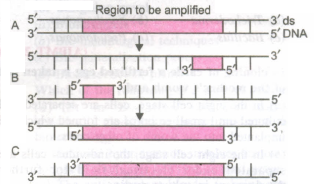
B-denaturation at a temperature of about 98\(^{o}\)C separating the two DNA strands
A-denaturation at a temperature of about 50\(^{o}\)C
C-extension in the presence of heat stable DNA polymerase
A-annealing with two sets of primers
21.
Match the items in column 'A' and column 'B' and choose correct answer
| Column 'A' | Column 'B' |
| (i) Lady bird | (a) Methanobacterium |
| (ii) Mycorrhiza | (b) Trichoderma |
| (iii) Biological control | (c) Aphids |
| (iv) Bio-gas | (d) Glomus |
(i)-(b), (ii)-(d), (iii)-(c), (iv)-(a)
(i)-(c), (ii)-(d), (iii)-(b), (iv)-(a)
(i)-(d), (ii)-(a), (iii)-(b), (iv)-(c)
(i)-(c), (ii)-(b), (iii)-(a), (iv)-(d)
22.
In protoplast fusion the enzymes required
Celluase,hemicellulase,pectinase
Pectinase
Ligase,hemicellulase
Hemicellulase
23.
Which chemical is used for induction of polyploidy?
Cytokinin
Nitrous acid
Colchicine
IAA
24.
The technique of genetic engineering includes
creation of recombinant DNA
use of gene cloning
gene transfer
All of these.
25.
Saccharomyces cerevisiae is used for production of
Bread
Ethanol
Both (a) and (b)
Acetic acid
26.
The process of reverse transcription was brought to light by the work of
George Beadle and Edward Tatum
Garrod
H.W. Temin and D. Baltimore
R.W. Holley and Grover
Marshall and W. Nirenberg
27.
The varieties of plants produced by
Introduction and selection
Mutation and selection
Selection and hybridization
Introduction and Mutation
28.
Which of the following is not a component of innate immunity?
Antibodies
Interferons
Complement proteins
Phagocytes
29.
Which of the following combinations of risk are associated with genetically modified food?
I. Toxicity
II. Allergic reaction
III. Antibiotic resistance in micro-organisms present in the alimentary canal.
I and II
I, II and III
I and III
II and III
30.
Which of the following properties of acquired immunity is the basis of vaccination?
Specificity
Diversity
Memory
Discrimination between self and non self.
31.
Which of the following is maintained for optimum production of vinegar?
Anaerobic condition
Temperature of \(65^{ \circ }C\)
Aerobic condition
Microaerophilic condition
32.
Which of the following is included in biopesticide?
Viruses and bacteria
Viruses, bacteria and fungi
Viruses, bacteria, fungi, protozoa and mites
Viruses, bacteria, fungi and protozoa
1.
Pest Resistant Plants : Nematodes like Meloidgyne incognitia infects the roots of tobacco plants and causes reduction in yield. The infestation of these nematodes can be prevented by the process of RNA interference (RNAi). RNAi is present in all eukaryotic organisms as cellular defence by silencing of specific mRNA due to complementary dsRNA molecules that bind to and prevents translation of the mRNA.
The source of complementary dsRNA may be from an infection by viruses having RNA genomes or mobile genetic elements that replicate through RNA intermediate.
Nematode specific genes were introduced into host plant using Agrobacterium vectors. The parasite could not survive in a transgenic host expressing specific interfering RNA.
2.
The process of breeding crops for higher level of vitamins and minerals, higher proteins, healthier fats, to improve public health is known as biofortification.
It helps to improve:
(i) Protein content and quality;
(ii) Oil content and quality;
(iii) Vitamin content: and
(iv) Micronu ient and mineral content.
IARI has released several vegetable crops that are rich in vitamins and minerals. e.g. Vitamin A enriched carrots, spinach, pumpkin, vitamin C enriched bitter grourd, bathua, mustard, tomato, iron and calcium enriched spinach and bathua, protein enriched beans-lablab, broad, French and garden pea.
3.
(i) The doctor must have injected the tetanus vaccine into the patient.
(ii) The vaccine/injection stimulates the body to make antibodies against the tetanus toxin.
(iii) The disease is tetanus caused by bacterium Clostridium tetani. The injection provides passive immunity.
4.
Withdrawal syndrome.
These are the characteristic and unpleasant manifestations of the body,when regular dose of drugs/alcohol is abruptly discontinued.
Characteristics:
(i) Anxiety
(ii) Excess sweating
(iii) Shakiness
(iv) Nausea.
In some cases withdrawal symptoms can be severe and even life-threatening.
5.
a) Inbreeding depression can be overcome by outcrossing.
(b) (i) Inbreeding is necessary to evolve purelines in any animal, as it increases homozygosity.
(ii) Inbreeding exposes the harmful recessive alleles, which become eliminated by selection.
(iii) It helps in accumulation of superior genes and elimination of the less desirable ones.
(c)Hisardale, a breed of sheep.
6.
Restriction endonucleases are enzymes that cut double-stranded DNA at very specific recognition sites. They were originally discovered in bacteria that use them to restrict the growth of viruses but are now among the workhorse enzymes of biotechnology and recombinant DNA research. The endonuclease that was first discovered was Hind II.
7.
They are those plants, bacteria, fungi and animals in which a gene or genes have been introduced using recombinant DNAtechnology.They can be tailored to fulfil specific needs and perform functions which their natural counterparts can never perform. The factors are:
(i) The nature of gene transferred.
(ii) The nature of the host cell.
8.
Eli Lilly prepared two DNA sequences corresponding to A and B chains of human insulin and introduced them in plasmids ofE. cold to produce insulin chains. Chains A and B were produced separately,
extracted and combined by creating disulfide bonds to form human insulin. Insulin in human pancreas is synthesised as a pro-hormone containing the C peptide, which is removed in mature hormone. The synthesised insulin did not contain C peptide and was prepared in m form.
9.
Production of transgenic tobacco plant with resistance to nematode. Meloidegyne incognitia.
1. A nematode Meloidegyne incognitia infects the roots of tobacco plant and reduces its yield.
2. RNA interference (RNA i) is the process or the basis of which action plan have been developed to prevent this infestation.
3. The process involves {he splicing the specific mRNA by a complementary dSRNA molecule, that binds to and prevents the translation of mRNA.
4. This complementary RNA can be obtained from infection by viruses having RNA genomes or transposons that replicates via RNA intermediate.
5. Using Agrobacterium vector, the nematode specific genes were introduced into host plant.
6. Thus both sense and a.tisense strand of RNA are produced in the host cells.
7. These two RNA's are complementary to each other. formed as dSRNA that initiated RNA i spliced R.
10.
Restriction endonuclease enzymes are called molecular scissors which can cut double stranded DNA at specific sites.
Role of restriction endonuclease.
1. Restriction endonuclease inspects the length of DNA sequence.
2. It find specific recognition sequence i.e. Palindromic nucleotide sequence in DNA.
3. These enzymes cut the strand of DNA a little away from centre of palindromic sites.
4. Thus restriction endonucleases leave overhanging stretches called sticky ends on each strand.
11.
Restriction endonuclease enzymes are called molecular scissors which can cut double stranded DNA at specific sites.
Role of restriction endonuclease.
1. Restriction endonuclease inspects the length of DNA sequence.
2. It find specific recognition sequence i.e. Palindromic nucleotide sequence in DNA.
3. These enzymes cut the strand of DNA a little away from centre of palindromic sites.
4. Thus restriction endonucleases leave overhanging stretches called sticky ends on each strand.
12.
MOET (Multiple Ovulation and Embryo Transplantation Technique). It is latest technique to produce super milch cows.
(i) Superovulation. It involves the stimulation of high milk-producing cows to ovulate more eggs by hormonal stimulation. Fertilization is done by artificial insemination. In this way, 4 to 10 embryos are developed in such cows.
(ii) Embryo transfer. In this, embryos are collected from superovulated cows. Each embryo is transplanted in the uterus of surrogate cows of inferior quality to produce large number of calves with good germplasm. It can also be done in sheep, goats and other livestock animals as well.
13.
a) ADA - deficiency It is caused by the deletion of the gene for adenosine deaminase. The enzyme is crucial for the functioning of the immune system; hence the immune system gets affected.
(b) Vector - A retroviral vector Recipient - Lymphocytes.
14.
Bt toxin gene has been cloned from the bacteria, and has been expressed in plants, to provide resistance to insects (without the need for synthetic insecticide), Bt toxin gene forms protein crystals, These crystals contain a toxic insecticidal protein. Bt toxin protein exists as inactive protoxin in the host, but once the insect ingests the inactive toxin, it is converted into active form of toxin, due to alkaline pH of the gut which solubilises the crystals, causing death of the insect
15.
(a) Refer Quick Review (Same value points to be awarded in an explanation)
(b) Purpose : Used to ligate with a vector for further cloning. Detection of bacteria or virus by amplification of their DNNdetection of HIV in AIDS patient. Detection of mutation in genes in suspected cancer patients.
16.
(i) The desired gene is cut by using the enzymes restriction endonucleases. Firstly, the restriction endonucleases that recognise the palindromic nucleotide sequence of the desired gene is identified. The endonuclease inspects the entire DNA sequences to find and recognise the site. It cuts each of the double helix at a specific point, which is a little away from the centre of the palindromic site. The cutting site is between the same two bases on the opposite strands. This results in over-hanging of single stranded stretches, which act as sticky ends.
(ii) Multiple copies of the desired gene is synthesised by Polymerase Chain Reaction (PCR) method. In this method, the desired gene is synthesised in vitro. The double-stranded DNA is denatured using high temperature of 95°C and the strands are separated. Each separated strand acts as a template.
Two sets of oligonucleotide primers are annealed to the denatured DNA strands. The thermostable Taq polymerase extends the primers using nucleotides provided in the reaction mixture. Finally, the amplified fragments are ligated into recipient cells.
17.
(c)
Kaposi's sarcoma
18.
(b)
Alcohol
19.
(c)
Bread and beer
20.
(a)
B-denaturation at a temperature of about 98\(^{o}\)C separating the two DNA strands
21.
(b)
(i)-(c), (ii)-(d), (iii)-(b), (iv)-(a)
22.
(a)
Celluase,hemicellulase,pectinase
23.
(c)
Colchicine
24.
(d)
All of these.
25.
(a)
Bread
26.
(c)
H.W. Temin and D. Baltimore
27.
(c)
Selection and hybridization
28.
(a)
Antibodies
29.
(b)
I, II and III
30.
(c)
Memory
31.
(a)
Anaerobic condition
32.
(c)
Viruses, bacteria, fungi, protozoa and mites

12th Standard CBSE Syllabus & Materials
12th Standard CBSE
CBSE 12th Computer Science Python Revision Tour I - New Previous year Question Papers Study Material - QB365 Set A
NEW12th Standard CBSE
CBSE 12th Business Studies Planning Important Questions And Answers Study Material - QB365 Set A
NEW12th Standard CBSE
CBSE 12th Business Studies Business Environment Important Questions And Answers Study Material - QB365 Set A
NEW12th Standard CBSE
CBSE 12th Business Studies Principles of Management Important Questions And Answers Study Material - QB365 Set A



NCERT Books

Syllabus

Exam Pattern

Sample Question Papers

Previous year Question Papers

Important Notes

MCQ Practice test

NCERT Exemplers

Case study Questions

Image Based Questions

Passage based Questions

HOT Questions

Value Based Questions

Model Questions Papers
NCERT ( Book Back ) Questions

Assertion and Reason
Important Questions And Answers

CBSE 12th Standard CBSE Subjects
CBSE Standards








