
 100% FREE ACCESS
12th Standard CBSE Syllabus & Materials
12th Standard CBSE
CBSE 12th Economics Government Budget and the Economy Previous year Question Papers Study Material - QB365 Set A
NEW12th Standard CBSE
CBSE 12th Computer Science Interface Python with MySQL - New Previous year Question Papers Study Material - QB365 Set A
NEW12th Standard CBSE
CBSE 12th Computer Science Database Concept - New Previous year Question Papers Study Material - QB365 Set A
NEW12th Standard CBSE
CBSE 12th Computer Science Data Communication - New Previous year Question Papers Study Material - QB365 Set A
NEW12th Standard CBSE
CBSE 12th Computer Science Data Structures - New Previous year Question Papers Study Material - QB365 Set A
NEW12th Standard CBSE
CBSE 12th Computer Science Functions - New Previous year Question Papers Study Material - QB365 Set A

Published on: 25/10/2025
Download CBSE Class 12th Standard CBSE Biology question papers, sample papers, important questions, and previous year solved papers in PDF format. Get free study materials, NCERT solutions, and exam preparation resources for Class 12th Standard CBSE Biology
Questions + Answers key
Take MCQ Biology Test
1.
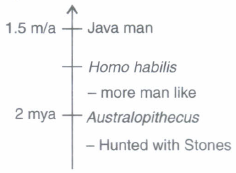
Study the ladder of human evolution given above and answer the following questions.
(a) Where did Australopithecus evolve?
(b) Write scientific name of Java man.
2.
Give reasons for the following:
The human testes are located outside the abdominal cavity.
3.
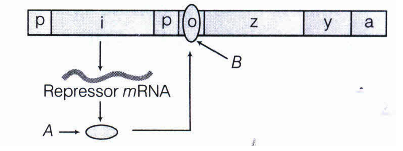
Give below is a schematic representation of a lac operon in the absence of an inducer.Identify A and B in it.
4.
In the year 1963 two enzymes responsible for restricting the growth of bacteriophage in E.Coli were isolated. How did the enzymes act to restrict the growth of the bacteriophage?
5.
Name two diseases that have been treated by producing biological compounds in transgenic animals.
6.
Mention one positive and one negative application of aminocentesis.
7.
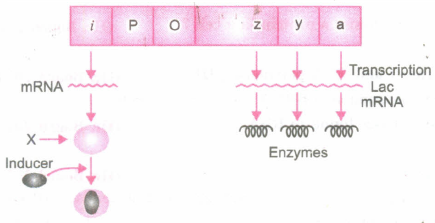
(a) Name the molecule 'X' synthesised by 'i' gene.How does this molecule get inactivated?
(b)Which one of the structural genes code for \(\beta \)-galactosidase?
(c)When will the transcription of this gene stop?
8.
Explain structure of Insulin. How insulin is synthesised in human (or mammals)? Why is proinsulin so called? How is insulin different from it?
9.
The plants are selfed.The white flowered plants produced only white-flowered \({ F }_{ 3 }\). Some of the purple flowered \({ F }_{ 2 }\) produced only purple flowered \({ F }_{ 3 }\) while others produced both white and purple flowered \({ F }_{ 3 }\) plants.Provide the genetic basis for the observation.
10.
(a)A recombinant vector with a gene of interest inserted within the gene of \(\alpha\) -galactosidase enzyme is introduced into a bacterium. Explain the method that would help in selection of recombinant colonies from non-recombinant ones.
(b)Why is this method of selection referred to as 'insertional inactivation'?
11.
Choose two pairs of homologous structures from the following and mention why they are so called?
(a) Hearts of humans and monkeys.
(b) Eyes of Octopus and mammals.
(c) Thorns of Bougainvillea and tendrils of Cucurbits.
(d) Flippers of penguins and dolphins.
12.
Why is there a statutory ban on amniocentesis?Why is the technique so named?
13.
Name the embriyonic stage that gets implanted in human female.Explain the events that occur during this process.
14.
Name the blank spaces a,b,c and d from the table given below:
| Item | What it represents in the plant |
|
(i) Pericarp |
a |
| (ii) b | cotyledon in seeds of grass family |
| (iii) Embryonal axis | c |
| (iv) d | remains of nucellus in a seed |
15.
Explain the events in a normal woman during her menstrual cycle on the following days:
(a) Ovarian event from 13-15 days
(b) Ovarian hormones level from 16 to 23 days
(c) Uterine events from 24 to 29 days
16.
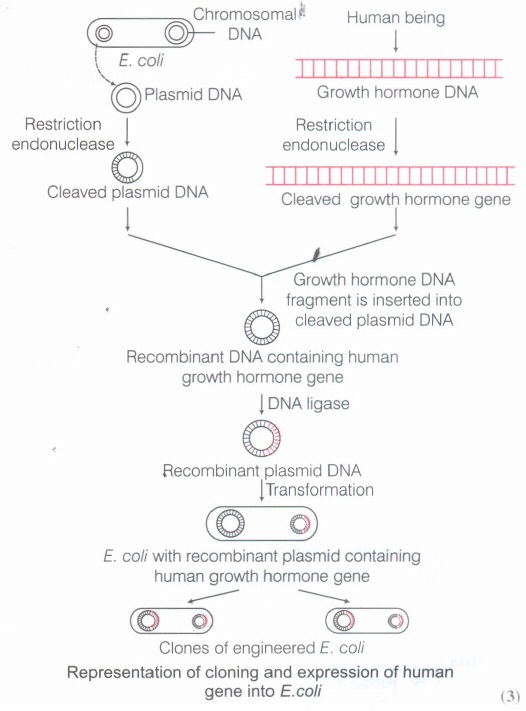
Diagrammatically represent the experimental steps in cloning and expressing a human gene (say the gene for growth hormone) into a bacterium like E. coli.
17.
Observe the figure carefully and the answer of the following question:
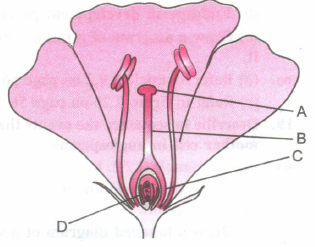
(a) Write whether ovary is superior or inferior?
(b) What is the type of flower - hypogynous, perigynous or epigynous?
(c) What type of ovule is shown the figure?
(d) What changes occur in C after fertilization?
(e) What does A, B, C, D represent in the figure.
18.
(i) A transgenic organism gives milk which has huge quantities of human protein.
(ii) A transgenic fruit acts as edible vaccine which protects children against diarrhoea.
(iii) A transgenic fruit has capability of producing ethylene 10% less as compared to normal slowing down the process of ripening.
19.
Match the items given in column I with appropriate items (one or more) of column II.
| Column I | Column II |
| (i) Vasectomy | (a) Progesterone and estrogens |
| (ii) Tubectomy | (b) Coitus interruptus |
| (iii) Oral pills | (c) Acne |
| (iv) Temporary birth control method | (d) Male |
| (v) Adolescents | (e) Female |
| (f) Vas deferens | |
| (g) Oviduct |
20.
"A population has been exhibiting genetic equilibrium? Answer the following with regard to the above statement.
(i) Explain the above statements.
(ii) Name the underlying principle.
(iii) List any two factors which would upset the genetic equilibrium of the population.
(iv) Take up any one such factor and explain the gene pool will change due to that factor.
21.
A little child girl, Ruchika of five years had curiosity, asked her mother.Why did not she possess the moustaches and beard like her daddy.
(i) Name the hormone responsible for the development of moustaches and beard.
(ii) Name the cells and their location which secrete this hormone.
(iii) Name the cells and their location which secrete the hormone responsible for the development of female characteristics in a female.Are there additional structures in the female reproductive system which secrete hormones? Name them.
22.
A joint large family living in small house face many problems.
(i) Suggest a few measures to check over-population.
(ii) Suggest any three propaganda campaign for restricting population control measures highlighting the safety of the persons.
23.
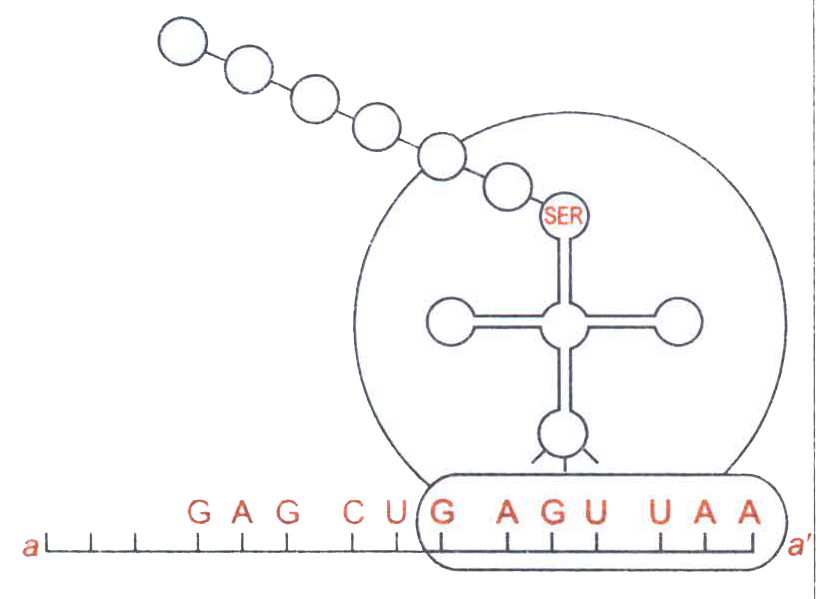
(a) Identify the polarity from a to a', in the above diagram and mention how many more amino acids are expected to be added to this polypeptide chain.
(b) Mention the DNA sequence coding for serine and the anticodon of tRNA for the same amino acid.
(c) Why are some untranslated sequence of bases seen in mRNA coding for a polypeptide? Where exactly are they present on mRNA?
24.
(a) Write the palindromic nucleotide sequence for the following DNA segment:5' - GAATTC -3'
(b) Name the restriction endonuclease that recognises this sequence.
(c) How are 'sticky ends' produced? Mention their role.
25.
(a) How does the Hardy Weinberg's expression (p2+2pq+q2=1) explain that genetic equilibrium is maintained in a population?
(b) List any two factors that can disturb the genetic equilibrium.
26.
A child has blood group O. If the father has blood group A and mother has blood group B, work out the genotypes of the parents and the possible genotypes of the other offspring.
27.
Given below are the sequences of nucleoides in a particular mRNA and amino acids coded by it
UUU AUG UUC GAC UUA GUG UAA
Phe - Met - Phe - Glu - Leu - Val
Write the properties of genetic code that can be and cannot be correlated from the above given data.
28.
(a) Sickle-cell anaemia in humans is a result of point mutation. Explain.
(b) Write the genotypes of both the parents who have produced a sickle-celled anaemic offspring.
29.
(a) Give one example each of albuminous and non-albuminous seeds.
(b) Name the parts of the ovule and the embryo sac of an angiosperm that develop into
(i) perisperm,
(ii) seed coat,
(iii) endosperm, and
(iv) embryonal axis.
30.
One day, father complained of severe pain in the abdomen. Naresh took him to doctor for examination. Doctor diagnosed it to be a case appendicitis and advised immediate surgical removal of vermiform appendix.
Read the above passage and answer the following questions:
(i) What is appendicitis?
(ii) What is vermiform appendix?
(iii) What value was displayed by Naresh?
31.
Ravi saw that in the city at several places banners were displayed advising people to visit Red Ribbon Express Train standing at railway station of his city. He became curious and reached station. There, he came to know that the train was there to spread awareness about AIDS.
Read the above passage and answer the following questions:
(i) What is AIDS?
(ii) What are the methods to stop the spread of AIDS?
(iii) What are the misconceptions about AIDS?
(iv) What value is displayed by Ravi?
32.
A woman has conceived and implantation has occurred.Discuss the sequence of changes up to parturition which will take place within her under the influence of hormones.
33.
Two blood samples A and B picked up from the crime scene were handed over to the forensic department for genetic fingerprinting. Describe how the technique of genetic fingerprinting is carried out. How will it be confirmed whether the samples belonged to the same individual or to two diferent individuals?
34.
(a) Write the blood group of people with genotype IA IB. Give reasons in support of your answer.
(b) In one family of four children, each has a different blood group. Their mother has blood group A and their father has blood group B. Work out a cross to explain how it is possible.
35.
(a) Draw a diagrammatic sectional view of a mature anatropous ovule and label the following parts in it.
(i) that develops into seed coat.
(ii) that develops into embryo after fertilisation.
(iii) that develop into endosperm in an albuminous seed.
(iv) through which the pollen tube gains entry into the embryo sac.
(v) that attaches the ovule to placenta.
(b) Describe the characteristic features of wind-pollinated flowers.
1.
()
(a) East Africa.
(b) Homo Erectus.
2.
()
Human testes are located outside the abdominal cavity for maintaining low temperature (2–2.5o C lower than the normal internal body temperature) necessary for spermatogenesis.
3.
()
A - Repressor protein
B - Repressor bound to the operator it prevents transcription of structural genes.
4.
()
-One of them added methyl groups to DNA.
-The other cut at specific points within the DNA.
5.
()
Emphysema and cystic fibrosis
6.
()
Amniocentesis is a foetal sex-determination test with both positive and negative applications.
Positive Application It is a medical procedure used in prenatal diagnosis of chromosomal abnormalities, foetal infections, etc.
Negative Application It has lead to increased female foeticide in gender based communities.
7.
(a)Molecule 'X' synthesised by 'i ' gene is repressor of the Lac operon.The repressor is inactivated by interaction with the inducer(i.e.,lactose)
(b)The gene 'Z' codes for beta-galactosidase
(c)Transcription of this stops as soon as the inducer is usedup i.e in absence of inducer.Once whole of lactose is consumed and there is no inducer present to blind to the repressor,the repressor becomes active and switches off the operon.
8.
(1) Insulin is made up of two short polypeptide chains; A and chain B which are linked together bydisulphide bridges. (2) It is synthesised in inactive form called proinsulin.
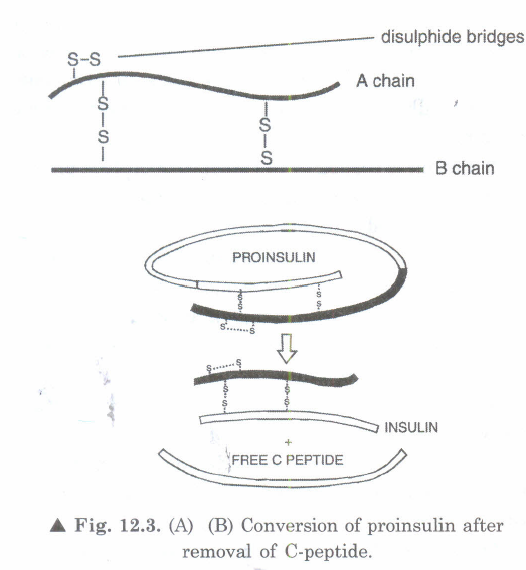
(2) Insulin is synthesised as pro-hormone called proinsulin (i.e. which is to be processed before becoming functional) contains an extra stretch called C-peptide which is usually removed during maturation of insulin.
9.
The results of Mendel's experiments showed that the observed or expressed monohybrid ratio of 3:1 of dominant to recessive forms of a trait in the \({ F }_{ 2 }\) generation was, in reality, a hidden 1:2:1 ratio of \(\frac { 1 }{ 4 } \) pure dominant, \(\frac { 1 }{ 2 } \) impure or hybrid dominant and \(\frac { 4 }{ 4 } \) pure recessive also called genotypic ratio.
10.
(a)The recombinants can be differentiated from the non-recombinants by their inability to produce colour in the presence of a chromogenic substrate.
The recombinants do not produce any colour, while the non-recombinants produce a blue colour with the chromogenic substrate in the medium.
(b) Since, the insert inactivates the enzyme, a-galactosidase, this method is called insertional inactivation.
11.
(a) Hearts of humans and monkeys.
(c) Thorns of Bougainvillea and tendrils of Cucurbits.
These are homologous structures as they have similar anatomical structures, but perform different functions.
12.
1. The ban is meant to legally check the female foeticides, following the sex determination of the unborn child
2. Since the technique analyses the cells from the amniotic fluid surrounding of the foetus in the womb it is called amniocentesis.
13.
Blastocyte gets implanted.
The trophoblast of the blastocyst gets attached to the endometrium of the uterus.
The uterine cells divide rapidly and cover the blastocyst; as a result, the blastocyst becomes embedded in the endometrium.
14.
(a) Fruit wall
(b) Scutellum
(c) Plumule and radicle
(d) Perisperm
15.
(a) Rupture of Graafian follicleleads to ovulation! release of ovum.
(b) Estrogen level islow.
(c) Disintegtation of endometrium and menstrual cycle begins again.
16.
The multiple identical copies of specific template DNA can be produced by DNA cloning. It can be carried out by the use of a vector to carry specific foreign DNA fragment into the host cell. The mechanism of cloning and transfer of a gene for human growth hormone into
E. coil is diagrammatically represented below:
17.
(a) Ovary is superior
(b) Flower is hypogynous because all the floral arise from thalamus below the level of ovary
(c) Ovule is anatropous because it is completely inverted. The micropyle is near the hilum and faces down towards the placenta.The embryo sac is straight.
(d) The ovary of the flower gets converted into fruit after fertilization.
(e) A = Stigma, B = Style, C = Ovary and D = Ovule
18.
(i) A sheep named 'Tracy'.
(ii) Transgenic bananas that contain a portion of the 'enterotoxin' gene of E.coli.These bananas have potential to protect children against diarrhoea.
(iii) Flavr Savr tomatoes.
19.
(i) d,f (ii) e,g (iii) a (iv) b (v) c
20.
(i) Allelic frequency in a population is stable and constant from generation to generation. The gene pool remains constant.
(ii) (a) Frequency of gene remains fixed. (b) It follows Hardy-Weinberg principle.
(iii) Genetic drift and mutations.
(iv) Advantages mutations when selected will result in observation of new phenotypes. Over a few result in observation of new phenotypes. Over a few generation it would result in speciation. It has been proved in experiments with many microbes.
21.
(i) Androgens, mainly testosterone, secreted by testes and adrenal gland.
(ii) Interstitial cells or Leydig cells, present in the interstitial spaces between the seminiferous tubules.
(iii) Estrogens secreted by ovary.Progesterone hormone is secreted by corpus luteum of ovary and placenta during pregnancy.
22.
(i) Measure to check over-population
1. Use of contraceptive measures.
2. Education.
3. Raising of marriageable age.
4. Couples with small families should be given incentive.
(ii) Propaganda campaign:
1. display of posters showing a happy couple with one or two children.
2. Small street corner skits highlighting need for small family.
3. Use of TV media or print media.
23.
(a) a to a' is \({ 5 }^{ ' }\longrightarrow { 3 }^{ ' }\)
No more amino acid will be added.
(b) TCA; anticodon is UCA.
(c) The untranslated regions are required for efficient translation process.
They are present before the initiation codon at the 5'-end and after the stop/termination codon, at the 3'-end.
24.
\(\left( a \right) { 5 }^{ ' }-\begin{matrix} { G } A \end{matrix}\begin{matrix} A T \end{matrix}\begin{matrix} T C \end{matrix}-{ 3 }^{ ' }\)
\( { 3 }^{ ' }-\begin{matrix} { C } T \end{matrix}\begin{matrix} T A \end{matrix}\begin{matrix} { A } G \end{matrix}-{ 5 }^{ ' }\)
(b) EcoRI is the restriction endonuclease that recognises this palindrome.
(c) When the restriction enzyme cuts the DNA strands a little away from the centre of the palindromic sequence, between the same two
bases on both the strands, sticky ends are produced.
The stickiness of the ends facilitates the action of the enzyme DNAligase.
25.
The given equation represents Hardy-Weinberg's (genetic) equilibrium.
The principle states that allele frequencies in a population are stable and remain constant from generation to generation.
(a) The sum total of all the allelic frequencies is one.
Individual frequencies are named p and q, which represent the frequency of allele A and a, respectively, in a population of diploid organisms.
The frequency of AA individuals is p2, while that of aa is q2 and Aa is 2pq; hence p2+2pq+q2=1.
(b) When the frequency measured differs from the expected values, the difference indicates the extent of evolutionary change.
The disturbance in genetic equilibrium, would then be interpreted as resulting in evolution.
26.
The child with blood group O will have homozygous recessive alleles. Therefore, both the parents should be heterozygous, i.e. the genotype of father will be IAi and the mother will be IBi.
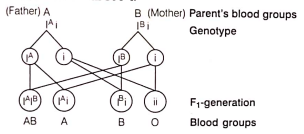
The other possible genotypes of offsprings willbe A, B and AB blood groups.
27.
(i) UAA does not code for any amino acid; it is a termination codon.
(ii) Genetic code is specific and unambiguous, i.e. one codon codes for a particular amino acid only.
(iii) Genetic code is degenerate, as one amino acid is coded by more than codon, e.g. UUU and UUC code for phenylalanine.
(iv) Genetic code is read in a contiguous manner without any punctuation (any three) AUG has a dual function; it is initiation codon as well as codes for methionine.
28.
(a) Mutation arising due to a change in a single base pair of DNA, is called point mutation.
The defect is caused by the single base substitution at the sixth codon of the beta chain of haemoglobin from GAG to GUG; this leads to substitution of glutamic acid by valine.
The mutant or defective hemoglobin molecule undergoes polymerization under low oxygen tension causing sickle-shaped RBCs.
(b) The parents must be \(Hb^{ \wedge }\) \(Hb^{ s }\)
29.
(a) Albuminous seed-Castor, Coconut
Non-albuminous seed-Pea, groundnut.
(b) (i) Nucellus
(ii) Integuments
(iii) Primary endosperm cell
(iv) Zygote.
30.
(i) Appendicitis is an inflammation of vermiform appendix.
(ii) It is a vestigial organ in human beings and has no function in our body.
(iii) Naresh was concerned about the health of his father.
31.
(i) Acquired Immune Deficiency Syndrome(AIDS) is a fatal disease caused by HIV. It spreads through HIV infected blood transfusion, Unprotected sex, sharing syringe with infected person etc.
(ii) Avoid sharing syringes and unprotected sex with persons.
(iii) It can spread by shaking hand, or sharing clothes and living with AIDS patients.
(iv) Ravi, being a good citizen, wanted to be aware about current problems in the society.
32.
Changes in the body during pregnancy
1.Under the impact of progesterone and estrogen the size of uterus and birth canal increases.Relaxation of pelvic ligament takes place.Placenta is developed between chorionic and uterine tissues.
2.Breast size increases to full maturity under the impact of progesterone.
3.Corpus luteum grows in early month and then regresses in the later month.
4.Menstrual cycle and ovulation do not occur.
5.Uterine changes.Sex hormones, the estrogenic and placental gonadotropins are excreted with urine.
6.The volume of blood increases.
7.Some of the endocrine glands such as adrenal cortex, anterior pituitary and thyroid show enlargement.
8.Relaxin hormone is essential in relaxing the pelvic ligament during parturition.
9.Oxytocin control uterine contraction during childbirth.
33.
DNA-Fingerprinting
The steps/procedure in DNA-fingerprinting include the following.
(i) Extraction. DNA is extracted from the cells in a high-speed, refrigerated centrifuge.
(ii) Amplification. Many copies of the extracted DNA are made by polymerase chain reaction.
(iii) Restriction Digestion. DNA is cut into fragments with restriction enzymes into precise reproducible sequences.
(iv) Separation of DNA sequences restriction fragments. The cut DNA fragments are introduced and passed through electrophoresis set-up containing agarose polymer gel; the separated fragments can be visualised by staining them with a dye that shows fluorescence under ultraviolet radiation.
(v) Southern Blotting. The separated DNA sequences are transferred on to a nitrocellulose or nylon membrane.
(vi) Hybridisation. The nylon membrane is immersed in a bath and radioactive probes (DNA segments of known sequence) are added; these probes target a specific nucleotide sequence that is complementary to them.
(vii) Autoradiography. The nylon membrane is pressed on an X-ray film and dark bands develop at the probe sites.
The bands form a characteristic pattern, which varies from individual to individual.
34.
(a) The person will be of blood group AB; since the alleles IA and IB are codominant, both express themselves in the presence of the other, i.e. both glycoprotein A and B are produced and hence the person is of blood group AB.
(b) Since all the blood groups (including the recessive 0 group) have appeared in the progeny, father must be heterozygous for B group and mother must also be hetrozygous for A group.
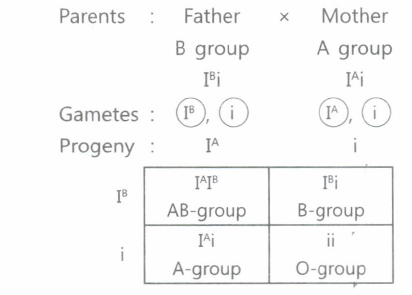
ABO blood group is under the control of a single gene, which exists in three allelic forms \(I^{ \wedge }I^{ B }\) and i, i.e. it shows multiple allelism.
\(I^{ \wedge }\)and \(I^{ B }\) IBare equally dominant and exhibit codominance and produce blood group AB.
Six genotypes are possible with the three alleles and they produce four phenotypes, i.e. blood groups A, B, AB and O.
35.
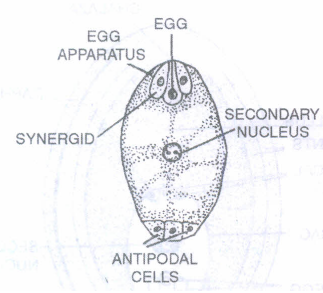
(i) part that develops into seed coat integuments
(ii) part that develops into an embryo after fertilization-egg
(iii) that develops into endosperm in a albuminous seed-polar nuclei
(iv) through which pollen tube enters into embryo sac-micropyle
(v) that attaches the ovule to the placenta funiculus.

12th Standard CBSE Syllabus & Materials
12th Standard CBSE
CBSE 12th Computer Science Python Revision Tour I - New Previous year Question Papers Study Material - QB365 Set A
NEW12th Standard CBSE
CBSE 12th Business Studies Planning Important Questions And Answers Study Material - QB365 Set A
NEW12th Standard CBSE
CBSE 12th Business Studies Business Environment Important Questions And Answers Study Material - QB365 Set A
NEW12th Standard CBSE
CBSE 12th Business Studies Principles of Management Important Questions And Answers Study Material - QB365 Set A



NCERT Books

Syllabus

Exam Pattern

Sample Question Papers

Previous year Question Papers

Important Notes

MCQ Practice test

NCERT Exemplers

Case study Questions

Image Based Questions

Passage based Questions

HOT Questions

Value Based Questions

Model Questions Papers
NCERT ( Book Back ) Questions

Assertion and Reason
Important Questions And Answers

CBSE 12th Standard CBSE Subjects
CBSE Standards








