
 100% FREE ACCESS
12th Standard CBSE Syllabus & Materials
12th Standard CBSE
CBSE 12th Economics Government Budget and the Economy Previous year Question Papers Study Material - QB365 Set A
NEW12th Standard CBSE
CBSE 12th Computer Science Interface Python with MySQL - New Previous year Question Papers Study Material - QB365 Set A
NEW12th Standard CBSE
CBSE 12th Computer Science Database Concept - New Previous year Question Papers Study Material - QB365 Set A
NEW12th Standard CBSE
CBSE 12th Computer Science Data Communication - New Previous year Question Papers Study Material - QB365 Set A
NEW12th Standard CBSE
CBSE 12th Computer Science Data Structures - New Previous year Question Papers Study Material - QB365 Set A
NEW12th Standard CBSE
CBSE 12th Computer Science Functions - New Previous year Question Papers Study Material - QB365 Set A

Published on: 25/10/2025
Download CBSE Class 12th Standard CBSE Biology question papers, sample papers, important questions, and previous year solved papers in PDF format. Get free study materials, NCERT solutions, and exam preparation resources for Class 12th Standard CBSE Biology
Questions + Answers key
Take MCQ Biology Test
1.
Which part of the plant is best suited for making virus-free plants and why?
2.
How are tobacco plants benefitted when nematode specific genes are introduced into them using certain vectors?
3.
Given below is the diagram of agarose gel kept under UV light:
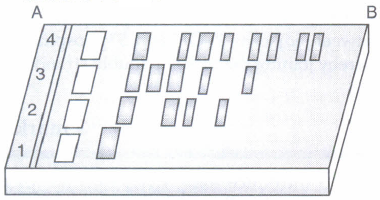
(a)Mark the positive and negative terminals.
(b) What is the charge carried by DNA molecule and how does it help in its separation?
(c)How are the separated DNA fragments finally isolated?
4.
Describe briefly origin of replication.
5.
Name the source organism that possesses Taq polymerase. What is so special about the function of this enzyme?
6.
How did American company Eli Lilly produce human insulin using/DNA technique ?
7.
(a) What are transgenic animals?
(b) Name the transgenic animal having the largest number amongst all the existing transgenic animals.
(c) Mention any three purposes for which these animals are produced.
8.
Describe briefly the following:
(a) Origin of replication
(b) Bioreactors
(c) Downstream processing
9.
How does silencing of specific mRNA in RNA interference prevent parasitic infestation?
10.
The following illustrates the linking of DNA fragments
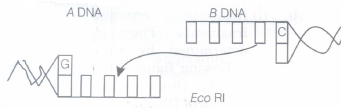
(i) Write the name of A and B.
(ii) Complete the palindrome, which is recognised by Eco RI.
(iii) Write the name of the enzymes that can link the two DNA fragments.
11.
DNA being hydrophilic cannot pass through the cell membrane of a host cell. Explain how the recombinant DNA gets introduced into the host cell to transform the latter.
12.
Draw a schematic sketch of pBR 322 plasmid and label the following in it
(a) Any two restriction sites
(b) Ori and rop genes
(c) An antibiotic resistant gene.
13.
14.
15.
16.
17.
18.
19.
The example of a natural genetic engineer is
Bacillus subtilis
Salmonella typhimurium
Agrobacterium tumefaciens
Bacillus amyloliquefaciens
20.
The genes cryIAb and cryIIAb produce toxins against _____ and_________ respectively.
cotton bollworms, corn borer
nematode, cotton bollworm
corn borer, cotton bollworm
corn borer, nematodes
21.
Biolistics (gene gun) is suitable for
introducing rDNA into plant cells
introducing rDNA into animal cells
disarming the pathogen vectors
DNA fingerprinting.
22.
Which of the following should be chosen for best yield if one were to produce a recombinant protein in large amounts?
Laboratory flask of largest capacity
A stirred-tank bioreactor without in-lets and out-lets
A continuous culture system
Any of the above
23.
Gene recombinant technology is used for
vectorless gene transfer into target cell
vector based gene transfer into target cell
direct transfer of DNA protein complex
lipsome base direct gene transfer into target cell
24.
A technique which involves deliberate manipulation of genes within or between species is called
Gene therapy
Hybridoma technology
Tissue culture
Genetic engineering
25.
Give one word
(i) Supply of alternative resources to industries In the form of starches fuels & pharmaceuticals.
(ii) New strategy adopted to protect the tobacco Plant infestation by Meloidogyne incognitia.
(iii) Technique based on the principle of antigen antibody interaction
(iv) Uses of bioresources by multinational companies /other organization Without proper authorization from the concerned parties.
(v) Decision making organization regardingvalidity of G.M. resources & the safety of introducing G.M. crops
26.
Mohan is a farmer in a village of Karnataka. He is worried about his cotton crop, which being destroyed by insects. His friend suggested him to use Bt variety of cotton. Explain:
(i)Why to use Bt variety of cotton?
(ii) What are the advantage of genetically modified crops?
27.
No evidence was found on a crime scene, other than only a few hair strands. The inspector wants to proceed for DNA fingerprinting but the amount of DNA is very less.
(i) In your opinion what could be the solution to this problem?
(ii) Write the basic steps of this technique.
(iii) Name the scientist who developed this technique.
(iv) What values show by the inspector?
28.
Read the following and answer any four questions from (i) to (v) given below:
European patent office, Munich granted patent for fungicidal use of neem oil, to firm of WR. Grace & Co. It was challenged by Vandana Shiva and Ajay Phadke who had researched neem in India and it was shown that Grace & Co. had not unveiled any novelty factor in neerns properties. Ethics include rules of conduct by which a community regulates the behaviour and decides as to which activity is lawful and which is not.
(i)_________ allow private, monopoly right over animals and plants.
| (a) Bioethics | (b) Biopatents | (c) Bioweapons | (d) Either (a) or(b) |
(ii) Which of the following is not a criteria of granting patent?
| (a) Novelty | (b) Utility | (c) Non-obviousness | (d) Prior art |
(iii) On which plants patents have been granted?
| (a) Piper nigrum | (b) Brassica campestris | (c) Punica granataum | (d) All of these |
(iv) Rules of conduct that may be used to regulate our activities in relation to biological world are included in
| (a) bioethics | (b) biopiracy | (c)biopatents | (d) biowar |
(v) Assertion : Genes and cells should not be patented.
Reason : Genes and cells are not an inventions
| (a) Both assertion and reason are true and reason is the correct explanation of assertion |
| (b) Both assertion and reason are true but reason is not the correct explanation of assertion |
| (c) Assertion is true but reason is false |
| (d) Both assertion arid reason are false |
29.
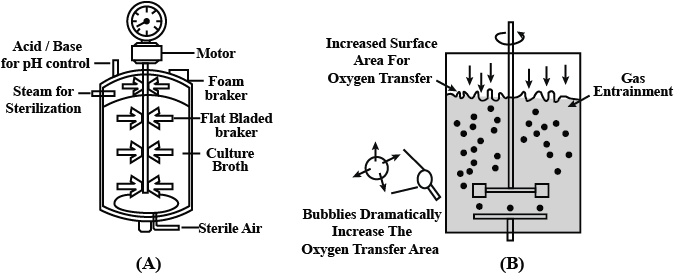
(a) Name the type of bioreactor shown above.
(b) Why does it have a curved base?
(c) What is the significance of the stirrer?
30.
31.
32.
Assertion (A) : Managerment of adult onset diabetes is possible by taking insulin at regular time intervals.
Reason (R) : Insulin used for diabetes was earlier extracted from the pancreas of slaughtered cattle and dogs.
(a) If both A and R are true and R is the correct explanation of A
(b) If both A and R are true,but R isnot the correct explanation of A
(c) IfA is true, but R is false
(d) If A is false, but R is true
33.
Assertion: YAC vectors have been exploited extensively in the mapping of large genomes.
Reason: YAC vectors have a composite structure made of bacteriophage and plasmid.
Codes:
(a) Both assertion and reason are true and reason is the correct explanation of assertion.
(b) Both assertion and reason are true but reason is not the correct explanation of assertion.
(c) Assertion is true but reason is false.
(d) Both assertion and reason are false.
1.
The meristem is the plant part that is best suited for making virus-free plants. This is because even when the plant is infected with a virus, the meristem (apical and axillary) remains infection free; it can be removed, grown in vitro to obtain virus-free plants.
2.
1. The tobacco plants show resistance to nematode attack; the nematode cannot survive in such plants, as they show RNA interference.
2. The vector used is Agrobacterium
3.
(a) Positive terminal-B' Negative terminal-' A'
(b) DNA being negatively charged, moves towards the positive electrode (anode)
(c) By elution-separated bands of DNA are cut out from the agarose gel and extracted from the gel piece.
4.
Origin of replication:
Origin of replication (Ori) is a specific sequence of DNA bases, which is responsible for initiating replication.
An alien DNA for replication should be linked to the origin of replication.
A prokaryotic DNA has normally a single origin of replication, while eukaryotic DNA may have more than one origin of replication
5.
1. Taq polymerase is obtained from the bacterium Thermus aquaticus.
2. It is a thermostable enzyme, that can withstand the high temperature used in the denaturation and separation of the two strands of DNA; hence it can be used for a number of cycles of amplification.
6.
The American company, Eli Lily used the following technique to produce synthetic human insulin or humulin. The steps followed were :
Two DNA sequences corresponding to A and B chains of human insulin were prepared and introduced into plasmids of E. coli. Chains A and B were produced separately, extracted and combined by creating disulfide bonds to form human insulin.
7.
(a) Transgenic animals are those animals, which have their DNA manipulated to possess and express one/ more foreign gene(s).
(b) Mica.
(c) They are produced for the following purposes:
(i) Transgenic animals are designed to allow the study of how genes are regulated and how they affect the normal functions of the body and its development, e.g. information has been obtained as to how insulin has a role as growth factor.
(ii) Transgenic animals that produce useful biological compounds are created by introducing a portion of the DNA that codes for the product, e.g. a-I-antitrypsin is produced for treating emphysema.
(iii) Transgenic animals are being developed to test the safety of vaccines, e.g. polio vaccine has been tested on transgenic mice.
(iv) Transgenic animals with more sensitivity to toxic substances are being developed to test the toxicity of drugs.
8.
(a) Origin of replication is the DNA sequence that serves as a start site for the replication process.
(b) The large customised tanks used to carry out the biological process/reaction at commercial scale are called as bioreactors.
(c) Downstream processing includes stages in the isolation and purification of the biotechnological products.
9.
RNA interference is a gene-silencing process that blocks the expression of genes in the parasite when it enters the host's body.
10.
(i) A- Vector DNA/Plasmid DNA
b- Foreign DNA
(ii) 5'- GAATTAC-3'
3'-CTTAAG-5'
(iii) DNA ligase.
11.
Introduction of rDNA into host cell
(i) Microinjection
In this method, the recombinant DNA is directly injected into the nucleus of an animal cell.
(ii) Gene gun/Biolistics
In this method, used for plant cells, the cells are bombarded with high velocity microparticles of gold or tungsten coated with DNA.
(iii) Heat shock method In this method, the rDNA is forced into the competent cell by incubating the cell with rDNA on ice followed by placing them briefly at \({ 42 }^{ ° }C\) ( (heat shock) and then putting them back on ice.
12.
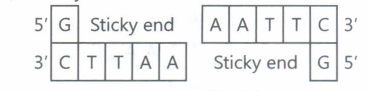
(i) Palindromic sequence and the site where EcoRI cuts it (indicated by the arrows).
\({ 5 }^{ ' }{ G }^{ \downarrow }\begin{matrix} A & A \end{matrix}\begin{matrix} T & T \end{matrix}C\quad { 3 }^{ ' }\)
\({ 3 }^{ ' }C\begin{matrix} T & T \end{matrix}\begin{matrix} A & { A }_{ \uparrow } \end{matrix}G\quad { 5 }^{ ' }\)
(ii) Sticky ends
13.
(b)
14.
(b)
15.
(d)
16.
(b)
17.
(b)
18.
(b)
19.
(c)
Agrobacterium tumefaciens
20.
(c)
corn borer, cotton bollworm
21.
(a)
introducing rDNA into plant cells
22.
(c)
A continuous culture system
23.
(b)
vector based gene transfer into target cell
24.
(d)
Genetic engineering
25.
| i | Supply of alternative resources to industries in the form of starches fuels & pharmaceuticals | i | Tailor-made plants |
| ii | New strategy adopted to protect the tobacco plant infestation by Meloidogyne incognitia | ii | RNA interference |
| iii | Technique based on the principle of antigen antibody interaction | iii | ELISA |
| iv | Uses of bioresources by multinational companies /other organization whitout proper authorization from the concerned parties | iv | Biopiracy |
| v | Decision making organization regardingvalidity of G.M. resources & the safety of introducing G.M. crops | v | GEAC |
26.
(i) Because Bt cotton is resistant to some insects and therefore it decreases the need of pesticides.
(ii) The advantages of genetically modified crops are:
(a) These are tolerant to abiotic stresses.
(b) These have enhanced nutritional value of food.
(c) These are resistant against some plant pathogens.
(d) These have reduced the use of chemical pesticides.
27.
(i) Amplification of gene of interest using PCR is required.
(ii) Denaturation, annealing and extension are the basic steps of PCR.
(iii) Kary Mullis developed PCR in 1985
(iv) Honesty and sense of responsibility towards his duty.
28.
(i) (b) : A patent is the right granted by a government to an inventor to prevent others from commercial use of his invention. Biopatent system allows private, monopoly rights over cells, genes, animals and plants.
(ii) (d) : Patents are supposed to satisfy three criteria of novelty, non-obviousness and utility.
(iii) (d) : Patents have been taken out on plants such as black pepper, basmati rice, Indian mustard, Pomegranate, Turmeric and neem.
(iv) (a)
(v) (a) : Genes, cells, micro-organisms, plants and animals are not inventions and hence must not be patented.
29.
(a) It is a simple stirred-tank bioreactor.
(b) The curved base facilitates the mixing of the contents in the reactor.
(c) The stirrer facilitates even mixing and oxygen availability throughout the bioreactor.
30.
31.
32.
(c) IfA is true, but R is false
33.
(c): Yeast Artificial Chromosome (YACs) is a human engineered DNA molecule derived from the yeast. YACs are often used in connection with mapping and sequencing of genomes. Segments of an organism's DNA, upto one million base pairs in length, can be inserted into YACs. The YACs are then taken up by yeast cells. As the yeast cell grow and divide, they amplify the YAC DNA, which can be isolated and used for DNA mapping and sequencing.

12th Standard CBSE Syllabus & Materials
12th Standard CBSE
CBSE 12th Computer Science Python Revision Tour I - New Previous year Question Papers Study Material - QB365 Set A
NEW12th Standard CBSE
CBSE 12th Business Studies Planning Important Questions And Answers Study Material - QB365 Set A
NEW12th Standard CBSE
CBSE 12th Business Studies Business Environment Important Questions And Answers Study Material - QB365 Set A
NEW12th Standard CBSE
CBSE 12th Business Studies Principles of Management Important Questions And Answers Study Material - QB365 Set A



NCERT Books

Syllabus

Exam Pattern

Sample Question Papers

Previous year Question Papers

Important Notes

MCQ Practice test

NCERT Exemplers

Case study Questions

Image Based Questions

Passage based Questions

HOT Questions

Value Based Questions

Model Questions Papers
NCERT ( Book Back ) Questions

Assertion and Reason
Important Questions And Answers

CBSE 12th Standard CBSE Subjects
CBSE Standards








