
 100% FREE ACCESS
12th Standard CBSE Syllabus & Materials
12th Standard CBSE
CBSE 12th Economics Government Budget and the Economy Previous year Question Papers Study Material - QB365 Set A
NEW12th Standard CBSE
CBSE 12th Computer Science Interface Python with MySQL - New Previous year Question Papers Study Material - QB365 Set A
NEW12th Standard CBSE
CBSE 12th Computer Science Database Concept - New Previous year Question Papers Study Material - QB365 Set A
NEW12th Standard CBSE
CBSE 12th Computer Science Data Communication - New Previous year Question Papers Study Material - QB365 Set A
NEW12th Standard CBSE
CBSE 12th Computer Science Data Structures - New Previous year Question Papers Study Material - QB365 Set A
NEW12th Standard CBSE
CBSE 12th Computer Science Functions - New Previous year Question Papers Study Material - QB365 Set A

Published on: 25/10/2025
Download CBSE Class 12th Standard CBSE Biology question papers, sample papers, important questions, and previous year solved papers in PDF format. Get free study materials, NCERT solutions, and exam preparation resources for Class 12th Standard CBSE Biology
Questions + Answers key
Take MCQ Biology Test
1.
Mohan's wife is pregnant for the last four months. He took his wife to gynacologist for routine check up. After check up the doctor suggested his wife to undergo amniocentasis test in order to know the genetic disorder, if any in the foetus. After performing amniocentasis test the doctor advised for PCR test so as to confirm the presence of genetic defect in the foetus. After coming back home Mohan's wife discussed this matter with her mother in law, who denied her to undergo, such tests and told that two much such tests may harm the baby.
Answer the following questions on the basis of above informations.
(i)What is amniocentasis?
(ii) What do you understand by PCR. Explain briefly its uses.
(iii) Do you think that Mohan's mother is justified in her behaviour?
2.
Diagrammatically explain the steps of rDNA technology.
3.
(a) Describe the different steps in one complete cycle fPCR.
(b) State the purpose of such an amplified DNA sequence.
4.
Explain briefly Chitinase
5.
What is genetic engineering? List the steps involved in rDNA technology.
6.
Following figure shows one of the artificial plasmids constructed to act as a vector.
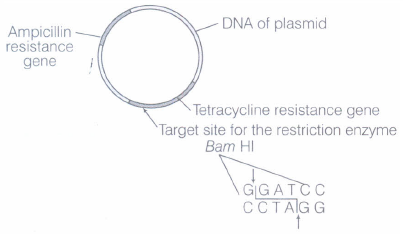
(i) With reference to above figure explain the importance of the plasmids having a single target site for a particular restriction enzyme, such as Bam HI.
(ii) The genes for ampicillin resistance and tetracycline resistance on the plasmid allow the genetic engineer to distinguish between bacteria that have taken up different circuits of DNA.
Complete the table to shoe whether bacteria which have taken up each of the different circuits of DNA are resistance to ampicillin, to tetracycline or to both. Show presence of resistance with a tick (\(\surd \)) and absence of resistance with a cross(\(\times \)).
(iii) (a) Explain why genes for antibiotic resistance are now rarely used as markers in gene technology.
(b) Describe the use of one alternative marker gene that can be used instead of an antibiotic resistance gene..
7.
Suresh thought of straight export of orchids as these flowers fetch high price in international market due to their beauty and longer vase life. He consulted his Botanist uncle who suggested him a fast method of propagation of orchids to earn good profits.
Read the above passage and answer the following questions:
(i) What is plant tissue culture ?
(ii) What is micropropagation ?
(iii) What value is displayed by Suresh's uncle ?
8.
How do bioreactors help in production of recombinant proteins?
9.
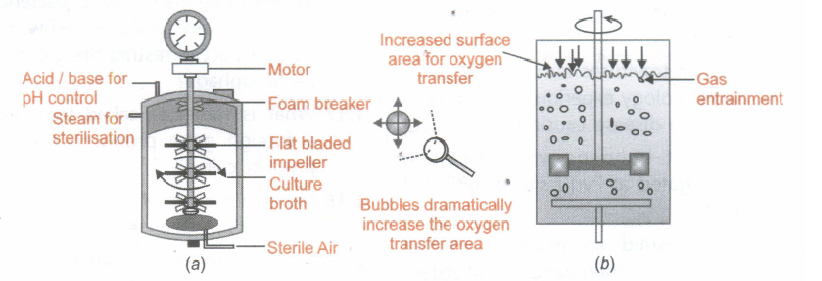
Describe briefly the bioreactors.
10.
What is a bioreactor? Draw a labelled diagram of a sparged stirred-tank-bioreactor. Explain its functionating.
11.
Draw a labelled diagram of a simple stirred-tank bioreactor and describe its functionating.
12.
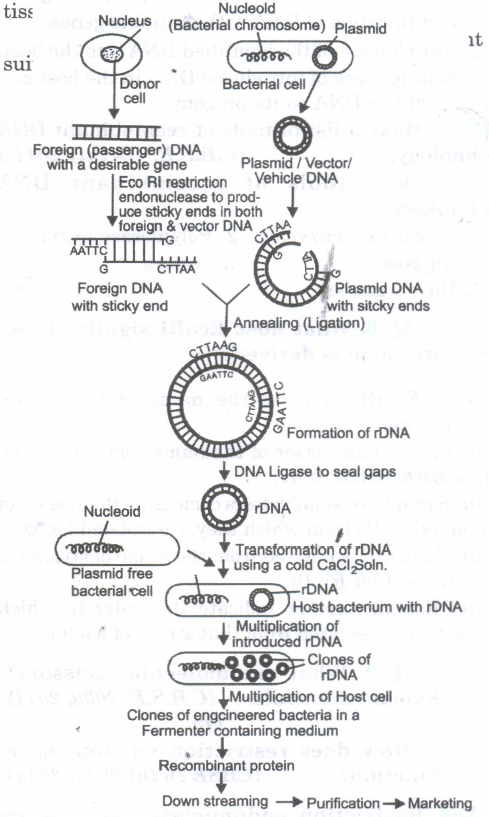
(a)With the help of diagrams show the different steps in the formation of recombinant DNA by action of restriction endonuclease enzyme EcoRI.
(b)Name the technique that is used for separating the fragments of DNA cut by restriction endonucleases.
1.
(i) Amniocentasis is a prenatal diagnostic technique used to determine sex and genetic disorder of an unborn foetus.
(ii) PCR stands for polymerase chain reaction. This technique is used to amplify selected sequences of DNA so as to facilitate the genetic diagnosis of diseases such as sickle cell anaemia, muscular distrophyetc. PCR is also used in the detection of HIV, DNA finger-printing, it is also used to clone DNAm fragments extinct animals.
(iii) No Mohan's mother is not justified denying for the tests to be conducted. Amniocentasis and PCR test are primarily ment for finding out the genetic disorders in the developing foetus. They do not harm the developing baby. If the foetal genetic defects are confirmed by the tests the termination of such and pregnancy is not illegal.
2.
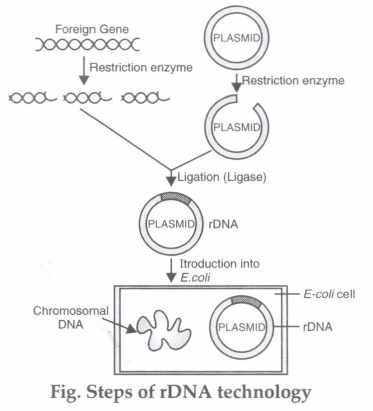
3.
(a) Refer Quick Review (Same value points to be awarded in an explanation)
(b) Purpose : Used to ligate with a vector for further cloning. Detection of bacteria or virus by amplification of their DNNdetection of HIV in AIDS patient. Detection of mutation in genes in suspected cancer patients.
4.
Chitinase It is an enzyme used to break the cell wall of fugi to release its cellular parts. Certain plants and fungus consist of a cell wall composed of chitin, which provides strength to the cell. Chitinase is used when there is a need to break this wall and allow entry of foreign DNA in plant cells.
5.
Genetic engineering is a manipulation of genetic material in vitro. It involves the techniques to alter the chemistry of genetic material (DNA and RNA), to introduce the host organisms and thereby change the phenotype of the host organism.
Steps of rDNA technology are:
(i) Isolation of DNA.
(ii) Fragmentation of DNA by restriction endonucleases.
(iii) Isolation of the desired DNA fragments.
(iv) Amplification of the gene of interest.
(v) Ligation of the DNA fragment into the victor using DNA ligase.
(vi) Transfer of the recombinant DNA into the host.
(vii) Culturing the host cell on a suitable medium on a large scale.
(viii) Extraction of the desired product.
(ix) Downstream processing of the products as finished products.
6.
(i) Single target site is present for particular restriction enzyme. If more than one site is present, then more cuts would fragment the plasmid.
(ii)
| Circle of DNA taken up by Bacteria | Bacteria Resistant to Ampicillin | Bacteria Resistance to Tetracycline |
| Unaltered plasmids | \(\surd \) | \(\surd \) |
| Recombinant plasmids that have taken up the wanted gene | \(\surd \) | \(\times \) |
(iii) (a) Now a days antibiotic resistance gene as markers are not used as they create more risk of plasmids to resistant gene to other bacteria.
It may spread the antibiotic resistance in many bacteria.
(b) Reporter genes are used now a days instead of antibiotic resistance genes. These genes have an ability to produce color in the presence of chromogenic substrate.
7.
(i) It is the technique of growing cell, tissue, organ or whole plant under controlled conditions.
(ii) Micropropagation is the technique of producing a large number of identical plants from small explant within a short period using tissue culture technique.
(iii) His uncle, being a Botanist, guided his nephew to adopt modern biotechnology techniques so that he could earn handsome profits.
8.
Small volume cultures cannot yield appreciable quantities of products. To produce these products in large quantities the development of 'bioreactors' was required where large volumes (100-1000 litres) of culture can be processed. Thus bioreactors can be thought of as vessels in which raw materials are biologically converted into specific products, using microbial, plant, animal or human cells or individual enzymes.
Role. A bioreactor provides the optimal conditions for achieving the desired product by providing optimum growth conditions (temperature, pH, substrate, salts, vitamins, oxygen). One of the most commonly used bioreactor is of stirring type. A stirred tank reactor is usually cylindrical or with a curved base to facilitate the mixing of the reactor contents. The stirrer facilitates even mixing and oxygen availability throughout the bioreactor. Alternatively air can be bubbled 1lhroughthe reactor. If you look at the figure closely you will see that the bioreactor has an agitator system; an oxygen delivery system, a foam control system, a temperature control system, pH control system, sampling ports so that small volumes of the culture can be withdrawn periodically.
9.
10.
11.
1. Bioreactors can be considered as vessels in which raw materials are biologically converted into specific products using microbial, plant or human cells.
2. A bioreactor provides optimal conditions for achieving the desired product by I providing optimum growth conditions, pH, substrate salts, vitamins, oxygen, etc.
3. The commonly used bioreactors are of stirring type. A stirred-tank reactor is usually cylindrical or with a curved base to facilitate the mixing of the contents.
4. The stirrer facilitates the even-mixing and oxygen availability throughout the bioreactor.
12.
Genetic engineering. It is a technique for artificially and deliberately modifying DNA (genes) to suit human needs. It is also called recombinant DNA technology or DNA splicing. It is a kind of biotechnology
Steps in genetic engineering:
1. Identification and isolation of agronomically important genes.
2. Cloning of isolate genes in a vector.
3. Introduction of gene into plant protoplast cell

12th Standard CBSE Syllabus & Materials
12th Standard CBSE
CBSE 12th Computer Science Python Revision Tour I - New Previous year Question Papers Study Material - QB365 Set A
NEW12th Standard CBSE
CBSE 12th Business Studies Planning Important Questions And Answers Study Material - QB365 Set A
NEW12th Standard CBSE
CBSE 12th Business Studies Business Environment Important Questions And Answers Study Material - QB365 Set A
NEW12th Standard CBSE
CBSE 12th Business Studies Principles of Management Important Questions And Answers Study Material - QB365 Set A



NCERT Books

Syllabus

Exam Pattern

Sample Question Papers

Previous year Question Papers

Important Notes

MCQ Practice test

NCERT Exemplers

Case study Questions

Image Based Questions

Passage based Questions

HOT Questions

Value Based Questions

Model Questions Papers
NCERT ( Book Back ) Questions

Assertion and Reason
Important Questions And Answers

CBSE 12th Standard CBSE Subjects
CBSE Standards








