
 100% FREE ACCESS
12th Standard CBSE Syllabus & Materials
12th Standard CBSE
CBSE 12th Economics Government Budget and the Economy Previous year Question Papers Study Material - QB365 Set A
NEW12th Standard CBSE
CBSE 12th Computer Science Interface Python with MySQL - New Previous year Question Papers Study Material - QB365 Set A
NEW12th Standard CBSE
CBSE 12th Computer Science Database Concept - New Previous year Question Papers Study Material - QB365 Set A
NEW12th Standard CBSE
CBSE 12th Computer Science Data Communication - New Previous year Question Papers Study Material - QB365 Set A
NEW12th Standard CBSE
CBSE 12th Computer Science Data Structures - New Previous year Question Papers Study Material - QB365 Set A
NEW12th Standard CBSE
CBSE 12th Computer Science Functions - New Previous year Question Papers Study Material - QB365 Set A

Published on: 25/10/2025
Download CBSE Class 12th Standard CBSE Biology question papers, sample papers, important questions, and previous year solved papers in PDF format. Get free study materials, NCERT solutions, and exam preparation resources for Class 12th Standard CBSE Biology
Questions + Answers key
Take MCQ Biology Test
1.
(a) Describe the different steps in one complete cycle fPCR.
(b) State the purpose of such an amplified DNA sequence.
2.
Unless the vector and source DNA are cut, fragments separated and joined, the desired recombinant vector molecule cannot be created.
(a) How are the desirable DNA sequence cut?
(b) Explain the technique used to separate the cut fragments.
(c)How are the resultant fragments joined to the vector DNA molecule?
3.
Explain briefly Chitinase
4.
Following figure shows one of the artificial plasmids constructed to act as a vector.
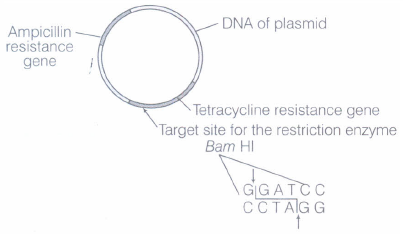
(i) With reference to above figure explain the importance of the plasmids having a single target site for a particular restriction enzyme, such as Bam HI.
(ii) The genes for ampicillin resistance and tetracycline resistance on the plasmid allow the genetic engineer to distinguish between bacteria that have taken up different circuits of DNA.
Complete the table to shoe whether bacteria which have taken up each of the different circuits of DNA are resistance to ampicillin, to tetracycline or to both. Show presence of resistance with a tick (\(\surd \)) and absence of resistance with a cross(\(\times \)).
(iii) (a) Explain why genes for antibiotic resistance are now rarely used as markers in gene technology.
(b) Describe the use of one alternative marker gene that can be used instead of an antibiotic resistance gene..
5.
Shilpi heard about clones in cartoon serials on TV and also came to know about "Dolly" as a cloned sheep. She discussed it with her biology teacher who explained the meaning of clone and the method to raise the clones.
Read the above passage and answer the following questions :
(i) What is a clone ?
(ii) How clones are produced in plants ?
(iii) Why did Shilpi discuss the matter with her biology teacher ?
6.
David came to India to meet hid friend Anil. Anil introduced him to his uncle and told that David is pursuing course in biotechnology. Uncle had never heard this term earlier and was curious to know about this term. David pointed towards a big tree at the base of which were present numerous tumour-like structures and said that this is the example of natural biotechnology.
Read the above passage and answer the following questions :
(i) What is biotechnology?
(ii) How are crown gall tumours formed ?
(iii) Why was uncle curious to know about biotechnology ?
7.
How do bioreactors help in production of recombinant proteins?
8.
What are bioreactors? Sketch the two types of bioreactors. What is the utility? Which is the common type of bioreactors?
9.
Can you list 10 recombinant proteins which are used in medical practice. Find out where they are used as therapeutics (use the internet).
10.
(a)Mention the role of vectors in recombinant DNA technology. Give any two examples.
(b)With the help of diagrammatic representation only, Show the steps of recombinant DNA technology.
1.
(a) Refer Quick Review (Same value points to be awarded in an explanation)
(b) Purpose : Used to ligate with a vector for further cloning. Detection of bacteria or virus by amplification of their DNNdetection of HIV in AIDS patient. Detection of mutation in genes in suspected cancer patients.
2.
(a) DNA sequences of the vector as well as the source are cut by the same restriction enzyme like EcoRI, in a palindromic sequence. (The cut ends overhang to as sticky ends in the medium.)
(b) These cut ends fragments are to be extracted from the culture medium using gel electrophoresis. This has an agarose gel matrix. Fragments are fed in the wells. They are negatively charged. So, they move towards anode under an electric field through the gel. Smaller fragments move faster, thus separated.
(c) Fragments are now added to the medium containing the vector DNA. The sticky ends facilitates the action of the enzyme ligase and join the source DNA to the vector.
3.
Chitinase It is an enzyme used to break the cell wall of fugi to release its cellular parts. Certain plants and fungus consist of a cell wall composed of chitin, which provides strength to the cell. Chitinase is used when there is a need to break this wall and allow entry of foreign DNA in plant cells.
4.
(i) Single target site is present for particular restriction enzyme. If more than one site is present, then more cuts would fragment the plasmid.
(ii)
| Circle of DNA taken up by Bacteria | Bacteria Resistant to Ampicillin | Bacteria Resistance to Tetracycline |
| Unaltered plasmids | \(\surd \) | \(\surd \) |
| Recombinant plasmids that have taken up the wanted gene | \(\surd \) | \(\times \) |
(iii) (a) Now a days antibiotic resistance gene as markers are not used as they create more risk of plasmids to resistant gene to other bacteria.
It may spread the antibiotic resistance in many bacteria.
(b) Reporter genes are used now a days instead of antibiotic resistance genes. These genes have an ability to produce color in the presence of chromogenic substrate.
5.
(i) Clones are identical copies of an organism produced by biotechnological methods.
(ii) In plants, clones are produced by clonal propagation using tissue culture technique.
(iii) Shilpi was curious to enhance her knowledge about biotechnological techniques.
6.
(i) Biotechnology is the study of interchanged use of biochemistry, microbiology and engineering sciences in order to achieve technological application of the capabilities of microorganisms, cultured cells/tissue and parts thereof.
(ii) These are formed by integration of a segment of DNA of the bacterium Agrobacterium tufmefaciens into the host DNA.
(iii) His desire to know the latest developments in science.
7.
Small volume cultures cannot yield appreciable quantities of products. To produce these products in large quantities the development of 'bioreactors' was required where large volumes (100-1000 litres) of culture can be processed. Thus bioreactors can be thought of as vessels in which raw materials are biologically converted into specific products, using microbial, plant, animal or human cells or individual enzymes.
Role. A bioreactor provides the optimal conditions for achieving the desired product by providing optimum growth conditions (temperature, pH, substrate, salts, vitamins, oxygen). One of the most commonly used bioreactor is of stirring type. A stirred tank reactor is usually cylindrical or with a curved base to facilitate the mixing of the reactor contents. The stirrer facilitates even mixing and oxygen availability throughout the bioreactor. Alternatively air can be bubbled 1lhroughthe reactor. If you look at the figure closely you will see that the bioreactor has an agitator system; an oxygen delivery system, a foam control system, a temperature control system, pH control system, sampling ports so that small volumes of the culture can be withdrawn periodically.
8.
Small volume cultures cannot yield appreciable quantities of products. To produce these products in large quantities the development of 'bioreactors' was required where large volumes (100-1000 litres) of culture can be processed. Thus bioreactors can be thought of as vessels in which raw materials are biologically converted into specific products, using microbial, plant, animal or human cells or individual enzymes.
Role. A bioreactor provides the optimal conditions for achieving the desired product by providing optimum growth conditions (temperature, pH, substrate, salts, vitamins, oxygen). One of the most commonly used bioreactor is of stirring type. A stirred tank reactor is usually cylindrical or with a curved base to facilitate the mixing of the reactor contents. The stirrer facilitates even mixing and oxygen availability throughout the bioreactor. Alternatively air can be bubbled 1lhroughthe reactor. If you look at the figure closely you will see that the bioreactor has an agitator system; an oxygen delivery system, a foam control system, a temperature control system, pH control system, sampling ports so that small volumes of the culture can be withdrawn periodically.
9.
| Recombinant protein | Therapeutic use |
| 1. Reo-pro | Prevention of blood clots. |
| 2. Hirudin | As anticoagulant. |
| 3. OKT-3 | Prevents acute kidney transplant rejection |
| 4. Humulin | Treatment of diabetes |
| 5. DNase | Treating cystic fibrosis |
| 6. Blood Clotting Factor | Treatment of haemophilia-A. |
| 7. Hepatitis-B vaccine | Prevention of hepatitis-B. |
| 8. Asparaginase | Used to treat leukaemia. |
| 9. INF-2 | Treatment of hepatitis-C. |
| 10. Tissue plasminogen activator (TPA) | Treatment of myocardial infarction. |
10.
(a) Role of Vectors
Ethidium bromide
The vectors have the ability to replicate within the bacterial cells independent of the control of chromosomal DNA.
If an alien piece of DNA is linked to the vector, it can be made to multiply its number equal to the copy number of the vector.
Vectors are also used in the selection of recombinants from non-recombinants.
e.g., plasmids and bacteriophages are the most commonly used vectors.

12th Standard CBSE Syllabus & Materials
12th Standard CBSE
CBSE 12th Computer Science Python Revision Tour I - New Previous year Question Papers Study Material - QB365 Set A
NEW12th Standard CBSE
CBSE 12th Business Studies Planning Important Questions And Answers Study Material - QB365 Set A
NEW12th Standard CBSE
CBSE 12th Business Studies Business Environment Important Questions And Answers Study Material - QB365 Set A
NEW12th Standard CBSE
CBSE 12th Business Studies Principles of Management Important Questions And Answers Study Material - QB365 Set A



NCERT Books

Syllabus

Exam Pattern

Sample Question Papers

Previous year Question Papers

Important Notes

MCQ Practice test

NCERT Exemplers

Case study Questions

Image Based Questions

Passage based Questions

HOT Questions

Value Based Questions

Model Questions Papers
NCERT ( Book Back ) Questions

Assertion and Reason
Important Questions And Answers

CBSE 12th Standard CBSE Subjects
CBSE Standards








