
 100% FREE ACCESS
12th Standard CBSE Syllabus & Materials
12th Standard CBSE
CBSE 12th Economics Government Budget and the Economy Previous year Question Papers Study Material - QB365 Set A
NEW12th Standard CBSE
CBSE 12th Computer Science Interface Python with MySQL - New Previous year Question Papers Study Material - QB365 Set A
NEW12th Standard CBSE
CBSE 12th Computer Science Database Concept - New Previous year Question Papers Study Material - QB365 Set A
NEW12th Standard CBSE
CBSE 12th Computer Science Data Communication - New Previous year Question Papers Study Material - QB365 Set A
NEW12th Standard CBSE
CBSE 12th Computer Science Data Structures - New Previous year Question Papers Study Material - QB365 Set A
NEW12th Standard CBSE
CBSE 12th Computer Science Functions - New Previous year Question Papers Study Material - QB365 Set A

Published on: 17/10/2025
Download CBSE Class 12th Standard CBSE Biology question papers, sample papers, important questions, and previous year solved papers in PDF format. Get free study materials, NCERT solutions, and exam preparation resources for Class 12th Standard CBSE Biology
Questions + Answers key
Take MCQ Biology Test
1.
Draw the structure of human antibody and mention its types and functions.
2.
Explain insertional inactivation.
3.
(i) Restriction enzymes cut into fragments.They cut at specific sites determined by the sequence of bases.Following figures shows the base sequences cut by three restriction enzymes and a section of DNA cut by one of these enzymes, Restriction enzymes DNA Sequence.
\(\downarrow \)
HindIII AAGCTT
\(\downarrow \)
EcoRI GAATTC
\(\downarrow \)
Bam HI GGATTCC
Section of DNA 5'- TACGAATTCGTAA-3'
3'-ATGCTTAAGCATT-5'
\(\downarrow \)
5'-TACG-3' 5'-AATTCGTTAA-3'
3' ATGCTTAA-5' 3'-GCATT-5'
(a) Identify the restriction enzyme that has cut the section of DNA shown in figure.
(b) State the name given to the unpaired base sequences that remain after DNA has been cut by the three restriction enzymes shown in figure.restriction
(iii) Human genes may be cloned by inserting lengths of DNA into bacteria. This may be carried out by inserting the required DNA plasmid Explain how lengths of DNA, cut by restriction enzymes, are inserted into plasmids?
4.
Suresh thought of straight export of orchids as these flowers fetch high price in international market due to their beauty and longer vase life. He consulted his Botanist uncle who suggested him a fast method of propagation of orchids to earn good profits.
Read the above passage and answer the following questions:
(i) What is plant tissue culture ?
(ii) What is micropropagation ?
(iii) What value is displayed by Suresh's uncle ?
5.
Name the process involved in the production of nematode - resistant tobacco plants, using genetic engineering. Explain the strategy adopted to develop such plants.
6.
All cloning vectors do have a selectable marker. Describe its role in recombinant DNA technology.
7.
How are' sticky ends' formed on a DNA strand? Why are they so called?
8.
Name of the plant from which following drugs are obtained:
(i) Opium and its derivatives
(ii) Chars
(ii) Marijuana
(iv) Caffeine
(v) Cocaine
(vi) LSD
9.
What is Resource partitioning? Give an example.
10.
What is Gause's competitive exclusion principle? Give an example.
11.
(a) What is 'r' in the population equation given below:
dN/dt = rN.
(b) How does the increase and the decrease in the value of 'r' affect the population size?
12.
Bacillus thuringiensis plays an important role in Integrated Pest Management (IPM) strategy. Explain how, any two crops that are protected efficient from pests.
13.
(a) Match the microbes listed under Column-A with the products mentioned under Column-B
| Column A | Column B |
| (H) Penicillium notatum | (i) Statin |
| (I) Trichoderma polysporum | (ii) ethanol |
| (J) Monascus purpureus | (iii) antibiotic |
| (K) Saccharomyces cerevisiae | (iv) Cyclosporin-A |
(b) Why does 'Swiss cheese' develop large holes?
14.
(a) What is Gene therapy?
(b) Describe the procedure of such a therapy that could be a permanent cure for a disease. Name the disease.
15.
Explain the role of the following in providing defence against infection in human body:
(i) Histamine
(ii) Interferons
(iii) B-cells
16.
Mutualism often involves co-evolution of the mutualists. Describe taking the example of animal plant (wast-fig) relationship.
17.
Name the cells HIV attacks first when it gains entry into a human body.How does this virus replicate further to cause immunodeficiency in the body?
18.
There are two different farm lands, one where Bt cotton crop was cultivated and the other where non Bt cotton crop (indigenous) was cultivated. Famers responsible for this experimental cultivation werefree to use the farming practices of their choice. During the cultivation period, the data was collected with respect to the amount of pesticide use, water required for irrigation and at crop harvesting time, the productivity. Based on the data collected, a bar graph was plotted which is shown below.
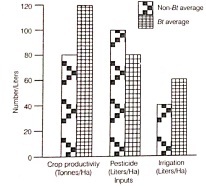
Answer the following questions
(i) Write your interpretation with reason, on the basis of the three parameters plotted in the graph.
(ii) Which one of the of the crops would you like cultivate in your farm and why ?
(iii) Which one out of these two crops would a farmer from Rajasthan like to cultivate and why ?
19.
Read the following and answer any four questions from (i) to (v) given below:
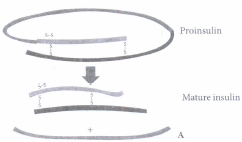
Insulin used to cure diabetes was earlier extracted from pancreas of slaughtered cattle and pigs. Insulin extracted from an animal source, though caused some patients to develop allergy or other types of reactions to the foreign protein. Human insulin consists of two short polypeptide chains: chain A and chain B, that are linked together by disulphide bridges. In mammals including humans, insulin is synthesised as a pro-hormone which contains an extra stretch called the C-peptide. This C peptide is not present in mature insulin and is removed during maturation into insulin.
(i) Identify A in the given figure.
| (a) Polypeptide chain A | (b) Polypeptide chain B | (c) Polypeptide chain C | (d) None of these |
(ii) The following is a list of some stages involved in producing human insulin from genetically engineered bacteria.
1. The bacteria are cultured in a fermenter for large scale production.
2. Recombinant insulin is extracted from the bacterial cells that expresses insulin gene.
3. The same restriction enzyme is used again to cut the bacterial plasmid for insertion of the human insulin gene.
4. Bacteria take up the plasmid carrying the insulin gene.
5. A restriction enzyme is used to cut human DNA to extract the insulin gene.
Select the correct order of these stages.
| (a) 1,5,3,4,2 | (b) 2,4,3,5,1 | (c) 4,5,3,2,1 | (d) 5,3,4,1,2 |
(iii) To insert the insulin gene into bacterial DNA, both the bacterial plasmid and the human chromosome containing the insulin gene are treated with the same restriction enzyme. Using the same restriction enzyme ensures that
| (a) DNA ligase is able to join the segments of human and bacterial DNA |
| (b) the exact length of nucleotides matching the insulin gene is removed from the plasmid |
| (c) both the bacterial and human DNA will contain sticky ends |
| (d) Sticky ends in the cut plasmid and insulin gene are complementary. |
(iv) Why is the fermentor important for the production of human insulin by transgenic bacteria
| (a) It provides optimal conditions for the transgenic to multiply rapidly. |
| (b) It facilitates the extraction and purification of insulin from the transgenic bacteria. |
| (c) It maximise the rate of fermentation of the transgenic bacteria. |
| (d) It provides the low-oxygen conditions that are important for insulin production. |
(v) A bacteriologist carries out his first attempt at engineering E.coli with the gene for human insulin. During the process, he realises that his stock of DNA ligase has depleted but decides to continue anyway. What is a likely consequence of his decision?
| (a) Bacteria with the rDNA will not be able to form colonies in a fermenter |
| (b) The resulting plasm ids are not able to enter the E.coli bacteria even after applying heat shock. |
| (c) The resulting E.coli bacteria do not contain the human insulin gene. |
| (d) The bacterial plasm ids do not have sticky ends and are unable to accommodate the human gene. |
1.
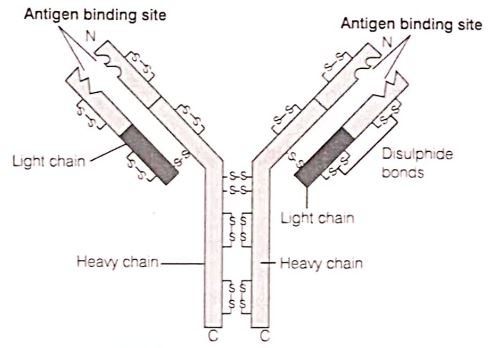
Types and functions.
| Types | Functions |
| IgG | Most prevalent class of antibody, constitutes 75-80% of total antibodies. Protects against fungi, bacteria, toxins, etc. It can cross placenta from mother to child and provides immune protection to newborns. Responsible for Rh-factor in blood. |
| IgA | Second most prevalent antibody. It is about 15% of the total antibodies. Secreted through parts lined by mucous system. Found in secretions from nose, eyes, lungs and digestive tract, saliva, tears, etc. Also found in colostrum, i.e. breast milk for newborn's immune protection. |
| IgM | Third most common antibody. It constitutes 5-10% of total antibodies. They are first to be produced in response to encounter with a pathogen. Responsible for blood transfusion reactions in ABO blood system. |
| IgE | The least common antibody. It makes upto only 0.1% of total antibodies and is involved in allergic reactions. |
| IgD | Their function is nor well understood yet. |
2.
Insertional inactivation is a technique used in recombinant DNA technology. In this procedure, a bacteria carrying recombinant plasmids or a fragment of foreign DNA is made to insert into a restriction site inside a gene to resist antibiotics, hence causing the gene to turn non-functional or in an inactivated state.
An example of this is a pUC19 plasmid vector in which the lacZ gene that encodes for beta-galactosidase can no longer be produced upon the insertion of a foreign gene. Selection or screening is a fundamental process in which once the recombinant DNA is inserted into a particular host cell, it becomes necessary to detect the cells that have received the recombinant or foreign DNA molecules.
This process is referred to as screening or selection. It is based on non-expression or expression of certain traits or characteristics. Insertional inactivation is an effective method of screening. In this procedure, one of the genetic characteristics is disturbed by the introduction of foreign DNA. One of the most influential selection methods of recombinant plasmid for the insertional inactivation procedure is a method known as ‘Blue-white’ selection method.
In this procedure, the lacZ gene which is a reporter gene is inserted in the vector. The enzyme β-galactosidase encoded by the lacZ gene comprises a few recognition sites for restriction enzymes. The β-galactosidase enzyme splits a synthetic substrate X-gal, which is an organic compound abbreviated as BCIG (5-bromo-4-chloro-indolyl-β-D-galactopyranoside) into an insoluble product that is blue in colour.
If a foreign gene is introduced into lacZ, the gene will be deactivated. Hence no blue colour will develop as β-galactosidase is not produced due to deactivation of the lacZ gene. Consequently, the host cell comprising the rDNA will create white coloured colonies on the medium containing X-gal, whereas other cells bearing non-recombinant DNA will tend to develop blue coloured colonies. The recombinants are thus selected on the basis of the colour of the colony.
3.
(i) (a) Eco RI
(b) Sticky ends/cohesive ends
(ii) Plasmid is cut with specific restriction enzyme. DNA and plasmid DNA are mixed together. Piece of DNA to be inserted should have same strictly ends made by cutting with same restriction bases like G to C and A to T pairing can take place. Ligase is then added to join the sticky ends.
4.
(i) It is the technique of growing cell, tissue, organ or whole plant under controlled conditions.
(ii) Micropropagation is the technique of producing a large number of identical plants from small explant within a short period using tissue culture technique.
(iii) His uncle, being a Botanist, guided his nephew to adopt modern biotechnology techniques so that he could earn handsome profits.
5.
Nematode-resistant tobacco plants are produced through RNA interference. The process RNA interference (RNAi) involves silencing of a specific mRNA.
A complementary double-stranded RNA binds to the mRNA and prevents its translation.
The complementary! RNA for making the double stranded RNA comes either from an infection by RNA viruses or mobile genetic elements, called transposons, which replicate through an RNA-intermediate.
The nematode-specific genes were introduced into the host plant by the use. of Agrobacterium vectors.
The introduction of DNA is such that it produced both sense and anti-sense RNA in the host cells.
These two RNAs are complementary to each other and hence form a double-strandedd RNA, which initiates the RNA interference and silencing of mRNA.
The parasite could not live in such a transgenic host that expresses the specific interfering double-stranded RNA; so, the transgenic plant is protected from the nematode.
6.
It helps in identifying or selecting transformants. These marker eliminate non-transformants by selectively permitting the growth of the transformants.
Transformation is a procedure, through which a piece of DNA is introduced into the host bacterium. Normally, the genes encoding resistance to antibiotics such as ampicillin, chloramphenicol, tetracycline, kanamycin, etc., are considered as useful selecrable markers for E. coli. The normal E. coli cells do not carry resistance against any of these antibiotics.
7.
Restriction enzymes cut the strands of the DNA, a little away from the centre of the palindromic sites, but between the same two bases on opposite strands.
They form hydrogen bonds with their complementary cut counterparts.
8.
(i)Fruits of Poppy plant (Papaver somniferum)
(ii) Cannabis sativa
(iii) Cannabis sativa
(iv) Coffea arabica
(v) Erythroxylon coca
(vi) Claviceps purpurea
9.
Resource partitioning:
If two species compete for the same resource, they could avoid competition by choosing different times for feeding or
different foraging patterns, e.g. five closely related species of warblers living on the same tree have been shown to coexist and avoid competition by behavioural differences in their foraging activities
10.
Gause's competitive exclusion principle states that two closely related species competing for the same resources cannot co-exist indefinitely and the competitively inferior one will be eliminated, e.g.
On the rocky sea coasts of Scotland, the larger and competitively superior barnacle Balanus dominates the intertidal area and excludes the smaller barnacle, Chathamalus from that zone
11.
(a) 'r' is intrinsic rate of natural increase.
(b) With increases while a decrease in 'r' decreases the population size.
12.
Integrated Pest Management (IPM) strategy is an ecosystem based strategy which focuses on long-term prevention of pests or their damage through a combination of techniques like biological control, use of resistant varieties, etc. In other words, it is an approach to control the pest in an integrated way. Bacillus thuringiensis plays a major role in the integrated pest management strategy. It is used to control butterfly catterpillars. Dried spores of Bt are mixed with water and sprayed on plants in order to protect them from various pests (especially catterpillars). It also renders non-target insects beings unharmed. Thus, they are equally important in the IPM strategy. Two crops that are protected effectively from pests include Brassica and cotton.
13.
(a) H - (iii), I - (iv), J - (i), K - (ii)
(b) Swiss cheese with large holes is produced by Propionibacterium shermanii. Holes are created due to the production of large amount of CO2 by this bacterium.
14.
(a) (Collection of) methods that allows correction of gene defect that has been diagnosed in a child/embryo/Here the genes are inserted into a person's cells and tissues to treat a hereditary disease. It compensate the non-functional gene this involves delivery of a normal gene into the individual/embryo to take over the function of non-functional/a defective gene.
(b) If the desired gene is isolated and introduced into cells at early embryonic stages it can provide a permanant cure. ADA/Adenosine deaminase deficiency
15.
(i) Histamines cause reactions of the immune system against allergens.
(ii) Interferons protect the non-infected cells of our body from viral infections.
(iii) B-cells produce antibodies against antigens/pathogens.
16.
Co-evolution of mutualists:
Evolution of the flower characteristics and its pollinator species is highly linked with each other as in wasp-fig relationship.
A given species of fig is pollinated by a specific (partner) wasp species.
The wasp pollinates the fig inflorescence while searching fon a suitable egg laying site.
The female wasp uses the ovary of flowers for oviposition (laying eggs) and the developing seeds provide nourishment to the young ones.
Later the young ones emerge from the fruits of fig.
17.
1. After entering the body of a person,the virus enters the macrophages.
2. The viral genome (RNA) undergoes replication and reverse transcription to become viral DNA with the help of reverse transcriptase.
3. The viral DNA gets incorporated into the DNA of the cells and directs these cells to produce virus particles.
4. The macrophages function as HIV factory and produce a number of HIV particles.
5. These HIV particles move out of macrophages and infect the helper T-lymphocytes and replicant to produce progeny viruses.
6. The progeny viruses released in the blood attack new helper T- cells.
7. This process is repeated and there is a progressive decrease in the number of helper T-cells.
18.
(i) On comparing non-Bt average and Bt average crops, the following three inferences can be drawn.
(a) With regard to crop productivity, the number of Bt average crops was found to be greater thanthat of non-Bt crops since the former weregenetically modified and the latter were destroyed by cotton bollworms.
(b) Growing Bt crops requires lessconventional or chemical insecticides because of the genetic modifications in them, whereas in non-Bt crops the use of pesticides is higher.
(c) Genetically modified crops (Bt here) require more water for irrigation when compared to normal or non-Btcrops, since they show resistance to biotic and abiotic stress.
(ii) It is better to cultivate Bt crops in our farms as theyprovide many advantages such as
(a) Better yield/high productivity
(b) Resistance to pests and insects
(c) Control of soil pollution .
(iii) A farmer from Rajasthan would like to cultivate non Btcrops as it requires less water for irrigation (since Rajasthan is a state with less water availability). It however leads to increased crop production and increased income
19.
(i) (c) : A represents polypeptide chain C which is removed prior to insulin formation.
(ii) (d)
(iii) (d) : Each particular restriction enzyme produces unique sticky ends. Using the same enzyme for both the bacterial and human DNA will produce complementary sticky ends that can bind together by complementary base pairing. This would allow the human insulin gene to be inserted into the plasmid.
(iv) (a) : The optimal temperature, pH, oxygen and nutrient conditions in the fermenter allow the bacteria containing the insulin gene to reproduce quickly and produce large quantities of it.
(v) (c) : DNA ligase forms strong hydrogen bonds between the DNA bases on the human insulin gene and the bacterial plasmid, producing a continuous double stranded DNA loop. Without DNA ligase, the human insulin gene, despite being able to undergo complementary base pairing with the bacterial DNA at the sticky ends would not be securely inserted into the plasmid. Thus, the resulting E.coli bacteria would receive plasm ids that lack the human insulin gene.

12th Standard CBSE Syllabus & Materials
12th Standard CBSE
CBSE 12th Computer Science Python Revision Tour I - New Previous year Question Papers Study Material - QB365 Set A
NEW12th Standard CBSE
CBSE 12th Business Studies Planning Important Questions And Answers Study Material - QB365 Set A
NEW12th Standard CBSE
CBSE 12th Business Studies Business Environment Important Questions And Answers Study Material - QB365 Set A
NEW12th Standard CBSE
CBSE 12th Business Studies Principles of Management Important Questions And Answers Study Material - QB365 Set A



NCERT Books

Syllabus

Exam Pattern

Sample Question Papers

Previous year Question Papers

Important Notes

MCQ Practice test

NCERT Exemplers

Case study Questions

Image Based Questions

Passage based Questions

HOT Questions

Value Based Questions

Model Questions Papers
NCERT ( Book Back ) Questions

Assertion and Reason
Important Questions And Answers

CBSE 12th Standard CBSE Subjects
CBSE Standards








