
 100% FREE ACCESS
12th Standard CBSE Syllabus & Materials
12th Standard CBSE
CBSE 12th Economics Government Budget and the Economy Previous year Question Papers Study Material - QB365 Set A
NEW12th Standard CBSE
CBSE 12th Computer Science Interface Python with MySQL - New Previous year Question Papers Study Material - QB365 Set A
NEW12th Standard CBSE
CBSE 12th Computer Science Database Concept - New Previous year Question Papers Study Material - QB365 Set A
NEW12th Standard CBSE
CBSE 12th Computer Science Data Communication - New Previous year Question Papers Study Material - QB365 Set A
NEW12th Standard CBSE
CBSE 12th Computer Science Data Structures - New Previous year Question Papers Study Material - QB365 Set A
NEW12th Standard CBSE
CBSE 12th Computer Science Functions - New Previous year Question Papers Study Material - QB365 Set A

Published on: 25/10/2025
Download CBSE Class 12th Standard CBSE Biology question papers, sample papers, important questions, and previous year solved papers in PDF format. Get free study materials, NCERT solutions, and exam preparation resources for Class 12th Standard CBSE Biology
Questions + Answers key
Take MCQ Biology Test
1.
(i) What does an ecological pyramid represent?
(ii) The ecological pyramids may have an 'upright' or an 'inverted' shape. Justify with the help of suitable examples
2.
(a) How is the grazing food chain different from the detritus food chain?
(b) "The detritus food chain may be connected to the grazing food chain at some levels in an ecosystem". Give an example in support of the statement.
3.
(i) How many primary producers do you think would be needed to support six tertiary consumers in a grassland ecosystem?
(ii) Draw a grassland pyramid to substantiate answer.
4.
Describe how do oxygen and chemical composition of detritus control decomposition.
5.
(a) Construct a pyramid of numbers by taking suitable examples for each trophic level in an ecosystem.
(b) Explain why a progressive decline is seen in the population size from the first to the fourth trophic level is the above pyramid.
6.
Outline the salient features of carbon cycle in an ecosystem.
7.
(a) Healthy ecosystems are the base of wide range of (ecosystem) services. Justify.
(b) Explain the difference and the similarities between hydrarch and xerarch successions of plants.
8.
How is the first law of thermodynamics satisfied in the functioning of an ecosystem?
9.
How does a detritivore differ froma decomposer? Explain each with an example.
10.
Why is earthworm considered a farmer's friend? Explain humification and mineralization occurring in decomposition cycle.
11.
Due to uncontrolled excessive hunting, the population of tigers in a forest has become zero.Discuss the long-term effects of this situation on the population of deer in that forest.
12.
Distinguish between following:
(a) Grazing food chain and detritus food chain
(b) Production and decomposition
(c) Upright and inverted pyramids
(d) Food chain and food web.
(e) Litter and detritus
(f) Primary and secondary productivity
13.
(i) Define pioneer species.
(ii) Among bryophytes, lichens and fern, which one is a pioneer species in a xeric succession? And why?
14.
Why are reducers or decomposers considered crucial and essential components of an ecosystem? Explain.
15.
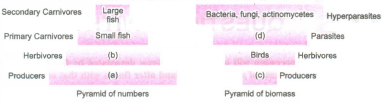
Given below are two figures depicting pyramid of numbers and pyramid of biomass in aquatic ecosystem and parasitic food chain.Observe the figures carefully and fill in the blanks (a), (b), (c) and (d).
16.
Name the pioneer species on a bare rock. How do they helping establishing the next type of vegetation? Mention the type of climax community that will ultimately get established.
17.
What is biosphere? What are the main subdivisions of the biosphere?
18.
Define an ecosystem. Give a few instances of an ecosystem.
19.
Describe the different classes of consumers.
20.
What is primary productivity? Give a brief description of factors that affect primary productivity.
1.
2.
(a) The differences between Grazing Food Chain (GFC) and Detritus Food Chain (DFC) are as follows
| GFC | DFC |
| Sun is the major source of energy. | Detritus is the major source of energy |
| Producers (eg plants and algae) occupies the first trophic level | Detritivores feeding on the detritus occupies the first trophic level |
| e.g. Grass \(\rightarrow\) Goat \(\rightarrow\) Man | e.g. Dead leaves \(\rightarrow\) Wood house \(\rightarrow\) Black bird |
| Comparatively lesser amount of energy flows through this chain. | Much larger amount of energy flows through this chain. |
| Long-sized chain. | Smali sized chain |
| Much more common. | Less common. |
| Major energy flow path in an aquatic ecosystem. | Major conduit of energy in terrestrial ecosystem. |
(b) The Detritus Food Chain (DFC) may be connected to the Grazing Food Chain (GFC) at same level in an ecosystem. It can be supported by the fact that certain organisms of the GFC are predators to certain animals of DFC.
For example, earthworms which are detritivores are eaten by small birds (DFC) which becomes prey to predators like vulture/kites or even small animals of the GFC.
3.
(i) and (ii)
In grassland ecosystem, the number of producers (plants) is highest to support fewer herbivores (primary consumers) and carnivores (secondary and tertiary consumers). This can be understood by the following pyramid of number in a grassland ecosystem.
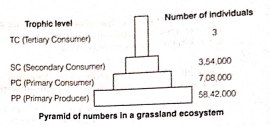
Only three top carnivores are supported in an ecosystem based on the production of nearly 60 lakh plants. As mentioned above, three tertiary consumers are supported by 60 lakh plants. Six tertiary consumers will be supported by 120 Lakh plants.
4.
Effect of Oxygen : The decomposition of detritus is an energy requiring process. Most of the decomposers (bacteria and fungi) are aerobic organisms. They require Oxygen for their cellular activities while acting on dead organic matter.
Effect of Chemical : Composition Decomposition rate is slower, if detritus is rich in lignin and chitin. It is quicker if detritus is rich in nitrogen and water soluble substances like sugars.
5.
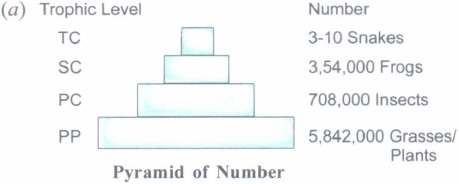
(b) (i) Since only 10% of energy is transferred from one trophic level to the next, the amount of energy keeps on decreasing as it travels to higher trophic levels.
(ii) Hence at higher trophic levels, the amount of energy is sufficient to sustain fewer organisms than the lower trophic levels.
6.
Carbon cycle is the circulation of carbon between the abiotic and biotic components of the ecosystem with reservoir pool being carbonate rocks while the cycling pool consists of atmosphere and hydrosphere. Input. Carbon is being added to the cycling pool regularly by combustion of fossil fuels, respiration of organisms, volcano eruptions, hot springs, methane chimneys, weathering of carbonate rocks and industrial processing. Internal Cycling. Carbon present in the atmosphere (as CO2) and hydrosphere (as bicarbonate and carbonic acid) is picked up by producers and changed into organic compounds in the process of photosynthesis. Annual carbon fixation is about 4 ×10 13 kg. It produces about 170 billion tonnes (17×10 13) of organic matter. Withdrawal of carbon by producers is called uptake. Part of organic matter synthesized by producers passes into higher trophic levels (herbivores, carnivores). It is called transfer. Wastes and dead bodies of organisms form detritus. Detritus is degraded by decomposers to release carbon locked in it. It enters the cycling pool for re-use by producers. Output. Some carbon is being taken out of cycling pool due to seepage of carbon rich water into interior of earth, skeletons and shells of animals and fossilisation.
7.
(a) Healthy ecosystems are the base for a wide range of economic, environmental and aesthetic goods and services. The products of ecosystem processes are named as ecosystem services. For examples, healthy forest ecosystem purifies air and water, minimize droughts and floods, cycle nutrients, generates fertile soils, provides wildlife habitat, maintains biodiversity, pollinate crops, provid storage site for carbon and also provide aesthetic,cultural and spiritual values. Though value of such services of biodiversity is difficult to determine, it seems reasonable to think that biodiversity should carry a healthy price tag.
(b) Based on the nature of the habitat - whether it is water (or very wet areas) or it is on very dry areas- succession of plants is called hydrarch or xerarch, respectively.
Differences: Hydrarch succession takes place in wetter areas and the successional series progress from hydric to mesic conditions. As against this, xerarch succession takes place in dry areas and the series progress from xeric to mesic conditions.
Similarity: Both hydrarch and xerarch successions lead to medium water conditions (mesic), neither too dry (xeric) nor too wet (hydric).
8.
Green plants are producers. They capture radiant energy of the sun during photosynthesis. Allother organisms depend upon plants directly (herbivores) or indirectly (carnivores) for their energy requirement. Thus the energy flows from producers to a number of consumers of various order in a unidirectional manner and it is neither created nor destroyed. In this way the first law of thermodynamics is satisfied in ecosystem functioning.
9.
| S.No | Detritivore | Decomposer |
| 1. | Feeds on waste dead plant and animal remains including faecal matter | Degrades dead organic matter |
| 2. | Breaks feeding material into fragments. | Secretes enzymes into dead organic matter for decomposition. |
| 3. | e.g., Earthworm | e.g., Bacteria/Fungi. |
10.
Earthworms are called farmer's friends because they bring about the fragmentation of detritus and loosening of soil. Humification is the process of formation of humus from detritus. Mineralization is the process of release of inorganic substances as both non-mineral and minerals from organic matter.
11.
If the number of predators (tigers) get reduced, the number of prey (deer) population will increase. The prey population increases pressure on the vegetation. As a result, plant population decreases due to overgrazing.Little vegetation puts pressure on deer population and as a result deer population will decrease due to starvation, death or migration and ultimately more tigers (predators) will be affected.
12.
(a)
| Grazing Food Chain | Detritus Food Chain |
|---|---|
|
1. It is the food chain where transfer of energy starts from the producers. |
1. It is the food chain where transfer of energy starts from detritus/decaying organic matter. |
(b)
| Production | Decomposition |
| It is the process of formation of organic matter | It is the process of breaking down of complex organic matter into simpler inorganic compounds like water, carbon dioxide, other nutrients, etc. |
| It is dependent on photosynthesis done by producers. | It is dependent on the decomposers. |
| For primary productivity, sunlight is required. | For decomposition, sunlight is not required. |
(c)
| Litter | Detritus |
| Litter is all types of above ground waste that has been disposed improperly | Detritus constitutes the remains of dead plants and animals. |
| It contains biodegradable and non-biodegradable material | It contains only biodegradable material |
(d)
| Upright pyramid | Inverted pyramid |
| In this type of pyramid the number and biomass of organisms at producer level is high, which keeps on decreasing at each trophic level | In this type of pyramid the number and biomass of organisms at each trophic level. |
| The base bar companies of producers in large number | The base bar companies of producers in small number |
| Energy pyramid is always upright | Pyramid of number and pyramid of biomass can be inverted. |
(e)
| Food chain | Food web |
| It is a linear sequence of organisms | It is an interconnection of many food chains |
| Members present at higher trophic level feeds on single type of organisms | One organisms has alternate food sources |
| The energy flow can be easily calculated | Energy flow is difficult to calcute |
| Competition is limited only to the members of same trophic level | Competition is amongst members of same and different trophic levels |
(f)
| Primary productivity | Secondary productivity |
| It is the amount of organic matter produced by producers per unit area over a period of time | It is defined as the rate of production of organic matter by consumers over a period of time |
13.
(i) The species that invade a bare area called pioneer species.
(ii) In a xeric succession the pioneer species are usually lichens then bryophytes, which are succeeded by ferns and some other bigger plants.
Lichen produces lichen acid and carbonic acid which corrode rock surface and release minerals required for growth. The corroded rock accumulates soil particle by wind and provides substrate for bryophytes and ferns.
14.
Sun is the endless source of energy, but the chemical materials of the environment are exhaustible.The producers fix solar energy into the chemical energy of organic compounds by utilizing inorganic substance (i.e., CO2 and water). This stored energy is passed to consumers by repeated eating and being eaten.Decomposers act on dead decaying organic matter and return the locked inorganic substance back to the environment for their reuse by producers.Without this, all life will ultimately cease to exist and earth will be full of dead organisms and waste organic substances.
15.
(a) Phytoplanktons
(b) Zooplanktons
(c) Oak tree
(d) lice and bugs
16.
(i) Lichens are the pioneer species on a bare rock. They are resistant to desiccation and temperature extremes. They produce organic acids which corrode the rock surface. This produces depressions and releases minerals which facilitate their further growth. The dead lichens add organic matter to the forming soil. The next community develops on thismeagre soil formed.
(ii) The climax community will be trees.
17.
All the regions of the world (atmosphere, lithosphere ad hydrosphere) where living organisms occur together with their abiotic environments from a biosphere. Main subdivisions of biosphere are atmosphere, lithosphere and hydrosphere.
18.
An ecosystem may be defined as a structural and functional unit of the biosphere, comprising living organisms and their non-living environment that interact by means of food chains and chemical cycles resulting in energy flow, niotic diversity and material cycling to form a stable, self-supporting system. Few instances of an ecosystem are a pond, a lake, a grassland, a desert, a village, a forest etc,.
19.
All organisms/animals which depend directly or indirectly on plants for their food are called consumers.
Consumers are of the following types:
(i) Primary consumers
They are the organisms/animals which depend directly on producers for their food;they are also called as herbivores,e.g. deer, rabbit, zooplanktons.
(ii)Secondary consumers
Secondary consumers are those animals which depend on the primary consumers for their food; they are primary carnivores, e.g frogs,hyena.
(iii)Tertiary consumers
Tertiary consumers are those animals which depend on the secondary consumers for their food;they are the secondary carnivores, e.g. lion, eagle, kite, etc.
20.
Primary productivity is defined as the amount of biomass or organic matter produced per unit area over a time period by the plants during photosynthesis.
It is also defined as the amount of biomass or organic matter produced per unit area over a time period by the plants during photosynthesis.
Primary productivity depends on:
(i)The plant species inhabiting a particular area.
(ii)The environmental factors.
(iii) Available of nutrient.
(iv) Photosynthetic capacity of plants.

12th Standard CBSE Syllabus & Materials
12th Standard CBSE
CBSE 12th Computer Science Python Revision Tour I - New Previous year Question Papers Study Material - QB365 Set A
NEW12th Standard CBSE
CBSE 12th Business Studies Planning Important Questions And Answers Study Material - QB365 Set A
NEW12th Standard CBSE
CBSE 12th Business Studies Business Environment Important Questions And Answers Study Material - QB365 Set A
NEW12th Standard CBSE
CBSE 12th Business Studies Principles of Management Important Questions And Answers Study Material - QB365 Set A



NCERT Books

Syllabus

Exam Pattern

Sample Question Papers

Previous year Question Papers

Important Notes

MCQ Practice test

NCERT Exemplers

Case study Questions

Image Based Questions

Passage based Questions

HOT Questions

Value Based Questions

Model Questions Papers
NCERT ( Book Back ) Questions

Assertion and Reason
Important Questions And Answers

CBSE 12th Standard CBSE Subjects
CBSE Standards








