
 100% FREE ACCESS
12th Standard CBSE Syllabus & Materials
12th Standard CBSE
CBSE 12th Economics Government Budget and the Economy Previous year Question Papers Study Material - QB365 Set A
NEW12th Standard CBSE
CBSE 12th Computer Science Interface Python with MySQL - New Previous year Question Papers Study Material - QB365 Set A
NEW12th Standard CBSE
CBSE 12th Computer Science Database Concept - New Previous year Question Papers Study Material - QB365 Set A
NEW12th Standard CBSE
CBSE 12th Computer Science Data Communication - New Previous year Question Papers Study Material - QB365 Set A
NEW12th Standard CBSE
CBSE 12th Computer Science Data Structures - New Previous year Question Papers Study Material - QB365 Set A
NEW12th Standard CBSE
CBSE 12th Computer Science Functions - New Previous year Question Papers Study Material - QB365 Set A

Published on: 25/10/2025
Download CBSE Class 12th Standard CBSE Biology question papers, sample papers, important questions, and previous year solved papers in PDF format. Get free study materials, NCERT solutions, and exam preparation resources for Class 12th Standard CBSE Biology
Questions + Answers key
Take MCQ Biology Test
1.
What is meant by sedimentary cycle? Depict diagrammatically the phosphorous cycle or sulphur cycle.
2.
Give two examples of artificial or man-made ecosystems. List the salient features by which they differ from natural ecosystems.
3.
What will happen to an ecosystem if
(a) All producers are removed.
(b) All organisms of herbivore level are eliminated and
(c) All top carnivore population is removed.
4.
A farmer harvests his crop and expresses his harvest in three different ways:
(a) I have harvested 10 quintals of wheat.
(b) I have harvested 10 quintals of wheat today in one acre land.
(c) I have harvested 10 quintals of wheat in one acre of land, 6 months after sowing.
Do the above statements mean one and the same thing. If your answer is "Yes", give reasons. And if your answer is "No", explain the meaning of each expression.
5.
Describe a pond as an ecosystem.
6.
(a) Draw a 'pyramid of numbers' of a situation, where a large population of insects fed upon a very big tree.The insects in turn are eaten by small birds,which in turns are fed upon by birds.
7.
Describe the components of an ecosystem.
8.
'All successions proceed to a similar climax community,the mesic'.Explain.
9.
Explain the carbon cycle with the help of a simplified model.
10.
List the different steps and state their role in the process of decomposition in an ecosystem.
1.
Sedimentary cycle. There is exchange of materials between the living and non-living world. This is called cycles of matter. The sedimentary cycle involves minerals, such as phosphorus, sulphur and calcium, the reservoir is lithosphere.
2.
(a) Two examples of man-made ecosystems are: Gardens and parks, crop fields and fishery tanks.
(b) Salient features of man-made ecosystems:
(i) These are simple and highly efficient.
(ii) These are generally monoculture (e.g. field crops) with low biodiversity.
(iii) These are generally unstable
(iv) These are more vulnerable to sudden changes because of low biodiversity, stability and self-regulation.
3.
(a) Removal of all producer reduce primary production in the ecosystem. Hence, no biomass will be available to the successive/higher trophic level or heterotrophic organisms.
(b) Elimination of all organisms of herbivore level results into an increase in primary productivity and biomass of producer and the carnivorous animal will not survive due to inavailability of food due to the elimination of herbivores.
(c) Removal of top carnivores also disturbs the ecosystem as it will result in huge increase in a number of herbivores which will finish plants creating desertification.
4.
Three above statements do not mean one and the same thing because:
(i) Statement (a) indicates total productivity of wheat but does not indicate the extent of area.
(ii) Statement (b) indicates productivity of wheat/acre on a specific day.
(iii) Statement (c) indicates productivity of wheat/acre/specific period.
5.
Pond - an Ecosystem
1. Pond is a fairly self-sustainable unit that shows even complex interactions of an aquatic ecosystem.
2. It is a shallow water body in which all the major/basic components of an ecosystem are well exhibited.
3. The abiotic components ar:
(i) Water with all the dissolved inorganic substance.
(ii) The rich soil deposit at the bottom.
(iii) The solar input.
(iv) The cycle of temperature.
(v) day length.
(vi) Climatic factor.
1. The producers or autotrophic components include phytoplanktons, some algae, floating and submerged and marginal plants.
2. The consumers are represented by
(i) zooplanktons,
(ii) f ree-swimming animals,
(iii) bottom dwelling animals.
1. The decomposers are the bacteria and fungi that are found at the bottom.
2. This system performs all the function of an ecosystem.
(i) Conversion of inorganic materials into organic compounds with the help of radiant energy of sun.
(ii) Consumption of autotrophs by heterotrophs, (food chain/food web), decomposition and mineralisation (nutrient cycling), etc.
6.
b)
| Pyramid of biomass | Pyramid of number |
| 1. The biomass of the single tree is much more than the biomass of insects | The base tier is much smaller with a single tree compared to the thousands of insects. |
| 2. The pyramid looks upright with those two levels | The pyramid looks inverted with these two levels |
| 3. The biomass of birds is much more than those of insects | The number of birds feeding on the insects is less than that of insects |
7.
Components of an Ecosystem:
The components are broadly classified into two categories:
(i) Biotic components
(ii) Abiotic components
Biotic components include the following:
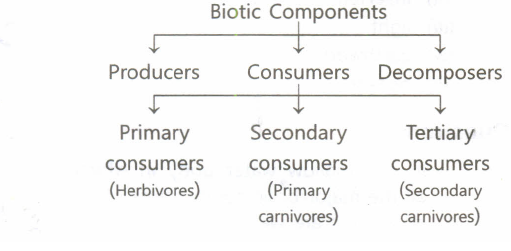
Producers:
These are the green plants or other autotrophs, which prepare their own organic food and feed energy into the ecosystem.
Decomposers:
Decomposers are the organisms which degrade the dead and decaying organic matter and satisfy their energy requirement, e.g. bacteria and fungi.
Abiotic Components:
They include the factors like:
(i) Air
(ii) Water
(iii) Solar radiation
(iv) Temperature
(v) Soil with organic and inorganic compounds as nutrients to plants.
8.
1. Hydrarch succession begins in water bodies or water areas and the successional stages process from hydric to mesic conditions.
2. The pioneers are the microscopic phytoplanktons,Which are replaced by the free floating angiosperms, followed by rooted hydrophytes, sedges, grasses and finally trees; the climax would be a forest.
3. Xerarch succession starts in dry areas (bare rocks) and progresses from xeric to mesic conditions.
4. The species that invade a bare rock, are usually lichens,which secrete some acids to dissolve the rock and help in weathering and soil formation.
5. This paves way to bryophytes which can take hold in small amount of soil.
6. They are replaced with time by bigger plants and ultimately a climax forest community is formed.
7. The climax community in both hydrarch and xerarch succession is a mesic forest.
9.
1. Carbon cycling occurs through atmosphere, oceans and living and dead organisms. About 49% of dry weight of organisms is constituted by carbon.
2. Carbon dioxide in the atmosphere and fossil fuel represent the reservoir of carbon.
3. About 71% of the global carbon is found dissolved in the ocean and this oceanic reservoir regulates the amount of carbon dioxide in the atmosphere.
4. About 4 x 10¹³ kg of carbon is fixed in the biosphere through photosynthesis annually.
5. A considerable amount of this is returned to the atmosphere as carbon dioxide through the respiratory activities of producers and consumers and decomposition by decomposers.
6. Some amount of fixed carbon is lost as sediments (limestone, dolomite, etc.)
7. Carbon dioxide is also returned to the atmosphere through :
(I) Respiration of living organisms
(ii) Forest fires
(iii) Volcanic activity and
(iv) Burning of fossil fuels, fuel wood and organic debris.
10.
Process of decomposition
(i) Fragmentation:
It is the process of breaking of the detritus into smaller particles by detritivores like earthworm.
(ii)Leaching:
It is the process in which water-soluble inorganic substances run down into soil horizon and get precipitated as unavailable salts.
(iii) Catabolism:
The enzymatic conversion of the detritus into simple organic compounds and then into inorganic compounds, is called catabolism.
The enzymes are secreted by the decomposers like bacteria and fungi.
(iv) Humification:
Humification during decomposition leads to the accumulation of a dark coloured, amorphous substance, called humus.
(v) Mineralisation:
It is the process in which the humus is degraded by certain microbes and the inorganic nutrients are released.

12th Standard CBSE Syllabus & Materials
12th Standard CBSE
CBSE 12th Computer Science Python Revision Tour I - New Previous year Question Papers Study Material - QB365 Set A
NEW12th Standard CBSE
CBSE 12th Business Studies Planning Important Questions And Answers Study Material - QB365 Set A
NEW12th Standard CBSE
CBSE 12th Business Studies Business Environment Important Questions And Answers Study Material - QB365 Set A
NEW12th Standard CBSE
CBSE 12th Business Studies Principles of Management Important Questions And Answers Study Material - QB365 Set A



NCERT Books

Syllabus

Exam Pattern

Sample Question Papers

Previous year Question Papers

Important Notes

MCQ Practice test

NCERT Exemplers

Case study Questions

Image Based Questions

Passage based Questions

HOT Questions

Value Based Questions

Model Questions Papers
NCERT ( Book Back ) Questions

Assertion and Reason
Important Questions And Answers

CBSE 12th Standard CBSE Subjects
CBSE Standards








