
 100% FREE ACCESS
12th Standard CBSE Syllabus & Materials
12th Standard CBSE
CBSE 12th Economics Government Budget and the Economy Previous year Question Papers Study Material - QB365 Set A
NEW12th Standard CBSE
CBSE 12th Computer Science Interface Python with MySQL - New Previous year Question Papers Study Material - QB365 Set A
NEW12th Standard CBSE
CBSE 12th Computer Science Database Concept - New Previous year Question Papers Study Material - QB365 Set A
NEW12th Standard CBSE
CBSE 12th Computer Science Data Communication - New Previous year Question Papers Study Material - QB365 Set A
NEW12th Standard CBSE
CBSE 12th Computer Science Data Structures - New Previous year Question Papers Study Material - QB365 Set A
NEW12th Standard CBSE
CBSE 12th Computer Science Functions - New Previous year Question Papers Study Material - QB365 Set A

Published on: 25/10/2025
Download CBSE Class 12th Standard CBSE Biology question papers, sample papers, important questions, and previous year solved papers in PDF format. Get free study materials, NCERT solutions, and exam preparation resources for Class 12th Standard CBSE Biology
Questions + Answers key
Take MCQ Biology Test
1.
Mention one application for each of the following:
(i) Passive immunisation
(ii) Antihistamine
(iii) Colostrum
(iv) Cytokininbarrier
2.
(i) List any two situations, when a medical doctor would recommend injection of preformed antibodies into the body of a patient. Name this kind of immunisation and mention its advantages.
(ii) Name the kind of immunity attained when instead of antibodies, weakened antigens are introduced into the body.
3.
Health is the basic to life, and is essential for the good results in any sphere of life. A factory owner cannot expect the optimum output, if he does not employ healthy workers. A farmer cannot get optimum yield in his fields, if he is not healthy What does health actually mean? How is it related to our personal life & professional efficiency?
4.
Match the items listed in column I with suitable items from column II.
| Column I | Column II |
| (i) Prevent sleep | (i) Ergot gungus |
| (ii) Induce sleep | (ii) Papaver somniferum |
| (iii) Lung cancer | (iii) Cannabis indica |
| (iv) Ganja | (iv) Smoking |
| (v) Codeine | (v) Barbiturates |
| (vi) LSD | (vi) Amphetamines |
| (vii) Quinine | (vii) Health hazard |
| (viii) Tobacco | (viii) Natural Drug |
5.
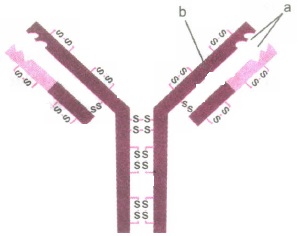
Study the given diagram and answer the following:
(i) What does the above diagram illustrate?
(ii) Name the labelled 'a' and 'b'
(iii) Name the type of cells that produce this molecule.
6.
Briefly, explain the functions of the following with reference to immunity:
(a)Antibodies
(b)T-helper cells
(c)HLA proteins
(d)B-cells
(e) Complement proteins
7.
(a)Name the infective stage of Plasmodium which Anopheles mosquito take along with the blood meal from an infected human.
(b)Why does the infection cause fever in humans?
(c)Give a flow chart of the part of the life-cycle of this parasite passed in the insect.
8.
The immune system of a person is suppressed.In then ELISA test, the person was found to be positive to a pathogen.
(a) Name the disease the patient is suffering from.
(b) What is the causative organism?
(c) Which cells of the body are affected by the pathogen?
9.
Many microbial pathogens enter the gut of humans along with food.What are the preventive barriers to protect the body from such pathogens?What type of immunity do you observe in this case?
10.
State the effect of carcinogens on human body.Name the carcinogenic ionising and non-ionising radiations.Mention their carcinogenic effect.
11.
How do macrophages in the human body act as 'HIV factory'?
12.
Name the plant source of the drug popularly called 'smack'.How does it affect the body of the abuser?
13.
Name the two special types of lymphocytes in humans.How do they differ in their roles in immune response?
14.
Name the different types of cells that are responsible for producing the acquired immune response in a human body.How do these cells respond when a pathogen enters the body?
15.
A patient showed symptoms of constipation,abdominal pain and stools with excess mucus and blood clots.Name the disease and its pathogen.Where do these pathogens live in the victim's body?Name the mechanical carrier that transmits this pathogen.
16.
A patient showed symptoms of sustained high fever,stomach pain and constipation,but no blood clot in stools.Name the disease and its pathogen.How does the disease.How does the disease get transmitted?
17.
Why does a doctor administer tetanus antitoxoid and not a tetanus vaccine to a child injured in a roadside accident with a bleeding wound?Explain.
18.
Why is a person with cuts and brusis following an accident administered tetanus antitoxin?Given reasons.
19.
Explain the response initiated when a does of vaccine is introduced into the human body.
20.
Name and explain the type of immunity that is provided by injecting microbes deliberately during immunisation into the human body.
21.
How does a vaccine for a particular disease immunise the human body against that disease?
22.
Write the events that take place when a vaccine for any disease is introduced into the human body.
23.
A student on a school trip started sneezing and wheezing soon after reaching the hill station for no explained reasons,But on return to the plains,the symtoms disappeared.What is such a response called?How does the body produce it?
24.
The following are some well known abbreviations, which have been used in this chapter. Expand each one to its full form.
(i) MALT
(ii) CMI
(iii) AIDS
(iv) NACO
(v) HIV
25.
Virus(L.poison) is a nucleoprotein entity which able to utilize the synthetic machinery of a living cell of another organism for its multiplication which does not involve growth and division.Mosaic disease of tobacco was found to be caused by a filterable agent present in the extract of disease tobacco plant.Later, it was observed that the infectous agents were too small to be visible even under microscope and unlike bacteria could not be growth in cell free-media.They came to be known as 'filterable viruses'
Read the passage and answer the questions.
(i)Name the two diseases caused by viruses.
(ii)List any three measures to avoid a dread sexually transmitted viral disease.
26.
Explain the role of the following in providing defence against infection in human body:
(i) Histamine
(ii) Interferons
(iii) B-cells
27.
A person is suffering from amoebiasis,Mention the pathogen that causes it and mention the pathogen that causes it and one organ of the body that gets affected.Give three symptoms and one mode of its transmission.
1.
Applications of given components are as follows
(i) Passive immunisation provides a faster immune response.
(ii) Antihistamine is used to reduce the symptoms of allergy such as sneezing, watery eyes, rashes, running nose, etc.
(iii) Colostrum consists of antibodies (e.g. IgA) that provide immunity to an infant against infections.
(iv) Cytokinin barrier produces interferons and protects non-infected cells from further viral infection.
2.
(i) A doctor would recommend preformed antibodies in an injured person in an accident on snake bites and tetanus. The type of immunization is passive immunization.
Its advantages are:
(a) Provides immediate relief.
(b) Used either prophylactically or therapeutically.
(ii) Passive immunity
3.
A state of complete physical, mental & social well - being. A healthy person is more efficient at work. Increases productivity & brings economic prosperity.
4.
(i) (vi);
(ii) (v);
(iii) (iv);
(iv) (iii);
(v) (ii);
(vi) (i);
(vii) (viii);
(viii) (vii)
5.
(i) Diagram illustrates the structure of an antibody molecule.
(ii) 'a' - antigen binding site; 'b' - Variable region of the heavy peptide chain.
(ii) B-lymphocytes and T - lymphocytes.
6.
(a)Antibodies.Refer to terms to memorize.
(b)Helper T-cells,These cells stimulate the B-cells to produce antibodies.They also stimulate the killer T-cells to destroy the non-self cells.
(c) HLA proteins.(Human Leucocyte antigen protein).Chromosome 6 of mouse contains a cluster of genes known as major histocompatibility complex.In human, it is called human leucocyte antigen (HLA complex).The alleles of HLA genes are codominant.
The product of theses genes determine histocompatibility.
(d)B-cells.B-cells are produced in bone marrow.The b-cells direct the antibody mediated immunity.
(e)Complement proteins.These proteins participate in both innate and acquired immunities.They are about 30 proteins that act in various ways to protect the individuals in different ways.They form transmembrane pores which lead to lysis.
7.
(a)Gametocytes.
(b)Release of haemozoin in blood.
8.
(a) AIDS
(b) HIV
(c) Helper \({ T }_{ 4 }\) lymphocytes and macrophages.
9.
(i) The mucus coating of the gut epithelium is a barrier that traps microbes.
(ii) The hydrochloric acid secreted by gastric glands retards the growth of microbes.
This type of immunity is called innate immunity, which occurs right from birth.
10.
Carcinogens induce transformation of normal cells into neoplastic cells.
Carcinogenic ionising radiation;e.g. X-rays and carcinogenic non-ionising radiation ,e.g. UV-rays,cause damage to DNA that leads to transformation of these normal cells into neoplastic cells.
An autoimmune disease is produced when the immune system goes off the track and starts attacking the 'self' calls,due to genetic or other unknown reasons,e.g. Rheumatoid arthritis.
11.
After entering the macrophage,the RNA of the virus produces DNA catalysed by the enzyme reverse transcriptase.
This viral DNA gets incorporated into the DNA of the host cell or macrophage and directs the host cell to produce virus particles.
The macrophage continues to produce new viruses and thus,acts as a HIV factory.
12.
Smack is obtained from Papaver somniferum. It affects the Central Nervous System (CNS) and gastrointestinal system. It slows down the body functions. It acts as a depressant.
13.
Two special types of lymphocytes in humans are B-lymphocytes and T-lymphocytes. B-lymphocytes execute antibody-mediated response while T-lymphocytes show cell-mediated response.
14.
B-lymphocytes and T-lymphocytes
Both these types of cella multiply and produce a clone of cells.
B-lymphocytes produce an array of proteins,called antibodies.
The T-lymphocytes stimulate the B-cells to produce antibodies.
Memory B-cells and T-cells remain inthe body,for secondary immune response,in case of subsequent encounter by the pathogen.
15.
Amoebiasis
Large intestine
Houseflies.
Entamoeba histolytica
16.
Typhoid
Salmonella typi
Widal test
Transmission is by contaminated food and water.
17.
1. Tetanus antitoxin,i.e. preformed antibodies for tetanus are injected,as the child infected with deadly microbe (tetanus bacteria) to which quick immunisation response is required.
2. If tetanus vaccine is injected,it will take some time for the body to develop antibodies and this can lead to a fatal end.
18.
Tetanus antitoxin,i.e. preformed antibodies for tetanus are injected,as the child infected with deadly microbe (tetanus bacteria) to which quick immunisation response is required.
If tetanus vaccine is injected,it will take some time for the body to develop antibodies and this can lead to a fatal end.
19.
Active immunity is produced by injecting the microbes deliberately during immunisation.
Antibodies are produced by the B-cells of our body in response to the antigens;they neutralise the pathogenic agents during actual infection.
The vaccines also generate memory B-cells and T-cells,which recognise the same pathogen on subsequent exposure and destroy them by a massive production of antibodies.
20.
1. Active immunity is produced by injecting the microbes deliberately during immunisation.
2. Antibodies are produced by the B-cells of our body in response to the antigens;they neutralise the pathogenic agents during actual infection.
3. The vaccines also generate memory B-cells and T-cells,which recognise the same pathogen on subsequent exposure and destroy them by a massive production of antibodies.
21.
Active immunity is produced by injecting the microbes deliberately during immunisation.
Antibodies are produced by the B-cells of our body in response to the antigens;they neutralise the pathogenic agents during actual infection.
The vaccines also generate memory B-cells and T-cells,which recognise the same pathogen on subsequent exposure and destroy them by a massive production of antibodies.
22.
Active immunity is produced by injecting the microbes deliberately during immunisation.
Antibodies are produced by the B-cells of our body in response to the antigens;they neutralise the pathogenic agents during actual infection.
The vaccines also generate memory B-cells and T-cells,which recognise the same pathogen on subsequent exposure and destroy them by a massive production of antibodies.
23.
It is called allergy.
It is due to the release of histamine and serotonin by mast cells.
24.
(i) MALT - Mucosal Associated Lymphoid Tissue
(ii) CMI - Cell-Mediated Immunity
(iii) AIDS - Acquired Immuno Deficiency Syndrome
(iv) NACO - National AIDS Control Organisation
(v) HIV - Human Immunodeficiency Virus
25.
Viral diseases:
1.polio caused by Entiro virus and polio virus
2.Rabies caused by Rabies virus.
(ii)AIDS is a dread viral diseases.Measures to avoid AIDS.
1.Avoid sexual contact with infected person or multiple partner.
2.Use condom during sexual act.
3.Avoid use of infected syringes.
26.
(i) Histamines cause reactions of the immune system against allergens.
(ii) Interferons protect the non-infected cells of our body from viral infections.
(iii) B-cells produce antibodies against antigens/pathogens.
27.
(a) Amoebiasis is caused by Entamoeba histolytica.
(b) Symptoms:
(i) Constipation
(ii) Abdominal cramps and pain.
(iii) Stool with excess mucus and blood clots.
Transmission
Drinking water and food contaminated with the faeces of infected persons.
Houseflies act as mechanical carriers and transmit the parasite from faeces to food and water.

12th Standard CBSE Syllabus & Materials
12th Standard CBSE
CBSE 12th Computer Science Python Revision Tour I - New Previous year Question Papers Study Material - QB365 Set A
NEW12th Standard CBSE
CBSE 12th Business Studies Planning Important Questions And Answers Study Material - QB365 Set A
NEW12th Standard CBSE
CBSE 12th Business Studies Business Environment Important Questions And Answers Study Material - QB365 Set A
NEW12th Standard CBSE
CBSE 12th Business Studies Principles of Management Important Questions And Answers Study Material - QB365 Set A



NCERT Books

Syllabus

Exam Pattern

Sample Question Papers

Previous year Question Papers

Important Notes

MCQ Practice test

NCERT Exemplers

Case study Questions

Image Based Questions

Passage based Questions

HOT Questions

Value Based Questions

Model Questions Papers
NCERT ( Book Back ) Questions

Assertion and Reason
Important Questions And Answers

CBSE 12th Standard CBSE Subjects
CBSE Standards








