
 100% FREE ACCESS
12th Standard CBSE Syllabus & Materials
12th Standard CBSE
CBSE 12th Economics Government Budget and the Economy Previous year Question Papers Study Material - QB365 Set A
NEW12th Standard CBSE
CBSE 12th Computer Science Interface Python with MySQL - New Previous year Question Papers Study Material - QB365 Set A
NEW12th Standard CBSE
CBSE 12th Computer Science Database Concept - New Previous year Question Papers Study Material - QB365 Set A
NEW12th Standard CBSE
CBSE 12th Computer Science Data Communication - New Previous year Question Papers Study Material - QB365 Set A
NEW12th Standard CBSE
CBSE 12th Computer Science Data Structures - New Previous year Question Papers Study Material - QB365 Set A
NEW12th Standard CBSE
CBSE 12th Computer Science Functions - New Previous year Question Papers Study Material - QB365 Set A

Published on: 25/10/2025
Download CBSE Class 12th Standard CBSE Biology question papers, sample papers, important questions, and previous year solved papers in PDF format. Get free study materials, NCERT solutions, and exam preparation resources for Class 12th Standard CBSE Biology
Questions + Answers key
Take MCQ Biology Test
1.
Why is it that the organs cannot be taken from just anybody for transplantation? What is it that the doctors check?
2.
Name the two components of immune system
3.
List the harmful effects produced on a result of interaction of alcohol and drugs.
4.
Name any four groups of drugs that are abused.
5.
Do you think that friends can influence one to take alcohol/drugs? If yes,how may one protect himself/herself from such an influence?
6.
Explain what is meant by metastasis.
7.
What measure would you take to prevent water-borne diseases?
8.
Due to peer pressure, a group of adolescents started using opioids intra-venously. What are the serious problems they might face in future?
9.
Explain the following with reference to drug/alcohol abuse:
(a) Addiction,
(b) Dependence and
(c) Withdrawal symptoms
10.
How does the transmission of each of the following takes place? amoebiasis, Malaria, Ascariasis, Pneumonia
11.
Differentiate the following and give examples of each.
(i) Innate and acquired immunity.
(ii) Active and passive immunity.
12.
The following are some well known abbreviations, which have been used in this chapter. Expand each one to its full form.
(i) MALT
(ii) CMI
(iii) AIDS
(iv) NACO
(v) HIV
13.
Define health.Why should people be healthy?
14.
'Prevention is better than cure' is an apt slogan to safeguard adolescents from drug abuse .List any six steps that could be taken in this regard.
15.
Draw the structure of human antibody and mention its types and functions.
16.
In your view what motivates youngsters to take alcohol or drugs and how can this be avoided?
17.
(a) Name and explain any four lymphoid organs present in humans
(b) Categorise the named Lymphoid organs as primary or secondary lymphoid, giving reasons
18.
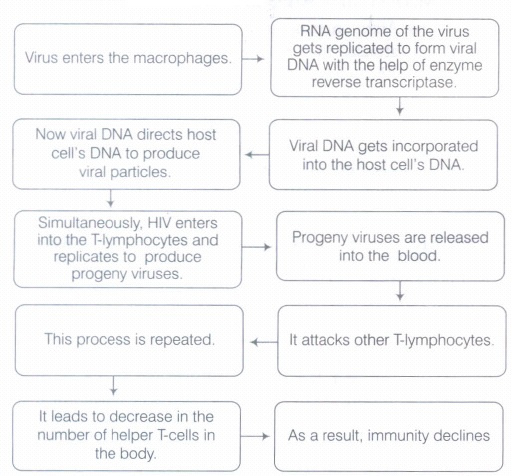
What is the mechanism by which the AIDS virus causes deficiency of immune system of the infected person?
19.
Municipal employee were taking samples of water from the coolers, flower pots and stagnant water at public places. Amit enquired from them about the purpose of this exercise. They replied that they were looking for the presence of larvae of mosquitoes in these samples.
Read the above passage and answer the following questions:
(i) Why were municipal employees looking for the presences of mosquitoes larvae?
(ii) Name three diseases spread by mosquitoes.
(iii) What value is displayed by municipal employees?
20.
A student on a school picnic to a park on a windy day started sneezing and having difficulty in breathing on reaching the park.The teacher enquired whether the student was allergic to something.
(a) What is an allergy?
(b)Write the two unique characteristics of the system involved in the response observed in the student.
21.
Make a table showing the major psychotrophic drugs.Give examples and write their effects
22.
List the harmful effects caused by the alcohol/drug abuse.
23.
Which of the following sets of diseases are non-contagious?
Chickenpox, cholera, influenza
Typhoid, ringworm, smallpox
Taeniasis, ringworm, influenza
Cholera, typhoid, taeniasis
24.
If you suspect major deficiency of antibodies in a person, to which of the following would you look for confirmatory evidence?
Serum globulins
Fibrinogen in the plasma
Haemocytes
Serum albumins
25.
Nicotine, the alkaloid in tobacco causes the hallucinogenic effect.
26.
Cannabinoids affect the digestive system.
27.
\(\alpha\)-interferon activates the immune system and help to destroy the tumour cells.
28.
Humoral immunity is responsible for rejection of organ transplants
29.
_____ is the filarial worm.
30.
Cell-mediated immunity is provided by _______.
31.
_____ mosquitoes are the vectors of dengue and chikungunya.
1.
1. Grafts cannot be taken from anyone just like that, because if the graft is not matching, it will be rejected sooner or later.
2. Doctors check the tissue matching and blood group matching before any organ transplant.
2.
Humoral immune system and cell mediated immune system
3.
| Name of cominations | Effects |
| Alcohol and other depressants,e.g., barbiturates | Dramatically increased depressure effect. |
| AlchocAlcoholhitamines(normally little or no sedative effect) | Marked drowsiness. |
| Alcohol + Valium Alcohol +Marijuana or hashish Alcohol +Aspirin |
Rapid increase in sedative effect; often dramatic |
4.
Opioids,cannabinoids,coca alkaloids,amphetamines,barburates,Lyseric acid diethylamide.
5.
Yes, a friend can influence one to take alcohol/drugs.
Steps to avoid influence of drugs/alcohol are
(i) Avoiding the company of friends who take drugs or alcohol.
(ii) Seeking help from parents, teachers and friends who do not indulge in alcohol/drug consumption.
(iii) Proper knowledge and awareness about alcohol and drug abuse.
(iv) Not experimenting with drugs and increasing the willpower to beat the curiosity.
(v) Taking immediate medical help and counseling, if required.
6.
When cells sloughed from a malignant tumour cell reaches other parts of body via blood and start a new tumour there, this condition is termed as metastasis.
7.
To prevent water-borne diseases, water bodies, ponds, water tanks, reservoirs in the city or village should be cleaned periodically. The proper disposal of domestic waste, excreta, sewage should be done. At personal level, boiling of water, using water purifier, washing hands before meals should be practiced.
8.
They are more likely to get infections like AIDS and hepatitis-B, as the viruses of these diseases are spread by the use of contaminated needles and syringes; both are chronic infections and are fatal.
Since, the tolerance levels of the receptors present in our body to these drugs increase, they respond only to higher doses of drugs leading to greater intake and addiction.
9.
(a) Addiction refers to the psychological attachment of the body to certain effects like euphoria and a temporary feeling of well-being associated with drugs/alcohol.
(b) Dependence is the tendency ofthe body to manifest certain characteristic and unpleasant symptoms, when the regular dose of the drug is not available.
(c) Withdrawal symptoms are those characteristic and unpleasant symptoms manifested by an addict when the regular dose of the drug/alcohol is abruptly discontinued.
10.
| Disease | Mode of Transmission |
| Amoebiasis | Transmitted by contaminated food and water. Vector involved is housefly |
| Malaria | It is also a vector-borne disease that is usually spread by the biting of female Anopheles mosquito. |
| Ascariasis | Transmitted by contaminated food and water |
| Pneumonia | It spreads by droplets/ aerosols released during nasal secretions of infected person. |
11.
(i) Differences between innate immunity and acquired immunity are:
| Innate Immunity | Acquired Immunity |
| It includes the defence elements with which an individual is born. | It is immunity which is acquired after birth. |
| It consists of various types of barriers that prevent the entry of foreign agents. | It consists of specialised cells (T-cells and B-cells) and antibodies that circulate in the body fluid. |
| It remains throughtout life. | It can be short lived or life long. |
(ii) Differences between active immunity and passive immunity are:
| Active Immunity | Passive Immunity |
| lt is developed by the body due to contact with pathogen or its antigen. | It is developed when ready-made antibodies are injected into the body. |
| It has no side effects. | It may cause a reaction. |
| It is slow but long lasting. | It is fast but lasts only for few days. |
| It takes time to develop its response. | It is used when the immune response has to be faster. |
| e.g vaccination for polio, etc. | e.g. administration of tetanus antitoxins, etc. |
12.
(i) MALT - Mucosal Associated Lymphoid Tissue
(ii) CMI - Cell-Mediated Immunity
(iii) AIDS - Acquired Immuno Deficiency Syndrome
(iv) NACO - National AIDS Control Organisation
(v) HIV - Human Immunodeficiency Virus
13.
Health is defined as a state of complete physical,mental and social well-being.
People should be healthy for the following reasons:
(i) Health increases longivity.
(ii) Health reduces infant mortality and maternal mortality.
(iii) Healthy people are more efficient in work and this increases the productivity and economic prosperity.
14.
(i) A child should not be pushed unduly to perform beyond his/her threshold limits in studies,sports or any other activities.
(ii) Educating and counselling him/her to face problems and stresses and accept disappointments and failure as a part of life.
(iii) Parents and teachers can identify the danger signs and take appropriate steps to diagnose the malady and underlying causes,so that proper remedial steps can be taken.
(iv) Help can/should be sought from qualified psychologists,psychiatrists,and deaddiction and rehabilitation programmes.
(v) The individual can seek help from parents and teachers.
(vi) Help can also be sought from close friends;this would help to vent the feelings and anxiety and guilt.
15.
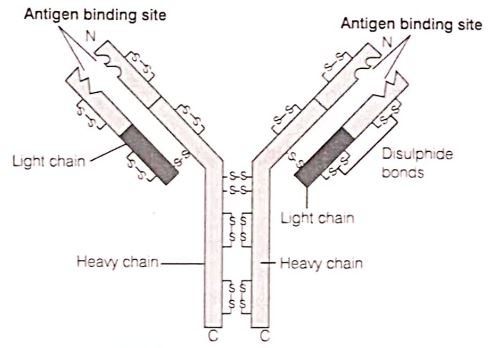
Types and functions.
| Types | Functions |
| IgG | Most prevalent class of antibody, constitutes 75-80% of total antibodies. Protects against fungi, bacteria, toxins, etc. It can cross placenta from mother to child and provides immune protection to newborns. Responsible for Rh-factor in blood. |
| IgA | Second most prevalent antibody. It is about 15% of the total antibodies. Secreted through parts lined by mucous system. Found in secretions from nose, eyes, lungs and digestive tract, saliva, tears, etc. Also found in colostrum, i.e. breast milk for newborn's immune protection. |
| IgM | Third most common antibody. It constitutes 5-10% of total antibodies. They are first to be produced in response to encounter with a pathogen. Responsible for blood transfusion reactions in ABO blood system. |
| IgE | The least common antibody. It makes upto only 0.1% of total antibodies and is involved in allergic reactions. |
| IgD | Their function is nor well understood yet. |
16.
Youngsters generally take alcohol or drugs on the basis of the following factors.
(i) Curiosity (ii) Pleasure (iii) To escape from the realities of life, to overcome frustrations and depression, (iv) Friends pressure, (v) Desire of excitement, (vi) Desire to do more work, (vii) Unhappy married life, (vii) Monotony of daily life,
It can be avoided by the following ways, (i) Educating and counseling the child to face problems and stresses and accept disappointments and failure as a part of life. (ii) A child should not be pushed unduly to perform beyond his capacity, (iii) Parents and teachers should be alert the activities of the child, (iv) Help can be taken from highly qualified psychologists and psychiatrists.
17.
a) Bone marrow - blood cells-lymphocytes are produced and mature.
Thymus,- Large at the time of birth but keep reducing in size with age. T-Lymphocytes are produced and mature
Spleen - Acts as a filter for micro-organisms in blood and reservoir for RBCs.In foetus it producers all types all types to blood cells but in adults it produces only lymphocytes. Macrophages of spleen are phagocytic
Lymph nodes - Act as filters for lymph, trap micro-organisms or other antigens and activate lymphocytes and initiate immune system
(b) Primary lymphoid organs - bone marrow and thymus.
Immature lymphocytes differentiate into antigen sensitive lymphocytes
Secondary lymphoid organ - spleen and lymph nodes.
Provide the site for interaction of lymphocytes with antigen, which proliferate to become effector cell.
18.
The process by which retrovirus gains entry into human host body or the mechanism by which AIDS virus causes immunodeficiency is as follows:
19.
(i) Mosquitoes are vectors of many fatal diseases.
(ii) Malaria, Dengue, Chickengunya.
(iii) Municipal employees were concerned about the health of public.
20.
The exaggerated response of the immune system to certain antigens present in the environment is called allergy.
(b)Unique characteristics
1.The substances to which such an immune response is produced are called allergens.
2.The antibody produced are of lgE
3.Allergy is due to release of chemicals like histamines and serotonin fro mast cells.
21.
Major groups of psychotropic drugs,examples and effects
| Types of drugs | Examples | Effects |
| I. Sedative tranquillizers(depressant) | Benzodiazephines (e.g., Valium),barbiturates. | Depresses brain activity and produces feelings of calmness, relaxation,drowsiness and deep sleep (high doses). |
| II. Opiate narcotics | Optimum,morphine,heroin,parathidine,methadone | Suppresses brain function,relieves intense pain. |
| III. Stimulants | Caffeine (very mild),cocaine,amphetamines. | Stimulate the nervous system ;makes a person more wakeful, increases alertness and activity,produces excitement. |
| IV. Hallucinogens | LSD ,mescaline psilocybin,charas,bhang,marijuana,hashish | Alters thought,feelings and perceptions |
22.
1. The immediate effects of drug/alcohol abuse are manifested as reckless behavior, vandalism, and violence.
2. Other symptoms include loss of weight, sterility, and loss of interest in work.
3. Secondary infections like AIDS, hepatitis and STDs are possible through use of contaminated needles/syringes to inject drugs.
4. Alcohol affects the liver.
5. Central nervous system is affected by alcohol as well as drugs.
23.
(d)
Cholera, typhoid, taeniasis
24.
(a)
Serum globulins
25.
(b)
26.
(b)
27.
(a)
28.
(b)
29.
()
Wuchereria.
30.
()
T-cells
31.
()
Aedes.

12th Standard CBSE Syllabus & Materials
12th Standard CBSE
CBSE 12th Computer Science Python Revision Tour I - New Previous year Question Papers Study Material - QB365 Set A
NEW12th Standard CBSE
CBSE 12th Business Studies Planning Important Questions And Answers Study Material - QB365 Set A
NEW12th Standard CBSE
CBSE 12th Business Studies Business Environment Important Questions And Answers Study Material - QB365 Set A
NEW12th Standard CBSE
CBSE 12th Business Studies Principles of Management Important Questions And Answers Study Material - QB365 Set A



NCERT Books

Syllabus

Exam Pattern

Sample Question Papers

Previous year Question Papers

Important Notes

MCQ Practice test

NCERT Exemplers

Case study Questions

Image Based Questions

Passage based Questions

HOT Questions

Value Based Questions

Model Questions Papers
NCERT ( Book Back ) Questions

Assertion and Reason
Important Questions And Answers

CBSE 12th Standard CBSE Subjects
CBSE Standards








