
 100% FREE ACCESS
12th Standard CBSE Syllabus & Materials
12th Standard CBSE
CBSE 12th Economics Government Budget and the Economy Previous year Question Papers Study Material - QB365 Set A
NEW12th Standard CBSE
CBSE 12th Computer Science Interface Python with MySQL - New Previous year Question Papers Study Material - QB365 Set A
NEW12th Standard CBSE
CBSE 12th Computer Science Database Concept - New Previous year Question Papers Study Material - QB365 Set A
NEW12th Standard CBSE
CBSE 12th Computer Science Data Communication - New Previous year Question Papers Study Material - QB365 Set A
NEW12th Standard CBSE
CBSE 12th Computer Science Data Structures - New Previous year Question Papers Study Material - QB365 Set A
NEW12th Standard CBSE
CBSE 12th Computer Science Functions - New Previous year Question Papers Study Material - QB365 Set A

Published on: 25/10/2025
Download CBSE Class 12th Standard CBSE Biology question papers, sample papers, important questions, and previous year solved papers in PDF format. Get free study materials, NCERT solutions, and exam preparation resources for Class 12th Standard CBSE Biology
Questions + Answers key
Take MCQ Biology Test
1.
Name the type of immunity the colostrum provides to a newborn baby. Write giving an example where this type of immunity should be provided to a person.
2.
Everyday, we are exposed to a large number of infectious agents. However, only a few of these exposures result in disease. Why?
3.
List any four withdrawal symptoms, if the regular dose of drug is not provided to a drug addict.
4.
Name two drugs obtained from poppy plant. "These drugs are medically useful but are often abused". Taking the mentioned examples justify by giving reasons
5.
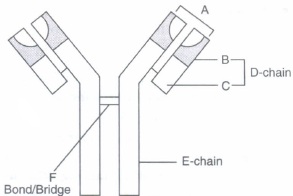
Identify A, D, E and F in the diagram of an antibody molecule given below:
6.
What does the term 'memory of the immune system' mean?
7.
Write the scientific names of plants from which morphine and cocaine are obtained.
8.
Define the following
(i) Cancer or malignancy
(ii)Carcinogenic
9.
Explain the following terms:
(i)Benign tumour (ii)Cancerous tumour
10.
Give the full form of CT and MRI.How are they dhygieneifferent from each other? where are they used?
11.
How is molecular biology helpful in preventing cancer?
12.
Name the different species of malarial parasite.Which of these does cause malignant malaria?
13.
What is 'Typhoid Mary'?
14.
Due to peer pressure, a group of adolescents started using opioids intra-venously. What are the serious problems they might face in future?
15.
Why do sports person often fall a victim to cocaine addiction?
16.
(a) Explain the property that prevents normal cells from becoming cancerous.
(b) All normal cells have inherent characteristic of becoming cancerous.Explain.
17.
(a) Name the lymphoid organ in human,where all the blood cells are produced.
(b) Where do the lymphocytes produced by the lymphoid organ mentioned above,migrate and how do they effect immunity?
18.
Name the host and the site where the following occur in the life cycle of a malarial parasite:
(a) Formation of gametocytes
(b) Fusion of gametocytes
19.
Write the scientific names of the casual organisms of elephantiasis and ringworm in humans.Mention the body parts affected by them.
20.
Name the two types of immunity in a human body.Why are cell-mediated and humoral immunities so called?
21.
Identify A,B,C and D in the following table:
| Scientific name of the source plant | Drug |
Harmful effects/Human body part affected |
| 1.Papaver sominiferum |
A |
Depressant/slows body functions |
|
2. Cannabis sativa |
Cannabinoids | B |
|
3. Erythoxylon coca |
C | D |
22.
(a) Name the group of viruses responsible for causing AIDS in humans,Why are these viruses so named?
(b) List any two ways of transmission of HIV infection in humans other than sexual contact.
23.
Name an opioid drug and its source plant.How does the drug affect the human body?
24.
A patient showed symptoms of sustained high fever,stomach pain and constipation,but no blood clot in stools.Name the disease and its pathogen.How does the disease.How does the disease get transmitted?
25.
A student on a school trip started sneezing and wheezing soon after reaching the hill station for no explained reasons,But on return to the plains,the symtoms disappeared.What is such a response called?How does the body produce it?
1.
1. Colostrum provides passive acquired immunity.
2. Passive immunisation is necessary, when a person is infected with a deadly microbe and quick immune response IS necessary. e.g. for tetanus, snake bite.
2.
It is because the body has the ability to defend (i.e. immunity) many of these infectious agents.
3.
The withdrawal symptoms are
(i) anxiety
(ii) shakiness
(iii) nausea
(iv)sweating
4.
Both morphine and heroin are extracted from the latex of plant Papaver somniferum.
Morphine acts as an effective sedative and painkiller while heroin acts as a depressant and slows down body functions. When taken in excess amount, these drugs alter the moods or induce sleep.
5.
A-antigen binding site,
B-variable region
C-constant region
D-light chain,
E-heavy chain (constant region),
F-disulphide bond
6.
When the body encounters a pathogen for the first time, it triggers an immune response by generating antibodies.
This response is of low intensity. Subsequent encounter with same pathogen elicits a highly intensified secondary response.
This is ascribed to the fact that our body appears to have memory of the first encounter. this types of secondary immune response is elicited by memory T-cells, B-cell which keep ready to mount a rapid and vigorous attack as soon as the same pathagen infects the body again.
7.
Papaver somniferum; Erythroxylon coca
8.
(i) Cancer (Malignancy). It is an abnormal form of development which occurs during adult life and converts normal cells into abnormal cells called cancerous cells.
(ii)Carcinogenic.The factors which are considered to cause cancer are known as carcinogenic e.g. Chewing of pan and tobacco.
9.
(i) Benign tumour(Non-malignant tumour).Such tumours grow slowly but become quite large.It remains restricted to the place of origin and does not spread to other areas of body.Mostly tumours are of this type and do not give rise to cancer.
(ii) Cancerous tumour(Malignant tumour). It begins as a small tumour growth it first,grows slowly in the start and more rapidly later on.The tumour ultimately spreads to the neighbouring tissue like the roots of a tree.Later on, cancerous cells separate off from the original site and they divide and redivide to form secondary tumour.
10.
(a) CT - Computed tomography.MRI - Magnetic resonance imaging
(b) Difference.CT is an invasive technique as it uses X-rays while MRI is a noninvasive technique as it uses magnetic field.
(c)Use. CT gives sectional and three dimensional picture of any part of the body while MRI gives better contrast of soft tissues. MRI, however, cannot be used on patients fitted with pace-maker and metal implants.
11.
Molecular Biology:
Techniques of molecular biology ca be applied to detect genes in individuals with inherited susceptibility to certain cancers.
Identification of such genes may be helpful in prevention of cancers.
12.
Plasmodium vivax
Plasmodium malariae
Plasmodium falciparum
Plasmodium faciparum causes malignantmalaria.
13.
Typhoid Mary is a classic case in madicine.
Mary Mallon was a cook by profession and was a typhoid carrier.
She continued to spread typhoid for several years through the food she prepared.
14.
They are more likely to get infections like AIDS and hepatitis-B, as the viruses of these diseases are spread by the use of contaminated needles and syringes; both are chronic infections and are fatal.
Since, the tolerance levels of the receptors present in our body to these drugs increase, they respond only to higher doses of drugs leading to greater intake and addiction.
15.
Cocaine has a potent stimulating action on the central nervous system.
It produces a sense of euphoria and increased energy and hence,sportspersons become addicted to it.
16.
(a) Contact inhibition is the property shown by normal cells,by the virtue of which contact with other cells inhibits their uncontrolled proliferation and growth.
(b) All normal cells have cellular oncogenes (c-onc) or proto-oncogenes;when activated under certain conditions,such genes could lead to oncogenic transformation of cells,i.e.they become cancerous.
17.
(a) Bone marrow.
(b) Some of the lymphocytes remain in the bone marrow and mature into B-lymphocytes.
B-lymphocytes produce antibodies,that neutralise the pathogen during actual infection.
Some of the lymphocytes move to the thymus and mature into T-lymphocytes.
T-lymphocytes stimulate B-cells to produce antibodies and some T-cells are involved in cell-mediated immunity and are responsible for rejecting organ transplants.
18.
(a) Human beings;in the erythrocytes (RBCs).
(b) Mosquito;in the intestine.
19.
Elephantiasis is caused by Wuchereria bancrofti and Wuchereria malayi.
It affects the lower limbs and genital organs.
Ringworm is caused by Microsporum,Trichophyton and Epidermophyton.
It affects the skin,nails and scalp.
20.
Innate immunity and acquired immunity or Active immunity and passive immunity.
Cell-mediated immunity is so called because it involves specialized cells,the T-lymphocytes.
Humoral immunity is so called because it includes the antibodies,which are found circulating in the body fluid,the blood. (humors-body fluids.)
21.
A - Heroin
B - Cardiovascular system
C - Cocaine
D - Stimulates central nervous system.
22.
(a) Retroviruses
They have RNA as the genetic material and can make DNA on RNA template with the help of enzyme reverse transcriptase;hence they are called retroviruses.
(d) Transmission of HIV infection
(i) by transfusion of blood and blood products contaminated with HIV.
(ii) by sharing infected needles as in the case of intravenous drug abusers.
(iii) from the infected mother to the foetus,through placenta.
23.
Smack is odtained from Papaver somniferum (Poppy).
It binds to specific opioid receptors present in our central nervous system and gastrointestinal tract.
It is a depressant and shows down the body functions.
24.
Typhoid
Salmonella typi
Widal test
Transmission is by contaminated food and water.
25.
It is called allergy.
It is due to the release of histamine and serotonin by mast cells.

12th Standard CBSE Syllabus & Materials
12th Standard CBSE
CBSE 12th Computer Science Python Revision Tour I - New Previous year Question Papers Study Material - QB365 Set A
NEW12th Standard CBSE
CBSE 12th Business Studies Planning Important Questions And Answers Study Material - QB365 Set A
NEW12th Standard CBSE
CBSE 12th Business Studies Business Environment Important Questions And Answers Study Material - QB365 Set A
NEW12th Standard CBSE
CBSE 12th Business Studies Principles of Management Important Questions And Answers Study Material - QB365 Set A



NCERT Books

Syllabus

Exam Pattern

Sample Question Papers

Previous year Question Papers

Important Notes

MCQ Practice test

NCERT Exemplers

Case study Questions

Image Based Questions

Passage based Questions

HOT Questions

Value Based Questions

Model Questions Papers
NCERT ( Book Back ) Questions

Assertion and Reason
Important Questions And Answers

CBSE 12th Standard CBSE Subjects
CBSE Standards








